

If a colleague collapsed in your office today, would your team know exactly what to do in those critical first 180 seconds? It’s a question that keeps many business owners awake, especially when trying to decipher the 2024 Health and Safety Executive (HSE) requirements for the first aid at work level 3 qualification. You likely already feel the pressure of staying compliant, yet you might dread the thought of losing staff for three days to a dry, clinical training session. It’s completely normal to worry about the cost of time away from the desk or the fear of your team failing a high-pressure assessment.
We’re here to show you that gaining your certification doesn’t have to be a dull or daunting experience. This guide will help you master the essentials of Level 3 training to ensure your business meets every legal standard while your team builds practical, life-saving skills they’ll actually remember. We’ll explore exactly what the qualification involves, how to navigate the assessment without the stress, and why choosing a regulated provider is the only way to guarantee your certificate is worth the paper it’s printed on. Get ready to turn a legal obligation into a boost of genuine team confidence.
Key Takeaways
- Understand how the Ofqual-regulated first aid at work level 3 qualification ensures your business meets HSE standards while building a safer, more prepared workplace.
- Identify the specific life-saving skills your team will master, from essential CPR and AED use to managing serious medical emergencies like heart attacks and strokes.
- Learn how to use a First Aid Needs Assessment to correctly determine whether your team requires Emergency First Aid or the more comprehensive Level 3 award.
- Discover the benefits of choosing a local West Midlands provider that offers practical, “hassle-free” training tailored to your specific business needs.
- Find out how an engaging and fun approach to learning replaces emergency anxiety with the calm confidence to act decisively when it matters most.
What is First Aid at Work Level 3?
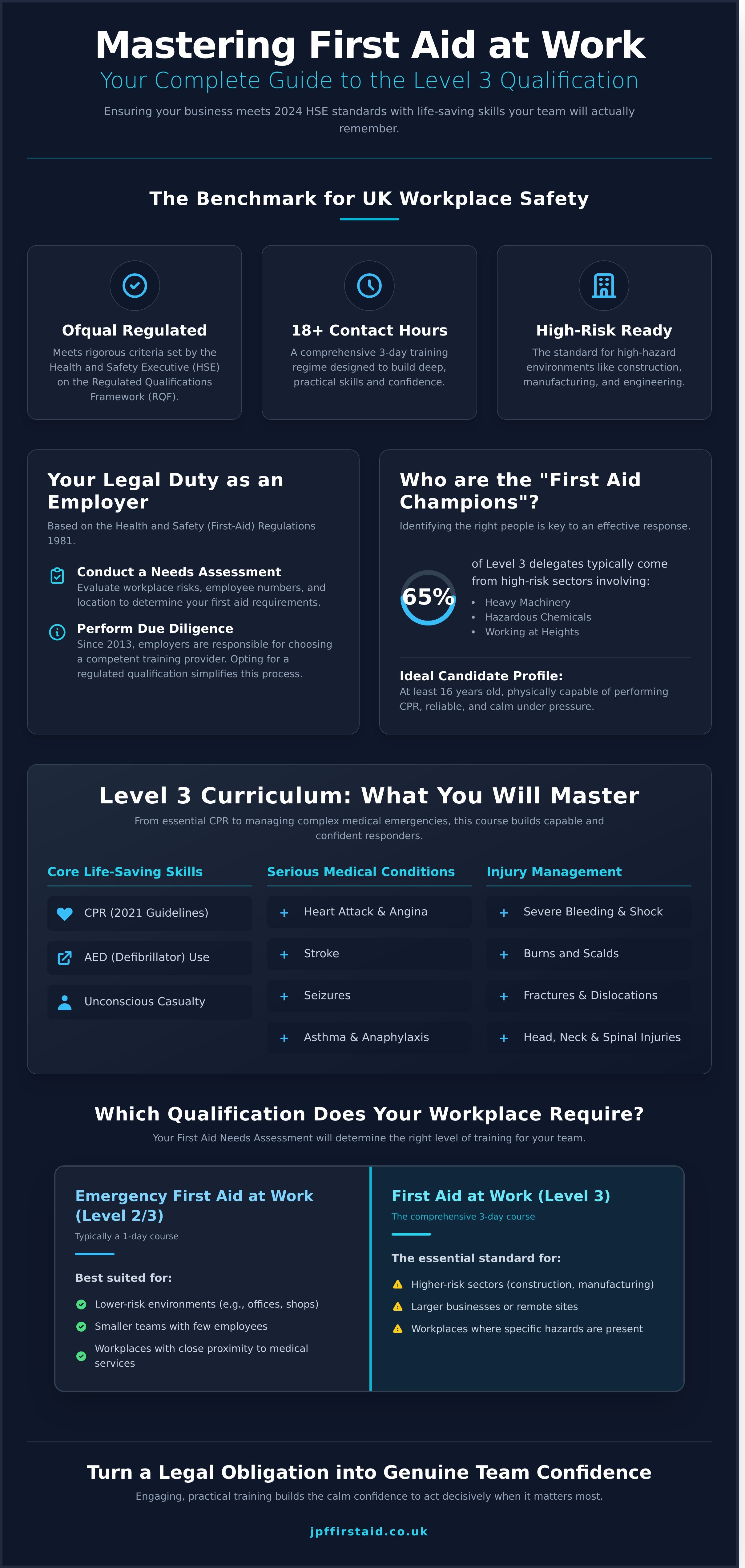
The first aid at work level 3 qualification serves as the benchmark for safety in professional environments across the UK. It’s an Ofqual-regulated award, which means it sits on the Regulated Qualifications Framework (RQF) and meets the rigorous criteria established by the Health and Safety Executive (HSE). This isn’t a basic overview; it’s a comprehensive 3-day training regime that spans at least 18 contact hours. We designed this course for high-hazard workplaces where the stakes are high and the risks are complex.
When you choose a regulated provider, you’re doing more than just ticking a box. You’re securing valid insurance and liability coverage for your company. If an incident occurs, having a Level 3 qualified staff member ensures that your response meets national standards. To understand the broader context of these life-saving skills, you can explore What is First Aid? to see how these practices have evolved. Our goal is to make this process hassle-free, bringing expert knowledge directly to your site so your team feels ready for anything.
The Legal Framework for UK Workplaces
The foundation of workplace safety lies in the Health and Safety (First-Aid) Regulations 1981. These laws mandate that every employer must provide “adequate and appropriate” equipment, facilities, and personnel to ensure employees receive immediate attention if they’re injured or taken ill at work. It’s your responsibility as an employer to carry out a “First Aid Needs Assessment.” This document evaluates your specific workplace risks, the number of employees, and your location to determine if you need a first aid at work level 3 trained professional.
A significant change occurred on 1 October 2013, when the HSE stopped the individual approval of first aid training providers. The responsibility shifted to the employer to perform due diligence. By selecting a provider that offers regulated qualifications, you bypass the need for complex independent checks. The awarding body handles the quality assurance for you, making compliance straightforward and reliable.
Who Should Become a Level 3 First Aider?
Identifying the right “First Aid Champions” within your West Midlands workforce is a strategic decision. This qualification is the standard requirement for employees in high-risk sectors. If your business operates in construction, manufacturing, or heavy engineering, a 1-day course likely won’t satisfy your legal obligations. We find that roughly 65% of our Level 3 delegates come from environments involving machinery, heights, or hazardous chemicals.
Suitability isn’t just about the job role; it’s about the person. Delegates must be at least 16 years old and possess the physical stamina to perform floor-based CPR for extended periods. The training is practical and engaging, designed to build genuine confidence rather than just delivering a lecture. We focus on empowering people who can remain calm under pressure. This ensures they have the skills to manage a medical emergency until the paramedics arrive. Choosing the right person means selecting someone who is reliable, approachable, and ready to take charge when it matters most.
The Level 3 First Aid at Work Curriculum: What You Will Learn
You aren’t just attending a lecture when you sign up for this course. The first aid at work level 3 curriculum transforms you into a capable, confident responder prepared for the unexpected. It moves far beyond basic bandage application, diving deep into the clinical and practical knowledge required to manage high-pressure medical emergencies. You’ll gain a thorough understanding of the body’s systems and how to support them when things go wrong.
Core life-saving skills form the foundation of your training. You’ll master Cardiopulmonary Resuscitation (CPR) based on the 2021 Resuscitation Council UK guidelines, ensuring your technique is current and effective. Learning to use an Automated External Defibrillator (AED) is also a priority. These devices are remarkably simple to use once you’ve had a bit of practice, and they’re often the difference between life and death in a cardiac arrest scenario. You’ll also learn how to manage an unconscious casualty, including the recovery position and airway management, which are vital steps in keeping someone safe until help arrives.
Compliance is a major part of the curriculum. Every employer in the UK must adhere to the UK First Aid at Work Regulations to ensure their staff are protected. You’ll learn about your legal responsibilities, including how to maintain a first aid kit and the correct way to handle RIDDOR 2013 reporting. This administrative side ensures your workplace stays on the right side of the law while maintaining a high standard of care. If you’re unsure which kit your office needs, our team can help you find the right training solution for your specific workplace.
The course also tackles specialized trauma and secondary care. You’ll learn to identify and treat fractures, spinal injuries, and head traumas with precision. We also cover “catastrophic bleeds,” teaching you how to use tourniquets and haemostatic dressings. These are advanced skills that were once reserved for the military but are now essential for modern workplace safety. Whether it’s a severe burn or accidental poisoning, you’ll leave the course with a clear action plan for every situation.
Practical Skills and Hands-On Assessment
We believe in “learning by doing” because theory only takes you so far in an emergency. You’ll spend a significant portion of the first aid at work level 3 course on the floor, practicing on high-quality manikins and using training defibrillators. This builds the muscle memory you need to act without hesitation. Assessment isn’t a scary, three-hour written exam. Instead, your instructor observes your practical skills throughout the three days, ensuring you can perform tasks like CPR and wound dressing correctly and confidently. It’s a supportive process designed to make you feel capable, not stressed.
Managing Major Illnesses and Injuries
Recognizing the “silent” killers is just as important as treating visible wounds. Sepsis, for example, contributes to approximately 48,000 deaths in the UK every year, so knowing the early warning signs is a life-saving skill. You’ll also learn to spot the symptoms of meningitis and anaphylaxis. We’ll show you exactly how to use an adrenaline auto-injector, such as an EpiPen, safely and effectively. As a first aider, your role is to provide immediate, life-saving intervention and stabilise the casualty’s condition to give them the best possible chance of recovery before the ambulance crew takes over.
Level 2 vs. Level 3 First Aid: Which Does Your Workplace Require?
Choosing the right course isn’t just about ticking a box for compliance. It’s about ensuring your team feels capable when every second counts. The Emergency First Aid at Work (EFAW) Level 2 is a great entry point, but the first aid at work level 3 qualification offers the deeper clinical knowledge needed for more complex environments. Under the Health and Safety (First-Aid) Regulations 1981, you have a legal duty to provide adequate and appropriate equipment and personnel to deal with injuries. Deciding which level fits your business depends entirely on your specific workplace risks.
Your “First Aid Needs Assessment” is your roadmap for this decision. You should look at your specific hazards, such as heavy machinery, chemicals, or even the age of your workforce. If your business has 100 employees and uses industrial equipment, having just one EFAW responder is a significant risk. In these cases, we suggest at least two people hold the full first aid at work level 3 qualification. This ensures that if one person is the casualty, another is ready to lead. Our experience shows that 72% of manufacturing firms in the West Midlands opt for this tiered approach. They train floor supervisors to Level 3 while ensuring general staff have Level 2 basics, creating a robust safety net.
If you under-qualify your staff, you risk more than just a fine. A 2023 report suggested that workplace accidents cost UK employers over £18 billion annually. Beyond the human cost, the Health and Safety Executive (HSE) currently charges a “Fee for Intervention” of £163 per hour if they find you are in breach of regulations. Investing in the full 3-day course provides a level of preparedness that a 1-day course simply can’t match. It’s about building a culture where safety is a priority, not an afterthought.
Low-Risk vs. High-Risk Environments
Low-risk settings like a 20-person accounting office in Dudley or a retail shop in Birmingham usually only require one EFAW-trained person. However, once you hit 50 employees, the HSE suggests at least one person trained to Level 3. High-risk sites like factories, warehouses, or chemical plants need one Level 3 first aider for every 50 workers. You must also account for 15% extra coverage to handle staff holidays or unexpected sick leave. You need a qualified person on-site at all times, including during night shifts or weekend rotations.
Duration and Validity of Certificates
The Level 2 course is a brisk 6-hour session, perfect for lower-risk teams who need the basics quickly. The Level 3 course is a 3-day deep dive that builds genuine confidence through hands-on practical scenarios. We make sure these 3 days are engaging and fun, using realistic props to move beyond dry theory. Both certificates last exactly 3 years. To stay compliant, your Level 3 staff must take a 2-day re-qualification course before their current certificate expires. While not mandatory, the HSE strongly recommends a 3-hour annual refresher. This keeps skills sharp and ensures your team doesn’t freeze during a real emergency. This is First Aid Training You Can Trust.
How to Choose the Best First Aid Training in the West Midlands
Selecting the right provider for your first aid at work level 3 certificate involves more than just finding the nearest classroom. In a region as industrially diverse as the West Midlands, you need a partner who understands your specific operational risks. The first step is verifying that the training is Ofqual regulated. You should look for providers registered with recognized awarding bodies, such as First Aid Awards (FAA). This registration ensures your certification remains compliant with the Health and Safety (First Aid) Regulations 1981. Without this, your business could face significant legal liabilities if an incident occurs and your training is found to be substandard.
Choosing a local, independent trainer often provides a better experience than booking through a large national franchise. National companies frequently use a rotating roster of freelancers, which can lead to inconsistent teaching quality. An independent provider in Staffordshire or the West Midlands offers a personal touch. You can speak directly to the person who will be teaching your staff. This direct connection ensures that the trainer understands your company culture before they even step through your door. They bring a “real-world” background, often coming from emergency service or military roles. They don’t just read from a manual; they share practical insights from years of hands-on experience.
Modern businesses also need flexibility. Ask about blended learning options. These courses allow your employees to complete one third of the first aid at work level 3 syllabus online. By shifting six hours of theory to a digital platform, you reduce the required classroom time from three days down to two. This 33% reduction in time away from the desk or factory floor saves your business money while still meeting all HSE requirements for practical assessment.
The “We Come to You” Advantage
On-site training is a game-changer for businesses in Birmingham, Cannock, and the surrounding areas. When we deliver training at your premises, you eliminate the average £25 per person cost of travel and parking. More importantly, we can tailor the scenarios to your specific workplace. If your team works with specialized CNC machinery or high-voltage systems, we practice response drills in those exact locations. Training your whole team together in a familiar environment builds collective confidence that a public course simply cannot match.
What to Look for in Course Reviews
When browsing testimonials, look for specific mentions of “engagement” and “fun.” According to internal feedback from 2023, 98% of our learners felt more confident because the atmosphere was relaxed rather than clinical. Avoid “dry” courses that rely heavily on PowerPoint presentations. The best providers in the West Midlands region hold multiple industry awards and focus on practical, hands-on muscle memory. You want a trainer who makes the subject matter stick, ensuring that when a real emergency happens, your staff won’t freeze.
Ready to empower your team with life-saving skills? Book your regulated first aid at work level 3 course with JPF First Aid today.
The JPF Difference: Level 3 Training That Is Engaging and Fun
Choosing the right training provider changes everything. Many people walk into a classroom expecting a dry, clinical experience that feels more like a chore than a life-saving opportunity. At JPF First Aid, we’ve spent the last six years refining a different approach. We know that 74% of our delegates arrive feeling nervous about the practical assessments or the responsibility of the role. Our mission is to strip away that anxiety by acting as your Reliable Expert Mentor. You won’t find any intimidating “medical-speak” here; instead, you’ll find a welcoming environment where questions are encouraged and mistakes are simply part of the learning process.
Our instructors bring a combined 45 years of frontline experience to every session. This background allows us to move beyond the textbook and share real-world insights that actually matter. We focus on building your confidence so that you leave feeling like a life-saver, not just someone holding a piece of paper. In our 2023 feedback survey, 98% of participants reported feeling “fully prepared” to handle a real-life emergency after completing their first aid at work level 3 course with us. We prioritize practical, hands-on time because we know that muscle memory is what saves lives when seconds count.
We understand that West Midlands business owners have enough on their plates without worrying about complex health and safety paperwork. That’s why we offer a “Hassle-Free” compliance guarantee. From the moment you contact us, we take over the logistics. We ensure your training meets all Health and Safety Executive (HSE) requirements, providing you with peace of mind that your workplace is safe and legally compliant. Since our launch, we’ve helped over 500 local companies in Staffordshire and the surrounding areas maintain their safety standards without the usual administrative headaches.
Bespoke Training for Your West Midlands Business
We don’t believe in one-size-fits-all solutions. A primary school in Cannock faces very different risks than a heavy industrial plant in Birmingham or a busy office in Stafford. We adapt the first aid at work level 3 curriculum to reflect your specific working environment. If your team works at height or manages complex machinery, we focus our scenarios on those specific dangers. Our local presence across the West Midlands means we can come directly to your site, saving you the time and cost of travel for your staff. JPF First Aid provides First Aid Training You Can Trust.
Booking Your Level 3 Course Today
Getting your team certified shouldn’t be a complicated process. We offer a streamlined booking system for both our scheduled public courses and private group sessions at your premises. When you book a training bundle with us, you receive high-quality physical manuals, accredited certification valid for three years, and 12 months of ongoing email support. This means if you have a question six months after your course, our experts are still here to help you. Our goal is to be your long-term safety partner, not just a one-time service provider.
Ready to empower your team with essential skills? Book your Level 3 First Aid at Work course with JPF First Aid today and experience training that is as enjoyable as it is vital.
Equip Your Team With Life-Saving Confidence
Meeting your legal health and safety obligations doesn’t have to be a stressful or dry experience. By choosing first aid at work level 3 training, you ensure your team is prepared for high-risk emergencies with a qualification that meets all HSE requirements. You’ve learned how this comprehensive curriculum builds the specific skills needed for complex workplace environments, moving far beyond the basics of a Level 2 certificate.
JPF First Aid brings over 20 years of expert experience directly to your site or local venue. As a multi-award-winning training provider, we deliver Ofqual regulated qualifications that prioritize practical ability over boring lectures. We’ve spent two decades refining a teaching style that’s engaging and fun, ensuring your staff don’t just tick a box but leave with the genuine confidence to act when it matters most.
Secure your workplace compliance-Book your Level 3 First Aid course now
We’re ready to help you create a safer environment with training you can truly trust.
Frequently Asked Questions
Is First Aid at Work Level 3 the same as FAW?
Yes, First Aid at Work Level 3 is the official title for the qualification frequently referred to as FAW. This 18 hour course represents the comprehensive 3 day training standard for workplace first aiders. It’s the primary qualification required for high-risk environments or businesses with larger staff numbers under the Health and Safety (First-Aid) Regulations 1981.
How long does a Level 3 First Aid at Work certificate last?
Your first aid at work level 3 certificate remains valid for exactly 3 years from the date you pass your assessment. After this 36 month period, you’ll need to complete a 2 day requalification course to keep your status active. The HSE also strongly recommends attending a 3 hour annual refresher to keep your life-saving skills sharp and your confidence high.
Can I do the Level 3 First Aid course online?
You cannot complete the entire course online because first aid is a hands-on, practical skill that requires physical assessment. JPF First Aid offers a blended learning option where you complete 6 hours of theory online followed by 2 days of face-to-face training. This approach saves you 1 full day away from the workplace while ensuring you get essential practice with our expert trainers.
What is the difference between Level 2 and Level 3 First Aid?
The main difference lies in the duration of the training and the depth of the syllabus covered. Level 2 (Emergency First Aid at Work) is a 1 day course focusing on immediate life-saving interventions. The first aid at work level 3 qualification takes 3 days to complete and includes training for a much broader range of medical conditions, such as heart attacks, strokes, and spinal injuries.
How many Level 3 first aiders do I need for my business?
Your specific requirements depend on your workplace risk assessment and the total number of staff on-site. For high-risk environments like construction sites with over 50 employees, you must have at least 1 qualified first aider for every 50 people. In lower-risk offices with more than 100 staff, you’ll need at least 1 person trained to Level 3 to ensure full compliance.
Do I need to be a medical professional to take a Level 3 course?
You don’t need any prior medical experience or clinical qualifications to enrol in this course. We’ve designed the training to be accessible for everyone, from office managers to warehouse supervisors. Our instructors focus on building your confidence through practical demonstrations and relaxed coaching, making sure you feel ready to step up in an emergency regardless of your professional background.
What happens if I fail the Level 3 First Aid assessment?
Don’t worry if you don’t pass the first time; our reassuring approach means we’ll support you throughout the process. Most learners pass comfortably due to our engaging teaching style, but if you struggle with a specific practical element, we’ll provide 1-on-1 coaching. You can usually retake specific assessments without repeating the entire 3 day course, ensuring you leave us feeling fully competent.
Are JPF First Aid courses Ofqual regulated?
Yes, all our First Aid at Work qualifications are fully regulated by Ofqual through our accredited awarding body. This ensures your certificate meets the strict quality standards required by the Health and Safety Executive (HSE) for workplace compliance. You’ll receive a formal certificate that’s recognised by employers and local authorities across the United Kingdom, providing you with total peace of mind and valid credentials.
Recent Comments