

We’ve all felt that flicker of worry: what would you actually do if a colleague collapsed or suffered a serious injury right in front of you? Beyond the human element, there is the constant pressure of staying on the right side of HSE regulations and avoiding the risks of legal non-compliance. Finding the right emergency first aid at work course shouldn’t feel like another dry, box-ticking exercise that leaves you feeling bored and unprepared. You deserve more than just a certificate; you need the genuine, life-saving confidence to act when every second counts.
In this complete 2026 guide, we will show you how to master the essentials of workplace safety through the Level 3 Emergency First Aid at Work qualification. At JPF First Aid, we believe that training should be as engaging and fun as it is vital. We will walk you through everything you need to ensure full legal compliance while promising a relaxed, practical experience that replaces anxiety with a calm, “can-do” attitude. Whether you are a business owner or an individual learner, discover how to gain the skills that protect your team and provide you with total peace of mind through first aid training you can trust.
Key Takeaways
- Understand your legal obligations under the Health and Safety (First-Aid) Regulations 1981 and how a Level 3 qualification ensures your business remains fully compliant.
- Master life-saving skills, from the 5-step Primary Survey to modern AED usage, by selecting the most effective emergency first aid at work course for your specific environment.
- Learn how to conduct a straightforward workplace risk assessment to decide between the 1-day EFAW and the more in-depth 3-day First Aid at Work (FAW) qualification.
- Identify why Ofqual-regulated training and high student engagement are the “non-negotiable” factors for ensuring your team actually retains their life-saving knowledge.
- Discover the JPF “Confidence Guarantee” and how a practical, fun approach to training turns serious medical theory into reliable, real-world skills.
What is the Emergency First Aid at Work (EFAW) Course?
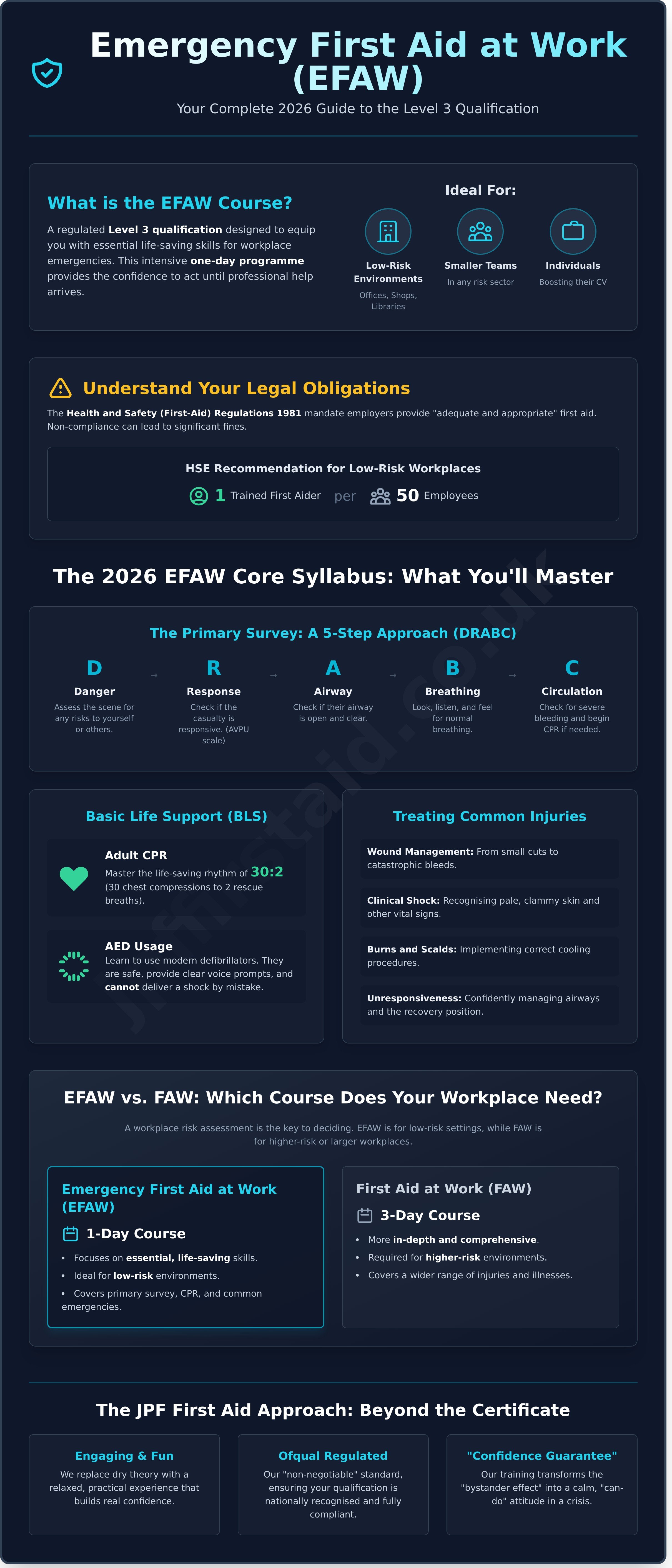
The emergency first aid at work course is a regulated Level 3 qualification designed to equip you with the essential skills needed to handle accidents and emergencies in the workplace. This intensive one-day programme focuses on the fundamental principles of first aid, ensuring that you can provide immediate, life-saving care until professional medical help arrives.
At JPF First Aid, we believe that learning these skills shouldn’t be intimidating. Our training is designed to be engaging and practical, moving away from dry theory to focus on hands-on confidence. This course is specifically tailored for:
- Low-risk environments: Such as offices, shops, or small libraries.
- Smaller teams in high-risk sectors: Providing a vital layer of protection alongside more advanced first aiders.
- Individuals: Looking to boost their CV with a nationally recognised, Ofqual-regulated certificate.
The Legal Responsibility of UK Employers
Under the Health and Safety (First-Aid) Regulations 1981, UK employers are legally required to provide “adequate and appropriate” equipment and personnel to ensure employees receive immediate attention if they are injured or taken ill at work. As we move into 2026, the consequences of non-compliance are steeper than ever, with business owners facing significant fines and legal liability if their first aid provision is found lacking during an HSE inspection.
It is important to understand your specific role: while an Appointed Person is simply someone chosen to take charge of first aid arrangements-such as calling 999-a First Aider is a trained individual capable of administering treatment, a distinction that is crucial given that the HSE recommends at least one qualified first aider for every 50 employees in low-risk environments.
Why Certification Matters for Your Career
Holding an Ofqual-regulated emergency first aid at work course certificate is a powerful asset in the UK job market. It demonstrates to employers that you are a responsible, proactive team member who can handle pressure. Beyond the workplace, these skills translate directly to your personal life, allowing you to protect your family and community.
Perhaps the greatest benefit is the psychological shift; our training transforms the “bystander effect” into a “can-do” attitude. You will leave the session not just with a piece of paper, but with the confidence to be the calm, capable person who knows exactly what to do when a crisis occurs.
The 2026 EFAW Syllabus: What You Will Learn
Stepping into an emergency first aid at work course shouldn’t feel like walking into a dry, academic lecture. At JPF First Aid, we transform complex life-saving protocols into manageable, hands-on skills. To help you meet the legal requirements for first aid, our 2026 syllabus focuses on the most critical interventions that save lives in the workplace.
You will start by mastering the Primary Survey. This is the universal five-step approach (DRABC) used by professionals to assess any scene safely. From there, we dive into managing unresponsiveness, ensuring you can confidently handle airway management and place a casualty in the recovery position to keep them safe until help arrives.
Mastering Basic Life Support (BLS)
The heart of the emergency first aid at work course is the adult CPR algorithm. You will learn the 2026 standards for chest compressions and rescue breaths, focusing on the 30:2 rhythm. We also demystify the Automated External Defibrillator (AED). Modern AEDs are incredibly safe; they provide clear voice prompts and cannot deliver a shock by mistake, as the device only activates if it detects a specific heart rhythm. Our training prioritises hands-on practice with manikins over classroom theory, ensuring the movements become second nature.
Treating Minor and Major Injuries
Workplace accidents range from “nuisance” injuries to life-threatening traumas. We provide practical, “can-do” solutions for handling the most common workplace incidents:
- Wound Management: How to treat everything from a small cut to a catastrophic bleed using direct pressure and sterile dressings.
- Clinical Shock: Recognising the subtle signs of shock (such as pale, clammy skin) before it becomes a fatal condition.
- Burns and Scalds: Implementing the “20-minute rule”-cooling the injury under lukewarm running water for a full 20 minutes to limit tissue damage.
- Choking: Rapidly identifying the difference between a partial and complete airway obstruction and acting decisively.
Our goal is to leave you feeling relaxed and capable. By the end of the session, you won’t just have a regulated qualification; you’ll have the confidence to step forward when it matters most.
EFAW vs. FAW: Which Course Does Your Workplace Need?
Choosing between the 1-day emergency first aid at work course (EFAW) and the comprehensive 3-day First Aid at Work (FAW) qualification is a vital step in your health and safety planning. While both provide life-saving skills, they are tailored to different levels of risk. Generally, the EFAW course is perfect for smaller, low-risk environments like offices or retail shops. In contrast, the FAW course is a legal necessity for higher-risk settings where employees work with machinery, chemicals, or in remote locations.
The Decision Framework for Business Owners
To determine your requirements, you should conduct a “First Aid Needs Assessment” as part of your health and safety policy. You must consider several factors to ensure your team’s safety:
- Number of employees: Larger workforces naturally require more trained first aiders.
- Building layout: If your business spans multiple floors, you may need a first aider on each level.
- Proximity to hospitals: Remote sites need more advanced training because professional help takes longer to arrive.
Consider a case study: A small digital agency in Birmingham city centre, a typical low-risk environment, would likely only require the 1-day EFAW. However, a construction site or manufacturing plant in Cannock involves higher physical risks. In these environments, having a staff member who can provide advanced care within the first few minutes of an accident is critical to a positive outcome.
Duration and Validity of Certificates
Both the EFAW and FAW certificates remain valid for three years, providing you with long-term peace of mind. However, the renewal paths differ. An EFAW holder simply retakes the 1-day emergency first aid at work course to stay current. For the FAW, you can often take a condensed 2-day “requalification” course, provided your previous certificate has not yet expired.
Because skills can fade over time, the HSE strongly recommends an annual “skills refresh.” This keeps your confidence high and ensures you are ready to act in a real emergency. If you are approaching your expiry date, it is easy to Renew Your First Aid Certificate in Staffordshire through our relaxed and practical training sessions, designed to fit around your business schedule.
Choosing the Right Training Provider: Beyond the Certificate
Selecting an emergency first aid at work course is about more than just meeting a legal requirement; it is about ensuring your team has the genuine confidence to save a life. While Ofqual-regulated certification is the non-negotiable baseline for HSE compliance, the “Engagement Factor” is what truly makes the difference. Dry, clinical training sessions often lead to poor skill retention, leaving learners feeling hesitant when a real emergency occurs. You should look for a provider who balances the gravity of the subject with an approachable, “can-do” attitude.
A great trainer is a “Reliable Expert Mentor” who brings passion and real-world experience to the room. They should move beyond theory, using practical, hands-on scenarios that make the learning process both engaging and fun. When you feel relaxed and supported, you are far more likely to absorb the life-saving techniques required to keep your colleagues safe.
The Benefits of On-Site Group Training
For businesses based in the West Midlands, hosting an emergency first aid at work course at your own premises is often the most cost-effective and “hassle-free” option. By bringing the training to you, you eliminate staff travel costs and significantly reduce workplace downtime.
On-site training also allows for a bespoke experience. We can tailor the practical scenarios to the specific hazards of your environment, whether that is a high-risk manufacturing floor or a busy retail space. Furthermore, learning these vital skills together acts as a powerful team-building exercise, fostering a collective sense of responsibility and confidence across your workforce.
Red Flags to Avoid When Booking
To ensure you are receiving high-quality, compliant training, be wary of the following red flags:
- Online-only practical certificates: The HSE is very clear that first aid is a practical skill. Beware of providers offering “online-only” certificates for EFAW; these often fail to meet regulatory standards because they lack face-to-face manikin practice.
- Excessive class sizes: If a class is overcrowded, you won’t get sufficient 1-on-1 time with the instructor or the equipment. Effective training requires enough manikins for everyone to practice thoroughly.
- Hidden “extra” costs: Some providers quote a low initial price but then add extra charges for certification fees, registration, or training manuals. Always look for transparent, all-inclusive pricing.
At JPF First Aid, we believe in straightforward, expert-led training that empowers you to act. If you are looking for a reliable partner to deliver your workplace training, explore our options at jpffirstaid.co.uk.
The JPF First Aid Approach: Engaging, Practical, and Professional
Many people approach first aid training with a sense of trepidation, expecting a dry day of clinical lectures and endless PowerPoint slides. At JPF First Aid, John Fogarty and his team have built a reputation for flipping that script. We believe that an emergency first aid at work course should be as engaging as it is essential. By blending high-energy practical demonstrations with a relaxed, supportive atmosphere, we turn a serious subject into an enjoyable, interactive experience.
Our “Confidence Guarantee” is at the heart of everything we do. We don’t just want you to pass a test; we want you to leave with skills you actually remember. We focus on hands-on practice and real-world scenarios, ensuring that if an emergency ever occurs, your response is instinctive rather than hesitant. Whether we are training a small local business, a large school, or a community group, our bespoke approach ensures the content is relevant to your specific environment.
First Aid Training You Can Trust in the West Midlands
Serving Birmingham, Cannock, and the wider Staffordshire area, we provide hassle-free solutions that fit around your schedule. Our “Reliable Expert Mentor” style resonates with small business owners because we cut through the jargon and focus on what truly matters: saving lives and staying compliant. JPF First Aid is proud to be a multi-award-winning provider, having been named the “Most Trusted First Aid Training Provider – West Midlands” at the SME News Midlands Enterprise Awards, a testament to our commitment to authority and excellence.
Book Your Course Today
We make the booking process as straightforward as the training itself. Whether you need a single seat for a new hire or a private group quote for your entire team, we have you covered. Once your emergency first aid at work course is confirmed, you will receive clear joining instructions and preparation details, ensuring a smooth experience from start to finish.
- Individual Bookings: Secure your spot on our next scheduled public course.
- Private Groups: We can come to your venue at a time that suits you.
- Full Support: From pre-course info to digital certificates, we handle the admin so you don’t have to.
Don’t leave your workplace safety to chance. Book your Emergency First Aid at Work course with JPF First Aid today and join the thousands of West Midlands professionals who trust us to deliver life-saving confidence.
Secure Compliance and Confidence for Your Workplace
Ensuring your team is prepared for the unexpected is one of the most vital investments you can make as a business owner. By choosing the right emergency first aid at work course, you are doing far more than just ticking a compliance box; you are fostering a culture of safety and care. Throughout this guide, we have explored how to navigate the 2026 syllabus and the importance of selecting a qualification that balances technical precision with practical, hands-on experience to ensure your staff are ready for any situation.
At JPF First Aid, we pride ourselves on being your “Reliable Expert Mentor.” With over 20 years of industry experience, our multi-award-winning training focuses on building genuine confidence through engaging, relaxed, and even fun sessions. We provide Ofqual Regulated Qualifications that take the hassle out of compliance, delivering bespoke training directly to your site. Our goal is to ensure that if an emergency occurs, your team feels empowered to act with a calm, “can-do” attitude rather than hesitation. You are in safe, expert hands with a partner dedicated to your success.
Ready to empower your team with life-saving skills? Get a Quote for On-Site Group Training today and experience first aid training you can trust.
Frequently Asked Questions
How long does an Emergency First Aid at Work certificate last?
Your Emergency First Aid at Work certificate is valid for three years from the date of your assessment. To remain compliant with UK health and safety regulations, you must complete a requalification course before your current certificate expires. The HSE also strongly recommends attending a short annual refresher session to keep your life-saving skills sharp and maintain your confidence between full certifications.
Is the EFAW course hard to pass?
Not at all! Our emergency first aid at work course is designed to be engaging, practical, and fun. We move away from dry, clinical theory and focus on hands-on learning that builds your skills step-by-step. Our expert mentors guide you through the day, ensuring you feel comfortable and capable. The goal is to empower you with a calm, “can-do” attitude for real-life emergencies.
Can I fail a first aid at work course?
While there are assessment criteria to meet, our trainers work closely with you to ensure you reach the required standard. We use continuous observation throughout the day rather than a high-pressure exam at the end. If you find a specific technique challenging, we provide extra coaching and support. We are here to help you succeed and gain the vital skills needed to save lives.
What is the difference between EFAW and FAW?
The EFAW is a one-day course best suited for smaller, low-risk environments like offices or retail shops. The full First Aid at Work (FAW) qualification is a more comprehensive three-day course. It covers a wider range of medical conditions and injuries, making it the legal requirement for high-risk workplaces, such as construction sites or factories, or businesses with a larger number of employees.
How many first aiders do I need for my business?
The number of first aiders required depends on your specific workplace risk assessment and employee headcount. For low-risk environments with fewer than 25 staff, one EFAW-trained person is typically sufficient. However, larger or higher-risk businesses will require more personnel or the more advanced FAW qualification. We can provide bespoke advice to ensure your business stays fully compliant with UK health and safety law.
Do I need to be physically fit to take the course?
You don’t need to be an athlete, but you must be able to perform practical tasks such as floor-based CPR and placing casualties into the recovery position. If you have any mobility issues or physical injuries, please let us know beforehand. We are experts at making reasonable adjustments to ensure our training remains accessible, inclusive, and hassle-free for every learner who joins us.
Is the AED training included in the 1-day course?
Yes, training in the use of an Automated External Defibrillator (AED) is a mandatory part of our emergency first aid at work course. Following HSE guidelines, we ensure all learners get hands-on experience with trainer AED units. You will leave the session feeling completely confident in your ability to use this life-saving equipment alongside high-quality CPR, significantly increasing the chances of survival during a cardiac arrest.
What should I wear to my first aid training day?
We recommend wearing comfortable, practical clothing as you will be spending plenty of time on the floor practicing life-saving techniques. Trousers, leggings, and flat shoes or trainers are the best choices. It is a relaxed and informal environment, so there is no need for formal business attire. Just choose an outfit that allows you to move freely and participate fully in the practical demonstrations.
Recent Comments