

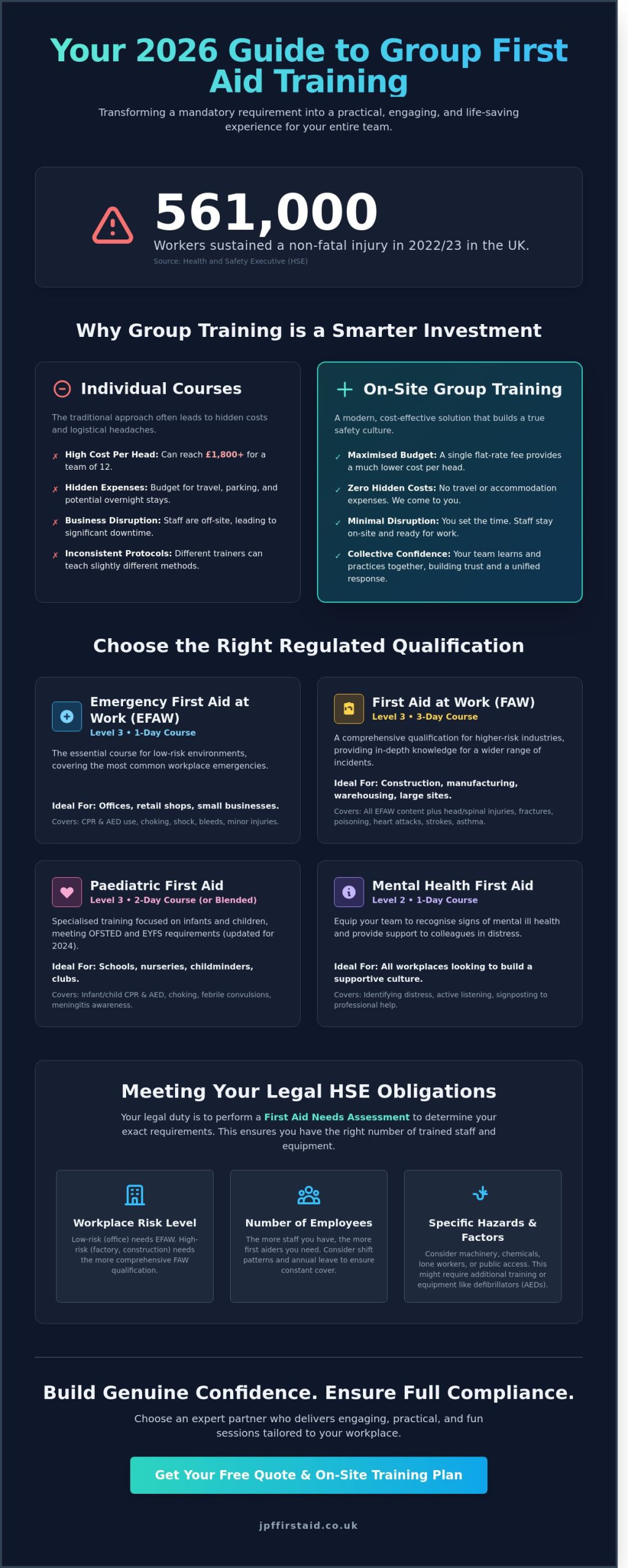
What if your next health and safety session was the most popular day of the year for your team? With the Health and Safety Executive reporting that 561,000 workers sustained non-fatal injuries in 2022/23, you already know that keeping your staff prepared is a serious responsibility. It’s common to feel anxious about the rising costs of certification or the fear that group first aid training for businesses will be a dry, boring experience that disrupts your daily operations.
We’re here to show you that professional training can be both practical and engaging. This 2026 guide reveals how to ensure full legal compliance while saving money through bespoke, on-site sessions that build genuine team confidence. We’ll explore the latest regulated qualifications, explain how to minimise business disruption, and provide a clear path to making your workplace safer without the hassle. You’ll learn exactly how to transform a mandatory requirement into a rewarding experience for your entire staff, ensuring you have first aid training you can trust.
Key Takeaways
- Discover how flat-rate fees and consistent instruction can maximize your training budget while ensuring every staff member follows identical emergency protocols.
- Learn how to select the ideal regulated qualification for your workplace, from one-day emergency courses to comprehensive training for higher-risk industries.
- Explore the flexibility of on-site and blended learning to find the most hassle-free way to deliver group first aid training for businesses without disrupting your operations.
- Understand your legal obligations under HSE guidance, including how to perform a First Aid Needs Assessment to ensure you maintain the correct ratios of trained staff.
- Find out why choosing an expert partner who promises “engaging and fun” sessions will build genuine confidence in your team’s ability to save lives.
The Strategic Benefits of Group First Aid Training for Businesses
Investing in your team’s safety isn’t just about ticking a compliance box. It’s a smart move that protects your most valuable assets. Choosing group first aid training for businesses allows you to transform a legal requirement into a high-value development day. You’ll see a shift from individual knowledge to a robust, company-wide safety net that keeps everyone protected. It’s a practical, “can-do” approach to health and safety that makes sense for your bottom line and your staff’s well-being.
Having a qualified trainer come directly to your premises is the ultimate hassle-free solution. You decide the start time, you control the environment, and you eliminate the logistical headache of sending staff to a distant training centre. This convenience reduces downtime significantly, as your team stays on-site and ready to return to work the moment the session concludes.
Maximising Your Training Budget
Booking individual places on open courses often costs between £80 and £150 per person in the UK. For a team of 12, this quickly climbs to £1,800. In contrast, a flat-rate group fee for a private on-site session provides a much lower cost per head. You’re effectively getting more for your money while keeping your staff under one roof. It’s a straightforward way to make your training budget work harder without compromising on the quality of the instruction.
On-site training also removes the hidden “drain” on your budget. You won’t need to pay for staff travel expenses, parking, or overnight stays. According to 2023 HSE statistics, 561,000 workers sustained a non-fatal injury at work. Better safety awareness through collective group first aid training for businesses reduces these incidents. This provides a long-term ROI by lowering absenteeism and potentially reducing your insurance premiums over time.
Building Collective Confidence
When your team learns life-saving skills together, they build a shared language for emergencies. Practising CPR or using an AED as a group removes the “spectator effect” where people hesitate, waiting for someone else to take charge. This comprehensive overview of first aid principles shows that immediate action is vital. By training in your own office or warehouse, we can tailor scenarios to your specific risks, such as high-shelf falls in a stockroom or kitchen-specific burns.
This approach creates a supportive, reassuring culture. Your staff won’t just leave with a certificate; they’ll leave with the confidence that their colleagues have their back. It turns a serious subject into an engaging, practical experience that strengthens professional bonds. We focus on making the day relaxed and fun, ensuring that every learner feels capable of stepping up when it matters most. It’s about creating a “can-do” atmosphere where everyone feels in safe, expert hands.
Choosing the Right Qualification for Your Group
Selecting the correct course is the first step toward building a confident, capable team. You don’t want to over-invest in training that doesn’t apply to your daily operations, but you must meet your legal obligations. We focus on making this process simple by offering group first aid training for businesses that targets your specific workplace risks. Whether you run a quiet accounting firm or a busy manufacturing plant, the training should feel relevant and practical.
- Emergency First Aid at Work (Level 3): This is the standard one-day course. It’s perfect for low-risk environments where you need to cover the essentials like CPR, choking, and wound management.
- First Aid at Work (3-Day): This is a deep dive into emergency care. It covers everything in the one-day course plus more complex scenarios like heart attacks, spinal injuries, and poisoning. It’s the gold standard for high-risk sectors.
- Paediatric First Aid: If you work in a school or nursery, this is a non-negotiable. It meets the 2024 EYFS requirements and focuses on the unique needs of infants and children.
- Mental Health First Aid: This qualification helps staff identify signs of psychological distress, providing a safety net for your team’s emotional well-being.
EFAW vs. FAW: Which Does Your Business Need?
The choice between the one-day Emergency First Aid at Work (EFAW) and the three-day First Aid at Work (FAW) depends on your risk assessment. When deciding on the right course, your first point of reference should be the HSE first aid at work regulations, which outline the legal requirements for different workplace environments. Generally, “low-risk” categories like retail or offices with fewer than 50 staff often find EFAW sufficient. However, if your business involves machinery, chemicals, or large numbers of the public, the FAW course is usually required. If your staff already hold a FAW certificate that’s approaching its three-year expiry, our two-day Re-qualification course is a great way to refresh those skills without repeating the full three days.
The Rise of Mental Health First Aid
Modern UK businesses are moving toward a more holistic view of safety. Data from MIND in 2023 shows that 1 in 4 people will experience a mental health problem each year, making psychological first aid just as vital as physical care. A Level 2 qualification provides a solid foundation for all staff to recognise signs of stress and anxiety. The Level 3 qualification is designed for supervisors or designated mental health first aiders, giving them the tools to lead a support strategy. Integrating these skills into your group first aid training for businesses ensures your team feels supported from every angle. If you’re looking for a hassle-free way to get your team certified, our group first aid training for businesses brings expert, engaging instruction directly to your site.
On-Site vs. Blended Learning: What Works Best for Your Team?
Deciding how your team receives their instruction is a vital step in meeting HSE requirements for first aid. For many UK firms, the choice boils down to physical presence versus digital flexibility. On-site training involves an expert instructor coming to your workplace with all the necessary equipment, including adult and paediatric manikins, bandages, and AED trainers. You only need to provide a clear, quiet space. This setup ensures your group first aid training for businesses is tailored to the specific risks of your site.
Booking shouldn’t be a headache. We coordinate training around your busy business schedule to find dates that cause the least disruption. Whether you need a weekend session or split days to cover different shift patterns, the goal is a hassle-free experience that leaves your team feeling capable and ready to act. We handle the logistics so you can focus on your day-to-day operations.
The Advantages of On-Site Training
Training in your actual workplace builds immediate confidence. If an emergency happens, your staff won’t be thinking about a generic classroom; they’ll know exactly where the first aid kit is located in their own building. We offer flexible start times to accommodate night shifts or early rotations. By removing the need for staff to commute to an external venue, you save on travel costs and eliminate the logistical stress of coordinating multiple journeys across town. It’s a practical solution that keeps your team in their familiar environment.
Understanding the Blended Approach
Blended learning is a modern solution for the 3-day First Aid at Work qualification. Instead of losing staff for three full days, they complete the theoretical components via an interactive digital portal first. This is followed by two days of intensive, hands-on practical assessment with our trainers. It’s a method that many of our corporate clients now prefer because it respects their time while maintaining high standards.
This approach works because:
- It reduces the time staff spend away from their primary roles by 33%.
- Learners can digest digital theory at their own pace, which improves retention.
- Practical sessions focus entirely on life-saving skills like CPR and wound management.
For purely theoretical subjects like Health and Safety or Mental Health Awareness, distance learning is an even more flexible option. Your team can complete these modules entirely online, making it easier than ever to keep your group first aid training for businesses up to date without pausing your productivity.
Meeting HSE Requirements: How Many First Aiders Do You Need?
Ensuring your workplace complies with the Health and Safety (First-Aid) Regulations 1981 is about more than just ticking a legal box. It’s about building a culture of safety where your team feels protected. When you arrange group first aid training for businesses, your first task is determining exactly how many staff members need to be qualified. This isn’t a guessing game; it’s a calculated decision based on your specific operational risks.
Legal implications for getting this wrong are serious. The HSE can issue material breach notices or fines, and in the event of an accident, a lack of adequate provision could lead to costly civil claims. Beyond the legalities, having a “buffer” of extra first aiders is a smart move. If your primary first aider is on annual leave or off sick, your business remains compliant and your staff remain safe. Aiming for 15% to 20% more first aiders than the minimum requirement ensures you’re never caught short during flu season or peak holiday periods.
Conducting a First Aid Needs Assessment
Your journey starts with a First Aid Needs Assessment. You must evaluate the specific hazards present in your building. An office focused on ergonomics carries different risks compared to a manufacturing site using heavy machinery. You should also consider your workforce demographics. According to 2023 ONS data, roughly 18% of the UK working-age population has a long-term health condition. If your team includes individuals with known medical issues, your training provision should reflect that. Finally, look at your geography. If your business is located in a rural area where an ambulance might take 20 minutes to arrive, you need more robust on-site expertise than a city-centre office located next to a hospital.
Calculating the Correct Numbers
HSE guidance provides a framework for these calculations. For low-risk shops or offices with fewer than 25 employees, at least one “Appointed Person” is required. Once you exceed 50 employees in a low-risk environment, you’ll need at least one person trained in Emergency First Aid at Work (EFAW) for every 100 staff members. High-risk environments, such as construction sites, require one qualified first aider for every 50 workers.
- Group Sizes: To maintain high standards, group first aid training for businesses is typically capped at 12 delegates per trainer. This ensures everyone gets the hands-on practice they need to feel confident.
- Remote Workers: Don’t forget lone workers or staff who travel. You are still responsible for their safety, often requiring portable first aid kits and basic training.
- Multi-site Operations: Each floor or separate building needs its own dedicated coverage to ensure help is always less than sixty seconds away.
Ready to ensure your team is fully compliant and confident? Book your hassle-free on-site group training with JPF First Aid today.
Why JPF First Aid is the Preferred Partner for Business Training
Choosing the right partner for your group first aid training for businesses determines whether your team leaves with a piece of paper or the actual ability to save a life. At JPF First Aid, we’ve built our reputation on the latter. Led by John Fogarty and a team of expert assessors, our award-winning training has supported hundreds of UK organisations in maintaining a safer workplace. We don’t just lecture; we demonstrate, practice, and refine. We prioritize a hands-on approach that ensures the skills you learn are the skills you can actually use.
We make a bold promise: our training is engaging and fun. Most employees dread health and safety days because they expect dry PowerPoint slides and endless technical jargon. We change that narrative. By using interactive scenarios and a relaxed atmosphere, we keep your staff focused and interested. Educational research suggests that active participation increases knowledge retention by up to 75% compared to passive listening. Our “Engaging and Fun” promise includes:
- Realistic practical simulations that mirror your specific workplace environment.
- A relaxed atmosphere that encourages questions and active participation.
- Hands-on experience with the latest first aid equipment and manikins.
- Expert feedback that builds skill mastery through positive reinforcement.
Training You Can Trust
It’s vital to select an accredited provider when booking first aid courses. Our qualifications are Ofqual regulated, which means they meet strict national standards for quality and reliability. We take the complexity out of emergency first aid at work regulations, translating legal requirements into practical, life-saving skills. Our commitment to building genuine confidence ensures every delegate leaves feeling ready to act in a real emergency rather than just holding a certificate.
Beyond the Certificate
Our relationship with your business doesn’t end when the course finishes. We provide ongoing support, including automated reminders for re-qualification dates so your business never slips out of compliance. You can also access workplace training bundles that include Fire Safety and Manual Handling, creating a streamlined solution for all your safety needs. We offer flexible delivery across the entire United Kingdom, coming directly to your site to minimize disruption. Contact us to get your bespoke quote for group first aid training for businesses today. We’ll provide a clear, fixed price based on your specific headcount and location requirements.
Empower Your Team With Life-Saving Confidence
Meeting your HSE requirements doesn’t have to be a box-ticking exercise that disrupts your workplace. By choosing a mix of on-site or blended learning, you ensure your staff gain practical skills that actually stick. Investing in group first aid training for businesses transforms your office or site from a compliant environment into a truly safe one where every team member feels capable of acting during an emergency.
JPF First Aid brings 20 years of industry experience directly to your door, providing Ofqual regulated qualifications that are as engaging as they are essential. We’ve built our reputation as a multi-award-winning training provider by making sure our sessions stay relaxed and hassle-free, allowing your team to learn in a familiar environment. You’ll walk away with more than just a certificate; you’ll have the genuine confidence to handle a crisis calmly and effectively.
Ready to secure your team’s safety for 2026 and beyond? Request a bespoke quote for your group first aid training today and let’s get your staff trained by the experts. We’re here to make the process simple, professional, and genuinely enjoyable for everyone involved.
Frequently Asked Questions
How many people can attend a group first aid training session at once?
Most group first aid training for businesses is capped at 12 learners per instructor to ensure safety and quality. This 12 to 1 ratio allows every person to receive hands-on support and sufficient practice time with the equipment. If you have a larger team of 24 or 36 staff members, we simply send additional qualified trainers to your site to maintain these high standards while keeping the session engaging.
Does our business need to provide any equipment for on-site training?
You don’t need to provide any medical or training equipment for your session because we bring everything required. We arrive at your workplace with all the necessary kit, including adult and paediatric manikins, bandages, and training AEDs. All we ask is that you provide a suitable room and a screen or wall for our presentation. This hassle-free approach means you can focus on learning while we handle the logistics.
How long do first aid at work certificates last before they expire?
First aid at work certificates remain valid for exactly 3 years from the date of issue. The Health and Safety Executive (HSE) recommends that staff attend a half-day annual refresher course during this period to keep their skills sharp. Once the 36-month window closes, your staff must complete a requalification course to maintain their status as a designated first aider and keep your business compliant with UK law.
Can we mix different courses, like EFAW and Paediatric, in one group session?
You can certainly combine different qualifications into a single session to save time and money. We often run combined days where staff needing Emergency First Aid at Work (EFAW) and those requiring Paediatric First Aid train together for the core modules. This approach covers 100 percent of the required curriculum for both groups. It’s a highly efficient way to manage your group first aid training for businesses when you have diverse team requirements.
What happens if a staff member fails the practical assessment during group training?
Our instructors provide immediate, supportive coaching if a learner struggles with a specific skill like CPR or bandage application. We don’t believe in high-pressure testing. Instead, we use continuous assessment throughout the day to build confidence. If someone doesn’t meet the criteria initially, we’ll work with them one-on-one to correct their technique. Most learners pass comfortably because our training is practical and easy to follow.
Is blended learning as legally valid as traditional classroom-based training?
Blended learning is fully recognized as a valid training method by the HSE and Ofqual. This format allows your team to complete the theoretical portion online before attending a face-to-face session for practical skills. It reduces time away from the desk by 50 percent for many courses. As long as the practical element is assessed in person by a qualified trainer, your certificates carry the same legal weight as a full classroom course.
How much space do we need in our office to host a first aid course?
You’ll need a clear floor space of roughly 2 square metres per person to allow for practical exercises. A standard meeting room or cleared staff room usually works perfectly for a group of 12. We need enough room for learners to kneel beside manikins and lie down for recovery position practice. If your office space is tight, we can help you find a local venue that meets the 2024 health and safety requirements.
Are there any discounts available for booking multiple group courses at once?
Booking a private group session is significantly more cost-effective than sending individuals to public courses. We offer reduced day rates when you book multiple sessions or schedule training for several departments at once. This often results in a saving of 20 percent or more compared to single-delegate bookings. Contact us for a bespoke quote that reflects the specific scale of your team’s training needs and your preferred schedule.
Recent Comments