If an HSE inspector walked into your office tomorrow, would your team’s digital certificates actually protect your business? You likely feel the constant pressure to balance legal compliance with a busy schedule, and it’s frustrating when generic distance learning first aid qualifications don’t meet the rigorous standards required for your specific risk assessment. You want your team to be ready for an emergency, but you shouldn’t have to sacrifice days of productivity for dry, clinical training that fails to stick.
This guide shows you how to achieve regulated certification that is both flexible and fully compliant with the Health and Safety (First-Aid) Regulations 1981. You’ll learn how to combine modern digital modules with the essential practical assessments that build real-world confidence. We’ll preview the 2026 standards for blended learning and provide a clear, hassle-free path to obtaining an Ofqual regulated certificate that satisfies both your legal obligations and your peace of mind. By the end of this article, you’ll know exactly how to secure training that is engaging, fun, and above all, reliable.
Key Takeaways
- Learn the crucial difference between basic online awareness and Ofqual-regulated distance learning first aid qualifications to ensure your certification carries the weight you need.
- Understand exactly how blended learning meets HSE requirements, giving you total peace of mind that your workplace remains fully compliant with the 1981 Regulations.
- Identify the ideal training format for your organisation by using our framework to evaluate subject complexity against your team’s existing first aid experience.
- Discover why Mental Health First Aid has become a leading distance learning success story and how you can begin your journey to becoming a qualified mentor today.
- Gain the confidence to act in an emergency through engaging, instructor-led remote sessions that replace dull screens with real-time feedback and expert mentoring.
What Are Distance Learning First Aid Qualifications?
Distance learning first aid qualifications are professional certifications achieved through a combination of independent study, virtual classrooms, and live video-link assessments. This model moves away from the traditional “four walls” classroom setup, allowing you to gain life-saving skills from your own home or office. To get a better grasp of the foundation of this method, exploring What is Distance Learning? reveals how technology has transformed education into a highly interactive, accessible experience. In the 2026 workplace, where approximately 40% of UK employees now work in hybrid or remote roles, this flexibility isn’t just a luxury; it’s a necessity for modern compliance.
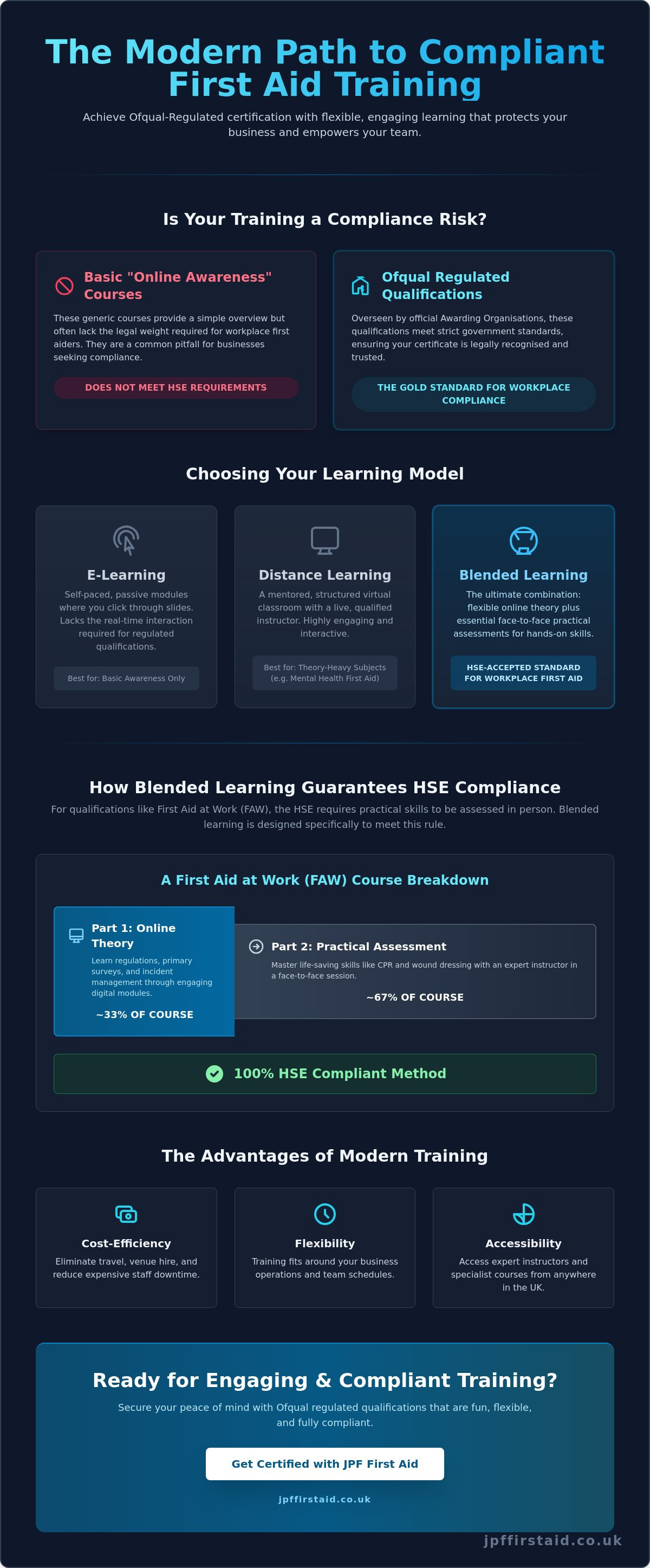
You’ll find a clear distinction between “online awareness” courses and “Ofqual regulated” distance learning. Awareness courses provide a basic overview but often lack the legal weight required for workplace first aiders. Regulated qualifications, overseen by Awarding Organisations like FAA, meet strict government standards. These bodies ensure that remote training maintains the same rigour as face-to-face sessions, keeping standards high and ensuring your certificate is one you can trust. It’s a professional, structured approach that guarantees you’re ready to act when it matters most.
Distance Learning vs. E-Learning: Knowing the Difference
E-learning is typically a self-paced, passive process where you click through slides at your own speed. Distance learning is far more engaging because it’s mentored and structured. You’ll have a real-time connection with a qualified instructor who guides you through the material. This “real-time” interaction is a requirement for regulated qualifications. It allows an assessor to check your understanding and answer your questions directly, ensuring the training remains practical and far from dry or clinical.
The Benefits of Remote First Aid Training
Choosing distance learning first aid qualifications offers several practical advantages for both individuals and business owners:
- Cost-efficiency: You eliminate travel expenses and the need for expensive venue hire. It reduces staff downtime, as learners don’t need to spend hours commuting to a training centre.
- Flexibility: The training fits around your operational needs. It’s a hassle-free way to ensure your team stays compliant without disrupting their daily workflow.
- Accessibility: Remote training removes geographic barriers. This is especially helpful for specialist subjects like Mental Health First Aid, making expert instruction available to everyone, regardless of their location in the UK.
This modern approach builds the same “can-do” attitude as traditional training. It empowers you with the confidence to handle emergencies while providing a relaxed, professional learning environment that suits your lifestyle.
Is Distance Learning HSE Compliant for Workplace First Aid?
The most common question we hear from business owners is whether a certificate earned through a screen actually satisfies the law. It’s a valid concern. Under the Health and Safety (First-Aid) Regulations 1981, employers are legally required to provide “adequate and appropriate” equipment and personnel to ensure employees receive immediate attention if they are injured or taken ill at work. For decades, this meant mandatory multi-day classroom attendance. However, since 2016, the HSE has formally accepted blended learning as a robust method for achieving distance learning first aid qualifications.
It is important to understand the distinction between “online-only” and “blended” training. While you can learn the theory of a primary survey or the legalities of an incident report from your sofa, the HSE is clear that physical life-saving skills must be assessed in person. When comparing HSE and OSHA compliance, both regulatory bodies highlight that digital learning is a supplement, not a total replacement, for hands-on practice. At JPF First Aid, we ensure your team remains 100% compliant by blending modern digital resources with high-energy, face-to-face practical sessions.
HSE Requirements for Blended Learning
The HSE allows for a portion of the First Aid at Work (FAW) and Emergency First Aid at Work (EFAW) syllabus to be delivered remotely. For a three-day FAW course, the standard ratio is usually one-third theory to two-thirds practical. This means you can complete your first day of training online, covering the essential knowledge at your own pace. However, the remaining two days must involve a trainer to observe your CPR technique and bandage application. Current guidance also permits virtual classroom technology, provided the trainer can interact with students in real time to answer questions and clarify complex medical points.
The Importance of Ofqual Regulation
Not all distance learning first aid qualifications are created equal. The market is currently flooded with “online-only” certificates that cost £10 and take twenty minutes to complete. These are often “awareness” courses rather than regulated qualifications. They rarely meet workplace compliance standards and can leave your business vulnerable if an accident occurs. Most UK insurance companies prioritize Ofqual-regulated qualifications because they provide a guaranteed level of quality and assessment.
- Check the Awarding Body: Ensure your provider is an approved centre for organizations like Qualsafe or TQUK.
- Verify the Level: Workplace first aiders typically need a Level 3 Award to be fully compliant.
- Practical Assessment: If there is no face-to-face assessment, the certificate likely won’t satisfy an HSE inspector.
Choosing a regulated path doesn’t have to be a headache. We focus on making the process hassle-free so you can focus on your business. If you want to ensure your team is both legal and confident, you can view our compliant training options to see how we bring the classroom to you.
Choosing the Right Format: Classroom, Blended, or Distance?
Selecting the right training method isn’t just about ticking a box for compliance. It’s about ensuring you or your team feel ready to act when every second counts. To find the best fit, you should weigh the complexity of the skills against the learner’s existing knowledge. For instance, a veteran first aider might find distance learning first aid qualifications perfect for staying sharp, while a complete beginner will usually benefit from the reassurance of an instructor’s physical presence. You need to consider how much hands-on practice is required to build genuine confidence in a crisis.
Budget is always a factor, but it shouldn’t come at the cost of life-saving skills. While 100% online courses often have a lower price point, they can’t replace the muscle memory gained from performing CPR on a manikin. When making your decision, consult the HSE guidance on selecting a first aid provider to ensure your choice meets legal requirements for your specific workplace. If you aren’t sure which path to take, our comprehensive guide to first aid courses provides a deeper dive into the specific syllabus for each level of training.
When to Choose 100% Distance Learning
Purely digital training is a fantastic solution for theory-heavy subjects. It’s the ideal choice for Mental Health First Aid or general Health and Safety awareness where physical intervention isn’t the primary focus. If you’re looking for an annual refresher to bridge the gap between three-year certifications, this format keeps your knowledge fresh without needing a full day out of the office. It’s perfect for learners who prefer a quiet, self-paced environment where they can digest information without the pressure of a group setting. Choosing distance learning first aid qualifications for theoretical units allows for a flexible, stress-free learning experience.
When Blended Learning is the Smarter Move
Blended learning has become the “gold standard” for courses like Emergency First Aid at Work. This approach typically cuts your classroom time in half. You complete the theory online at home, then join us for a high-energy, practical session to master the physical techniques. It’s a massive time-saver for busy professionals. Many schools and nurseries now insist on blended paediatric first aid training. It allows staff to maintain their full 12-hour qualification status while only spending one day away from the classroom, ensuring both legal compliance and operational continuity without the hassle of finding two days of cover.
Top Qualifications Available via Distance Learning
You can begin your journey toward regulated certification without stepping into a physical classroom. In 2026, distance learning first aid qualifications have expanded to cover a wide range of essential workplace skills. These courses aren’t just “online videos”; they’re interactive, tutor-led experiences that meet strict Ofqual standards. This shift ensures you get the same level of expertise and recognition as traditional learners while maintaining total flexibility.
Mental Health First Aid (Levels 1-3)
It’s no surprise that mental health first aid has become the flagship for remote learning. Since the focus is on communication, empathy, and crisis management rather than physical bandaging, the format translates perfectly to the screen. You’ll find three main tiers available through our remote platforms:
- Level 1: Focused on awareness and starting the conversation about mental health.
- Level 2: Providing the practical tools to support colleagues in distress.
- Level 3: Comprehensive training for supervisors to manage wellbeing across an entire department.
Virtual classrooms use secure breakout rooms to facilitate sensitive role-play scenarios. This setup often feels safer for learners, allowing for honest discussions from the comfort of their own office or home. It’s a relaxed way to tackle serious topics without the pressure of a crowded room.
Health and Safety & Fire Safety
Compliance training is another area where remote delivery shines. Completing Fire Marshal training via distance learning allows your team to understand fire chemistry, evacuation procedures, and legal duties without the logistical headache of travel. Similarly, manual handling theory provides the vital anatomical knowledge required before any physical lifting takes place. These courses build a consistent culture of safety across multiple sites, ensuring every employee receives the same high-standard instruction.
For Level 2 and Level 3 awards, video-link assessments ensure the qualification remains robust and respected. An expert trainer observes your skills in real-time through a secure link, verifying your competence just as they would in person. This approach has seen a 40% increase in uptake since 2024 because it respects your time while maintaining professional standards. It’s a hassle-free way to stay compliant without compromising on the quality of your training.
Ready to get started? Explore our range of flexible distance learning courses today and build your confidence with the help of our expert mentors.
Why JPF First Aid Makes Remote Learning Engaging and Fun
Most people expect online training to be a series of dry, static slides that require hours of mindless clicking. We’ve changed that. JPF First Aid breaks the boring e-learning stereotype by delivering distance learning first aid qualifications that feel alive. Our sessions are instructor-led and interactive, ensuring you stay focused and involved from start to finish. We believe that if you aren’t engaged, you won’t retain the life-saving skills you need when it matters most.
Our approach focuses on building your confidence through real-time feedback. You won’t be left wondering if you’ve understood a concept. Instead, you can ask questions and participate in discussions just as you would in a traditional classroom. This conversational style removes the anxiety often associated with emergency response training, replacing it with a practical, can-do mindset. We make the booking process entirely hassle-free, so you can focus on learning while we handle the admin.
Expert Mentors, Not Just Modules
The true value of our training lies in our people. Being taught by John Fogarty and our team of experienced trainers means you’re learning from professionals who’ve dealt with real emergencies. We don’t just read from a manual; we use real-life scenarios from 2024 and 2025 call-outs to make the theory feel practical. This expert mentoring ensures that every learner feels ready to act. You’ll finish your course with the competence to handle a crisis, backed by the wisdom of mentors who’ve been there themselves.
First Aid Training You Can Trust
Our multi-award-winning status isn’t just for show; it’s a reflection of our 98% learner satisfaction rate across the United Kingdom. We’ve streamlined our certification process to be as simple as possible. Once you complete your session, your regulated PDF certificate is issued quickly, keeping your compliance records up to date without any stress. Whether you’re an individual looking to upskill or a business owner booking a group session, we provide a reliable, professional service that puts your needs first.
Don’t settle for a certificate that’s just a piece of paper. Choose training that actually prepares you for the real world. Secure your spot in our next session or book a group course for your team to experience the JPF difference. Explore our distance learning qualifications and build your confidence today.
Build Your Life-Saving Confidence Today
Choosing distance learning first aid qualifications doesn’t mean you’re compromising on quality or legal compliance. As we look toward 2026, the shift toward flexible, Ofqual regulated training makes it easier than ever to balance your professional responsibilities with essential safety skills. You’ll gain the same HSE-compliant certification as a traditional classroom setting, but with the freedom to learn at a pace that suits your schedule.
At JPF First Aid, we bring over 20 years of industry experience to every course. We’ve spent two decades proving that remote learning can be just as engaging and fun as being there in person. As a multi-award-winning training provider, our goal is to move beyond dry theory and give you the practical confidence to act when it matters most. Whether you’re a business owner or an individual learner, you’re in safe, expert hands with our team.
View Our Regulated Distance Learning Qualifications and take the first step toward becoming a certified lifesaver. We’re here to make your training hassle-free, professional, and genuinely enjoyable.
Frequently Asked Questions
Can I get a fully regulated First Aid at Work certificate 100% online?
No, you cannot get a 100% online First Aid at Work certificate if you need to meet HSE requirements. UK regulations specify that life-saving skills like CPR and the recovery position must be assessed in person. You can complete your theory online, but you’ll need to spend at least 1 day in a classroom for the practical assessment to gain a fully regulated qualification.
What is the difference between a blended course and a distance learning course?
A blended course splits your time between online theory and a face-to-face practical session. In contrast, 100% distance learning is usually for theory-heavy subjects. Most distance learning first aid qualifications are actually blended, ensuring you get the flexibility of home study alongside the hands-on practice needed to feel confident in an emergency. This approach often saves you 1 or 2 days in the classroom.
Do I need any special equipment for a distance learning first aid qualification?
You don’t need any complex medical kit to start. A reliable laptop, tablet, or smartphone with an internet connection is enough to access our interactive learning portal. If you’re doing a blended course, we provide all the bandages, manikins, and AED trainers during your practical session. You just need to bring your willingness to learn and a positive attitude to the training.
How are practical skills assessed during a distance learning course?
You’ll demonstrate your skills in front of an expert assessor during the practical part of your course. For the First Aid at Work qualification, this includes performing 2 minutes of continuous CPR and demonstrating how to use a defibrillator. These assessments follow the Resuscitation Council UK 2021 guidelines, ensuring your techniques are up to date and meet the highest safety standards.
Will my employer accept a distance learning first aid qualification?
Employers will accept these certificates as long as they meet Ofqual standards. Most UK businesses now prefer blended distance learning first aid qualifications because they reduce staff time away from the office by 33% or more. We ensure every course we deliver complies with the Health and Safety (First-Aid) Regulations 1981, giving your employer total peace of mind regarding legal compliance.
How long does a distance learning first aid certificate last?
Your certificate will be valid for 3 years from the date of issue. This 36 month expiry applies to both Emergency First Aid at Work and the full 3 day qualification. To maintain your status as a first aider, you’ll need to complete a requalification course before your current certificate expires. We’ll even send you a reminder 3 months early so you don’t miss your renewal date.
Is Mental Health First Aid valid when taken as a distance learning course?
Yes, Mental Health First Aid is perfectly suited for distance learning. Because this training focuses on conversation and support frameworks rather than physical intervention, you can complete the full qualification via a virtual classroom. These sessions are led by a live instructor, allowing you to engage in group work and case studies from the comfort of your own home or office.
Can I switch from distance learning to a classroom session if I struggle?
You can definitely switch to a classroom session if you find the online modules difficult. We understand that everyone learns differently, and our approach means we’re here to support you. If you’re struggling with the digital content, just let us know. We’ll find a spot for you in one of our upcoming local training sessions so you can learn in person with an expert mentor.
Recent Comments