

Did you know that research from bodies like the British Red Cross suggests first aid skills can start to decline significantly just six months after your initial course? It’s a sobering thought when you’re responsible for the safety of your team or family. If you’re currently staring at a certificate on the wall and wondering how long does a first aid certificate last, you aren’t alone. Most UK professionals find themselves second-guessing their expiry dates or feeling a bit of “compliance anxiety” regarding current HSE regulations.
We agree that keeping track of training cycles shouldn’t feel like a stressful chore. You deserve to feel prepared and capable in an emergency, not worried about whether your paperwork is still valid. This 2026 guide is designed to give you total clarity. We’ll show you exactly when your specific qualification expires, explain why the three-year rule exists, and highlight the best time to book your requalification. By the end of this article, you’ll understand the vital difference between an annual refresher and a full course, ensuring you stay confident and legally compliant.
Key Takeaways
- Understand why most UK qualifications are valid for three years and how Ofqual and HSE regulations keep your training current and safe.
- Discover exactly how long does a first aid certificate last for your specific role, whether you work in a standard office or a paediatric setting.
- Learn why the HSE strongly recommends annual refresher training to combat skill fade and maintain your confidence in emergency situations.
- Identify the immediate legal consequences of an expired certificate and how to protect your business from unnecessary liability risks.
- Find out the best time to book your 2-day requalification course to ensure a hassle-free transition and continuous workplace compliance.
Understanding First Aid Certificate Validity Periods in the UK
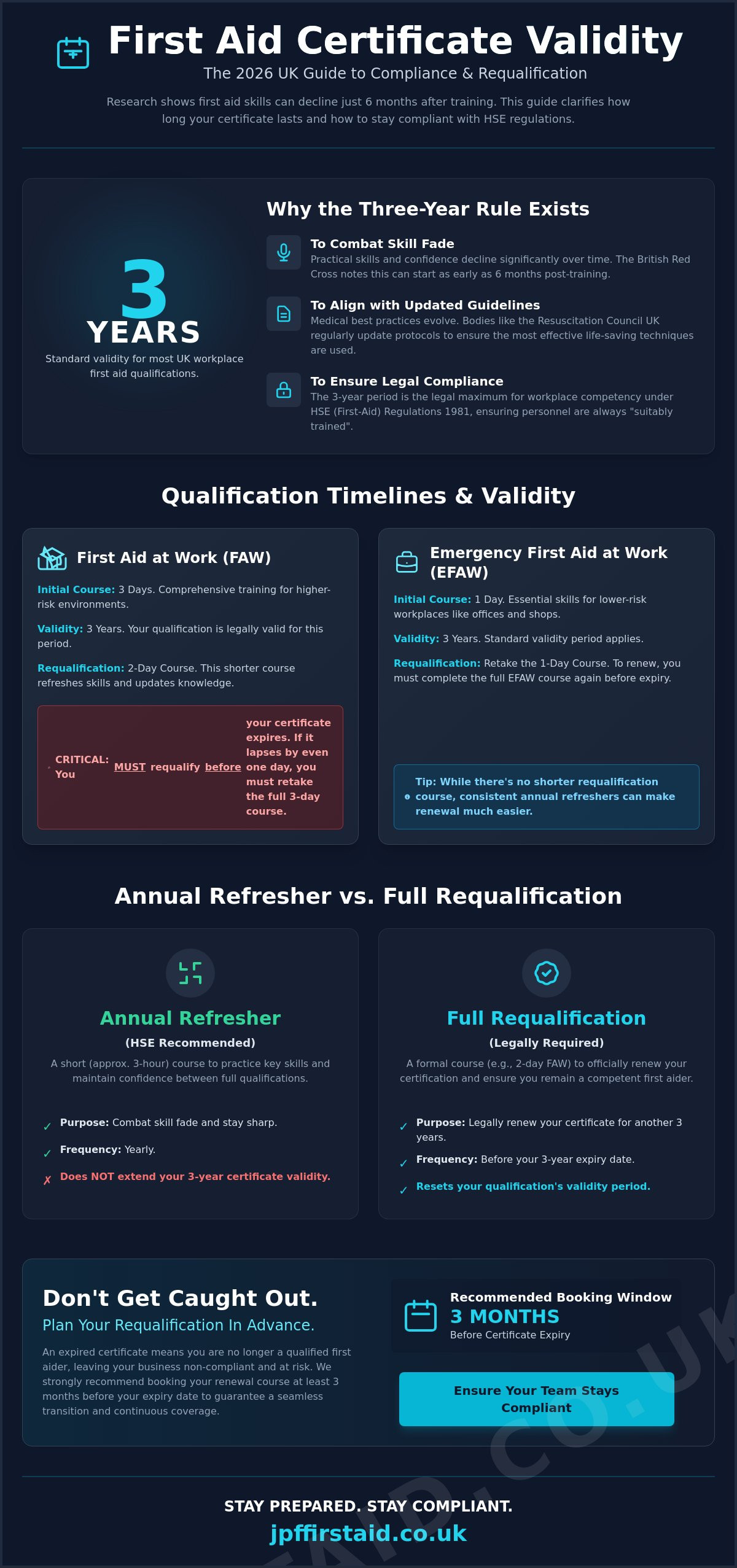
You’ve completed your training, practiced your chest compressions, and received your certificate. Now you’re likely wondering, how long does a first aid certificate last before you need to refresh those skills? In the UK, the standard validity period for the vast majority of workplace first aid qualifications is three years from the date your certificate was issued. The three-year rule serves as the absolute legal maximum for workplace competency under current health and safety standards.
While you might feel confident today, medical guidelines don’t stay still. Organizations like the Resuscitation Council UK regularly update protocols to reflect the latest life-saving research. To understand the basics of these emergency interventions, it’s helpful to look at What is First Aid? and how its core principles aim to preserve life. Certificates expire because your practical skills can fade over 36 months, and staying current ensures you’re using the safest, most effective techniques when every second counts.
The Legal Framework: HSE and Ofqual Regulations
The Health and Safety (First-Aid) Regulations 1981 require employers to provide adequate equipment and “suitably trained” personnel. To meet this legal obligation, most businesses choose regulated qualifications overseen by Ofqual. These Awarding Organisations ensure that your training provider follows a strict curriculum. A regulated certificate carries an official logo from a body like FAA (First Aid Awards), proving it meets national standards. While non-regulated “in-house” certificates exist, they often lack the same level of external quality assurance, making it harder to prove compliance during a Health and Safety Executive (HSE) inspection.
How to Read Your First Aid Certificate
Your certificate is more than just a piece of paper; it’s your proof of competence. Always look for the “Date of Issue” first. Your three-year countdown starts from this specific day, not the day you received the physical copy. Most modern certificates clearly list an “Expiry Date” or “Valid Until” date to make your life easier. If you see an Awarding Body logo like FAA, you can trust your qualification is part of a regulated framework.
If your document doesn’t explicitly state when it ends, the industry standard of three years from the issue date applies. If you’re ever unsure, you should contact your training provider to verify your status in their database. Knowing exactly how long does a first aid certificate last helps you plan your hassle-free renewal well in advance, ensuring there’s never a gap in your workplace’s safety coverage. We always recommend booking your refresher at least 3 months before your current term ends to stay fully compliant.
Validity Variations Across Different First Aid Qualifications
While many people assume a standard timeline for safety training, understanding exactly how long does a first aid certificate last depends entirely on the specific qualification you hold. Safety standards in the UK aren’t one-size-fits-all because different environments carry different levels of risk. A construction site requires a different level of preparedness than a small retail shop or a primary school. Choosing the correct path is much easier when you review our guide to first aid courses, which helps you match your training to your specific workplace needs and legal obligations.
Workplace First Aid: EFAW vs. FAW
The Emergency First Aid at Work (EFAW) 1-day course and the more comprehensive First Aid at Work (FAW) 3-day course both result in certificates valid for three years. However, the requalification process for the 3-day course is more specific. To remain qualified, you can take a shorter 2-day refresher course, but you must complete this before your current certificate expires. If you let your qualification lapse by even a single day, you’ll likely need to sit the full 3-day course again to regain your status. Following UK Government Regulations is essential for business owners to remain compliant and ensure there’s always adequate cover on-site. We suggest booking your renewal at least three months before your expiry date to avoid any administrative stress.
Paediatric and Mental Health First Aid Durations
If you work in early years settings, Paediatric First Aid is a mandatory requirement for EYFS and Ofsted compliance. These certificates follow the standard 3-year lifecycle. Mental Health First Aid qualifications also typically follow a three-year renewal recommendation to ensure support strategies remain current. The depth of these courses varies by level:
- Level 1: Focuses on mental health awareness and identifying early signs of distress.
- Level 2: Provides practical skills for designated mental health advocates in the workplace.
- Level 3: Advanced training for supervisors and managers to implement wellbeing strategies.
Refreshing these skills every three years ensures you feel confident and capable when supporting colleagues or students who may be experiencing a crisis.
Basic Life Support and AED Training
In clinical settings or high-risk environments, the answer to how long does a first aid certificate last is often shorter. Basic Life Support (BLS) certificates are frequently restricted to a 1-year validity period. This is because CPR skills are perishable; medical data suggests that the quality of chest compressions can decline significantly within just six months of training. While AED (Defibrillator) training is usually integrated into the standard 3-year workplace cycle, performing an annual CPR check is the best way to maintain your life-saving muscle memory. If you’re unsure which certificate your team needs for 2026, feel free to reach out for a chat about our flexible on-site training options.
The Critical Role of Annual Refresher Training
While you know the technical answer to how long does a first aid certificate last is three years, relying solely on that timeframe can be a risky strategy for your team. The Health and Safety Executive (HSE) guidance strongly recommends that all workplace first aiders attend annual refresher training. This recommendation exists to combat the “forgetting curve,” a psychological phenomenon where life-saving skills begin to degrade quickly without regular practice. Studies show that CPR proficiency can drop significantly within just six to seven months after initial training.
There’s a massive difference between being legally valid and being practically competent. Your certificate might still be in date, but if you’re faced with a sudden cardiac arrest or a severe bleed, your ability to act depends on muscle memory. Annual refreshers bridge the gap between theory and action. These sessions turn a nervous “I think I know what to do” into a confident “I’m ready to help.” By practising once a year, you build the mental clarity required to stay calm under intense pressure.
What is Covered in an Annual Refresher?
An annual refresher is a focused, three-hour session designed to keep your skills sharp without taking you away from your desk for too long. We concentrate on the most critical, life-saving techniques that you’re most likely to forget. You’ll spend time practising the primary survey, perfecting your CPR technique, and ensuring you’re comfortable with the recovery position. We also use this time to update you on any vital changes to Resuscitation Council UK guidelines. This short time investment ensures your response remains instinctive and accurate.
Benefits for Employers and Employees
For business owners, refreshers are a smart way to manage risk. In high-risk environments like construction or manufacturing, “skill fade” can have serious consequences. Beyond simple compliance, these sessions foster a genuine culture of safety and preparedness. Employees feel valued and empowered when they know their skills are current and their employer cares about their confidence.
- Easier Requalification: When the three-year mark arrives, the full requalification course feels much easier because you’ve kept the basics fresh.
- Reduced Anxiety: Regular practice removes the fear of making a mistake during a real emergency.
- Updated Knowledge: You stay ahead of any medical changes that occurred since your original training.
Investing in these short, engaging sessions ensures that when someone asks how long does a first aid certificate last, your team’s answer isn’t just about the date on the paper. It’s about their genuine readiness to save a life today. We make these sessions practical and relaxed, ensuring everyone leaves feeling capable and refreshed.
What Happens When a First Aid Certificate Expires?
The moment the clock strikes midnight on your certificate’s expiry date, your legal status as a designated first aider ends. There’s no soft landing or tapering off period. In the eyes of the Health and Safety Executive (HSE), you’re no longer qualified to provide first aid in a professional capacity. This creates an immediate gap in your company’s safety provision. If an accident occurs and your only first aider has an out-of-date certificate, your business is failing its legal duty of care. When you consider how long does a first aid certificate last, you must treat the expiry date as a hard deadline for compliance. You can find more details on staying compliant in our guide to emergency first aid at work.
The 28-Day Grace Period Explained
A common myth in UK workplaces is that there’s a 28-day grace period where you can still act as a first aider. This is factually incorrect and potentially dangerous. While the HSE allows a 28-day window after expiry to attend a requalification course, this is strictly for training eligibility. It doesn’t extend your qualification. You cannot be the named first aider on your site during this time. If you miss this 28-day window entirely, you’ll likely lose the right to take a shorter refresher course. This means you’ll have to sit the full 3-day First Aid at Work course again, rather than the 2-day requalification, which increases both your costs and time away from the office.
Insurance and Liability Implications
Expired certificates are a major red flag for insurers. Most workplace insurance policies require you to follow all relevant health and safety laws. If a claim arises from an incident where the responding first aider was unqualified, your insurer may refuse to pay out. This leaves the business directly liable for legal costs and compensation. Understanding how long does a first aid certificate last is vital for avoiding these insurance pitfalls. HR departments should maintain a live training matrix to track these dates. If you realize a staff member’s certificate has expired, you must remove them from the first aid rota immediately and book a course. It’s better to be a person short on the rota for a day than to risk a massive liability hit.
Don’t wait until your compliance is at risk; book your hassle-free on-site training with JPF First Aid today to keep your team protected and confident.
Planning Your Requalification for Continuous Compliance
Don’t leave your workplace safety to chance by waiting until the last minute. The most effective time to book your renewal is three months before your current certificate expires. This 90-day window provides a vital safety net, ensuring you secure a spot in a local course and avoid any lapse in your legal cover. If your credentials expire before you finish your training, you technically lose your status as a qualified first aider, which can leave your business vulnerable during an HSE inspection.
Choosing the right path for renewal saves both time and resources. If you currently hold a valid First Aid at Work (FAW) certificate, you’re eligible for the 2-day requalification course. This shorter format is specifically designed to refresh your existing knowledge and update your techniques to meet 2026 standards. It’s a significant time-saver compared to the full 3-day initial course. You can choose between traditional classroom learning, blended options that move theory online, or on-site sessions that come directly to your workplace. To stay sharp before your course begins, we recommend reviewing our guide on first aid essentials to brush up on core life-saving skills.
The Requalification Timeline
Maintaining your compliance is a straightforward process when you follow a structured timeline. Start by checking your certificate’s expiry date today. We suggest booking your next session at least 12 weeks in advance. Waiting until the final week often results in limited availability, which adds unnecessary stress to your schedule. At JPF First Aid, we believe the renewal process should be something you look forward to. Our instructors make the training engaging and fun, focusing on practical scenarios rather than just reading from a manual. This approach ensures you walk away with the confidence to handle a real-life crisis.
On-Site vs. Public Course Renewals
For businesses with multiple staff members, booking on-site training is often the most cost-efficient strategy. We can train groups of up to 12 delegates at your own facility, which eliminates staff travel time and keeps your team in their familiar environment. This setup allows us to provide bespoke training that focuses on your specific workplace risks. Whether you work in a high-risk warehouse or a busy office, we tailor the scenarios to fit your daily reality. Every certificate we provide is Ofqual regulated, ensuring your business remains fully compliant with UK law. Understanding how long does a first aid certificate last is the first step toward a safer workplace; booking your 2026 requalification is the second.
Stay Compliant and Ready to Act
Maintaining your workplace safety standards doesn’t have to be a complex task. Most UK certificates, such as the First Aid at Work qualification, remain valid for 3 years from the date of issue. While this is the legal limit, the Health and Safety Executive (HSE) suggests completing a refresher every 12 months to keep your skills sharp. Understanding how long does a first aid certificate last ensures you never face a gap in your legal compliance or your ability to help someone in need.
JPF First Aid is here to make your requalification process simple and stress-free. We are a multi-award-winning training provider offering Ofqual regulated qualifications that are as practical as they are professional. Our experts deliver engaging and fun training designed to build your confidence, ensuring you leave the classroom feeling capable and empowered. We believe that life-saving skills should be accessible and memorable for every learner.
Ready to update your credentials? Book your first aid requalification with JPF First Aid today. It’s the best way to ensure you’re always prepared for the unexpected, and we’ll be with you every step of the way.
Frequently Asked Questions
How long is an Emergency First Aid at Work (EFAW) certificate valid for?
Your Emergency First Aid at Work (EFAW) certificate is valid for exactly 3 years from the date of your assessment. While the Health and Safety Executive (HSE) sets this 36 month limit, they strongly recommend an annual skills update to keep your confidence high. At JPF First Aid, we ensure your 1 day training session leaves you feeling ready to handle workplace incidents until your next renewal date.
Is there a grace period for first aid certificates in the UK?
There is no official grace period for first aid certificates under HSE guidelines. Once the 3 year expiry date passes, you’re no longer considered a qualified first aider for workplace compliance. You should aim to book your training at least 1 month before the expiry date to ensure your business remains legally covered. We offer flexible on-site training to help you avoid any gaps in your certification.
Can I renew my first aid certificate after it has expired?
You can renew your certificate after it expires, but you must stop acting as a designated first aider immediately. If your First Aid at Work (FAW) certificate has been expired for more than 28 days, you typically cannot take the shorter 2 day requalification course. In this case, you’ll need to attend the full 3 day initial training again to regain your regulated qualification and confidence.
Do I have to do the full 3-day course again if my FAW certificate expires?
You must repeat the full 3 day course if your First Aid at Work certificate expired more than 28 days ago. If you book within that 28 day window, you can usually attend a 2 day requalification course instead. This is why tracking how long does a first aid certificate last is vital for business owners who want to save time and reduce training costs.
How often should I do a first aid refresher course?
The HSE recommends that you complete a half day annual refresher course every 12 months between your main certifications. While not a legal requirement like the 3 year renewal, these 3 hour sessions are crucial for maintaining life-saving skills. Our engaging refresher sessions focus on practical drills, ensuring you don’t lose the “can-do” attitude needed during a real medical emergency.
What is the difference between first aid requalification and a refresher?
A requalification is a formal 2 day course required every 3 years to maintain your legal status as a first aider. A refresher is a shorter, 3 hour annual update designed to keep your skills sharp between those 3 year milestones. We provide both options as bespoke, hassle-free solutions that fit your schedule while keeping your workplace fully compliant with 1981 Health and Safety regulations.
How long does a Paediatric First Aid certificate last for Ofsted?
A Paediatric First Aid certificate lasts for 3 years to meet Ofsted and EYFS requirements. Early years providers must ensure at least 1 person with a full 12 hour Paediatric First Aid qualification is on the premises at all times when children are present. Our expert mentors deliver these 2 day courses in a relaxed environment, giving you the specific skills needed to care for infants and children safely.
Is an online first aid certificate valid for workplace compliance?
Purely online certificates are generally not sufficient for workplace compliance because the HSE requires a practical, face-to-face assessment of skills like CPR. Blended learning is a valid alternative where you complete 1 day of theory online and 1 or 2 days of practical training in person. This approach ensures you gain the hands-on experience and confidence that only a qualified instructor can provide during a physical training session.
Recent Comments