
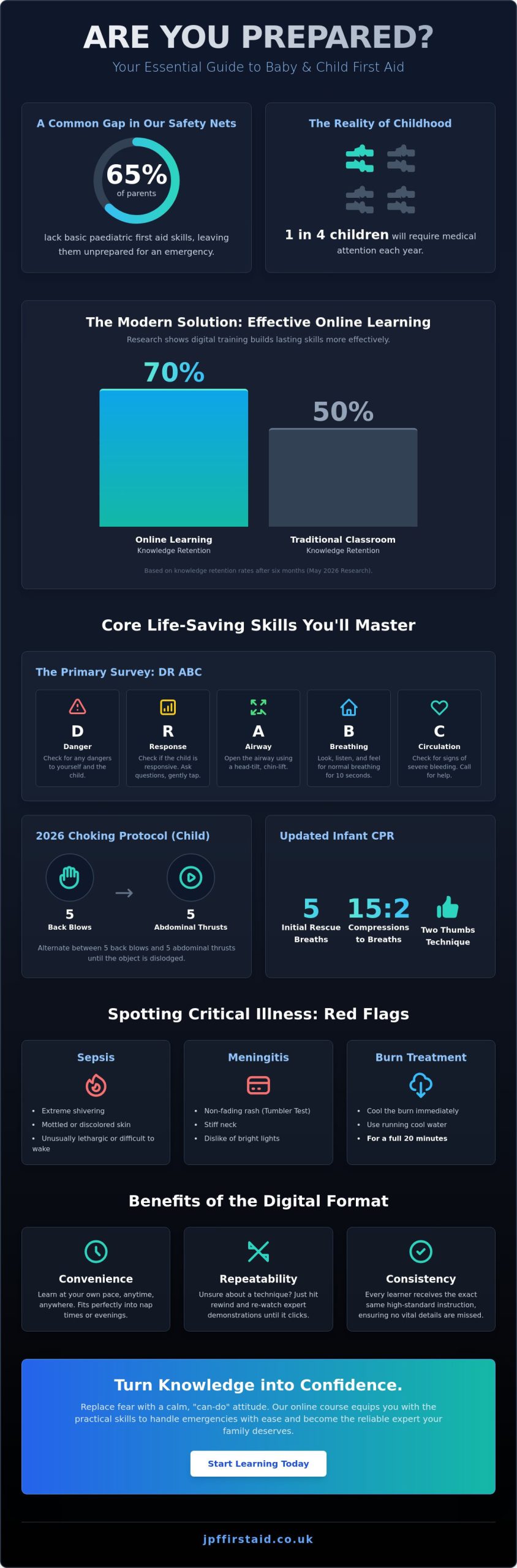
Did you know that 65% of parents lack basic paediatric first aid skills, even though one in four children will need medical attention every single year? It’s a staggering figure that highlights a common gap in our safety nets. You likely feel that familiar knot of anxiety when you think about your child choking or falling suddenly ill, especially when conflicting medical advice makes everything feel more confusing. Enrolling in a baby and child first aid course online is the most effective way to replace that fear with a calm, “can-do” attitude. Research shows that online learners actually have a 70% knowledge retention rate after six months; this is significantly higher than the 50% retention seen in traditional classroom settings.
We know you’re busy and don’t have time for long seminars, but you still want the peace of mind that comes with expert training. This guide will show you how flexible, digital learning equips you with practical skills and the confidence to handle emergencies with ease. We’ll preview the latest 2026 guidelines, including updated infant CPR techniques and the new 5-and-5 choking protocol, so you can become the reliable expert your family deserves.
Key Takeaways
- Learn why modern digital training has evolved from dry, clinical lectures into interactive experiences that fit into your busy schedule.
- Master the adapted “DR ABC” primary survey and step-by-step choking protocols to act decisively when every second counts.
- Discover how a baby and child first aid course online provides the essential knowledge base you need for general parenting awareness.
- Understand the difference between simple awareness courses and Ofqual regulated qualifications to ensure your training meets the highest standards.
- Find out how an engaging, fun approach to learning replaces anxiety with a practical “can-do” attitude during childhood emergencies.
What is a Baby and Child First Aid Course Online?
A baby and child first aid course online is a sophisticated digital training programme designed to put life-saving skills directly into your hands. It isn’t just a collection of reading materials or static PDFs. Instead, it uses high-definition video, interactive modules, and knowledge assessments to teach you exactly how to respond when a child’s life is on the line. Forget the days of sitting in a draughty village hall for eight hours listening to dry, clinical lectures. Modern training is engaging, visual, and fits perfectly into your pocket.
In 2026, we’ve seen a massive shift toward “blended learning” for parents and carers. The first aid training market is projected to reach $5.22 billion this year, largely because people now demand flexibility without sacrificing quality. This format is the gold standard for busy households where time is a luxury. It provides the same expert instruction as a traditional classroom session but allows you to learn at your own pace, ensuring you feel calm and capable rather than rushed or overwhelmed.
The Scope of Online Paediatric Training
Effective training must be specific to the age of the patient. Our digital courses clearly differentiate between “baby” protocols for infants under one year and “child” protocols for those from one year up to puberty. You’ll learn how to apply Pediatric Basic Life Support principles through video-led demonstrations. These visuals are vital for long-term memory. Instead of just reading about a technique, you see exactly where to place your hands and how much pressure to apply. We focus on both preventative safety, like child-proofing your home, and high-stakes emergency response for sudden illnesses.
Benefits of the Digital Format for Carers
The most obvious benefit is convenience. You can complete your baby and child first aid course online during nap times or in the evening without the hassle of travel or finding a babysitter. However, the real power lies in repeatability. If you’re unsure about the rhythm of chest compressions or the new 2026 choking protocols, you can simply hit rewind and watch the expert demonstration again until it clicks.
Consistency is another huge win for families. Every learner receives the exact same high-standard instruction, ensuring no vital details are missed. Research from May 2026 shows that online first aid certification leads to a 70% knowledge retention rate at the six-month mark. That’s a significant improvement over the 50% retention rate usually seen in traditional classroom settings. By choosing a digital format, you aren’t just checking a box; you’re building lasting skills that stay with you when you need them most.
Core Life-Saving Skills Covered in Virtual Paediatric Training
A baby and child first aid course online ensures you are ready for the unexpected by providing a clear mental roadmap. We start with the Primary Survey, or “DR ABC.” This sequence teaches you to assess Danger, check for a Response, open the Airway, look for Breathing, and check Circulation. It’s about creating a calm, logical flow in your mind before you act. By following these steps, you can prioritise the most critical needs of an injured child without feeling overwhelmed by the situation.
The 2026 guidelines updated the protocol for choking, and our training reflects these changes. You should now alternate between 5 back blows and 5 abdominal thrusts for a child who is choking. This replaces older advice that relied more heavily on thrusts alone. If a child becomes unresponsive, you’ll need to move to CPR first aid procedures. For paediatric care, the current guidance suggests starting with 5 initial rescue breaths followed by a cycle of 15 compressions to 2 breaths. Note that for infants, the two-finger technique was removed in late 2025; you should now use two thumbs wrapped around the chest or the heel of one hand.
We also cover day-to-day mishaps that every parent faces. You’ll learn exactly how to treat a burn safely by cooling the area for a full 20 minutes under running water. This section of the baby and child first aid course online also covers managing bumps and scrapes to prevent infection and promote faster healing.
Spotting Critical Illness and Red Flags
This is where many parents feel most anxious because infants can’t tell you what’s wrong. You must be able to recognise early sepsis symptoms, such as extreme shivering, mottled skin, or a child who is unusually lethargic. We also teach you how to perform the “Tumbler Test” to identify meningitis symptoms through a non-fading rash. Identifying respiratory distress or a febrile convulsion early can save a life and helps you provide better information to emergency call handlers.
First Aid for Common Household Accidents
Accidents happen in even the most carefully child-proofed homes. If poisoning or ingestion occurs, we’ll explain why you should never induce vomiting unless instructed by a medical professional. You’ll also learn to stabilise fractures or dislocations for active children and how to use an adrenaline auto-injector correctly for anaphylaxis. If you want to feel this level of confidence, our paediatric first aid training provides a supportive environment to build these vital skills.
Online Learning vs. Practical Workshops: Which Should You Choose?
Choosing between a digital platform and a traditional classroom often comes down to the “Knowledge vs. Muscle Memory” debate. Some critics suggest that you can’t learn life-saving skills without a plastic manikin in front of you, but modern technology has changed the game. A baby and child first aid course online is perfectly sufficient for general parenting awareness. It provides the essential “what to do” knowledge that removes the initial freeze response during an emergency. If your goal is to feel confident at home or while out at the park, the convenience of digital learning is hard to beat.
However, your specific role determines whether you need a purely digital experience or a regulated, in-person qualification. For Ofsted-registered childminders or those working in early years settings, a full paediatric first aid certificate is usually required to meet legal safety standards. This often involves “Blended Learning,” which is becoming the standard in 2026. You complete the theory modules online at your own pace and then attend a shorter practical session to demonstrate your skills. This approach follows the same rigour as state-mandated first aid training requirements seen globally, ensuring that professional carers are both knowledgeable and physically prepared.
The Effectiveness of Remote Assessment
Don’t underestimate the power of a screen. Seeing a life-saving technique demonstrated in high-definition 4K video is often clearer than trying to peer over a dozen other students in a crowded classroom. Many modern courses now use video-link assessments where an expert watches you perform a technique in real-time, providing immediate corrections. There’s also a significant psychological benefit to learning in your own home. By practicing in the living room or kitchen, you’re training in the exact environment where an accident is most likely to happen, which helps build genuine, localized confidence.
Choosing Based on Your Role
If you’re a new parent, focus on courses that build immediate response skills and confidence. You don’t necessarily need a formal certificate for the workplace, but you do need the peace of mind that you can protect your child. For babysitters and nannies, an online course with a recognised certificate helps build a professional portfolio, showing parents that you take safety seriously. Grandparents often benefit from a digital refresh to update “old-school” advice. For example, the removal of the two-finger compression technique in late 2025 is a vital update that many who trained decades ago won’t know.
How to Evaluate an Online Paediatric First Aid Provider
Choosing a baby and child first aid course online shouldn’t be a decision based solely on the lowest price or the quickest completion time. Since the updated Resuscitation Council UK guidelines were implemented in January 2026, the gap between high-quality training and outdated content has widened. You need to ensure your provider is a “Reliable Expert Mentor” who keeps their curriculum current. Look for courses that explicitly mention the 2026 updates, such as the removal of the two-finger compression technique and the new 5-and-5 choking protocol. Verifying these first aid essentials ensures you aren’t learning obsolete methods that could be less effective in a crisis.
Trainer expertise is another non-negotiable factor. The best online platforms are led by medical professionals or career first aiders who have real-world experience in paediatric emergencies. This background allows them to move beyond the theory and offer practical, “can-do” advice that builds genuine confidence. Don’t forget to check social proof and reviews from other parents. While a certificate is a great milestone, the real value lies in the “confidence boost” reported by previous learners. National safety data shows that while many adults have basic training, only 18% feel truly confident enough to act in a real emergency. Your goal is to be part of that confident minority.
Regulated vs. Non-Regulated Courses
Understanding the difference between “awareness” and “regulated” is vital. A Level 3 Paediatric First Aid qualification is a regulated credential that meets Ofsted and EYFS requirements. This is essential if you’re a childminder or work in a nursery. However, if you’re a parent or grandparent, a non-regulated awareness course is often perfectly sufficient. These courses focus on the same life-saving skills but without the formal exam pressure. Always check if the certificate carries weight with insurers, as this is a strong indicator of the course’s quality and reliability.
Technical and Support Features
A modern baby and child first aid course online should be as flexible as your schedule. Check if the provider offers ongoing access to the materials after you’ve finished the course. Being able to refresh your memory on your phone while on the go is a huge advantage. Look for platforms that offer a dedicated help line or an expert-led forum. Having a place to ask specific questions about your child’s health or a particular technique ensures you never feel like you’re learning in isolation. If you’re ready to start building your life-saving skills today, explore our range of expert-led training options designed for your peace of mind.
Turning Knowledge into Confidence with JPF First Aid
At JPF First Aid, we believe that learning to save a life shouldn’t be an intimidating or clinical experience. Our philosophy is simple: first aid training should be engaging, fun, and completely accessible. We know that the gravity of paediatric emergencies can cause anxiety, which is why our approach focuses on building a “can-do” attitude. By stripping away the jargon and focusing on practical, real-world application, we ensure you leave our course feeling like a capable responder rather than just someone who has read a manual. Our award-winning training is designed to prioritise your ability to act decisively when it matters most.
Whether you choose a fully distance-learning path or a blended qualification, our paediatric first aid options are built around your life. We understand that as of May 2026, parents and professional carers are busier than ever. That’s why we’ve streamlined our baby and child first aid course online to deliver high-impact learning in manageable segments. You don’t have to sacrifice the quality of your training for the sake of your schedule. We bring expert, bespoke instruction directly to your device, ensuring you receive the same level of care and detail as an on-site session.
Why Confidence is the Ultimate Outcome
The biggest barrier to performing first aid isn’t a lack of knowledge; it’s the fear of doing it wrong. Our expert mentors are here to help you move past that hesitation. We provide a relaxed, professional learning environment where you can ask questions and refine your understanding of the 2026 Resuscitation Council UK guidelines. By the time you finish the final module, that initial knot of anxiety about choking or sudden illness is replaced by a steady sense of readiness. You’ll know exactly how to handle the 5-and-5 choking protocol or the updated infant CPR techniques because you’ve seen them demonstrated clearly and repeatedly.
Next Steps: Booking Your Peace of Mind
Our booking process is designed to be completely hassle-free, whether you’re an individual parent or a manager organising training for a large group of nannies. Once you’ve completed your baby and child first aid course online, you don’t just walk away with a certificate. You join a community of confident responders who trust JPF First Aid as their reliable expert mentor. We remain a partner in your safety journey, providing the ongoing support and updates you need to keep your skills sharp. Don’t wait for an emergency to find out if you’re prepared. Empower yourself with life-saving skills today and gain the confidence that comes from being truly ready.
Take the First Step Toward Life-Saving Confidence
Empowering yourself with the skills to save a child’s life doesn’t have to be a daunting task. By choosing a baby and child first aid course online, you’re opting for a flexible, high-impact way to protect your family. We’ve explored how modern digital platforms bridge the gap between theory and practice, ensuring you master the latest 2026 Resuscitation Council UK guidelines. Whether it’s the updated 5-and-5 choking protocol or the specific thumb-placement techniques for infant CPR, you now have the roadmap to handle emergencies with a calm, “can-do” attitude.
JPF First Aid is a multi-award-winning training provider dedicated to making life-saving skills accessible to everyone. Our Ofqual regulated qualifications ensure you receive expert instruction that meets the highest professional standards, all delivered in an engaging and fun style that avoids dry, clinical lectures. You don’t have to let the fear of the unknown hold you back any longer. Book Your Online Baby and Child First Aid Course Today and join a community of parents who prioritise safety and peace of mind. You’re in safe, expert hands, and we’re here to support your journey toward becoming a confident responder.
Frequently Asked Questions
Is an online baby first aid course as good as an in-person one?
An online baby first aid course is an excellent way to gain the vital “what-to-do” knowledge needed to stop the initial freeze response. While it doesn’t replace the physical feel of a manikin, the ability to pause and rewind expert-led video demonstrations ensures you understand the nuances of every technique. It provides a relaxed, pressure-free environment that is ideal for building the confidence parents need for everyday safety.
Will I get a certificate for completing a baby and child first aid course online?
Yes, you will receive a certificate of completion after finishing your baby and child first aid course online. It’s important to check if the certificate is for “awareness” or if it’s a “regulated qualification.” Awareness certificates are perfect for parents and grandparents, while regulated Level 3 certificates are required for professional childcare roles. Most digital certificates are available for immediate download once you pass the final assessment.
Do I need a special manikin to do an online paediatric first aid course?
You don’t need a manikin for awareness-based online courses. These programmes focus on visual learning and theoretical understanding through high-definition demonstrations. However, if you’re pursuing a regulated qualification through a blended learning model, you’ll need to attend an in-person skills assessment using professional equipment. For home learning, many parents find practicing the motions on a sturdy doll or cushion helps reinforce the visual lessons effectively.
How long does a typical online baby first aid course take to complete?
Most comprehensive courses take between 2 and 4 hours to finish. Since the training is modular, you can complete your baby and child first aid course online at your own pace over several days. This flexibility is vital for busy carers who can’t commit to a full day in a classroom. You have the freedom to revisit specific modules, like the 2026 choking protocols, as many times as necessary until you feel completely comfortable.
Is online paediatric first aid training Ofsted approved?
Fully online courses are generally not Ofsted approved for professional childminders or nursery staff. To meet Ofsted and EYFS requirements, you must complete a “blended” course that includes a face-to-face practical assessment. For parents who aren’t working in regulated childcare, a 100% online course is a fantastic and sufficient way to gain life-saving skills and the confidence to act in an emergency at home.
What happens if I have questions during my online first aid training?
Reliable providers offer direct access to expert mentors through email support or dedicated student forums. You shouldn’t feel like you’re learning in a vacuum. If a specific technique seems unclear, you can reach out for clarification from a qualified professional. This support ensures you receive the same expert guidance as you would in a classroom, keeping your learning experience personal, thorough, and supportive.
How often should I refresh my online baby first aid skills?
We recommend a skills refresher every 12 months to keep your response times fast and your knowledge fresh. While your formal certification lasts for two years, medical guidelines are updated regularly to reflect new clinical evidence. Annual updates ensure you’re always using the most effective techniques, such as the 5-and-5 choking protocol, giving you the best chance of a positive outcome during a childhood emergency.
Can I do a baby and child first aid course online for free?
Yes, some organisations offer free introductory modules, but these usually only cover basic awareness rather than deep clinical skills. Free courses often lack the detail required for complex emergencies and rarely provide a recognised certificate. For comprehensive training that covers the full range of paediatric red flags and updated 2026 protocols, a paid course led by qualified experts is a safer and more reliable investment for your family.
Recent Comments