

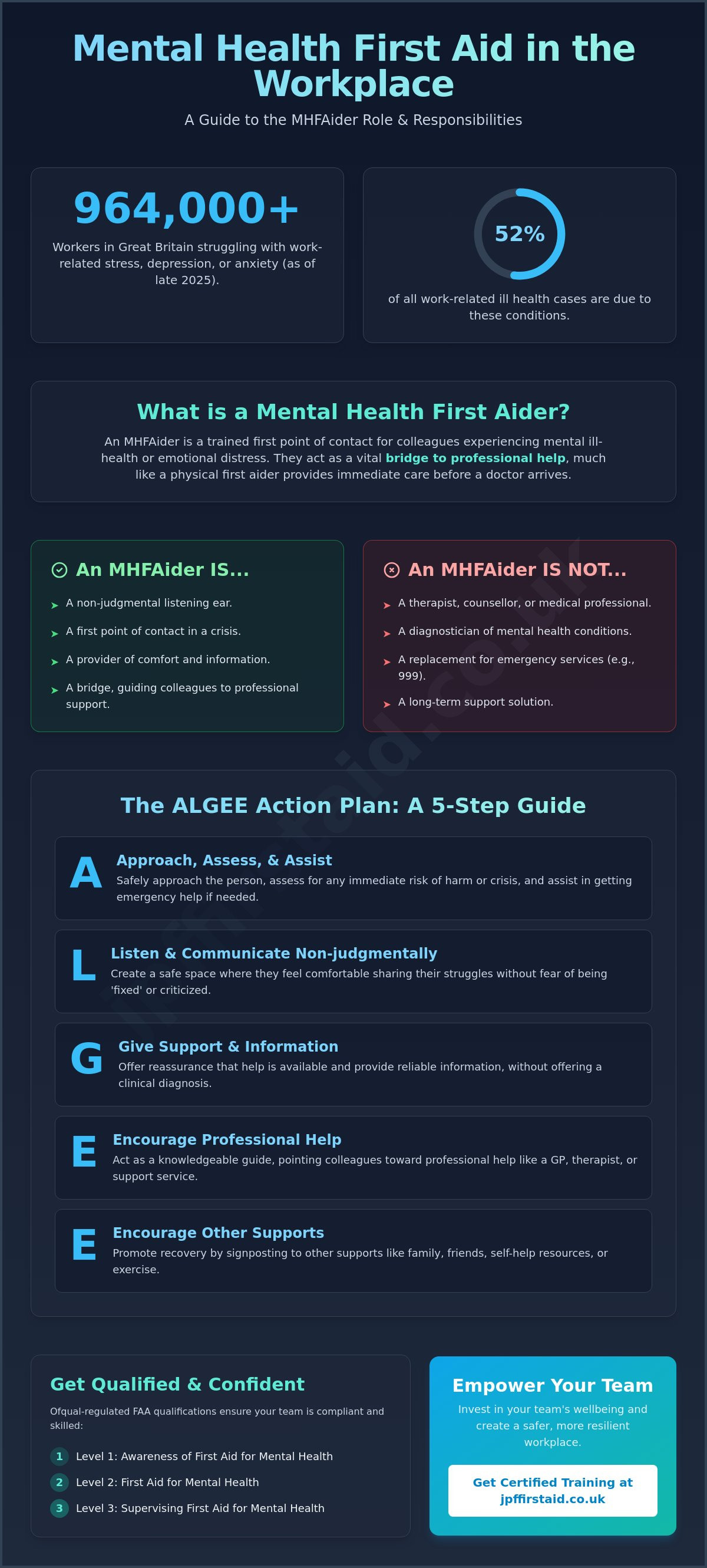
Did you know that over 964,000 workers in Great Britain are currently struggling with work-related stress, depression, or anxiety? According to data from late 2025, these conditions account for 52% of all work-related ill health cases. You likely feel a strong desire to help your teammates, but you might worry about saying the wrong thing or misunderstanding the mental health first aider role and responsibilities. It’s a common concern that often keeps well-meaning people from stepping forward, yet your support as a “bridge” to professional care has never been more vital.
This guide clears up the confusion so you can provide expert support while staying within your remit. You’ll discover how to use the ALGEE framework effectively, set healthy boundaries to protect your own wellbeing, and meet the legal expectations for a supportive workplace in 2026. We’ll show you how to implement this role with confidence, ensuring you feel like a capable mentor rather than an overwhelmed amateur. By the end of this article, you’ll have a clear path to fostering a safer, more resilient environment for everyone on your team.
Key Takeaways
- Learn how the mental health first aider role and responsibilities function as a vital bridge to professional care without crossing into clinical therapy or diagnosis.
- Discover how to apply the ALGEE framework as a structured, step-by-step guide for every mental health intervention in your workplace.
- Gain clarity on setting firm professional boundaries to ensure you provide safe support while protecting your own mental wellbeing.
- Find out how to select the most empathetic volunteers and create a supportive policy that empowers your internal first aid team.
- Explore Ofqual-regulated FAA Level 1, 2, and 3 qualifications to ensure your team remains compliant and confident in their skills.
What is a Mental Health First Aider (MHFAider)?
Think of a Mental Health First Aider as the psychological equivalent of a physical first aider. When someone trips and breaks an arm at work, you don’t expect the first aider to perform surgery; you expect them to provide immediate care, keep the person calm, and ensure they get to a hospital. The Mental Health First Aid philosophy follows this exact same logic. You are a trained individual who acts as a first point of contact for colleagues experiencing mental ill-health or emotional distress. Your job isn’t to diagnose or treat, but to offer a steady hand and a listening ear until professional help is reached.
In recent years, the presence of these roles has surged across UK workplace culture. This growth isn’t just about following a trend. It’s a response to a clear need for better support systems that reduce long-term sickness absence and help people feel seen. It’s vital to distinguish between an informal “wellbeing champion” and a certified MHFAider. While a champion might encourage healthy habits or organise yoga sessions, a certified aider has undergone rigorous training to handle crises. Understanding the mental health first aider role and responsibilities involves knowing how to spot early warning signs and, crucially, knowing where your boundaries lie.
The Core Purpose of the Role
The most critical objective is to preserve life. If a person is at risk of harming themselves or others, you are trained to step in and keep them safe until professional emergency services take over. Beyond these high-pressure moments, your daily purpose is to provide comfort. By intervening early, you can often prevent a mental health issue from escalating into something more severe. Finally, you promote recovery by signposting. You act as a knowledgeable guide, pointing colleagues toward professional medical help or self-help resources that fit their specific needs.
Why Organisations Need Certified MHFAiders
Modern businesses have a corporate social responsibility to look after their people. Fostering a supportive culture helps build trust and loyalty, but there is also a strong economic argument. Mental health-related staff turnover is expensive; losing and replacing a skilled employee costs significantly more than investing in their wellbeing. By aligning with HSE recommendations for workplace first aid needs assessments, you ensure your business is prepared for the modern world. Having staff trained in qualifications like First Aid for Mental Health (Level 2) or Supervising First Aid for Mental Health (Level 3) proves that you take these obligations seriously and are committed to a safe, resilient environment.
Core Responsibilities: The ALGEE Action Plan
When you step into this role, you don’t need to rely on guesswork. The ALGEE framework provides a clear, five-step roadmap for every interaction you have. It’s designed to keep you on track and ensure the person you’re supporting feels safe and heard. Understanding the mental health first aider role and responsibilities starts with mastering these steps. You begin by Approaching the person and assessing for any immediate risk of harm. If there’s a crisis, your priority is to assist them in getting emergency help. If the situation is less urgent, you move to the next vital phase.
Listening and communicating non-judgmentally is the foundation of trust. It’s about creating a space where someone feels comfortable sharing their struggles without fear of being “fixed” or criticized. This is a central part of the mental health first aider role and responsibilities. Once they’ve spoken, you Give support and information. You aren’t there to provide a clinical diagnosis; you’re there to offer reassurance that help is available. Finally, you Encourage professional help, such as a GP or counsellor, and Encourage other supports like family, friends, or exercise. Effectively implementing mental health first aid in the workplace means following this structure every time.
Identifying Early Warning Signs
You’ll often notice a need for support before a colleague even speaks up. Physical signs are frequently the first to appear. You might see a teammate who looks exhausted, has stopped taking care of their appearance, or mentions unexplained aches. Behavioural shifts are just as telling. Irritability, a sudden loss of concentration, or withdrawing from team lunches can all be red flags. When you notice these changes, approach them sensitively in a private setting. A simple, “I’ve noticed you haven’t been yourself lately, how are you doing?” can be the lifeline they need.
Non-Judgmental Listening Skills
Active listening is a skill that takes practice. It’s the difference between waiting for your turn to speak and truly absorbing what the other person is saying. Keep your body language open; avoid crossing your arms or looking at your watch. Use verbal cues like “I see” or “That sounds tough” to show you’re engaged. One of the biggest pitfalls to avoid is giving unsolicited advice. Your goal is to empower them to find their own way forward, not to tell them what to do. If you’re ready to build these practical skills, our First Aid for Mental Health (Level 2) course offers the hands-on training you need to feel confident.
Critical Boundaries: What an MHFAider is Not
You might feel a heavy sense of responsibility when you take on this position. It’s only natural to want to do as much as possible for a colleague in distress. However, the most vital part of the mental health first aider role and responsibilities is knowing where your help ends and professional intervention begins. You aren’t a therapist, a counsellor, or a psychiatrist. Your training gives you the tools to identify and support, but it doesn’t provide the clinical expertise required to treat complex conditions. Staying within these boundaries isn’t just about protecting yourself; it’s a legal and ethical necessity for the person you’re supporting.
Creating a “red line” prevents you from becoming a single point of failure for someone’s mental health. If a situation feels too heavy or exceeds your level of comfort, you have the absolute right to step back. You are a supportive peer, not a 24-hour crisis service. By maintaining these limits, you ensure that the help provided is safe and that you don’t experience burnout. Recognising these boundaries is a core component of the mental health first aider role and responsibilities, ensuring the “bridge” to professional care remains sturdy and reliable.
The “Not a Doctor” Rule
You should never suggest specific medications or psychological interventions, even if you’ve found them helpful personally. Recommending a certain antidepressant or a specific type of therapy can be dangerous; you don’t know the person’s full medical history. Over-helping often leads to dependency, where a colleague relies on you instead of seeking professional clinical care. The aider’s goal is to signpost, not to solve. Your success is measured by how effectively you guide someone toward the right expert, not by how many problems you fix yourself.
Confidentiality and its Limits
Trust is built on the promise of a safe space. When a colleague opens up, they need to know their private struggles won’t become office gossip. However, you must be transparent from the start about the limits of that privacy. If you believe there is an immediate risk of harm to their life or the lives of others, your legal obligation to safeguard takes priority over confidentiality. You must inform your designated lead or emergency services in these rare cases. When documenting these interactions, keep your notes factual and brief. Avoid including personal opinions or unnecessary details to stay compliant with GDPR and privacy standards. If you’re managing a team of first aiders, our Supervising First Aid for Mental Health (Level 3) course provides deeper insights into managing these complex ethical dilemmas.
Implementing the Role Within Your Organisation
Successful implementation starts with choosing the right people. When HR teams look for volunteers, the focus should be on natural empathy and emotional resilience. It isn’t just about finding someone who wants to help; it’s about finding individuals who can handle the weight of others’ struggles without taking that burden home. Clearly defining the mental health first aider role and responsibilities within your company policy ensures that both the aider and the organisation understand the boundaries of the position. This formal framework provides a safety net, giving your team the confidence to act when needed.
Visibility is the next step in reducing workplace stigma. If your staff don’t know who the aiders are, the program can’t succeed. Promote your MHFAiders through internal newsletters, office posters, or digital signatures. This normalises the conversation around mental health, making it as common as discussing physical safety. Integrating this support into your broader first aid courses strategy creates a holistic approach to employee care. It shows that your business values “whole person” safety, treating mental and physical health with equal importance.
Choosing and Supporting Your Volunteers
The role must always be voluntary. Mandating someone to become a mental health first aider through their job description is a recipe for burnout and ineffective support. Once you have your team, they need their own support system. Providing regular peer-support groups or professional supervision allows aiders to decompress after difficult interventions. Self-care for the aider is a non-negotiable part of the mental health first aider role and responsibilities. Without it, your volunteers risk vicarious trauma, which can be just as damaging as the primary stressor itself. We recommend setting up “debrief” sessions where aiders can talk through their feelings in a confidential, safe environment.
Reporting and Measuring Impact
You can’t manage what you don’t measure, but mental health data requires a delicate touch. Track the number of interventions and the types of issues raised, such as stress or anxiety, without ever recording names or identifying details. This data is gold for improving your workplace wellbeing initiatives. It helps you spot trends, like a spike in stress during certain projects, allowing for proactive changes. Keep your program current by reviewing and refreshing training every three years to stay compliant with 2026 standards. If you’re ready to empower your team with these skills, our Supervising First Aid for Mental Health (Level 3) course is the perfect next step for your managers.
Getting Qualified: FAA Level 1, 2, and 3 Courses
Choosing the right training is about more than just checking a box. To truly master the mental health first aider role and responsibilities, you need a qualification that is recognized and regulated. We provide Ofqual regulated FAA courses that ensure national compliance and give you the peace of mind that your training meets the highest industry standards. Whether you’re looking for a brief introduction or a deep dive into supervision, there’s a tiered path designed to fit your specific needs. These courses move beyond theory, giving you the practical confidence to act when it matters most.
Busy teams often struggle to find time for traditional classroom sessions. That’s why we offer flexibility through blended learning and distance options. You can complete parts of your theory online before joining us for interactive sessions. This approach makes the learning process manageable and ensures that essential skills are accessible to everyone, regardless of their schedule or location. Our goal is to make the journey toward certification as smooth and stress-free as possible.
Which Level is Right for You?
- Level 1 (Awareness of First Aid for Mental Health): This half-day course is ideal for building a baseline of empathy across your entire company. It helps staff recognize the signs of mental ill-health and understand how to start a conversation without feeling overwhelmed.
- Level 2 (First Aid for Mental Health): This is the standard requirement for anyone taking on the active MHFAider role. It covers a wider range of conditions and provides the practical tools needed to support colleagues effectively over a full day of training.
- Level 3 (Supervising First Aid for Mental Health): Essential for managers, HR professionals, or lead first aiders. It focuses on the mental health first aider role and responsibilities from a leadership perspective, including how to support other aiders and manage workplace policy over two days.
Why Train with JPF First Aid?
We believe that safety training shouldn’t feel dry or clinical. Our approach is fundamentally interactive and designed to build your confidence through practical scenarios and open discussion. We want you to leave our sessions feeling empowered, not just certified. As a multi-award-winning provider, our expert trainers bring deep knowledge and a personable touch to every session. We’re here to be your partner in creating a safer, more supportive workplace. Book your Mental Health First Aid course today to empower your workforce and take a proactive lead in employee wellbeing.
Building a Resilient Workplace Together
Supporting your team doesn’t have to be intimidating. By mastering the ALGEE framework and respecting clear boundaries, you transform from a concerned colleague into a capable “bridge” to professional care. You now know that the mental health first aider role and responsibilities are about providing immediate, non-judgmental support while protecting your own wellbeing through self-care. This structured approach ensures that every intervention is safe, effective, and sustainable for everyone involved.
Taking the next step is simple and rewarding. As a multi-award-winning training provider, we offer Ofqual regulated FAA qualifications that are both interactive and engaging. Whether you prefer in-person sessions or the flexibility of blended and distance learning, we have a solution tailored to your team’s busy schedule. Empower your team with a Mental Health First Aid course today and start making a tangible difference in your workplace culture. You already have the heart to help; let us provide the expert mentor support to ensure you do it with total confidence.
Frequently Asked Questions
What is the primary role of a Mental Health First Aider?
The primary role is to act as a first point of contact for anyone experiencing emotional distress or a mental health crisis. You are there to provide initial support and guide the person toward professional help rather than attempting to treat them yourself. Understanding the mental health first aider role and responsibilities means knowing how to listen non-judgmentally and use the ALGEE framework to keep someone safe until an expert takes over.
Is a Mental Health First Aider legally required in UK workplaces?
While not currently a standalone legal requirement in the same way as physical first aid, the Health and Safety Executive (HSE) recommends including mental health in your workplace first aid needs assessment. Employers have a legal duty of care to ensure a safe working environment. Failing to provide adequate support for mental ill-health can lead to complications regarding workplace safety and employee wellbeing.
How many Mental Health First Aiders should a business have?
There isn’t a fixed legal ratio, so you should base the number on your specific workplace risk assessment. Many organizations aim for a similar number of mental health first aiders as they have physical first aiders. If your workplace has high stress levels or remote teams, you might need more aiders to ensure everyone has easy access to support during their shift.
What is the difference between Level 2 and Level 3 Mental Health First Aid?
The Level 2 Award in First Aid for Mental Health is a one-day course designed for designated aiders who provide direct support. The Level 3 Award in Supervising First Aid for Mental Health is a more comprehensive two-day course. It’s tailored for managers or team leads who need to oversee the mental health first aider role and responsibilities across the entire business and manage internal policies.
Can a Mental Health First Aider be held liable for their advice?
You are generally not held liable as long as you stay within the boundaries of your training and follow your company’s policy. Your role is to support and signpost, not to provide clinical medical advice or a diagnosis. Most employers’ liability insurance covers trained first aiders who act in good faith and remain within the scope of their FAA qualification.
Does a Mental Health First Aid certificate expire?
Yes, FAA Level 1, 2, and 3 qualifications are valid for three years. Mental health legislation and workplace best practices change frequently, so a refresher course is essential to keep your skills sharp. Staying up to date ensures you remain a reliable and safe point of contact for your colleagues as new support strategies emerge in 2026.
How do I signpost someone to professional help?
Signposting involves providing clear information about professional resources like GPs, Employee Assistance Programmes (EAPs), or specialist charities. You don’t make the appointment for them, but you empower them with the contact details they need to take the next step. In an emergency, signposting means helping them access A&E or calling emergency services if there’s an immediate risk to life.
Recent Comments