

With a 2026 report finding that 90% of workplace incidents and near misses go unreported, the true risk to your business is likely much higher than your manager realizes. If you’re currently weighing the logistics of on-site vs public first aid courses, you aren’t just comparing schedules; you’re trying to protect your team from becoming another statistic. It’s natural to feel anxious about being responsible in an emergency without the right skills, especially when management seems more focused on budget cuts than safety.
We know it’s frustrating to feel unsupported when you’re trying to do the right thing for your colleagues. This guide is designed to help you build a bulletproof business case that turns first aid training from an optional expense into an essential investment. We’ll explore the 2026 implementation of the latest resuscitation guidelines, explain how to articulate the return on investment, and show you exactly how to prove that the cost of training is always lower than the cost of a single workplace accident.
Key Takeaways
- Understand how to define ‘adequate and appropriate’ first aid provision under UK law to ensure your workplace remains fully compliant.
- Learn how to frame safety training as a strategic investment in staff retention and psychological safety rather than just a line-item expense.
- Compare the logistical and financial benefits of on-site vs public first aid courses to find the most cost-effective solution for your team size.
- Follow a step-by-step strategy to audit your current equipment and identify training gaps that leave your business vulnerable.
- Discover how to pitch an interactive, award-winning training experience that overcomes management’s objections to boring or clinical corporate sessions.
Understanding the Legal and Moral Why Behind First Aid
The Health and Safety (First-Aid) Regulations 1981 require every UK employer to provide “adequate and appropriate” equipment, facilities, and personnel to ensure their employees receive immediate attention if they are injured or taken ill at work. While that sounds straightforward, the word “adequate” is intentionally flexible. It means your safety provision must scale with your specific risks. Whether you are choosing between on-site vs public first aid courses, your decision must be rooted in this legal obligation. Compliance isn’t a static box to tick; it’s a moving target that evolves as your workforce grows and your operational hazards change.
Beyond the law, there is a profound moral duty of care. This duty extends not just to your staff, but to visitors and contractors on your premises. When an accident occurs, the immediate response sets the tone for your entire corporate culture. If a team feels their employer hasn’t prioritised their physical safety, psychological safety suffers. Untreated or poorly managed injuries lead to long-term anxiety and a breakdown in trust. By mastering foundational first aid principles, your designated responders become a visible symbol of a supportive, capable workplace. This investment in human capital often pays dividends in staff loyalty and overall morale.
The HSE First Aid Needs Assessment
A formal needs assessment is the legal foundation for all training decisions. It’s the primary tool you’ll use to justify your training spend to management. You must consider specific workplace hazards, such as machinery or chemicals, alongside the health conditions of your specific employees. Proximity to emergency services is also vital. If your office is in a remote area or a congested city centre where ambulances might be delayed, your on-site skills need to be sharper. This assessment helps you decide if on-site vs public first aid courses better serve your specific risk profile and logistical needs.
Minimum Requirements vs. Best Practice
There is a significant gap between having an “Appointed Person” and a fully qualified Level 3 First Aider. An appointed person is simply someone who takes charge of first aid arrangements, like calling 999 or stocking the kit. They aren’t necessarily trained to save a life. In real-world multi-person incidents, the bare minimum often fails. Choosing First Aid Courses that exceed basic requirements provides a safety net that protects your business from litigation and your staff from harm. For a deeper dive into modern standards, see our Emergency First Aid at Work: The Complete 2026 Guide to Workplace Compliance.
Building the Business Case: The ROI of First Aid Training
When you walk into a budget meeting, the figures on your spreadsheet shouldn’t represent a loss. Instead, you’re presenting a strategy to protect your company’s most valuable asset: its people. Framing first aid training as an investment in human capital changes the conversation from “how much will this cost?” to “how much will this save?”. By weighing the benefits of on-site vs public first aid courses, you can demonstrate a commitment to efficiency that resonates with senior leadership.
Workplace injuries in the UK contribute to millions of lost working days every year. Beyond the immediate medical concern, a single accident triggers a cascade of hidden costs. You have to account for the sudden halt in productivity, the management time required for investigations, and the potential expense of hiring temporary cover. Companies with robust, visible safety records often find themselves in a stronger position when negotiating insurance premiums, as insurers recognise the reduced risk of significant claims. If you’re ready to build this foundation of safety, you can view our full list of courses to find the right fit for your team.
The impact on staff retention is equally measurable. Safety builds loyalty. When your team sees that you’ve invested in their ability to handle a crisis, it fosters a culture of psychological safety. Employees are more likely to stay with an organisation that clearly values their well-being, reducing the high costs associated with recruitment and onboarding new staff.
Reducing Workplace Absenteeism
Immediate first aid is often the difference between a minor incident and a long-term absence. Quick, competent intervention prevents small injuries from escalating into complications that keep staff away for weeks. This proactive approach should also include your team’s psychological health. Incorporating Mental Health First Aid allows your staff to spot signs of burnout or stress before they lead to extended leave. Industry data suggests that early intervention in the workplace can significantly reduce recovery times and keep your operations running smoothly.
Protecting Brand Reputation and CSR
Reputation is fragile. An accident that is poorly managed can lead to lasting PR damage and legal scrutiny. Conversely, being a “Safety-First” employer makes you a magnet for high-quality job candidates who prioritise responsible leadership. Demonstrating first aid readiness is a tangible way to prove your commitment to Corporate Social Responsibility (CSR). It shows that your business doesn’t just meet the bare legal minimum but actively cares about the welfare of the community and the individuals who make your success possible.
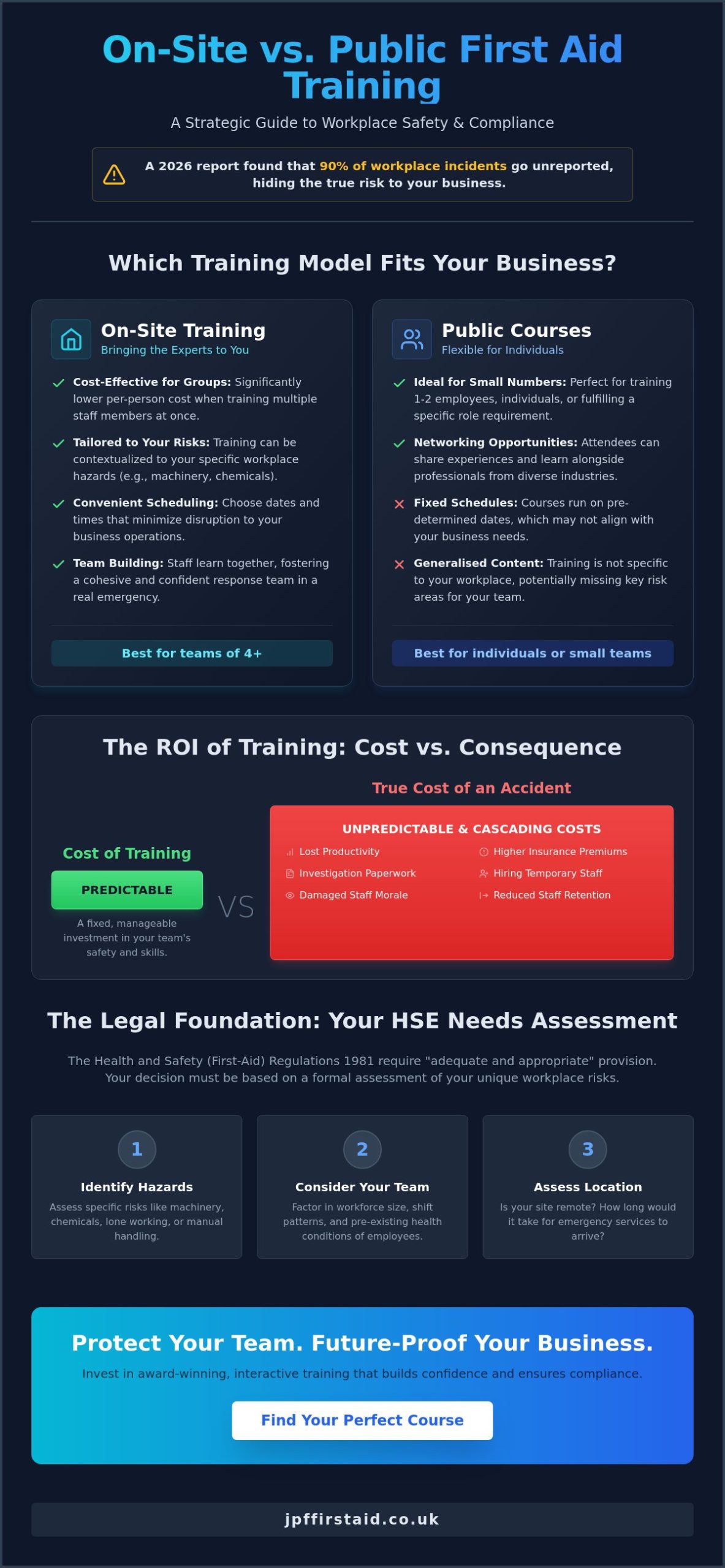
On-Site vs Public First Aid Courses: Which is Right for Your Business?
Choosing between on-site vs public first aid courses is one of the most practical decisions you’ll face when building your business case. It isn’t just a matter of checking a calendar; it’s about matching the delivery style to your company’s unique culture and logistical needs. While public courses offer a structured environment away from the office, bringing a trainer to your premises transforms the learning experience into a hands-on workshop that feels immediately relevant to your team’s daily reality.
From a financial perspective, the “per-head” cost savings for on-site training are often the strongest selling point for management. Most providers charge a flat daily rate for group bookings, meaning that as you fill the session toward the maximum capacity, your cost per person drops significantly. This eliminates the individual booking fees, travel expenses, and potential hotel costs associated with sending multiple staff members to a central training hub. It keeps your team on familiar ground, reducing the time they spend away from their core responsibilities.
Perhaps the most valuable advantage of training at your own facility is the ability to tailor scenarios to your specific workplace hazards. Instead of discussing generic accidents in a sterile classroom, your team can practice response techniques in the actual warehouse, kitchen, or office space where an emergency might occur. This context-specific training builds immense confidence, as learners aren’t just memorising theory; they’re physically navigating their own environment to provide care. This level of practical preparation is a powerful way to turn a standard certification into a life-saving asset.
When On-Site Training Wins
This model is ideal for groups of 6 to 12 delegates, allowing you to maximise the value of a flat-fee quote. It’s particularly effective when you want to synchronise your team’s skills, ensuring everyone follows the same protocols simultaneously. On-site sessions also allow for Basic Life Support Training that uses your own specific AED equipment. Practising with the exact devices you have mounted on your walls removes the hesitation often felt during a real emergency.
The Case for Public Courses
Public courses remain an excellent solution for small businesses that only need to train one or two people at a time. They’re the perfect choice for onboarding a single new starter or managing a lone certificate that is about to expire. These sessions provide a unique opportunity for your staff to network with professionals from other industries, sharing experiences and learning how different sectors approach safety. It’s a flexible way to maintain your legal compliance without the need to coordinate a full group session internally.
How to Pitch to Your Boss: A Step-by-Step Strategy
Securing approval for safety training requires more than just a request. You need a structured proposal that speaks the language of management: risk, reward, and resilience. By following a logical, five-step strategy, you can move the conversation from “optional extra” to “business necessity.” This approach ensures your manager understands the logistical trade-offs between on-site vs public first aid courses and why your chosen route is the most efficient use of the company budget.
Start by auditing your current first aid kits and checking for expired certificates. This data provides the evidence you need to prove a gap in your current safety net. Once you’ve identified these vulnerabilities through a formal needs assessment, you can select the specific solution that fits your risk profile, whether that’s an Emergency First Aid at Work (Level 3) course or a focus on Mental Health First Aid. Prepare a one-page executive summary that focuses on risk mitigation and cost efficiency. Finally, schedule a formal meeting to discuss workplace resilience rather than just “training.” If you need help identifying which course matches your audit findings, you can browse our full course list to find the perfect fit.
The 30-Second Elevator Pitch Script
If you’re caught in a brief moment with your manager, use a script that focuses on outcomes. Try saying: “I’ve noticed a way to significantly reduce our safety risk while meeting our 2026 compliance goals more efficiently. By updating our first aid training now, we can ensure we’re fully protected against potential ‘Fee for Intervention’ costs from the HSE.” This pitch works because it highlights a benefit to the manager while addressing a specific financial risk to the business.
Creating a Comparison Table for Your Proposal
Visual aids make your business case much harder to ignore. In your proposal, include a simple table that contrasts a “Do Nothing” scenario with your proposed training plan. Use rows to compare legal risk, impact on staff morale, and emergency response speed. This is also the best place to present the financial logic of your choice. If you’re suggesting a group booking, show how the flat-rate fee results in a significant per-head saving compared to individual bookings. This side-by-side view makes the logistical benefits of on-site vs public first aid courses clear, showing that your recommendation is the most responsible way to manage both safety and spend.
Why JPF First Aid is the Easiest Proposal to Approve
Management often hesitates to fund training because they’ve experienced dry, clinical sessions that feel like a box-ticking exercise. JPF First Aid changes that narrative. We offer an explicit promise: our learning process is enjoyable and interactive. By stripping away the intimidation factor, we ensure your team stays engaged. When you present your findings on on-site vs public first aid courses, the choice becomes clear when you factor in our mobile delivery. We bring the expertise to your doorstep, which immediately saves the company the mounting costs of travel and hotel stays for multiple staff members.
Choosing a training partner is about trust. As a multi-award-winning provider, JPF First Aid serves as a marker of reliability for your business case. We don’t just hand out certificates; we focus on psychological empowerment. Your colleagues won’t just leave with a formal credential; they’ll gain the genuine confidence to act during a crisis. This shift from theory to practical capability is what transforms a standard training day into a life-saving asset for your organisation. It’s a proactive approach that shows your manager you’re looking for a partner, not just a service provider.
Regulated Qualifications for Peace of Mind
For corporate compliance, nothing is more important than the validity of your certifications. Every course we lead, from Emergency First Aid At Work (Level 3) to Mental Health First Aid, provides Ofqual regulated qualifications. This ensures your business meets the strict standards of the Health and Safety (First-Aid) Regulations 1981 without any guesswork. Because you’re working with an independent, expert mentor like John Fogarty, you receive a level of quality assurance that larger, more clinical providers often lack. We handle the bulk of the paperwork and tracking, which significantly reduces the administrative burden on your management team. This ease of process makes the proposal even more attractive to a busy boss.
Taking the Next Step
Building a bulletproof business case is about showing that “adequate” provision is a living commitment to safety. Whether your audit suggests on-site vs public first aid courses, the goal is to create a resilient workplace where every person feels protected. You’ve identified the gap and found the solution; now it’s time to finalise the numbers. We’re here to help you cross the finish line with a proposal that’s impossible to ignore. Ready to build your case? Get a bespoke quote for your workplace today and take the first step toward a safer, more confident team.
Secure Your Workplace’s Future Today
You now have the tools to transform a safety requirement into a powerful business investment. By highlighting the legal obligations and the clear return on investment, you can present a proposal that focuses on resilience and staff retention. Whether your needs assessment points you toward on-site vs public first aid courses, the goal remains the same: ensuring every member of your team feels capable and supported in a crisis.
Choosing JPF First Aid means partnering with a multi-award-winning training provider that delivers Ofqual regulated qualifications in an interactive and enjoyable learning environment. We don’t just provide a certificate; we build the genuine confidence that saves lives. It’s time to move from planning to action and protect your colleagues from the risks of the modern workplace. You’ve done the hard work of building the case. Now, let’s make sure your team is in safe, expert hands.
Ready to turn your business case into reality? Request a private group training quote for your team and let us help you create a safer, more empowered workplace today.
Common Questions About Workplace First Aid Training
Does my employer legally have to pay for first aid training?
Yes, your employer is responsible for all costs associated with meeting their health and safety obligations. Under the Health and Safety (First-Aid) Regulations 1981, businesses must provide adequate personnel to handle emergencies. This means the company should cover the course fees and any travel expenses, ensuring you aren’t out of pocket for mandatory workplace safety skills.
How many first aiders does a workplace need in 2026?
The number of first aiders you need depends entirely on your specific needs assessment rather than a single fixed ratio. For a low-risk office with fewer than 50 employees, at least one person trained in Emergency First Aid at Work is usually sufficient. In higher-risk environments or larger organisations, the HSE suggests one fully qualified first aider for every 20 or 50 people, depending on the hazard level.
Can first aid training be done entirely online?
No, 100% online courses don’t meet the HSE requirements for workplace compliance because they lack a practical, hands-on assessment. While you can learn theory through digital modules, you must demonstrate skills like CPR and wound dressing in person to be certified. This is a vital consideration when choosing on-site vs public first aid courses, as both provide the necessary face-to-face expert guidance.
What happens if an employer refuses to fund first aid training?
An employer who refuses to provide adequate first aid coverage is in breach of their legal duty of care. This leaves the business vulnerable to HSE inspections, substantial fines, and “Fee for Intervention” costs. If an accident occurs and no trained staff are available, the company faces significant legal liability and potential compensation claims that far outweigh the cost of a training session.
Is Mental Health First Aid a legal requirement in the UK?
While not yet a standalone legislative requirement, HSE guidance explicitly states that employers should consider mental health alongside physical health in their needs assessments. By providing Mental Health First Aid training, your employer demonstrates they are taking their duty of care seriously. It’s a proactive way to manage workplace stress and support overall staff wellbeing before it leads to long-term absenteeism.
How long does a workplace first aid certificate last?
Standard workplace first aid certificates, such as EFAW and FAW, are valid for three years. After this period, you must complete a re-qualification course to maintain your status as a recognised first aider. The HSE also strongly recommends attending an annual half-day refresher session to ensure your life-saving skills and confidence remain sharp between full certifications.
What is the difference between EFAW and FAW?
Emergency First Aid at Work (EFAW) is a one-day course focusing on life-saving skills for low-risk environments. First Aid at Work (FAW) is a comprehensive three-day qualification that covers a much broader range of medical conditions and injuries. When comparing on-site vs public first aid courses, your decision should reflect whether your workplace hazards require the basic EFAW syllabus or the advanced FAW training.
Can I be sued if I give first aid at work and it goes wrong?
It’s incredibly rare for a first aider to be sued in the UK when acting in good faith. As long as you provide care within the scope of your training, your employer’s liability insurance typically covers your actions. The law protects those who step up to help, and your organisation is responsible for the first aid provision they have put in place.
Recent Comments