

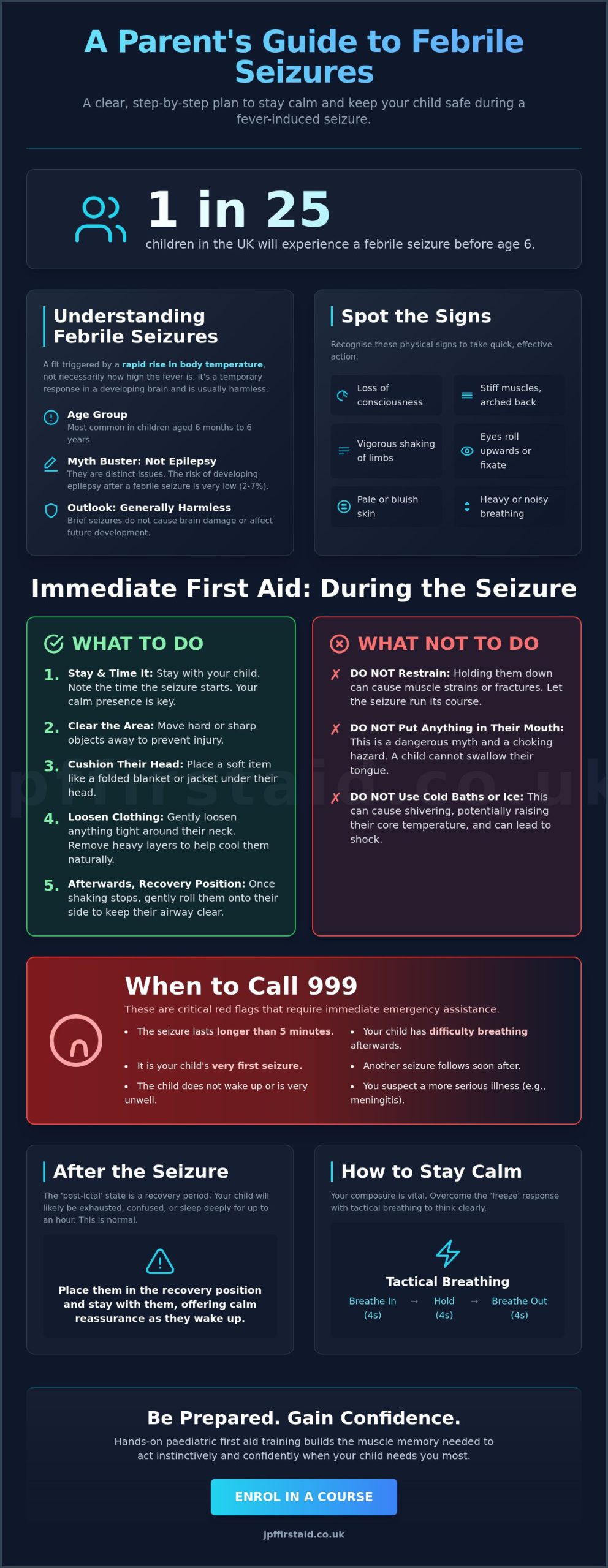
Did you know that 1 in 25 children in the UK will experience at least one febrile seizure before their sixth birthday? Watching your child’s body stiffen and shake while their fever spikes is one of the most terrifying moments you can face as a parent. It’s natural to feel a surge of panic or fear that your little one is suffering permanent brain damage. However, mastering the correct first aid for febrile seizures is the most powerful tool you have to stay grounded and act effectively during those critical minutes.
We know how helpless it feels when you aren’t sure if you’re doing the right thing. This guide is designed to replace that anxiety with a clear, structured plan to keep your child safe and help you maintain control. You’ll learn how to recognise the immediate signs of a seizure, the exact physical steps to take during the fit, and when it’s essential to call 999 for an ambulance. We’ll provide the expert knowledge you need to transform from a worried bystander into a calm, capable protector for your family.
Key Takeaways
- Learn why these seizures happen in children aged 6 months to 6 years and how to spot the early warning signs of a fever-induced fit.
- Master a simple, step-by-step protocol for first aid for febrile seizures to keep your child safe and protected from injury during an episode.
- Understand the ‘Five-Minute Rule’ and other critical red flags that signal when you must call 999 for emergency assistance.
- Discover practical mental techniques like tactical breathing to override the ‘freeze’ response and maintain your composure in a high-pressure situation.
- Explore how hands-on paediatric training builds the muscle memory needed to act instinctively and confidently when your child needs you most.
Understanding Febrile Seizures: Why They Happen and What to Look For
A febrile seizure is a fit triggered by a rapid rise in body temperature. It isn’t necessarily about how high the fever goes, but how quickly it climbs. Most often, these occur during common childhood illnesses like ear infections, tonsillitis, or the flu. For a parent, seeing this for the first time is overwhelming, but understanding the biological trigger is the first step toward staying calm and prepared.
These episodes are most common in children aged between 6 months and 6 years. During this window, a child’s brain is still developing and is more sensitive to the electrical disruptions caused by a sudden fever. This Febrile seizure overview explains that while the experience is intense, it’s a temporary physiological response rather than a permanent condition. About 1 in 25 children in the UK will experience at least one of these seizures, so you aren’t alone in facing this challenge.
One of the biggest fears parents face is a potential link to epilepsy. It’s a common myth that one leads to the other, but they are distinct issues. Febrile seizures are specifically heat-related. While approximately one-third of children who have one will have another during childhood, the risk of developing epilepsy remains very low, typically between 2% and 7%. Learning the correct first aid for febrile seizures ensures you can manage these episodes safely at home and protect your child’s wellbeing.
Spotting the Signs in Your Child
You need to recognise the physical signs quickly to take action. Your child might suddenly lose consciousness and fall if they’re standing. Their muscles often stiffen, causing their back to arch and their fists to clench. You might see their eyes roll upwards or fixedly to one side. Their breathing may become heavy, and you might notice their skin turning pale or bluish, especially around the mouth. Vigorous shaking or twitching of the limbs is the most recognisable sign that a seizure is occurring.
The Duration and Aftermath
Most simple febrile seizures are brief, lasting under five minutes, and often concluding within 2 to 3 minutes. After the twitching stops, your child will likely be exhausted. This ‘post-ictal’ state is a recovery period where they might sleep deeply or seem very confused and “out of it” for up to an hour. While these episodes are frightening to witness, short seizures are generally harmless and don’t cause lasting damage to your child’s brain or future development.
Immediate First Aid Steps: What to Do During a Seizure
When a seizure starts, your primary goal is safety. It feels like time slows down, but your actions matter immensely. Stay with your child throughout the entire episode. Don’t leave them alone to find help; shout for someone else in the house if you need assistance. Your presence is the first step in managing the situation effectively.
Start by clearing the immediate area of any hazards. Move coffee tables, toys, or hard objects that could cause an injury if your child knocks against them. This is a core part of first aid for febrile seizures. Once the area is safe, look at a clock or start a timer on your phone. Knowing exactly how long the fit lasts helps paramedics or doctors decide on the next clinical steps. A precise time is much more useful to medical staff than a “rough guess” made during a moment of high stress.
While the seizure is happening, gently loosen any tight clothing around their neck. If they’re wearing a heavy jumper or wrapped in a thick blanket, remove these layers. Helping their body cool down naturally is much safer than using cold water or ice. If you want to feel truly prepared for these moments, attending paediatric first aid training can give you the hands-on practice needed to act without hesitation and protect your child’s safety.
Protecting Without Restraining
You might feel a desperate urge to hold your child still to stop the shaking. Don’t. Restraining a child during a seizure can lead to muscle strains or even bone fractures because their muscles are contracting with significant force. Instead, place something soft like a folded blanket or a small pillow under their head to prevent it from hitting the floor. Ensure the room has plenty of fresh air by opening a nearby window. This helps keep the environment comfortable as their body works through the episode.
The ‘Don’ts’ of Febrile Seizure First Aid
There are several common myths that can be dangerous if followed. Never put anything in your child’s mouth. They won’t swallow their tongue, but they could easily choke on an object or break their teeth if you try to force their jaw open. Avoid giving any fluids, including water or medicine, while they’re unconscious or seizing. This poses a serious choking risk. Finally, don’t put them in a cold bath or use ice packs. Sudden “shocks” to the system can be harmful. Stick to removing outer clothing and keeping the room at a steady, cool temperature.
When to Call 999: Identifying Emergency Red Flags
Most febrile seizures end within a couple of minutes and don’t require an ambulance. However, you must recognize the specific moments when professional medical help becomes non-negotiable. If this is your child’s first ever seizure, you should dial 999 immediately. Even if the fit seems to have ended by the time you reach the phone, paramedics need to check that the fever isn’t caused by something more serious, such as meningitis.
The ‘Five-Minute Rule’ is your most important guideline during the episode. If the seizure lasts longer than five minutes, it’s considered a medical emergency. You should also call for help if your child has more than one seizure in a 24-hour period or if they don’t seem to be recovering properly afterwards. Watch for breathing issues; if their breath is shallow, irregular, or if their lips stay blue after the shaking stops, get help straight away. Knowing when to escalate your first aid for febrile seizures is just as vital as knowing how to handle the fit itself.
The Recovery Position for Children
Once the shaking stops, your child will likely be very drowsy or unconscious. This is the time to put them into the recovery position. Place them on their side and tilt their head back slightly to keep the airway open. This position prevents them from choking if they vomit and allows their tongue to fall forward. Stay with them and keep talking to them, even if they don’t respond. If you’ve completed basic life support training, use those skills to check their breathing and pulse every minute until the ambulance crew takes over.
Communicating with Emergency Dispatchers
When you call 999, the dispatcher will ask for specific details to help the crew prepare. You can stay focused by using the LIONEL method. Tell them your exact Location first. Then explain the Incident, mentioning that you’re providing first aid for febrile seizures for a child. Detail the Number of people involved and the Extent of the situation, such as the exact duration of the seizure and if the child is currently breathing. Finally, confirm your Location one last time.
Don’t hang up the phone. The dispatcher will stay on the line to talk you through What to do during a febrile seizure until the crew arrives. They are trained to keep you calm and will provide instructions based on your child’s current symptoms. Having your timer or phone log ready with the exact duration of the seizure will help the paramedics provide the best possible care when they arrive at your door.
Overcoming Panic: Staying Calm While Helping Your Child
Seeing your child have a fit is a visceral, terrifying experience. Your brain is hardwired to protect them, but in a crisis, this can lead to what psychologists call an ‘Amygdala Hijack’. This is when the emotional centre of your brain takes over, temporarily shutting down your ability to think logically. If you’ve ever felt yourself freeze or your mind go blank during an emergency, this is why. Understanding that this is a natural biological response helps you move past the guilt of feeling helpless and focus on the first aid for febrile seizures that your child needs.
The most effective way to break this freeze response is through tactical breathing. Use the 4-7-8 method: inhale deeply through your nose for four seconds, hold that breath for seven seconds, and exhale slowly through your mouth for eight seconds. This simple act sends a physical signal to your nervous system that you are safe, allowing your logical brain to come back online. Instead of worrying about the “what ifs” or the long-term outcome, focus entirely on the ‘next right step’. Whether that’s moving a chair or looking at your watch, small actions build the momentum you need to stay in control.
Grounding Techniques for the Responder
If you feel the panic rising again, use the 5-4-3-2-1 grounding technique to anchor yourself in the room. Identify five things you can see, four you can touch, three you can hear, two you can smell, and one you can taste. Another powerful tool is narrating your actions out loud. Saying “I am clearing the floor” or “I am loosening his collar” keeps your mind focused on the present task. Remember that providing ‘imperfect help’ is infinitely better than doing nothing at all. Your child doesn’t need a perfect medical professional; they need a parent who is present and acting on their behalf.
The Good Samaritan Principle in the UK
Many parents worry about doing the wrong thing or facing legal consequences for their actions. In the UK, you are protected by the ‘Good Samaritan’ principle. This means that as long as you act in good faith and to the best of your ability, you are not legally liable for trying to help. This protection is a cornerstone of emergency first aid at work and community care. Knowing you are legally safe allows you to act with more confidence during those high-pressure minutes.
The aftermath of a seizure can be just as difficult for the parent as the event itself. It’s common to experience a ‘come down’ of adrenaline, leaving you feeling shaky or anxious for days. Recognising the impact on your own wellbeing is vital, and many find that learning about mental health first aid helps them process the trauma of the event. If you want to replace your fear with certainty, the best step is to book a paediatric first aid course where you can practice these skills in a safe, supportive environment.
Building Confidence Through Paediatric First Aid Training
Reading about how to help your child is an excellent starting point, but there’s a significant difference between theoretical knowledge and practical action. While you now understand the steps for first aid for febrile seizures, your body needs to learn the movements to ensure you don’t hesitate when it counts. Hands-on training transforms information into instinct. By physically placing a manikin in the recovery position or timing a simulated seizure, you build the muscle memory required to override the natural ‘freeze’ response. This physical repetition is what allows you to act decisively while others might be standing still in shock.
This practical experience provides a level of psychological peace of mind that an article simply can’t match. Holding a regulated qualification means you’ve been assessed by experts and found competent to save a life. It changes your internal narrative from “I hope I remember what to do” to “I know exactly how to handle this.” To keep these skills sharp, we recommend regular refresher sessions. Life-saving techniques can fade if they aren’t practiced; keeping them ‘front of mind’ ensures you’re always ready for the unexpected, no matter how much time has passed since your last course.
Choosing the Right Paediatric Course
When you look for training, it’s vital to choose a programme that meets high standards. A basic awareness session might give you the gist, but an Ofqual-regulated paediatric first aid course Cannock provides a much deeper level of competence. In a JPF First Aid session, we focus on making the experience interactive and stress-free. We don’t believe in dry, clinical lectures. Instead, we use practical scenarios to prepare you for real-world emergencies. A full 12-hour course covers a wide range of topics, including choking, CPR, and head injuries, ensuring you have a complete toolkit for child safety.
The Long-term Benefit of Preparedness
Investing time in first aid training moves you from a state of anxious awareness to one of calm capability. You become a reliable anchor for your family, friends, or colleagues. In a school or nursery setting, this training is even more critical. As of September 1, 2025, the EYFS framework requires anyone counted in the staff-to-child ratio to hold a valid Paediatric First Aid certificate. Whether you’re a parent or a professional, knowing you’re ‘the one who knows what to do’ is incredibly empowering. Don’t wait for an emergency to happen before you decide to learn. Join a course today and transform your fear into the confidence your child deserves.
Take Control of Your Child’s Safety Today
Witnessing a seizure is a life-changing moment for any parent. By now, you understand that while these episodes are frightening, they are usually a brief physiological reaction to fever. You’ve learned the essential physical steps for first aid for febrile seizures, including the importance of timing the fit and protecting your child’s head without using restraint. Most importantly, you now have the mental tools to override panic and recognise the red flags that require a 999 call.
Knowledge is a great foundation, but nothing replaces the confidence gained from hands-on practice. As a multi-award-winning training provider, we offer Ofqual regulated qualifications delivered by our expert instructor, John Fogarty. Our sessions are designed to be interactive and welcoming, ensuring you leave feeling empowered rather than overwhelmed. You don’t have to wait for an emergency to find out if you’re ready; you can choose to be prepared right now.
Book a Paediatric First Aid Course and Build Your Confidence Today. Taking this step ensures you are always the calmest person in the room when your family needs you most.
Frequently Asked Questions
Can a febrile seizure cause permanent brain damage?
Simple febrile seizures do not cause permanent brain damage or affect a child’s future intelligence. While the sight of a fit is distressing, the brain’s electrical activity returns to its normal state once the fever-induced trigger passes. Only extremely rare and prolonged seizures, typically those lasting over 30 minutes, carry a risk of injury, which is why following the five-minute rule for emergency help is so vital.
Should I give my child paracetamol during a seizure?
Never attempt to give paracetamol, ibuprofen, or any fluids while your child is actively fitting or unconscious. This creates a severe choking hazard because your child cannot swallow or protect their airway during an episode. You can use liquid medicine to help manage their temperature once they are fully awake and alert, but remember that research shows these medications don’t actually prevent a seizure from occurring.
What is the very first thing I should do if my child starts fitting?
The very first step is to stay with your child and start timing the episode immediately. Look at a clock or use the stopwatch on your phone, as the exact duration is the most important information you can give to a doctor. Once you’ve started the timer, focus on the immediate environment by moving hard objects out of the way to ensure your child doesn’t hurt themselves while shaking.
Can I be sued in the UK for giving first aid to a child?
You cannot be successfully sued in the UK for providing first aid in good faith during an emergency. The law protects individuals who act reasonably to help others, especially in life-threatening situations. Following a recognised plan for first aid for febrile seizures ensures you are acting in the child’s best interest, which keeps you firmly under the protection of the Good Samaritan principle.
Is a febrile seizure a sign that my child has epilepsy?
A febrile seizure is not a sign of epilepsy and most children who experience one will never develop a long-term seizure disorder. These fits are specifically triggered by a rapid rise in body temperature in a developing nervous system. While 1 in 25 children in the UK will have a febrile seizure, the risk of developing epilepsy only sits between 2% and 7%, which is only slightly higher than the general population.
How do I stop my own hands from shaking so I can help?
Use tactical breathing to steady your hands and regain your focus during the crisis. Inhale deeply for four seconds, hold for seven, and exhale slowly for eight to force your nervous system out of a panic response. Narrating your actions out loud, such as saying “I am clearing the floor now,” also helps ground you in the moment and allows your logical brain to take over from your fear.
What if I don’t have a mobile signal to call 999?
Try calling 999 anyway because emergency calls in the UK are designed to roam onto any available network, even if your own provider has no signal. If the call still won’t connect, use a landline or shout for a neighbour to help. You can also try dialling 112, which is the international emergency number and works identically to 999 on all UK handsets and networks.
How long does it take for a child to wake up after a febrile seizure?
It can take up to an hour for a child to become fully alert again after the shaking stops. This period of drowsiness or confusion is a normal recovery phase called the post-ictal state. During this time, your main task is to keep them in the recovery position and monitor their breathing. They will likely be exhausted and may fall into a deep, heavy sleep as their body recovers.
Recent Comments