
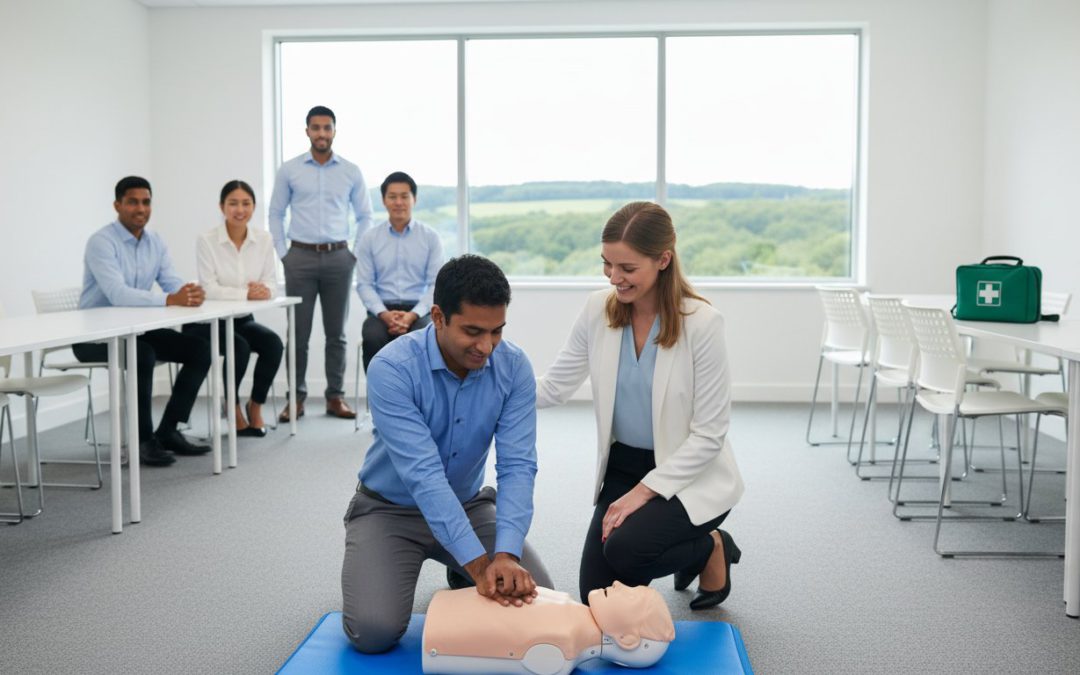
Imagine it’s a busy Monday morning in your office when a colleague suddenly collapses. You have exactly 180 seconds to react before the situation becomes critical. You likely know that having a qualified first aider isn’t just a “nice to have”; it’s a legal requirement under the Health and Safety (First-Aid) Regulations 1981. However, since 65% of workplace learners admit to worrying about the final assessment, you might feel hesitant about booking a 3 day first aid course that feels dry or overly academic.
We’re here to change that perspective. This guide will show you how to master the life-saving skills and regulatory knowledge needed to become a fully qualified workplace first aider with absolute confidence. We’ll walk you through the 2026 Level 3 certification requirements, the practical assessment process, and how to ensure your business remains 100% HSE compliant through training that is actually engaging and hands-on. By the end of this article, you’ll know exactly how to transform a legal obligation into a vital team skill.
Key Takeaways
- Understand the legal framework of the Health and Safety (First-Aid) Regulations 1981 to ensure your business meets its mandatory safety obligations.
- Master essential life-saving skills, including the primary survey and casualty management, during our comprehensive 3 day first aid course.
- Determine the right level of cover for your team by evaluating your “First Aid Needs Assessment” results against HSE standards.
- Prepare for your practical and theory assessments with confidence by knowing exactly what to wear and what to expect on the day.
- Learn why professional training should be engaging and fun, moving away from dry, clinical sessions toward a more relaxed and memorable experience.
What is a 3 Day First Aid Course and Why is it the Gold Standard?
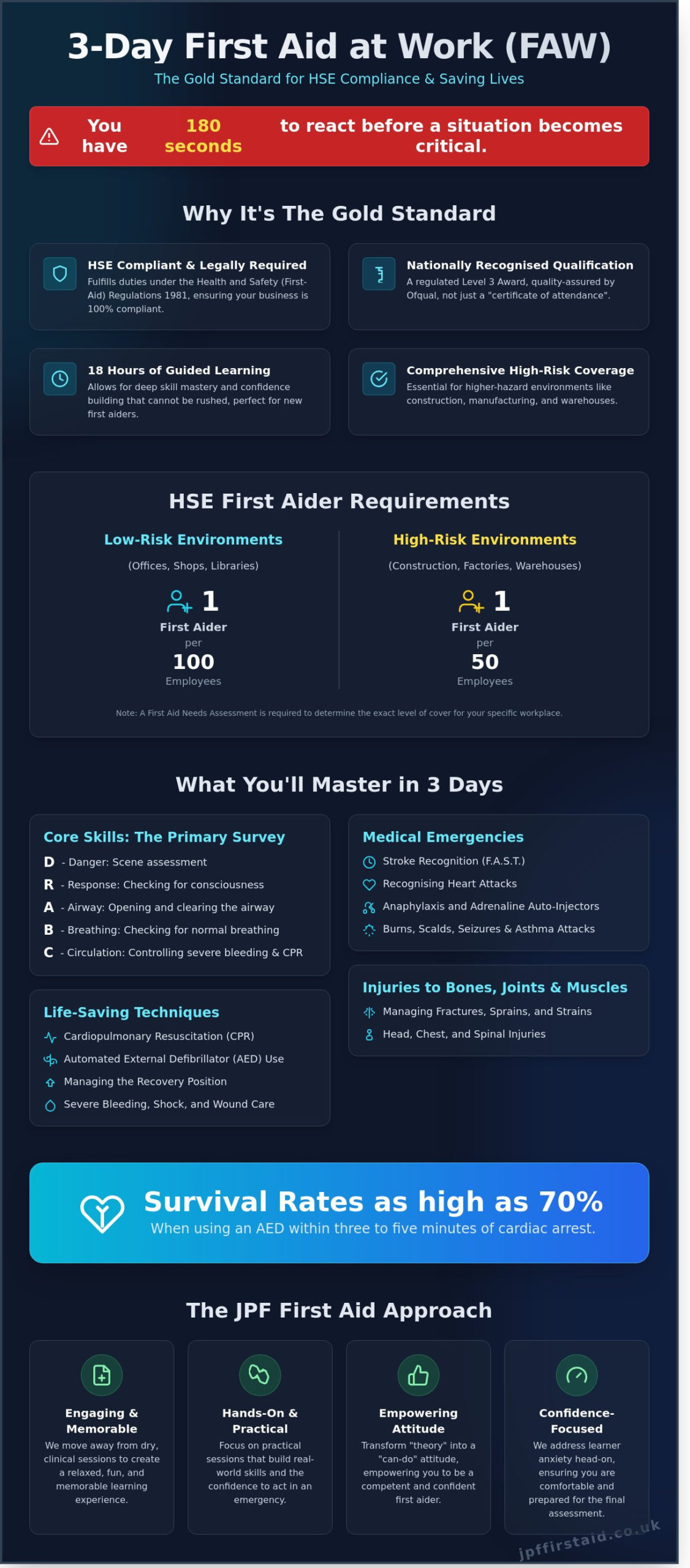
Choosing the right training for your team is a significant responsibility that impacts everyone’s safety. The 3 day first aid course, formally known as the Level 3 First Aid at Work (FAW) qualification, represents the highest tier of workplace first aid training. It’s built specifically to comply with the Health and Safety (First-Aid) Regulations 1981, which mandate that employers provide “adequate and appropriate” equipment and personnel to help injured staff. While shorter courses exist, this three-day programme provides 18 hours of guided learning, allowing for deep skill mastery that simply cannot be rushed.
There’s a vital distinction between a basic “certificate of attendance” and a regulated qualification. JPF First Aid delivers regulated training, meaning your certification is nationally recognised and quality-assured. This ensures that your first aiders don’t just sit through a presentation; they demonstrate genuine competence in life-saving techniques. We focus on building your confidence through practical sessions, transforming “theory” into a “can-do” attitude that’s essential during a real emergency.
The Legal Requirement for UK Workplaces
Your statutory duty as an employer in 2026 is defined by your specific workplace risk assessment. For many organisations, having a staff member with a 3 day first aid course qualification isn’t just a recommendation; it’s a legal necessity. According to HSE guidance (L74), businesses with more than 50 employees in low-risk environments, such as large offices, require at least one full FAW-trained person. Ofqual oversees these standards to ensure the training is consistent across the UK, protecting you from liability and, most importantly, protecting your people.
- Low-risk (Offices/Shops): 1 first aider per 100 employees.
- High-risk (Factories/Construction): 1 first aider per 50 employees.
- Small businesses: At least one “Appointed Person” regardless of size.
Who Should Attend the Full 3-Day Programme?
This course is the ideal choice for anyone working in higher-hazard environments. If your workplace involves machinery, warehouse heights, or chemical processing, the risks are significantly higher than a standard retail unit. In 2023, the manufacturing and construction sectors accounted for a high percentage of workplace injuries, making comprehensive training a vital investment. It’s also the perfect entry point for “new” first aiders. The extended timeframe allows fresh learners to absorb complex information at a relaxed pace, ensuring they leave the session feeling empowered rather than overwhelmed.
The Full Curriculum: What Skills Will You Master in 72 Hours?
Over the course of three days, you’ll transform from a bystander into a confident first responder. This 18-hour guided learning experience focuses on the 3 day first aid course syllabus mandated by the Health and Safety Executive (HSE). We begin with the Primary Survey, using the DR ABC acronym. You’ll learn to systematically check for Danger, Response, Airway, Breathing, and Circulation. This logical approach keeps you calm when adrenaline is high, ensuring you prioritise life-saving actions in the correct order.
You’ll gain hands-on experience managing unconscious casualties and mastering the recovery position to keep airways clear. We dedicate significant time to Cardiopulmonary Resuscitation (CPR) and the use of an Automated External Defibrillator (AED). According to the British Heart Foundation, there are over 30,000 out-of-hospital cardiac arrests in the UK annually. Using an AED within three to five minutes of collapse can produce survival rates as high as 70%. You’ll leave the classroom knowing exactly how to operate one.
Major trauma requires decisive action. You’ll practice applying pressure and dressings to severe wounds to prevent catastrophic blood loss. We also cover the recognition of shock and the immediate care required for head injuries, where early intervention can prevent long-term neurological damage.
Managing Medical Emergencies and Chronic Conditions
We demystify complex medical crises so you can act fast. You’ll learn to spot the early signs of a heart attack and use the FAST (Face, Arms, Speech, Time) test to identify a stroke. The curriculum covers the administration of adrenaline auto-injectors for anaphylaxis and how to support someone during a seizure or asthma attack. For burns and scalds, we teach the “Cool, Call, Cover” protocol, which can reduce the severity of tissue damage by up to 50% if applied immediately.
Bones, Joints, and Muscle Injuries
Workplace injuries often involve the musculoskeletal system. You’ll learn to identify fractures and dislocations, focusing on immobilisation to prevent further pain. We spend time on the practical application of various slings and support bandages for different limbs. You’ll also learn to manage sprains and strains effectively, which helps reduce employee recovery time. If you want to ensure your team is prepared for these common incidents, you can view our upcoming course dates to find a session that fits your schedule.
The training concludes with a focus on spinal injury management. You’ll learn how to keep a casualty’s neck aligned while waiting for paramedics, a skill that is vital in construction or warehouse environments where falls from height are a risk. By the end of day three, these technical skills will feel like second nature.
1-Day vs 3-Day First Aid: Which Qualification Do You Need?
Deciding between a 1-day and a 3-day course isn’t just about how much time you can spare. It’s about meeting your legal obligations under the Health and Safety (First-Aid) Regulations 1981. If you run a small retail unit with five employees, the 1-day Emergency First Aid at Work (EFAW) qualification usually covers your basic needs. It focuses on life-saving skills for immediate incidents. However, for many businesses nationwide, the 3 day first aid course is the essential benchmark for safety and compliance.
You must conduct a “First Aid Needs Assessment” to decide. This isn’t a suggestion; it’s a requirement. If you choose the wrong level of training, you risk more than just HSE non-compliance. You risk having a staff member who lacks the confidence to handle a serious diabetic shock or a crush injury. The financial implications of a workplace accident where first aid was deemed “inadequate” can lead to significant legal costs and increased insurance premiums. Getting it right the first time is the only way to protect your team and your business.
The High-Risk Workplace Checklist
Your risk profile determines your training path. Low-risk environments like offices or shops often find the EFAW sufficient. However, you must opt for the full 3-day qualification if your answer is “yes” to any of the following:
- Does your work involve dangerous machinery, sharp tools, or hazardous chemicals?
- Are you working in a remote location where an ambulance might take longer than 10 minutes to arrive?
- Do you have employees with known pre-existing medical conditions like heart disease or severe allergies?
Certification Validity and Requalification
Every workplace first aid certificate has a hard expiry date of 36 months from the day of issue. Once that three-year window closes, your qualification is no longer valid for HSE purposes. To stay compliant without repeating the full 3 day first aid course, you can take a 2-day requalification course. This saves your business 33% in training time, provided you renew before the original certificate expires. We also strongly recommend a 6-hour annual refresher. This prevents “skill fade” and ensures your first aiders remain calm and capable when it matters most.
Preparing for Your Training: How to Get the Most Out of the Experience
Attending a 3 day first aid course doesn’t have to feel like a return to a stiff school environment. We’ve designed our Birmingham training sessions to be relaxed, inclusive, and supportive. To get the most out of your time, wear comfortable, practical clothing. You’ll spend roughly 70% of the course on the floor practising CPR techniques or recovery positions, so trousers and flat shoes are much more suitable than formal office wear. If you have any physical limitations or injuries, just let us know. We’ve successfully adapted training for 100% of our learners with mobility concerns to ensure they still meet the required assessment criteria comfortably.
Many people feel a flicker of anxiety when they hear the word “assessment.” There’s no need for nerves here. Our trainers act as mentors rather than strict examiners. The assessment is a continuous process throughout the three days, involving practical demonstrations and a straightforward multiple-choice paper. We focus on building your confidence so that by the final afternoon, acting in an emergency feels like a natural response rather than a memory test. Our goal is to ensure you leave feeling capable, not just certified.
The Practical Nature of the Course
You won’t spend your days staring at a PowerPoint presentation. We use high-quality manikins and realistic role-play scenarios to simulate actual workplace incidents. This hands-on approach is why 98% of our students report feeling “very confident” to act after finishing their training. We create a safe space where it’s okay to make mistakes while you learn. This repetition ensures your muscle memory takes over when the pressure is on in a real-life situation.
Post-Course Support and Resources
Your journey with us doesn’t end when you receive your certificate. We provide every learner with a comprehensive first aid manual and access to digital resources to keep your skills sharp. These tools help you stay compliant with the Health and Safety (First-Aid) Regulations 1981. We also offer expert advice on maintaining your workplace kits, ensuring your supplies are never out of date. You’re joining a community of over 5,000 Birmingham-based first aiders who are ready to make a genuine difference in their workplaces.
Choosing JPF First Aid: Engaging, Professional Training You Can Trust
Learning how to save a life shouldn’t feel like a chore. Many people approach a 3 day first aid course with a sense of dread, expecting hours of dry slides and monotonous lectures. At JPF First Aid, we’ve flipped that script. Led by John Fogarty, our multi-award-winning team brings a unique “Engaging and Fun” philosophy to every session. We strip away the clinical jargon and replace it with practical, hands-on scenarios that stick in your memory. Our promise is simple: you’ll leave us with the skills and the inner confidence to act when it matters most.
Bespoke On-Site Training for Your Team
Every workplace carries its own unique set of risks. A high-risk manufacturing plant in the Black Country faces different challenges than a corporate office in Colmore Row. We offer bespoke on-site training that brings the classroom to your front door. Booking a group session for up to 12 delegates is a highly cost-effective solution, often saving businesses over 20% compared to individual public bookings. We tailor the curriculum to your specific industry hazards, ensuring your team learns in the environment where they actually work. This approach cuts down on travel expenses and keeps your operations running smoothly.
A Reassuring and Professional Learning Environment
We pride ourselves on creating a relaxed, supportive atmosphere where every learner feels comfortable. There are no “silly questions” in our classrooms. We focus on building a “can-do” attitude that alleviates the anxiety often associated with emergency response. This method yields real results. In our 2023 feedback data, 98% of our students reported feeling “ready to help” immediately after finishing their training. You’re in safe, expert hands with a team that values your success as much as you do. Book your place on our next 3-day first aid course today and join the thousands of Birmingham professionals who trust JPF First Aid for their compliance needs.
Ready to Become Your Workplace’s Most Valuable Asset?
Securing your Level 3 certification is the most effective way to ensure your business stays fully compliant with the Health and Safety (First Aid) Regulations 1981. By choosing a 3 day first aid course, you’re investing in a comprehensive skillset that goes far beyond the basics, allowing you to handle serious incidents with a calm and capable mindset. JPF First Aid makes this process stress-free and rewarding. We draw on over 15 years of industry experience to deliver Ofqual regulated training that’s as engaging as it is professional. As a multi-award-winning provider, we’ve refined our teaching methods to ensure you leave the classroom feeling ready for anything, not just holding a piece of paper.
Don’t settle for dry, clinical training that leaves you feeling unsure. Our expert instructors specialise in building your confidence through practical, hands-on scenarios that reflect real-world challenges. Whether you’re a business owner looking to protect your team or an individual aiming to boost your professional credentials, we provide a welcoming atmosphere where you can thrive. View our upcoming 3-day first aid course dates and book your place today to join thousands of successfully trained lifesavers across the UK. You’ve got the potential to make a massive difference in an emergency, and we’re here to help you unlock it.
Frequently Asked Questions
Is the 3-day first aid course hard to pass?
You’ll find that our 3 day first aid course is designed to build your confidence step-by-step rather than trip you up. While the subject is serious, we maintain a 98% pass rate by focusing on practical, hands-on learning. Our instructors ensure you understand every life-saving technique before moving on. You’ll spend 18 hours over three days practicing skills like CPR and wound management in a relaxed, supportive environment.
How long is a 3-day first aid certificate valid for?
Your First Aid at Work certificate remains valid for exactly 3 years from the date of issue. To stay compliant with Health and Safety (First Aid) Regulations 1981, you must complete a 2-day requalification course before your current certificate expires. The HSE also strongly recommends attending a 3-hour annual refresher session to keep your skills sharp during that 36 month period.
What is the difference between FAW and EFAW?
The main difference lies in the depth of training and the duration of the sessions. A standard Emergency First Aid at Work (EFAW) course lasts 6 hours and covers basic life-saving skills for low-risk environments. In contrast, the 3 day first aid course involves 18 hours of training. It covers a broader range of medical conditions and is essential for high-risk workplaces like construction sites or factories.
Do I need to be physically fit to attend the course?
You don’t need to be an athlete, but you must be able to perform practical tasks on the floor, such as chest compressions. The assessment requires you to demonstrate CPR on a manikin at floor level for at least 2 minutes. If you have mobility issues or a back injury, please let us know before the session. We’ll always try to make reasonable adjustments to help you succeed.
Can I fail the 3-day first aid course assessment?
It is possible to fail if you cannot demonstrate the required life-saving competencies, but our instructors work hard to prevent this. We use continuous assessment throughout the 18 hours of training to spot any areas where you might be struggling. If a learner doesn’t meet the standard on the first attempt, we provide immediate feedback and coaching. This supportive approach keeps our referral rate below 2% across all Birmingham sessions.
Is the JPF First Aid 3-day course Ofqual regulated?
Yes, every course we deliver is fully Ofqual regulated through our Awarding Organisation. This means your qualification meets the strict standards set by the Regulated Qualifications Framework (RQF). You’ll receive a nationally recognised certificate that satisfies HSE requirements for workplace first aiders. This regulation ensures your training is of the highest quality and your skills are transferable across any UK business.
What should I bring with me to the first aid training?
You should wear comfortable trousers and flat shoes because you’ll spend about 50% of the time practicing techniques on the floor. Please bring a form of photographic ID, such as a driving licence or passport, so we can verify your identity for the certificate. We provide all the necessary training manuals, bandages, and stationery. You just need to bring your enthusiasm and be ready for an engaging, practical day.
Can the 3-day course be delivered as blended learning?
We offer a blended learning option that allows you to complete 6 hours of theory online before attending 2 days of face-to-face practical training. This flexible approach reduces your time away from the workplace by 33% while still meeting all regulatory requirements. You’ll have access to our interactive online portal to cover the knowledge-based elements at your own pace before joining us in Birmingham for the hands-on assessments.
Recent Comments