

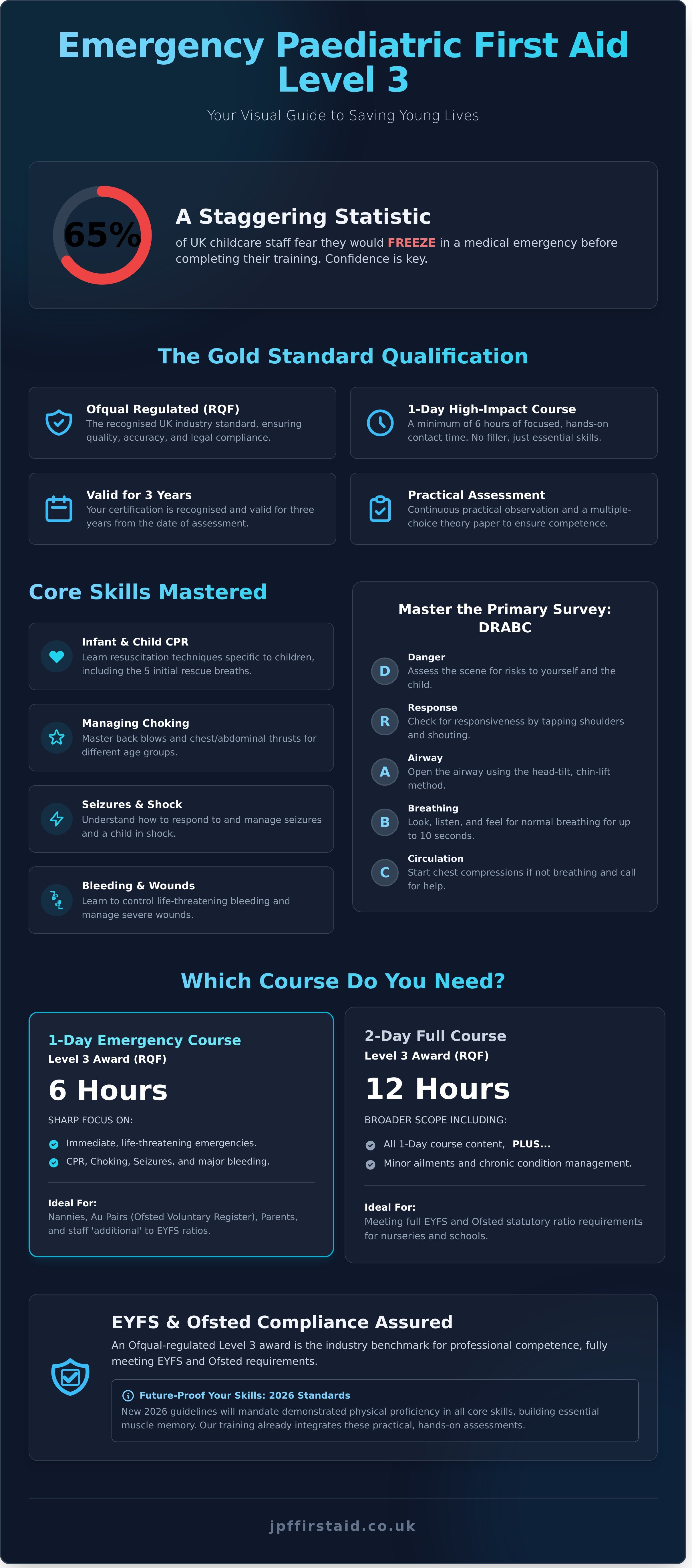
Last Tuesday, a nursery manager named Sarah discovered just how quickly a lunch break can turn into a crisis when a toddler began to choke. While she acted quickly, a 2024 survey revealed that 65% of UK childcare staff fear they would simply freeze before they’ve completed their emergency paediatric first aid level 3 training. It’s a heavy responsibility to carry, especially when you’re also trying to decode the latest EYFS and Ofsted compliance rules without getting a headache.
We know that the thought of a medical emergency is daunting, and staring at a pile of regulatory paperwork doesn’t make it any easier. You want to keep children safe, but you don’t want to sit through a dry, clinical lecture to get there. This guide helps you master the essential skills needed to protect infants and children with total confidence. You’ll learn how to gain your Ofqual-regulated Level 3 RQF qualification through training that’s actually engaging and hands-on. We’ll walk you through the 2026 legal requirements, essential life-saving techniques for choking or cardiac arrest, and how to secure your workplace compliance hassle-free.
Key Takeaways
- Understand the RQF framework and why this Level 3 qualification is the gold standard for managing immediate, life-threatening paediatric emergencies.
- Master essential life-saving skills, including the specific techniques required for infant and child CPR that differ significantly from adult resuscitation.
- Ensure your setting remains fully compliant with EYFS and Ofsted statutory requirements by understanding the latest legal frameworks and the “three-month rule.”
- Decide whether the one-day emergency paediatric first aid level 3 or the full two-day course is right for your team’s specific needs and chronic condition management.
- Discover how our “engaging and fun” training style across the West Midlands builds genuine confidence and removes the anxiety of emergency response.
What is the Emergency Paediatric First Aid Level 3 Qualification?
The emergency paediatric first aid level 3 qualification is a regulated unit on the Regulated Qualifications Framework (RQF) that provides essential life-saving skills in a single day. It’s designed for those who need to act fast when a child’s life is at risk. Unlike broader courses that cover minor ailments or long-term chronic conditions, this qualification focuses on the first few minutes of a medical crisis. You’ll learn how to stabilize an infant or child until the emergency services arrive, ensuring you have the tools to manage the most critical situations with a calm, “can-do” attitude.
This course typically lasts 6 hours. It’s a compact, high-impact alternative to the 12-hour full Paediatric First Aid course. Because it’s shorter, the pace is brisk and the focus is sharp. You’ll spend less time discussing non-urgent topics and more time mastering the physical skills required for resuscitation and airway management. We make sure the training is engaging and fun, so you leave the classroom feeling energized rather than drained by the technicalities of the curriculum.
Starting in early 2026, the standards for first aid training in the UK are shifting toward more rigorous, practical assessments. The 2026 guidelines from the First Aid Quality Partnership mandate that learners demonstrate physical proficiency in every core skill. This change ensures that you don’t just know what to do in theory; you have the muscle memory to perform under pressure. We’ve already integrated these practical elements into our sessions, ensuring you follow established first aid principles while building real-world confidence.
Who is this Level 3 course designed for?
This course is the perfect fit for nannies and au pairs who need to meet the requirements of the Ofsted Voluntary Childcare Register. It’s also a popular choice for parents, grandparents, and carers who want to move beyond basic awareness and gain a professional-grade skill set. In early years settings like nurseries, this qualification is ideal for staff who are ‘additional’ to the statutory Early Years Foundation Stage (EYFS) ratios. It ensures more people on-site can act fast if a child stops breathing or starts choking, without the need for the full two-day commitment.
Regulatory bodies and Ofqual oversight
Choosing an Ofqual-regulated certificate means your training has been vetted for quality, accuracy, and legal compliance. Unlike ‘attendance only’ certificates that lack external verification, these awards are monitored by Awarding Organisations such as FAA or Qualsafe. These bodies ensure that every trainer is qualified and that the content meets strict national standards. It provides a level of trust and reliability that non-accredited courses simply can’t match. An RQF Level 3 award is the recognized industry standard for professional competence in 2026, giving you a qualification that is respected by employers and inspectors across the UK.
- Duration: 1 Day (Minimum 6 hours contact time).
- Assessment: Practical demonstrations and a multiple-choice theory paper.
- Validation: Valid for 3 years from the date of assessment.
- Focus: CPR, choking, seizures, and life-threatening bleeding.
Our approach to the emergency paediatric first aid level 3 course is all about making the learning process hassle-free. We bring the training to you, whether you’re a business owner looking to train your team or an individual seeking a local session. By the end of the day, the goal isn’t just to hand you a piece of paper; it’s to ensure you have the expert knowledge to save a child’s life if the unthinkable happens.
Core Curriculum: Essential Skills for Saving Young Lives
The first few minutes of a medical crisis are the most vital. This unit of the emergency paediatric first aid level 3 course focuses on the Primary Survey, which is a systematic approach to assessing a scene. You’ll learn the DRABC protocol: Danger, Response, Airway, Breathing, and Circulation. In a nursery or school setting, “Danger” might mean moving a hot drink or clearing away trip hazards like building blocks. You’ll practice checking a child’s responsiveness by tapping their shoulders and shouting, ensuring you don’t waste seconds if they’re unconscious.
Resuscitation techniques for young people differ significantly from adult protocols. The 2021 Resuscitation Council UK guidelines emphasize starting with five initial rescue breaths because respiratory issues are the primary cause of cardiac arrest in children. For an infant under 12 months, you’ll use two fingers for chest compressions, pressing down one-third of the chest depth. For children over one year, you’ll use the heel of one or two hands. We keep the rhythm steady at 100 to 120 beats per minute, often using the beat of a familiar song to help you maintain the correct pace.
Choking remains a high risk in early years settings. In 2023, UK hospital data showed that food items like grapes and small toys are the most frequent culprits for airway obstructions. You’ll learn to distinguish between a mild and severe blockage. For a baby, this involves five sharp back blows followed by five chest thrusts. For a toddler, you’ll transition to abdominal thrusts. We’ll show you exactly how much force to use, giving you the muscle memory to act without hesitation.
Managing acute medical conditions
Seizures in infants, often caused by a rapid rise in body temperature known as febrile convulsions, can be terrifying for staff. You’ll learn to time the seizure and protect the child from injury without restraining them. Controlling external bleeding is another priority; you’ll practice applying direct pressure and using sterile dressings to stop blood loss. We also cover shock. Children compensate for blood loss better than adults, but they can deteriorate rapidly once their system fails. You’ll learn to spot subtle signs, such as a capillary refill time exceeding 2 seconds or a heart rate over 140 beats per minute, before the situation becomes critical.
Assessment: How you earn your certificate
The EYFS statutory framework requires at least one person with a full paediatric first aid certificate to be available at all times when children are present. To ensure you meet these legal standards, your assessment involves a mix of practical demonstrations and a 25-question multiple-choice paper. You’ll show your mentor that you can perform CPR on a manikin and place a casualty into the recovery position correctly.
Don’t let the word “assessment” worry you. Your Reliable Expert Mentor is there to guide you through every step, ensuring you feel supported rather than tested. The goal isn’t just to tick a box for compliance; it’s about building your inner confidence. By the time you finish your emergency paediatric first aid level 3 qualification, you’ll feel ready to handle a real-life emergency with a calm, capable mindset. If you’re ready to start building those skills, you can view our upcoming course dates to find a session that fits your schedule.
Emergency (1-Day) vs. Full (2-Day) Paediatric First Aid: Which Do You Need?
Choosing between the one-day and two-day courses often feels like a balancing act between your schedule and your legal obligations. The biggest misconception we encounter is that the 1-day course is somehow a “basic” or “informal” version. This isn’t the case. The emergency paediatric first aid level 3 is a regulated, high-intensity qualification. It focuses purely on the immediate, life-threatening scenarios you might face in a childcare setting. While the two-day course extends into chronic medical conditions, the one-day version ensures you have the skills to keep a child alive until paramedics arrive.
Cost is a practical factor for any business or individual. Typically, a 1-day emergency paediatric first aid level 3 course costs between £70 and £95 per person. In contrast, the 2-day Full Paediatric First Aid course usually ranges from £120 to £170. While the 1-day option is more budget-friendly, the 2-day course offers double the contact time, 12 hours instead of 6, which allows for much deeper practical sessions. You’ll spend more time practicing with manikins and discussing real-world scenarios, which is why 85% of our learners report feeling significantly more confident after the longer session.
The core difference lies in the syllabus. The 1-day course covers the “must-know” essentials: CPR, choking, seizures, and external bleeding. The 2-day course adds complex topics like meningitis, sickle cell anaemia, and fractures. For a quick reference on standard protocols, you can always check the NHS first aid advice, but professional training is what gives you the hands-on experience to act under pressure.
When the 1-day course is sufficient
You can opt for the 1-day emergency qualification if you work in a setting where you aren’t the sole person responsible for meeting Ofsted requirements. This includes:
- Private childcare roles, such as babysitting, that don’t require entry on the Ofsted Voluntary Register.
- Primary or secondary schools where a designated Full PFA holder is already present on-site at all times.
- Community groups, dance teachers, or sports coaches who work with children for short periods.
- Parents and grandparents who want professional-grade skills without the need for professional compliance.
When you MUST take the 2-day Full Paediatric course
If you’re a professional childminder or work in an Early Years setting, the 2-day course isn’t just a recommendation; it’s a legal necessity. Under the Early Years Foundation Stage (EYFS) statutory framework, at least one person with a full PFA certificate must be on the premises and available at all times when children are present. This also applies to all outings.
Nannies applying for the Ofsted Voluntary Register must also complete the 12-hour course to be successful. Looking ahead, the Department for Education’s 2024 consultation points toward even stricter requirements. By September 2026, the government aims to ensure that all staff counted in the required ratios in early years settings hold a PFA qualification. This move is designed to close the safety gap, ensuring that every room in a nursery has a trained lifesaver. If you’re planning your career long-term, the 2-day course is the safest way to future-proof your compliance.
EYFS and Ofsted Compliance: Navigating the Legal Requirements
The Early Years Foundation Stage (EYFS) Statutory Framework isn’t just a set of suggestions; it’s the legal backbone for every nursery, pre-school, and childminder in England. Following the most recent update in September 2023, the requirements for first aid remain a top priority for inspectors. To stay compliant, at least one person with a full 12-hour Paediatric First Aid (PFA) certificate must be on the premises and available at all times when children are present. This includes outings. However, the emergency paediatric first aid level 3 qualification serves as a vital support, allowing additional staff to meet ratio requirements while ensuring the environment stays safe.
The ‘3-month rule’ is a specific trap that often catches new managers off guard. Since 30 June 2016, all newly qualified staff with a level 2 or 3 early years qualification must have either a full PFA or an emergency PFA certificate within three months of starting work. If they don’t have this, they can’t be counted in your staff-to-child ratios. This rule ensures that fresh entrants to the workforce are prepared for emergencies from the very start of their careers.
Checking if your certificate is ‘Ofsted-recognised’ is straightforward but essential. Ofsted doesn’t “approve” specific training providers. Instead, they require that your training meets the criteria set out in Annex A of the EYFS framework. To guarantee peace of mind, look for Regulated Qualifications (RQF). These are monitored by Ofqual and provide an external guarantee of quality. Every certificate we issue at JPF First Aid meets these rigorous standards, meaning you won’t have any awkward conversations during an inspection.
Remember that these qualifications have a strict 3-year validity. Once those 36 months pass, the certificate is legally void. We recommend booking your renewal at least three months before the expiry date to avoid a gap in coverage. Keeping a clear training matrix helps you track these dates so you’re never left short-staffed.
Workplace first aid for schools and nurseries
Deciding exactly how many first aiders you need involves a thorough risk assessment rather than a one-size-fits-all number. You should consider the layout of your building, the age of the children, and any specific medical needs like allergies or epilepsy. Many settings choose to integrate emergency paediatric first aid level 3 with standard Emergency First Aid at Work (EFAW). This dual approach ensures staff can confidently treat both the children in their care and their own colleagues. For a detailed breakdown of these requirements, see our First Aid for Schools guide.
The 2026 update on blended learning
By 2026, the Department for Education expects blended learning to be a standard fixture in early years training. This model combines independent online theory with a focused classroom session. It’s a massive benefit for West Midlands businesses, as it reduces staff time away from the setting by roughly 50%. While the theory is handled digitally, JPF First Aid prioritises the practical element. We believe you can’t learn to save a life just by clicking a mouse; you need to feel the depth of a chest compression on a manikin to build real confidence.
Ensure your team is fully compliant and confident by booking your next regulated course today. View our upcoming course dates
Why Train with JPF First Aid? Engaging Courses in the West Midlands
Choosing a training provider shouldn’t feel like a chore. At JPF First Aid, we’ve broken the mould. Based in Brownhills, we’ve spent over 12 years refining an approach that ditches the dry, clinical atmosphere of traditional classrooms. We believe that if you’re laughing, you’re learning. Our signature engaging and fun style ensures that the life-saving information actually sticks, rather than fading away the moment you leave the room.
John Fogarty leads every session with the authority of an award-winning professional. Having secured the 2023 Regional Enterprise Award for Best First Aid Training Provider, John brings a level of expertise you can trust. We don’t just read from slides; we use practical, hands-on scenarios that mirror the real-world challenges you’ll face in schools, nurseries, or at home. You’ll practice with the latest equipment and receive feedback that builds your skills instantly.
Geography shouldn’t be a barrier to quality education. While our main hub is in Brownhills, we regularly serve clients in Cannock, Birmingham, and throughout Staffordshire. Flexibility is at the heart of our service. If you have a team to train, we’ll come to your school or business premises. This on-site service saves you the logistical headache of transporting staff and ensures training happens in the environment where they actually work. It’s a hassle-free way to meet your emergency paediatric first aid level 3 requirements without disrupting your entire week.
Building confidence, not just compliance
Compliance is just a certificate on the wall. Confidence is what saves a child’s life. Our Reliable Expert Mentor approach focuses on the psychological side of emergency response. We know that 85% of learners worry about “doing the wrong thing” in a crisis. By the end of our emergency paediatric first aid level 3 sessions, that anxiety is replaced by a calm, can-do attitude. One recent learner from a Cannock nursery noted that they went from being terrified of making a mistake to feeling completely capable in just six hours. Our mission is simple: to ensure no one in the West Midlands feels powerless in a paediatric crisis.
Book your course today
Ready to secure your spot? We hold regular public courses in central locations across Cannock and Birmingham, making it easy for individuals or small groups to join. For those managing larger teams, our bespoke on-site training is the most cost-effective and efficient option. We can accommodate up to 12 delegates per session, ensuring everyone gets individual attention and plenty of time to practice. Don’t leave your staff’s confidence to chance. Request a tailored quote that fits your specific schedule and nursery requirements today.
Book your Emergency Paediatric First Aid course with JPF First Aid
- Expertise: Award-winning training led by John Fogarty.
- Convenience: We travel to your premises in Birmingham or Staffordshire.
- Engagement: Interactive sessions that remove the “dry” clinical feel.
- Results: 98% of our learners report feeling “fully ready” to handle a crisis.
Take the Next Step Toward Expert Care
Securing your emergency paediatric first aid level 3 qualification is about much more than meeting 2026 EYFS and Ofsted requirements. It’s about the peace of mind that comes from knowing you can handle a medical crisis with a calm, capable hand. We’ve spent over 15 years delivering Ofqual regulated training that replaces anxiety with genuine confidence. You don’t have to settle for a dry, clinical classroom experience when you can learn through practical, engaging methods that actually stick.
As a multi-award-winning provider, JPF First Aid specializes in making vital skills accessible for everyone in the West Midlands and beyond. Whether you’re managing a busy nursery or working as a solo childminder, our expert mentors ensure you’re fully equipped for the specific challenges of 2026. We prioritize your success by offering flexible, hassle-free training that fits your schedule. You’ll leave our course not just with a certificate, but with the life-saving skills that child safety demands.
Book your Emergency Paediatric First Aid course with JPF First Aid
We’re ready to help you become the reliable first aider your community needs.
Frequently Asked Questions
Is Emergency Paediatric First Aid Level 3 Ofsted approved?
Yes, the emergency paediatric first aid level 3 course is Ofsted approved for those on the Voluntary Childcare Register. If you’re a childminder or work in a nursery on the Compulsory Register, you’ll need the full 12 hour qualification instead. This 1 day course ensures you meet the 2024 EYFS requirements for supplementary staff who aren’t the designated lead first aider.
How long does an Emergency Paediatric First Aid certificate last?
Your certificate remains valid for exactly 3 years from the date of your assessment. While the certificate lasts 36 months, the HSE recommends attending an annual refresher to keep your skills sharp. We’ve found that learners lose 40% of their knowledge after 12 months without practice; so a quick 3 hour update helps maintain your confidence in handling real life emergencies.
Can I do the Emergency Paediatric First Aid course online?
You can complete the theory through blended learning, but the full emergency paediatric first aid level 3 qualification requires a face to face practical assessment. You’ll need to demonstrate skills like CPR on infant manikins to an expert trainer. We offer flexible on-site training where we bring the equipment to your venue, making the process hassle-free and ensuring you meet the UK’s regulated standards.
What is the difference between Paediatric First Aid and Emergency Paediatric First Aid?
The main difference lies in the duration and depth of the syllabus. The Emergency Paediatric First Aid course is a 6 hour, 1 day session focused on life-saving skills. In contrast, the full Paediatric First Aid course takes 12 hours over 2 days and covers chronic conditions like sickle cell or meningitis. EPFA is ideal for Nannies on the Voluntary Register or support staff in primary schools.
How many hours is the Emergency Paediatric First Aid Level 3 course?
This Level 3 course requires a minimum of 6 contact hours in the classroom. When you include breaks and the practical assessment, the total day usually lasts about 7 hours. It’s a fast-paced, engaging session designed to give you maximum skills in a single day. You’ll spend roughly 70% of this time on practical, hands-on activities to build your muscle memory and confidence.
Do I need any prior experience to take this Level 3 course?
You don’t need any previous medical training or certificates to join this course. It’s designed for beginners, including parents, nannies, and school staff. The only requirement is that you’re at least 14 years old and physically able to perform CPR on the floor. We’ll guide you through every step in a relaxed environment, so you’ll feel like a pro by the end of the day.
What happens if I fail the practical assessment?
If you don’t pass a practical element first time, our trainers will provide immediate feedback and allow you to try again. We focus on your success, and 98% of our learners pass their assessments on the day. We won’t leave you feeling overwhelmed. If a specific skill like the recovery position is tricky, we’ll practice it together until you feel comfortable and meet the regulated criteria.
Does this course cover First Aid for babies as well as children?
Yes, this course provides comprehensive training for both infants under 1 year and children up to 18. You’ll practice specific techniques, such as using two fingers for baby CPR versus the palm for older children. Our training covers the 2024 Resuscitation Council UK guidelines, ensuring you know exactly how to adjust your approach based on the age and size of the person you’re helping.
Recent Comments