
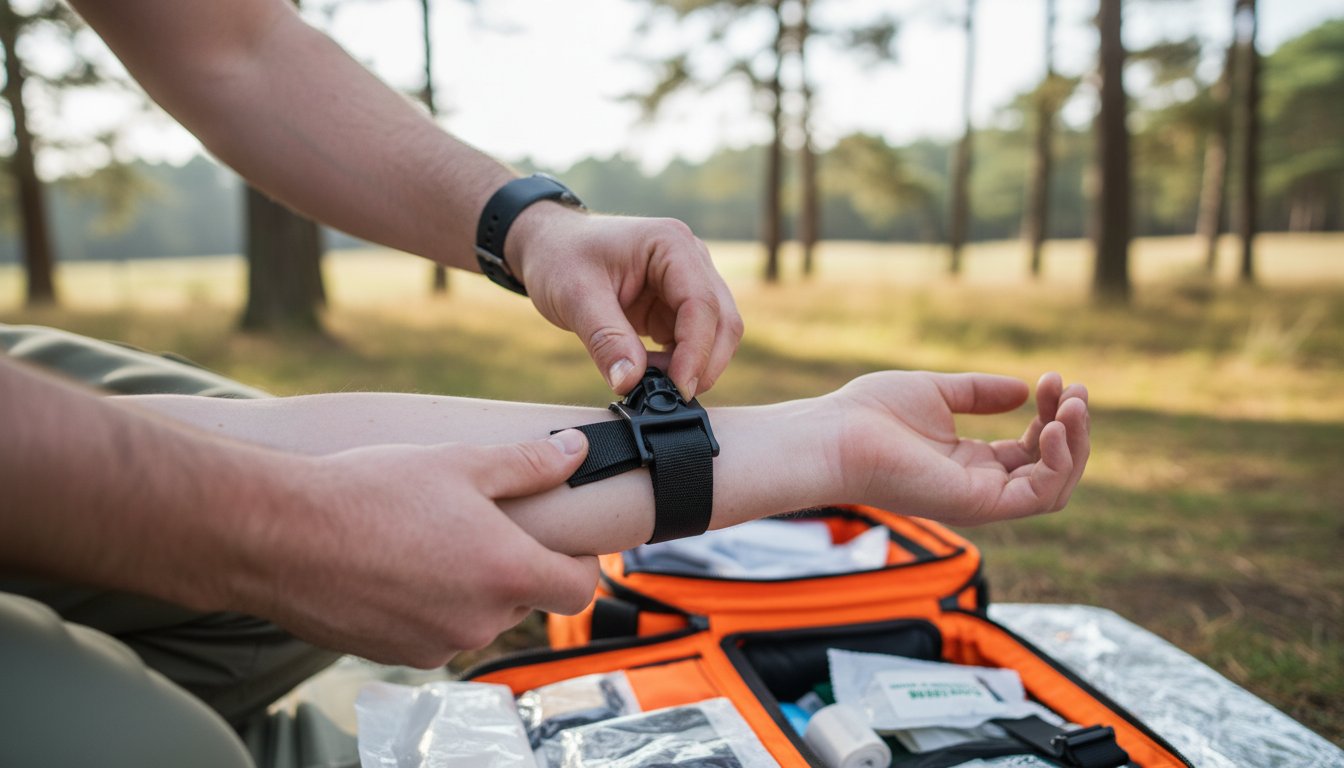
Imagine you are at a local community event when a freak accident leaves someone with a deep, pulsing wound. In the 180 seconds it can take for a person to lose a critical volume of blood from a major artery, your immediate response is the only thing that matters. It’s completely natural to feel a surge of panic or worry that you might do more harm than good. You might even feel anxious about the legal side of using specialist equipment or tourniquets here in the UK.
We know that the sight of a catastrophic bleed is daunting, but you don’t need to be a doctor to save a life. This guide will teach you how to identify life-threatening haemorrhage instantly and use a professional bleed kit with total confidence. We’ll walk you through the practical steps of tourniquet application, explain the contents of a standard British Standard 8599-1 kit, and show you why the law supports those who step up to help. You’ll gain the clear, expert knowledge needed to stay calm and act effectively when every second counts.
Key Takeaways
- Learn how to recognise a life-threatening injury using your senses and understand why every second counts when dealing with a catastrophic bleed.
- Discover the essential hierarchy of control for major haemorrhage, including the correct techniques for wound packing and applying direct pressure.
- Understand why standard workplace kits often fall short and identify the specialist equipment, such as PAcT kits, required for serious trauma.
- Overcome the “fear factor” by learning about your legal protections in the UK and why modern tourniquets are safer than you might think.
- See how practical, hands-on training can build your confidence, transforming a daunting subject into a manageable, life-saving skill.
What is a Catastrophic Bleed? Recognising Life-Threatening Haemorrhage
When we talk about a catastrophic bleed, we aren’t describing a typical household cut or a grazed knee. We are identifying a level of external bleeding so severe that it can lead to death in as little as 120 to 180 seconds. In a first aid context, having a foundational understanding of what is bleeding? helps you distinguish between a manageable injury and a life-threatening crisis that requires immediate, aggressive intervention. At JPF First Aid, we teach you that every second counts when the body’s main “pipes” are compromised.
Emergency responders often mention a “hearing test” for these types of injuries. It sounds intense, but it’s a practical reality. Because arterial blood is under significant pressure from the heart, a major rupture can actually be audible. You might hear a distinct hissing, splashing, or squelching sound as blood is forced out of the vessel at high velocity. If you hear blood before you see it, you should assume the situation is catastrophic and prepare to use a tourniquet or haemostatic dressing immediately.
It’s vital to understand the difference between a significant bleed and a catastrophic one. A significant bleed might create a large, frightening puddle on the floor, but it usually slows down or stops with firm, direct pressure. A catastrophic bleed is relentless. It’s often described as “pumping” or “spurting” in rhythm with the casualty’s heartbeat. If you see blood soaking through a thick winter coat or heavy denim work trousers in a matter of seconds, the volume of loss is too great for standard first aid techniques alone. You’re looking for blood that is actively moving away from the body, rather than just trickling.
These injuries are most common in high-risk environments. Industrial accidents involving heavy machinery, road traffic collisions, and incidents involving sharp force trauma are the primary causes we see in the UK. Data from the Health and Safety Executive (HSE) showed that 135 workers were killed in work-related accidents in Great Britain during 2022/23. A significant portion of these fatalities involved moving machinery or falls, both of which can cause the type of deep tissue trauma that leads to massive haemorrhage. Sharp force trauma, whether from a workshop accident or a deliberate act, can also sever major arteries like the femoral or brachial in an instant.
Given that road traffic collisions are a significant cause of such traumatic injuries, the importance of comprehensive driver education cannot be overstated. For learners, developing strong defensive driving skills through a professional institution like Pass4you Driving School is a critical step in preventing accidents before they happen.
High-adrenaline recreational activities also carry inherent risks, making professional oversight essential. For those interested in a thrilling, professionally managed adventure like parachuting, you can visit UK Skydiving to learn about their experiences.
Visual Signs of a Life-Threatening Bleed
You need to identify “red flags” within seconds of arriving on the scene. Look for bright red blood that spurts forcefully from a wound; this indicates an arterial bleed. You should also watch for blood that pools rapidly on the ground, covering an area larger than a dinner plate in moments. If a limb is missing or partially amputated, you don’t need to wait for blood to appear to know it’s a catastrophe. You must act before the casualty’s natural blood pressure drops and the “pumping” stops, as that’s a sign they are nearing death.
The Physiology of Hypovolaemic Shock
When a person loses approximately 20% of their blood volume, their body enters hypovolaemic shock. The heart tries to compensate by beating faster, but there isn’t enough fluid to maintain blood pressure. You’ll notice the casualty’s skin turning a ghostly pale colour, and they’ll likely feel cold and clammy. They may become confused, anxious, or even aggressive as their brain is starved of oxygen. In these moments, “stopping the tap” is your absolute priority. You don’t perform CPR on a casualty who is still actively losing blood; you must stop the bleed first to keep what little volume they have left inside their system.
How to Stop a Catastrophic Bleed: The Step-by-Step Response
Before you approach the casualty, pause for three seconds to assess the scene for danger. Your safety is the absolute priority; you cannot help if you become a second casualty. Once you’ve confirmed the area is safe, take charge of the environment immediately. Point directly at a specific bystander and give a clear, firm instruction: “You in the blue jacket, call 999 and tell them we have a catastrophic bleed, then find the nearest bleed kit or Public Access Trauma kit.” This direct communication prevents the bystander effect, where people assume someone else has already acted. In 2023, the City of London Police highlighted that the presence of these kits in public spaces can save lives, but only if someone takes the lead to fetch them.
The hierarchy of control for a catastrophic bleed follows a logical progression: direct pressure, wound packing, and finally, the use of a tourniquet. You should move through these steps quickly based on the severity and location of the injury. Developing these practical skills in a first aid course gives you the muscle memory needed to act without hesitation when every second counts.
Step 1: Applying Direct and Massive Pressure
The first and most vital action is to apply massive, downward pressure directly onto the source of the bleed. Use both hands and lock your elbows, using your entire body weight to “lean into” the wound rather than relying on arm strength alone. It’s essential that you don’t “peek” under the dressing to see if the bleeding has stopped, as this will disrupt the clotting process. If the first dressing becomes blood-soaked, simply place a second one directly over the top and keep pushing. Never remove the original layer; it’s acting as the foundation for a life-saving clot.
Step 2: Wound Packing and Haemostatic Agents
When a wound is deep or in a “junctional” area like the groin or armpit where a tourniquet cannot be used, you must pack the cavity. Use plain gauze or, ideally, a haemostatic dressing like Celox or QuikClot. These specialized dressings are treated with agents that accelerate the body’s natural clotting cascade. Following the Stop The Bleed guidelines, you should tightly pack the gauze into the wound until the cavity is full, then maintain firm, manual pressure for at least three minutes. This three-minute rule is critical to ensure the haemostatic agent has time to react with the blood and form a stable seal.
Step 3: When and How to Use a Tourniquet
If the injury is on a limb and direct pressure isn’t working, it’s time for a tourniquet. Follow the “high and tight” rule by placing the device as high up the limb as possible, over clothing if necessary. Tighten the windlass until the bright red, spurting bleeding stops and you can no longer feel a pulse in the lower part of the limb. It will be painful for the casualty, but it is necessary to save their life. Once the bleeding is controlled, document the exact time of application on the tourniquet’s “TIME” strap or the casualty’s forehead using a permanent marker. This specific data is vital for surgeons who will later need to determine the viability of the limb.
Bleed Kits and Equipment: Essential Tools for Emergency Response
Most UK workplaces rely on a standard green first aid box stocked to BS 8599-1 specifications. While these are perfect for minor cuts or burns, they are woefully inadequate for a catastrophic bleed. If a major artery is compromised, a standard 5cm light-duty bandage simply won’t suffice. You need specialised equipment designed to exert massive pressure and stop the flow in seconds. Since the 2021 initiative by the National Counter Terrorism Security Office (NaCTSO), Public Access Trauma (PAcT) kits have become more common in UK city centres. These kits are designed for the public to use in high-pressure situations, providing the exact tools needed to save a life before the ambulance arrives.
Choosing the right tourniquet is a vital part of your preparedness strategy. The CAT (Combat Application Tourniquet) is the most widely recognised tool in the world. It uses a plastic windlass system that you can often apply with one hand. In contrast, the SOFTT-W (Special Operations Forces Tactical Tourniquet – Wide) features a metal windlass and a screw-lock system. Many UK police forces prefer the SOFTT-W because it’s exceptionally durable and packs down smaller than the CAT. Both are highly effective, but they require hands-on practice to use correctly under stress.
Trauma shears are the unsung heroes of a bleed kit. In a real emergency, you don’t have time to faff with buttons or zips. These heavy-duty scissors can cut through denim, leather, and even thick winter coats in seconds. Exposing the wound is the only way to see exactly where the blood is coming from. Without this clarity, you might apply pressure to the wrong spot, wasting precious seconds. High-quality shears ensure you can reach the injury site without causing further trauma to the casualty.
Anatomy of a Professional Bleed Kit
Nitrile gloves are the first thing you should reach for. We recommend a minimum thickness of 4-mil to ensure they don’t tear when you’re working in wet or jagged environments. They protect you from bloodborne pathogens and help you maintain a firm grip. The centrepiece of the kit is often the Emergency Trauma Dressing, commonly known as the Israeli Bandage. Developed in 1994, this tool features a built-in plastic pressure bar. It allows you to apply up to 30 pounds of force directly to the wound site, acting as a sterile dressing and a pressure applicator in one. While UK businesses must meet HSE standards, following OSHA guidelines on bleeding control provides a global gold standard for workplace safety that goes beyond basic compliance.
Foil blankets are a mandatory inclusion for managing the “lethal triad” of trauma: acidosis, hypothermia, and coagulopathy. When a person loses blood, their body temperature drops rapidly. This drop prevents the blood from clotting effectively, which makes the catastrophic bleed even harder to manage. Wrapping a casualty in a foil blanket isn’t just about comfort; it’s a clinical intervention to keep their blood thick enough to clot.
Improvising in an Emergency
We’ve all seen action movies where a hero saves the day with a leather belt. In reality, a belt is a poor substitute for a professional tourniquet. Research shows that improvised tourniquets have a failure rate of up to 75% in some trials. They lack the mechanical advantage of a windlass, meaning they often compress the veins but fail to stop the arterial flow. This can actually make the bleeding worse. If you don’t have a professional kit, focus on wound packing instead. Use clean clothing, such as a t-shirt or a scarf, and push it firmly into the wound cavity. Keep applying direct, heavy pressure with both hands until help arrives. While improvising is better than doing nothing, it is never a replacement for a dedicated trauma kit.

Legal Protection and Overcoming the “Fear Factor” in the UK
Many people hesitate to help during a catastrophic bleed because they fear legal repercussions or making the injury worse. You should know that UK law is firmly on your side. The Social Action, Responsibility and Heroism (SARAH) Act 2015 was specifically designed to protect individuals who act in good faith to help others in an emergency. This legislation ensures that if you’re acting to save a life, the courts will consider the context of your actions and the fact that you were trying to help.
A common worry involves the “limb loss” myth associated with tourniquets. Research published by the Journal of Trauma and Acute Care Surgery demonstrates that tourniquets are incredibly safe when used correctly. Complications are exceptionally rare when the device is applied for less than 120 minutes. Modern first aid training focuses on the simple fact that losing a limb is a secondary concern when compared to losing a life. In a life-or-death situation, stopping the bleed is your absolute priority.
Your Duty of Care as a First Aider
The Health and Safety Executive (HSE) updated its guidance in 2017 to suggest that employers should consider trauma training if their risk assessment identifies a possibility of severe injuries. Choosing an “Ofqual Regulated” qualification ensures that you’re following a syllabus that meets national standards, which provides a robust layer of protection for both you and your employer. Under the “Reasonable Person” test in UK law, you aren’t expected to be a medical professional. You’re simply expected to act as any sensible person with your level of training would in that moment. Having a regulated certificate proves you’ve been taught the current best practices, making your actions much easier to justify.
Mental Preparation for Trauma
The sight of significant blood often triggers a “freeze” response. You can combat this by using visualisation during your downtime. Spend five minutes imagining the steps you’d take to apply pressure or a tourniquet. When a real crisis occurs, use the “Stop, Breathe, Think, Act” method to settle your pulse. Taking just three seconds to breathe deeply can clear the adrenaline fog that leads to panic. Remember that doing something is always better than doing nothing in these scenarios. A 2019 study showed that immediate bystander intervention increases survival rates for major trauma by over 15 percent. Your willingness to step in is the most important factor in the patient’s survival.
Once the ambulance arrives and takes over, you’ll likely experience a significant adrenaline dump. This can leave you shaking, feeling suddenly exhausted, or even feeling emotional. It’s vital to look after your own mental health following such an intense event. JPF First Aid advocates for Mental Health First Aid as a crucial follow-up to physical trauma training. Don’t bottle up the experience. Speak to a professional or use your company’s Employee Assistance Programme (EAP) to debrief properly. Taking care of your mind is just as important as the life-saving skills you’ve just put into practice.
Build your confidence and gain the skills to save lives by booking our trauma-informed first aid courses today.
Building Confidence Through Regulated First Aid Training
You’ve read the steps and understood the theory. However, knowing what to do and actually doing it under the intense pressure of a real-life emergency are two very different things. Reading a guide is a vital first step, but it cannot replicate the physical sensation of applying a tourniquet or the split-second decision-making required during a catastrophic bleed. At JPF First Aid, we bridge that gap by turning theory into instinctive action. We don’t believe in dry, clinical lectures that leave you checking the clock. Instead, our approach is built on creating a relaxed, engaging environment where you can ask questions, make mistakes, and build genuine competence.
Our Level 3 Emergency First Aid at Work (EFAW) course is a popular choice for individuals and businesses alike. This one-day, six-hour regulated qualification covers the essentials of life-saving care, including the management of severe trauma. In 2023 alone, we helped hundreds of learners move from feeling “unsure” to “fully prepared.” If you work in a high-risk sector, we offer bespoke training tailored to your specific environment. According to HSE statistics for 2022/23, 135 workers were killed in workplace accidents in Great Britain, with construction and manufacturing accounting for a significant portion. We adapt our scenarios to reflect the specific hazards of your site, ensuring the training is 100% relevant to your daily operations.
Hands-On Practice: The Only Way to Master a Tourniquet
In a real-world emergency, you have roughly 30 seconds to apply a tourniquet before a victim loses a life-threatening amount of blood. You can’t achieve that speed without muscle memory. During our sessions, we use advanced training manikins that actually “bleed” under pressure. This allows you to feel the resistance required to stop a catastrophic bleed effectively. Our expert trainers provide constant, supportive feedback, helping you refine your technique until the movements become second nature. This practical repetition is what builds the “can-do” attitude we’re known for.
Booking Your Course in the West Midlands
We make professional training hassle-free by offering flexible delivery options across the region. You can join one of our regularly scheduled courses at our training centre in Cannock, or we can bring the equipment to your business premises for a private session. As an award-winning, independently-run provider, we take pride in our reputation for reliability and excellence. We’ve simplified the compliance process so you can focus on learning. Whether you’re a small business owner or a health and safety manager, you’ll find our booking process straightforward and our sessions genuinely enjoyable. To get started, you can enquire about a private group booking or find a course near you today.
Choosing JPF First Aid means you’re not just ticking a box for health and safety regulations. You’re investing in a skillset that could save a colleague, a friend, or a family member. Our mission is to ensure that every learner leaves our session feeling empowered and ready to act. We’ve seen a 98% satisfaction rate from our 2023 cohorts, proving that when training is engaging and fun, the lessons actually stick. Don’t wait for an accident to happen before you decide to get prepared. Real confidence comes from professional, regulated training that you can trust.
Turn Your Knowledge Into Life-Saving Confidence
Managing a catastrophic bleed requires more than just equipment; it demands the decisiveness to act when every second counts. You now understand how to recognise life-threatening haemorrhage and the vital steps to control blood loss using modern tourniquets and haemostatic dressings. Since 2005, expert trainer John Fogarty has helped thousands of people across the UK move past the fear factor to become capable, calm responders. These practical skills aren’t just for medical professionals. They are essential tools for every workplace and community member.
JPF First Aid offers a hassle-free, on-site solution for businesses and individuals throughout the West Midlands. As a multi-award-winning training provider, we ensure our sessions are engaging and fun while meeting all necessary health and safety compliance standards. You don’t have to travel to a clinical classroom; we bring the expertise directly to your door. Gain the skills that save lives and the official certification to prove it. Book your Ofqual regulated first aid training with JPF First Aid today and start building the confidence you need to protect those around you. You’ve got this, and we’re here to help you every step of the way.
Frequently Asked Questions
Is a catastrophic bleed the same as an arterial bleed?
Not exactly, although many arterial bleeds fall into this category. A catastrophic bleed describes any extreme blood loss that can lead to death within 3 to 5 minutes if not treated. While arterial blood is bright red and spurts, a catastrophic bleed can also be venous, where dark blood flows rapidly and doesn’t stop. Your priority is always to stop the flow immediately, regardless of which vessel is damaged.
Can I get in legal trouble for using a tourniquet in the UK?
You’re very unlikely to face legal trouble for using a tourniquet in the UK if you act in the person’s best interest. Under the Social Action, Responsibility and Heroism (SARAH) Act 2015, UK courts must consider if you were acting for the benefit of society. If a person faces a catastrophic bleed, using a tourniquet is a life-saving necessity that outweighs the risk of minor tissue damage or bruising.
How long can a tourniquet stay on before it causes permanent damage?
A tourniquet can safely stay in place for up to 2 hours without causing permanent limb damage. Research from military medical journals shows that nerve damage risks increase significantly after the 6-hour mark. You should always note the exact time you applied the device on the tourniquet itself or the casualty’s forehead. This helps paramedics at the scene manage the injury safely when they arrive to take over.
What should I do if I don’t have a professional bleed kit?
Use your hands to apply firm, direct pressure to the wound immediately. If you don’t have a trauma dressing, use the cleanest absorbent material available, such as a folded jumper or a tea towel. You must maintain this pressure without stopping until emergency services arrive. While improvised tourniquets using a tie or belt are less effective than a £25 CAT tourniquet, direct pressure remains your most powerful tool in an emergency.
Should I remove an object that is stuck in a wound causing a major bleed?
Don’t remove an embedded object from a wound under any circumstances. The object often acts as a plug, helping to stem the flow of blood from damaged vessels. If you pull it out, you could cause an uncontrollable catastrophic bleed that’s much harder to manage. Instead, apply pressure around the object and use padding to secure it in place so it doesn’t move while you wait for the ambulance.
Does a standard First Aid at Work course cover catastrophic bleeding?
A standard 3-day First Aid at Work (FAW) course covers basic bleeding, but it doesn’t always include intensive tourniquet or haemostatic dressing training. Since the 2017 HSE update, employers should consider if their risk assessment requires these extra skills. We offer bespoke trauma sessions for £495 per group, which provide the hands-on practice you need to feel confident using professional bleed kits in high-risk environments.
What is the “Lethal Triad” in trauma, and why does it matter?
The Lethal Triad is a medical condition involving hypothermia, acidosis, and coagulopathy that significantly increases mortality rates. When a casualty loses blood, their body temperature drops below 35°C, which prevents blood from clotting properly. This creates a deadly cycle. You can help break this by stopping the bleed quickly and keeping the person warm with a blanket or coat while the emergency services are on their way.
How do I know if a bleed is “catastrophic” or just “heavy”?
A bleed is catastrophic if blood is spurting, pooling on the ground, or soaking through clothing in seconds. If you see a puddle larger than 50cm in diameter or the casualty appears pale and confused, it’s a life-threatening emergency. You won’t have time to look for a standard bandage in a kit; you must apply direct pressure or a tourniquet immediately to save their life before they lose too much volume.
Recent Comments