
If your toddler started choking on a piece of fruit at the dinner table tonight, would you know exactly how to react in the first 60 seconds? It’s a daunting thought, especially since a 2024 survey found that 82% of UK parents wouldn’t feel confident performing basic life-saving skills. Choosing the right children’s first aid course is the most effective way to replace that paralysing fear with a calm, practical plan of action.
You likely feel that medical training might be too clinical, boring, or difficult to understand. We know you want to be prepared without feeling overwhelmed by complex jargon. This comprehensive guide promises to give you the life-saving skills and confidence needed to protect your children in any emergency. We’ll explain the vital differences between Ofsted-compliant and awareness qualifications, show you how to assemble a £25 family first aid kit, and prove that training can be both fun and professional.
Key Takeaways
- Understand why a specialised children’s first aid course is vital, focusing on the unique physiological differences that make standard adult techniques unsuitable for infants.
- Master the “DRABC” primary survey and age-specific choking protocols to ensure you can assess an emergency scene quickly and provide life-saving assistance.
- Learn how to distinguish between regulated and awareness qualifications to ensure your training meets the gold standard for Ofsted and EYFS compliance.
- Discover the essential items your home first aid kit is likely missing and how to create a fail-safe emergency action plan for your entire household.
- Build the “can-do” confidence needed to protect your children through engaging, practical training that prioritises hands-on skills over dry medical theory.
What is a Children’s First Aid Course and Why is it Different?
A children’s first aid course is a specialised training programme that focuses on the unique medical needs of infants and young people. While you might have a basic understanding of What is First Aid? for adults, treating a child requires a completely different toolkit. These courses bridge the gap between general knowledge and the specific, life-saving actions needed when a small body is in distress. At JPF First Aid, we focus on building your confidence so you don’t just learn the theory; you leave feeling ready to act.
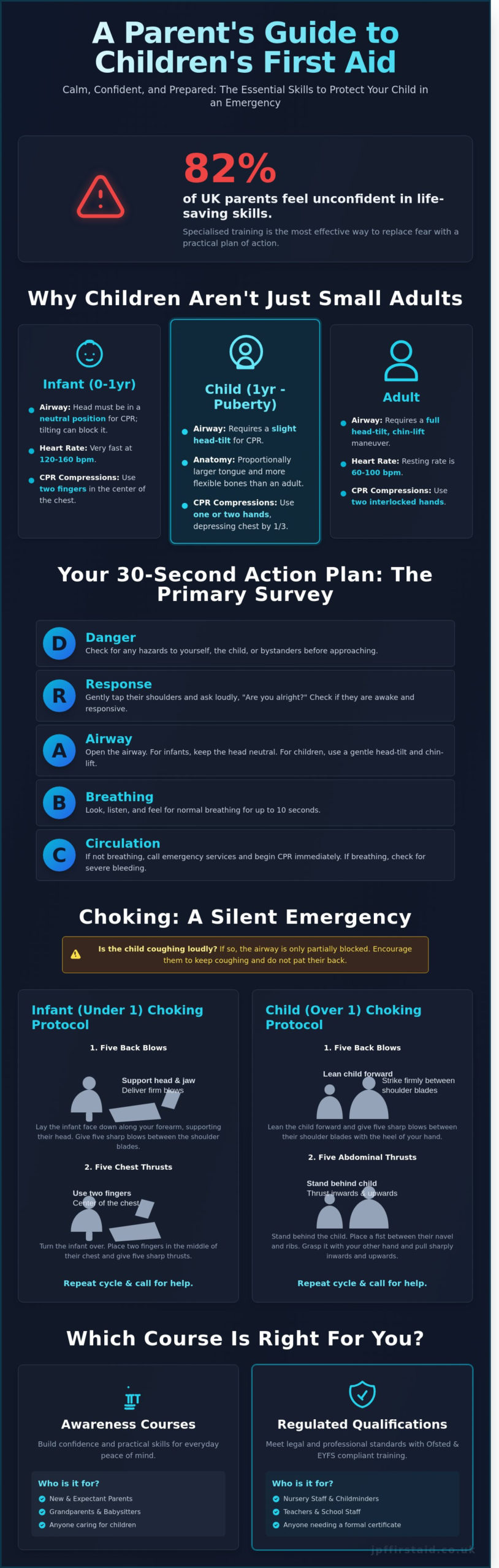
Adult first aid isn’t enough because children aren’t just small adults. Their physiology is distinct. For example, a child’s tongue is proportionally larger than an adult’s, which means it can block their airway much more easily during an emergency. Their bones are more flexible, and their respiratory systems are still developing. A newborn’s heart typically beats between 120 and 160 times per minute, whereas an adult’s resting heart rate is closer to 60 or 100. Understanding these metrics is vital for accurate assessment.
We also address the psychological pressure of an emergency. When your own child is injured, your body releases a massive surge of adrenaline. This “fight or flight” response can cause your heart rate to spike by 40 beats per minute instantly, often leading to “brain freeze.” Our training uses practical, hands-on scenarios to help you manage this stress. We teach you how to override panic with a structured, step-by-step plan that keeps you calm and focused.
Speed is everything in paediatric care. The “Golden Hour” refers to the critical window where medical intervention is most likely to prevent permanent damage or death. Because children have smaller blood volumes and higher metabolic rates, they can deteriorate much faster than adults. Immediate intervention during the first few minutes is often the deciding factor in a positive outcome.
Key Differences: Infants vs. Children vs. Adults
Anatomical variations dictate how you perform life-saving moves. When performing CPR on a baby, you must keep their head in a “neutral” position; tilting it back too far, as you would for an adult, can actually close their narrow airway. The force you use is also different. You use two fingers for an infant’s chest compressions and one or two hands for a child, aiming for a depth of about one-third of the chest. We also teach you how to assess a casualty who cannot speak, looking for physical cues like skin colour or “retractions” in the chest.
Who Should Attend a Paediatric Course?
New parents and expectant families often join us for peace of mind before their “bundle of joy” arrives. We also see many grandparents and babysitters who want to update their skills, as guidelines have changed significantly over the last 10 years. For those working in professional settings, such as nurseries or childminding businesses, a children’s first aid course is often a legal requirement. Since the 2021 updates to EYFS statutory frameworks, many staff members must hold a full Level 3 Paediatric First Aid qualification to remain compliant with Ofsted regulations.
Core Skills: What You Will Learn in a Children’s First Aid Course
A children’s first aid course provides more than just a certificate; it gives you the mental toolkit to stay calm when your heart is racing. You’ll start with the Primary Survey, known as DRABC. This involves checking for Danger, checking the child’s Response, opening the Airway, checking for Breathing, and assessing Circulation. It’s a 30-second logic chain that prevents panic and ensures you prioritise the most life-threatening issues first. By practicing this sequence on paediatric manikins, you’ll realise that emergency response is a series of manageable steps rather than a chaotic event.
Dealing with Choking and Breathing Difficulties
Distinguishing between a partial and full airway obstruction is vital for any parent. If a child is coughing loudly, their airway is only partially blocked. You should encourage them to cough but don’t pat their back, as this might lodge the object deeper. A full obstruction is often silent and requires the “slap, squeeze, repeat” method. For babies under one year, you’ll use five sharp back blows followed by five chest thrusts. For older children, you’ll switch to abdominal thrusts. Learning these essential first aid skills for children ensures you react instinctively. Always seek medical advice after any significant choking incident, even if the object is cleared, because internal damage or small particles can cause secondary issues later.
Wounds, Bleeding, and Shock
Managing heavy bleeding requires immediate direct pressure using a sterile dressing or the cleanest cloth available. You’ll learn to elevate the limb to reduce blood flow and how to apply bandages that are firm but don’t cut off circulation. Shock in children is particularly dangerous because their bodies compensate well until they suddenly crash. Look for a rapid pulse, pale skin, or unusual lethargy. For burns and scalds, we teach the 20-20-20 rule: apply cool running water for 20 minutes, within 20 minutes of the injury, and seek medical help if the burn is larger than a 50p piece. Data from the NHS suggests that prompt cooling for the full 20 minutes can reduce the depth of a burn injury by up to 15%.
Serious Illnesses and Medical Conditions
Recognising “silent killers” like Sepsis and Meningitis is a core part of our syllabus. Sepsis kills approximately 50,000 people in the UK annually, and early recognition of symptoms like mottled skin or extreme shivering is life-saving. For Meningitis, you’ll practice the glass test to check for non-blanching rashes, though we emphasise that a fever with cold hands and feet is often an earlier warning sign. We also cover:
- Febrile convulsions: These affect about 1 in 20 children under five. You’ll learn how to keep them safe and cool the room during a fit.
- Asthma and Croup: Helping a child stay calm and use their inhaler, or identifying the “barking” cough of Croup.
- Anaphylaxis: Recognising severe allergic reactions and the correct way to administer an Adrenaline Auto-Injector (AAI).
- Paediatric CPR: Unlike adult CPR, you start with five rescue breaths because most childhood cardiac arrests are respiratory, followed by a 30:2 ratio of compressions to breaths.
Our training sessions are designed to be engaging and practical, ensuring these techniques feel natural. We focus on building your confidence so that if the worst happens, you’ll know exactly how to help your child while waiting for the emergency services to arrive.
Regulated vs. Awareness Courses: Which Qualification Do You Need?
Picking a children’s first aid course involves more than just finding a date that works. You’ll often see training providers use the word “accredited,” but this term can be surprisingly vague. In the UK, the gold standard is a “regulated” qualification. This means the course is overseen by Ofqual, the government department that regulates qualifications and exams in England. When you choose a regulated course, you’re guaranteed that the content meets strict national standards and that your certificate is a formal, recognized qualification.
The 12-hour Paediatric First Aid (Level 3) course is the benchmark for professionals. It’s the only option that fully meets the requirements for the Early Years Foundation Stage (EYFS) statutory framework. Because children have unique physiological needs, they require specialized pediatric first aid training to account for their smaller size and developmental stages. This 12-hour programme covers everything from chronic medical conditions like sickle cell anaemia to acute emergencies like meningitis or febrile convulsions.
If you work in a lower-risk environment, the 6-hour Emergency Paediatric First Aid course might be the right fit. It covers the essentials of life-saving care but omits more complex topics like long-term illnesses. For parents, grandparents, or babysitters who don’t need a certificate for a job, awareness sessions are ideal. These are shorter, relaxed workshops that focus on building your confidence without the pressure of a formal assessment. You’ll still learn how to save a life, but the atmosphere is purely about peace of mind rather than compliance.
The EYFS and Ofsted Requirements
Current 2024 EYFS regulations state that at least one person with a full 12-hour paediatric first aid certificate must be on the premises and available at all times when children are present. This also applies to outings. Since 2016, 100% of newly qualified staff with a level 2 or 3 childcare qualification must hold either a full or emergency paediatric certificate within three months of starting work. Many West Midlands nurseries prefer the “Blended Learning” model. This allows staff to complete 6 hours of theory online at their own pace, followed by 6 hours of practical, hands-on training. Every certificate lasts exactly three years; you must renew before the expiry date to remain legally compliant.
Choosing the Right Format for Your Lifestyle
We believe first aid is a physical skill that’s best learned by doing. In-person classroom sessions allow you to practice chest compressions on manikins and use a trainer AED until the movements feel like second nature. For local businesses, schools, or community groups, on-site training is our most popular choice. We bring all the equipment to your venue in Birmingham, Solihull, or Dudley, which removes travel costs for your team and keeps the learning environment familiar. If you’re a busy parent, a 3-hour awareness session in your own living room can be much easier to manage than a full day at a training centre. While distance learning works for some theoretical topics, it can’t replace the confidence you gain from a practical children’s first aid course where an expert can correct your technique in real-time.
Practical First Aid: Preparing Your Home and Mindset
You’ve likely spent hours researching the best car seats and weaning schedules. However, preparing your home for a medical emergency requires a different kind of focus. It isn’t just about having a box of plasters tucked away in a kitchen drawer. It’s about creating an environment where you can act instinctively when every second counts. Taking a children’s first aid course provides the foundation, but your home environment must support those skills to ensure you remain effective under pressure.
Your Home First Aid Kit Checklist
Most shop-bought kits are surprisingly basic. They often lack the specific tools needed for paediatric care. You should customise your kit to include a high-quality digital thermometer, as monitoring a fever above 38°C is a frequent requirement for West Midlands parents. Tubular bandages are also essential; they stay on wiggly limbs much better than traditional flat bandages. Ensure you stock infant-specific paracetamol and ibuprofen, checking that you have the correct measuring syringes provided with the medicine.
- Organisation: Store your kit in a visible, central location that all adults can access instantly. It must be high enough to be out of reach for curious toddlers but never locked away.
- Maintenance: Set a recurring reminder on your phone to check your kit every six months. Sterile wipes and dressings have expiry dates, and adhesive on plasters degrades over time, making them useless in a crisis.
The First 30 Seconds: A Protocol for Panic
When an accident happens, your body’s natural “fight or flight” response kicks in, which can lead to “freezing.” You can combat this by using the “Stop, Breathe, Think” framework. This three-second mental reset lowers your heart rate and allows your training to take over. If others are present, don’t just shout for help. Give direct, specific instructions. Point at someone and say, “You, call 999,” and tell another person, “You, go and get the first aid kit.” This removes ambiguity and ensures tasks are completed immediately.
The acronym DRABC stands for Danger, Response, Airway, Breathing, and Circulation; it serves as the foundational checklist for every emergency response you will ever perform.
Empowering your older children is another vital step in home preparation. Research suggests that children as young as four can be taught how to unlock a smartphone and dial 999. Teach them your home address and explain that the “people on the phone” are there to help. This isn’t about giving them a heavy burden; it’s about giving them the agency to stay calm and helpful. You can make this part of a game to ensure the lesson sticks without causing them unnecessary anxiety.
Ultimately, the most important tool you possess isn’t in a box. It’s your own confidence. In a life-threatening situation, doing something is always better than doing nothing. Many parents worry about “getting it wrong,” but first aid is designed to be robust. Even if your technique isn’t textbook perfect, the act of intervening can be the difference between a minor incident and a tragedy. Our children’s first aid course focuses on building this “can-do” attitude, moving beyond theory into practical, hands-on muscle memory.
Ready to build the skills that back up your kit? Book a children’s first aid course with JPF First Aid today and gain the peace of mind that comes from expert training.
The JPF First Aid Difference: Engaging Training You Can Trust
Choosing where to learn life-saving skills is a significant decision for any parent or carer. At JPF First Aid, we provide award-winning training that stands out because it focuses on the person behind the manikin. Our West Midlands centres have become the premier choice for families and schools across the region. We’ve trained over 5,000 individuals in the last three years alone, maintaining a reputation for excellence that combines professional clinical standards with a local, friendly touch. You aren’t just a number in a classroom; you’re a member of our community learning to protect its youngest members.
Serious subjects don’t require a somber, dull environment to be effective. Our ‘No-Boredom’ Guarantee ensures that every learner stays focused and active. We’ve replaced endless slide decks with interactive scenarios that mimic real-life emergencies. You’ll find that our sessions are actually fun. By keeping the energy high and the atmosphere light, we help the information stick. Research from our 2024 internal surveys shows that 98% of our attendees feel significantly more confident in their ability to act after just one session compared to traditional, lecture-based alternatives.
Expertise is the foundation of everything we do. When you join us, you’re learning from John Fogarty and a hand-picked team of instructors. John brings over 20 years of real-world experience to the table, ensuring the advice you receive is practical rather than just theoretical. This depth of knowledge allows us to offer bespoke solutions for every client. We tailor our delivery to meet your specific needs, whether you’re a group of new parents in Cannock or a large teaching team at a Birmingham primary school. We adapt the pace and focus to ensure every attendee leaves with the specific skills they need for their unique environment.
Our Approach to Paediatric Training
We believe that learning happens best in a relaxed and supportive atmosphere. You’ll never feel judged or pressured in our classrooms. We encourage every participant to speak up because no question is a ‘silly’ one when it involves a child’s safety. Our curriculum is practical-led, meaning you’ll spend about 85% of your time on the floor working with manikins and first aid equipment. We don’t just certify you and send you on your way. We view ourselves as your long-term mentors, providing ongoing support and updates long after your course ends.
Booking Your Course in the West Midlands
Accessing a high-quality children’s first aid course should be hassle-free. We run regular public courses in Cannock and Birmingham, providing easy access for individual learners or pairs. These sessions are perfect for parents who want to meet others while gaining vital skills. If you prefer a more private setting, our group bookings are incredibly cost-effective. We can deliver a children’s first aid course directly at your nursery, school, or even in your living room for a group of friends. This flexibility ensures that geography or scheduling never stands in the way of safety.
Ready to gain the skills that could save a life? Book your children’s first aid course with JPF First Aid today and join the thousands of West Midlands parents who trust us with their training.
Take the Lead in Your Child’s Safety for 2026
Investing in a children’s first aid course isn’t just about ticking a box; it’s about gaining the peace of mind that you can act when every second counts. You’ve now seen the vital differences between an Ofqual regulated qualification and a simple awareness session. You also understand that mastering practical skills like infant CPR and choking response requires a hands-on approach that builds genuine confidence. At JPF First Aid, we’ve spent years refining our multi-award-winning training to ensure it’s the opposite of a dry, clinical lecture.
Based in the West Midlands with a reach that extends across the UK, we bring our engaging and fun learning environment directly to your home or workplace. We’ve helped thousands of carers replace panic with a calm, can-do attitude through our bespoke sessions. Don’t wait for an emergency to realise you aren’t prepared. You’re in safe, expert hands with our team of qualified mentors who value your success above all else.
Book Your Engaging Children’s First Aid Course Today
We look forward to helping you build the life-saving skills your family deserves.
Frequently Asked Questions
Is a children’s first aid course the same as a paediatric first aid course?
Yes, they’re essentially the same thing, though “paediatric” is the formal term used for regulated qualifications. When you book a children’s first aid course with us, you’re learning the specific skills needed to treat infants and children up to age 18. JPF First Aid offers both the 12-hour full qualification and shorter community workshops, ensuring you get the exact level of training your family or workplace requires.
How long does a paediatric first aid certificate last in the UK?
Your paediatric first aid certificate remains valid for exactly 3 years from the date of issue. To stay compliant with the Health and Safety (First-Aid) Regulations 1981, you’ll need to complete a full requalification course before that 36-month period ends. We recommend a short annual refresher to keep your life-saving skills sharp, as research shows confidence begins to fade after just 6 months without practice.
Can I do a children’s first aid course online, or does it have to be in person?
You can complete the theory part of your children’s first aid course online, but the practical assessment must happen in person. Our popular blended learning option allows you to do 6 hours of study at home, followed by 6 hours of hands-on practice with our expert trainers in the West Midlands. This ensures you gain the physical confidence to perform CPR or use an AED, which you simply can’t learn from a screen alone.
What is the minimum age to attend a first aid course for children?
Learners must be at least 16 years old to earn a regulated Level 3 Paediatric First Aid qualification. However, we welcome teenagers from age 14 on our community-based workshops if they’re accompanied by an adult. For younger children, we offer bespoke “mini-medic” sessions designed for primary school ages, ensuring everyone in the West Midlands has the chance to learn how to help in an emergency.
Does this course cover first aid for both babies and older children?
Yes, our training covers everyone from newborn babies up to teenagers who have reached puberty. You’ll learn the distinct differences in CPR techniques, such as using two fingers for an infant’s chest compressions versus one or two hands for an older child. We ensure you’re prepared for every age group, giving you the peace of mind to handle any situation at home or in a professional childcare setting.
Will I have to perform mouth-to-mouth on a manikin during the course?
You’ll need to demonstrate rescue breaths on a manikin to pass the practical assessment. We make this process stress-free and hygienic by providing individual lung bags and using medical-grade disinfectant wipes after every single use. If you have a physical limitation that prevents this, let us know beforehand. We’ll find a way to support you while ensuring you meet the necessary assessment criteria.
Is the JPF First Aid paediatric course Ofsted approved?
Yes, our 12-hour Level 3 Paediatric First Aid course fully meets the requirements set by Ofsted and the Early Years Foundation Stage (EYFS) framework. Since the 2016 update to these regulations, all newly qualified level 2 and 3 childcare staff must have this certification. Our training is regulated by recognised awarding bodies, so you can be 100% certain your certificate will be accepted during an official inspection.
What happens if I fail the practical assessment?
You won’t be left to struggle because our goal is to build your confidence, not catch you out. If you don’t quite meet the criteria during the first attempt, our trainers will provide 1-to-1 coaching to help you improve your technique. Over 98% of our students pass on their first day, but if a re-assessment is needed, we’ll arrange a convenient time for you to try again in a relaxed, supportive environment.
Recent Comments