
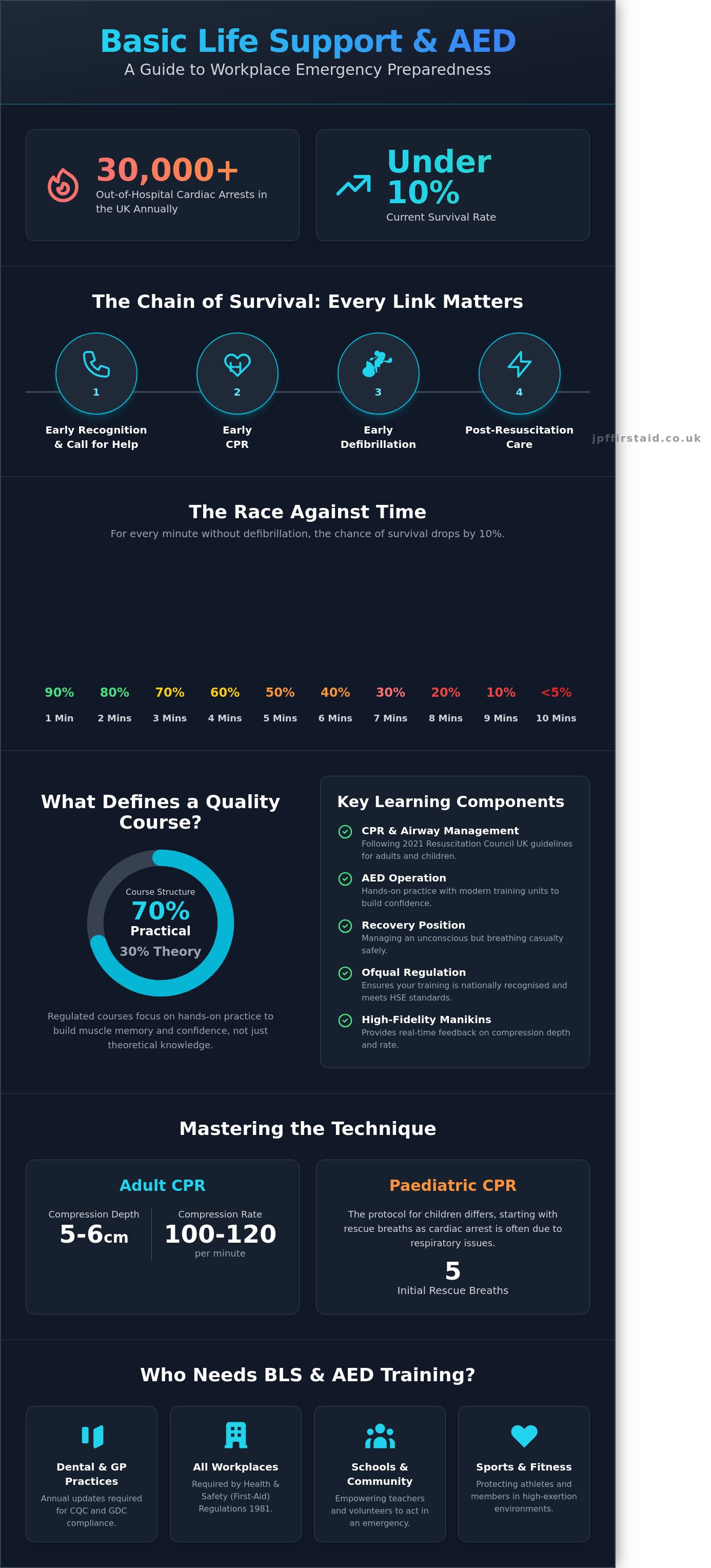
According to the British Heart Foundation’s 2024 report, over 30,000 out-of-hospital cardiac arrests occur annually in the UK, yet the survival rate remains a sobering 10%. You likely already understand that having a defibrillator on the wall isn’t enough if your team feels too intimidated to use it. It’s completely normal to worry that training might be a dry, tick-box exercise or to feel anxious about the responsibility of emergency response. You want a team that isn’t just legally compliant, but one that feels truly prepared to step up when seconds count. Choosing the right basic life support and aed training is the bridge between owning a piece of medical equipment and actually saving a life.
In this 2026 buying guide, you’ll discover how to identify high-quality training that your staff will actually enjoy, moving away from clinical lectures toward practical, confidence-building experiences. We’ll clarify the confusion between regulated and non-regulated certifications and show you how to book hassle-free, on-site delivery that fits your business schedule. This guide provides a clear roadmap to ensure your workplace is safe, compliant, and powered by people who have the skills to act with calm authority in a crisis.
Key Takeaways
- Understand why BLS and AED are critical links in the Chain of Survival and how they provide the foundational care needed during a life-threatening emergency.
- Learn what to look for in a regulated basic life support and aed training course to ensure your team gains both practical manikin skills and essential theoretical knowledge.
- Discover how to choose the right training provider by prioritising accreditation, expert mentorship, and the convenience of bespoke on-site learning.
- Explore the essential steps for maintaining your AED units and fostering a workplace culture of long-term emergency readiness.
- Find out how an engaging and relaxed training atmosphere can replace anxiety with the genuine confidence required to save lives.
What is Basic Life Support and AED Training?
Basic Life Support (BLS) is the foundational level of care provided to individuals experiencing life-threatening illnesses or injuries until they can receive full medical care at a hospital. If you have ever wondered What is Basic Life Support?, it is best understood as the primary safety net in our communities. It doesn’t require complex drugs or invasive surgery; instead, it focuses on keeping the heart pumping and the blood oxygenated through manual intervention. BLS is the combination of CPR and AED use to maintain life until professional help arrives.
While many people confuse this with a broader Emergency First Aid at Work course, there is a distinct difference. A full first aid qualification covers a wide spectrum of workplace incidents, including minor burns, fractures, and eye injuries. In contrast, basic life support and aed training is a concentrated, high-impact session designed specifically for cardiac arrest and choking emergencies. It is the “emergency button” of medical training, stripped of non-essential elements to focus entirely on saving a life in those first critical minutes.
The Chain of Survival: Why Seconds Matter
The “Chain of Survival” is a four-step process that dictates whether a person survives a sudden cardiac arrest. These links include early recognition and call for help, early CPR, early defibrillation, and post-resuscitation care. Every second counts because the statistics are stark: for every minute that passes without defibrillation, the chance of survival drops by 10%. This means after ten minutes without intervention, the odds of a positive outcome are incredibly low. Effective basic life support and aed training helps you make the vital psychological shift from being a worried bystander to a confident first responder. You won’t just stand there; you’ll know exactly how to act.
Who Needs BLS and AED Training?
The Health and Safety (First-Aid) Regulations 1981 require employers to provide adequate equipment and personnel to help if employees are injured or taken ill at work. While every workplace needs a plan, specific sectors have much higher compliance standards. Dental practices and GP surgeries, for example, must complete annual BLS updates to satisfy Care Quality Commission (CQC) and General Dental Council (GDC) requirements. It isn’t just for medical professionals, though. We see a growing demand from community groups, sports coaches, and school teachers. In 2026, having a defibrillator on-site is common, but it’s only effective if your team feels empowered to use it. Our goal is to make that process feel manageable, practical, and even a bit of fun.
Key Components of a Regulated BLS and AED Course
Choosing a basic life support and aed training course isn’t just about ticking a box for compliance. It’s about gaining the confidence to act when every second counts. A regulated course ensures you meet the high standards set by UK workplace first aid regulations, which have governed employer responsibilities since 1981. We focus on a balance of 30% theory and 70% practical work, ensuring you aren’t just listening to a lecture but are actively building muscle memory.
Ofqual regulation is your guarantee of quality. It means the training provider has been rigorously audited, so your certificate carries real weight with HSE inspectors. While the subject matter is serious, our instructors use an engaging and fun approach to keep the atmosphere relaxed. This helps alleviate the “panic factor” often felt during emergencies. We use high-fidelity manikins that provide real-time feedback, so you’ll know exactly how it feels to save a life.
Mastering CPR and Airway Management
We follow the 2021 Resuscitation Council UK guidelines to ensure you’re learning the most effective techniques. For adult CPR, you’ll practice chest compressions at a depth of 5 to 6cm and a rate of 100 to 120 beats per minute. For paediatric care, the protocol changes; you start with 5 initial rescue breaths because children usually suffer from respiratory issues rather than primary cardiac ones. You’ll also learn the recovery position, a vital skill for managing an unconscious casualty who is still breathing, which prevents the tongue from blocking the airway.
Operating an Automated External Defibrillator (AED)
Modern AEDs are designed for everyone to use, and we’re here to demystify them. These devices provide clear voice prompts and will never deliver a shock unless the victim’s heart rhythm requires it. You’ll practice pad placement; for adults, one pad goes on the upper right chest and the other on the lower left side. If a casualty has a pacemaker, you’ll learn to place the pad at least 8cm away from the device to ensure safety. We’ll also cover the essential “stand clear” protocols to keep you and your team safe while the device analyses the heart rhythm. If you’re ready to empower your team with these skills, you can view our available course dates here.
Buying Guide: How to Choose the Right Training Provider
Choosing a provider for your basic life support and aed training shouldn’t feel like a chore. You want a partner who makes the process simple and stress-free. Look beyond the initial price tag to the total cost of ownership. A professional quote should always include certification fees, high-quality training manuals, and any travel expenses. If a provider isn’t transparent about these extras, you might face an unexpected bill later. For more detail on the selection process, read our guide on choosing the right first aid training.
On-Site vs. Public Training Courses
Booking an on-site session is usually the most cost-effective route for businesses with 4 to 12 staff members. It’s often 25% to 35% cheaper per head than sending individuals to a public centre. Training in your own workplace allows the instructor to tailor the scenarios to your specific environment. You’ll learn exactly where your AED is kept and how to manage an emergency in your actual office, shop, or warehouse. Public courses remain a brilliant option for freelancers or small teams of two who need to meet their compliance goals without the need for a full group booking. They offer a great chance to network with other local professionals while gaining life-saving skills.
Regulated vs. Non-Regulated Qualifications
In the UK, the gold standard involves qualifications regulated by Ofqual. These courses are delivered through Awarding Organisations, ensuring the content meets strict national standards. Choosing a regulated course provides vital legal protection for employers. It proves you’ve conducted due diligence by selecting a provider whose curriculum is externally audited. Before you book, ask for the provider’s centre number. You can check this against the Awarding Organisation’s database to confirm they’re legitimate. This ensures your team learns exactly how to use a defibrillator according to the latest Resuscitation Council UK guidelines. It’s about peace of mind for you and safety for your staff.
The Importance of Engaging Training Delivery
Dry, clinical training often leads to poor knowledge retention. You need a trainer who brings energy and a bit of “fun” to the classroom. When people are relaxed, they’re more likely to ask questions and build the confidence required to act in a crisis. High-quality basic life support and aed training uses modern manikins equipped with real-time digital feedback. These devices show you exactly how deep your chest compressions are, which is essential for precision. Check recent reviews from the last 12 months. Look for mentions of the trainer’s personality and their ability to make complex medical topics feel accessible. A “hassle-free” booking process and flexible scheduling are the final hallmarks of a provider who truly values your time.
Preparing Your Workplace for BLS Excellence
Completing your basic life support and aed training is a fantastic milestone for your team, but the real work begins when the trainer leaves the building. Creating a “Rescue Ready” environment ensures that those hard-earned skills can be deployed effectively under pressure. You need to move from theory to a state of permanent readiness where every staff member knows exactly where to go and what to do when a cardiac emergency occurs.
Defibrillator Placement and Maintenance
Visibility is the most critical factor for AED success. Research from the Resuscitation Council UK indicates that every minute’s delay in defibrillation reduces the chance of survival by up to 10 percent. You should place your AED in a central, high-traffic area like a reception desk or a main staff breakroom. Never keep your defibrillator in a locked cupboard or behind a coded door; it must be accessible to everyone, including visitors, within seconds. Use high-visibility ILCOR-standard signage to mark the location clearly from multiple angles.
Maintaining the unit is just as vital as its location. You should assign a dedicated “AED Warden” to perform monthly checks using this simple checklist:
- Status Indicator: Check that the green “OK” light or tick symbol is visible on the front of the unit.
- Pad Expiry: Ensure the electrode pads are still within their use-by date, as the gel can dry out over time.
- Battery Life: Verify the battery hasn’t reached its replacement date, typically every two to five years depending on the model.
- Rescue Kit: Confirm the presence of a prep kit containing scissors, a razor, gloves, and a pocket mask.
Maintaining Skills and Confidence
Skill fade is a documented challenge in emergency response. While most certificates for basic life support and aed training are valid for three years, the Resuscitation Council UK strongly recommends annual refresher sessions to keep techniques sharp. Practical confidence often dips long before the certificate expires, so short, “hassle-free” drills can make a massive difference. You can run five-minute “toolbox talks” or surprise location checks to ensure everyone remembers where the AED is kept and how to activate the emergency response plan.
For a deeper dive into the latest protocols, you can consult our guide to BLS and CPR. This resource helps your team stay informed about current best practices between formal training dates.
Finally, remember your legal obligations under the Health and Safety (First-Aid) Regulations 1981. You must keep accurate records of all first aid training and maintain an incident report book. If a serious injury or cardiac event occurs on-site, you may need to report it under RIDDOR (Reporting of Injuries, Diseases and Dangerous Occurrences Regulations). Keeping these records organised ensures your business remains compliant and demonstrates a clear commitment to staff welfare.
Ready to ensure your team stays sharp and compliant? Book your annual BLS refresher with JPF First Aid today.
Why Choose JPF First Aid for Your BLS Training?
Choosing a provider for your basic life support and aed training shouldn’t feel like a chore. You want a mentor who brings both authority and a sense of calm to the room. JPF First Aid, led by John Fogarty, has spent a decade refining a teaching style that balances professional standards with a personable touch. As a multi-award-winning provider, we’ve helped thousands of people overcome the fear of “doing it wrong” during a cardiac arrest. We act as your reliable expert mentor, guiding you through the technicalities of resuscitation without the dry, clinical atmosphere of traditional courses.
The core of our mission is making life-saving skills accessible to everyone. We understand that the responsibility of learning medical procedures can feel overwhelming. That is why we focus on creating a supportive space where questions are encouraged. You aren’t just another number in a classroom; you’re a future life-saver.
Our sessions are intentionally engaging and fun. We’ve found that people learn best when they’re relaxed, not when they’re staring at a screen for four hours. By creating an interactive environment, we ensure that the skills stick. You’ll leave the session feeling empowered, not just “certified.” We offer total flexibility for your schedule, whether you need us to travel to your site or you prefer to join a local session.
A Personal Approach to Professional Standards
We tailor every course to the specific risks of your workplace. A warehouse team has different needs than a school staff, so we adjust our scenarios accordingly. The use of premium training equipment, such as Laerdal QCPR manikins, provides 100% accurate feedback on compression depth. This hands-on focus ensures every delegate gets the practice they need to feel ready. We replace clinical coldness with a “can-do” attitude that builds lasting confidence.
Simple Booking and Reliable Support
Booking your session is a completely hassle-free experience. We’ve streamlined everything from the initial quote to the final certification. You won’t be chasing us for paperwork; we deliver digital certificates promptly so your compliance records stay up to date. Join the community of over 8,500 confident first aiders we’ve trained across the UK. Don’t leave your safety to chance in 2026. Contact us today to book your basic life support and aed training and give your team the skills they need to save a life.
Secure Your Team’s Life-Saving Skills for 2026
Equipping your staff with basic life support and aed training is the most vital investment you’ll make this year. You now understand that prioritising Ofqual regulated qualifications ensures your business remains fully compliant with the latest UK Resuscitation Council guidelines. Choosing a training partner that balances professional rigour with a relaxed atmosphere is the key to ensuring knowledge actually sticks when a real emergency occurs. Practical skills are only useful if your team feels empowered to use them.
JPF First Aid is a multi-award-winning training provider dedicated to making first aid accessible for everyone. We believe that learning shouldn’t be intimidating; that’s why we’ve developed an engaging and fun delivery style that replaces panic with practical confidence. Our expert instructors come directly to your venue to provide bespoke sessions that fit your schedule. With our proven track record of delivering high-quality, regulated training across the UK, you can rest assured your team is in safe hands.
Book Your Engaging BLS and AED Training Today
You’ve got the power to create a safer environment, and we’re ready to help you every step of the way.
Frequently Asked Questions
How long does a basic life support and AED training course take?
A standard basic life support and AED training course takes between 3 and 4 hours to complete. This half-day session provides enough time for you to gain hands-on experience with manikins and trainer defibrillators. It’s a popular choice for 85% of our workplace clients because it fits into a single morning or afternoon while remaining thorough and engaging.
Do I need any prior first aid experience to attend?
You don’t need any previous first aid knowledge or qualifications to join this course. We’ve designed the training to take you from a complete beginner to a confident life-saver in a single session. You’ll learn how to identify an emergency, perform effective CPR, and use a defibrillator safely without any “medical” jargon or stress.
Is the AED training certificate legally recognised in the UK?
Yes, our Level 2 regulated qualifications are fully recognised across the UK and meet the strict standards set by the Health and Safety Executive (HSE). Because these courses are overseen by Ofqual-recognised awarding bodies, they provide the necessary due diligence for your business. This ensures your 2026 compliance requirements are met while giving your team skills they can trust.
Can a defibrillator accidentally shock someone who doesn’t need it?
No, an AED won’t deliver a shock to someone who doesn’t need it because the device’s internal software must first detect a shockable rhythm. If the unit doesn’t identify ventricular fibrillation, the shock button simply won’t work. This built-in safety feature is a key part of our training, ensuring you feel confident using the equipment in a real emergency.
How often should BLS and AED training be refreshed?
While your certificate is valid for 3 years, the Resuscitation Council UK recommends that you attend a refresher session every 12 months. Research shows that CPR skills can begin to decline within 6 months of training. An annual top-up ensures your staff remain 100% capable of acting decisively if a cardiac arrest occurs at your premises.
Is the training different for children and babies?
Yes, the techniques for performing CPR and using an AED change when you’re treating a child or an infant. Our basic life support and AED training covers these vital differences, such as using one hand for child compressions or two fingers for babies. You’ll also learn how to use paediatric pads or child-mode switches to ensure the shock level is safe for younger casualties.
What is the difference between BLS and Emergency First Aid at Work?
BLS and AED training focuses specifically on cardiac arrest and defibrillation, whereas Emergency First Aid at Work (EFAW) is a 6-hour course covering a wider range of incidents. While BLS is a deep dive into heart-start skills, EFAW includes modules on choking, heavy bleeding, and minor injuries. If you only need to master the defibrillator, the shorter BLS course is your most efficient option.
Recent Comments