

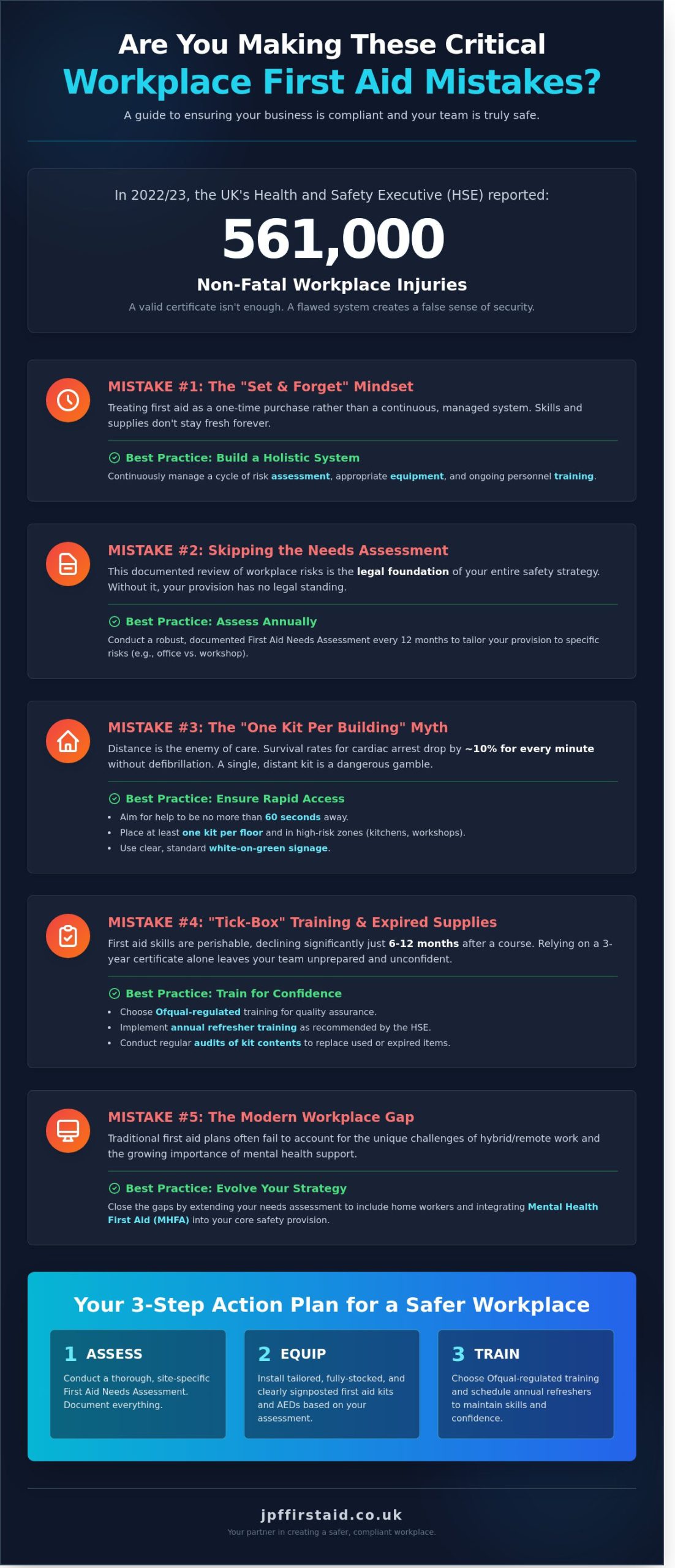
What if the certificate hanging on your office wall is actually giving you a false sense of security? It’s a sobering thought, but many UK business owners are currently overlooking common mistakes in workplace first aid provision that could lead to serious legal issues or, worse, an ineffective response during a crisis. With the Health and Safety Executive (HSE) reporting 561,000 non-fatal workplace injuries in 2022/23, ensuring your setup is robust for 2026 isn’t just about ticking a box; it’s about genuine peace of mind.
We know that understanding the difference between EFAW and FAW training can feel overwhelming, especially when you’re also trying to manage first aid for a growing team of remote and hybrid workers. You want to protect your staff and your business, but the fear of getting it wrong and facing liability is real. This guide is here to help you bridge that gap. You’ll discover how to identify and rectify frequent errors in your first aid setup to ensure full legal compliance and total staff safety.
We’re going to break down the current UK requirements and provide a practical checklist to audit your workplace. By the end, you’ll have the confidence that your team can actually handle an emergency, rather than just holding a piece of paper.
Key Takeaways
- Move beyond the “set and forget” mentality by learning how to build a holistic system of assessment, equipment, and trained personnel tailored to your specific site.
- Identify and rectify common mistakes in workplace first aid provision, such as using generic “one-size-fits-all” kits that fail to meet UK legal requirements.
- Ensure your team is truly prepared by choosing Ofqual-regulated training that focuses on building practical confidence rather than just “ticking a box.”
- Address modern challenges by closing the gaps in first aid for hybrid employees and integrating mental health support into your core safety strategy.
- Learn how to conduct a robust First Aid Needs Assessment every 12 months to maintain seamless compliance and keep your staff safe in an evolving workplace.
Beyond the Box: Why Workplace First Aid Provision Often Fails Compliance
Many business owners assume a dusty green box on the wall covers their legal duties. It doesn’t. Workplace first aid provision is a holistic system that integrates a formal risk assessment, physical equipment, and your trained personnel. Thinking of it as a simple purchase rather than a managed system is one of the most common mistakes in workplace first aid provision across the UK.
The Health and Safety Executive (HSE) requires you to provide “adequate and appropriate” equipment and facilities. This isn’t a suggestion; it’s a legal obligation under the Health and Safety (First-Aid) Regulations 1981. According to HSE statistics for 2022/23, 561,000 workers sustained a non-fatal injury at work. When your provision is poor, you don’t just risk a fine. You risk the wellbeing of your team and your business continuity. Effective first aid keeps people at work and shows your staff that their safety is your priority, boosting morale and trust in your leadership.
The Fatal Flaw: Skipping the First Aid Needs Assessment
You can’t fix a problem you haven’t identified. A First Aid Needs Assessment is a documented review of your specific workplace risks. The First Aid Needs Assessment is the legal foundation of all workplace safety provision. Many managers make the error of treating an office environment the same as a chemical processing plant. While an office might only need to account for trips or minor burns in the kitchen, a workshop requires specific items like eyewash stations or trauma dressings for crush injuries. Without this document, your entire safety strategy lacks a legal leg to stand on if an inspector visits or an accident occurs.
Ignoring Geography: The “One Kit per Building” Myth
Distance is the enemy of life-saving care. If a colleague suffers a cardiac arrest or a catastrophic bleed, every second is vital. Survival rates for cardiac arrest drop by roughly 10% for every minute that passes without defibrillation. Relying on a single kit tucked away in a ground-floor reception is a dangerous gamble if your business spans three floors or includes a detached warehouse.
- Multi-floor layouts: You should aim for at least one kit per floor to ensure help is never more than 60 seconds away.
- High-risk zones: Kitchens, workshops, and laboratories need dedicated kits regardless of how close the main office kit is.
- Visibility: Kits must be clearly signposted with standard white-on-green symbols so that even a panicked visitor can find them instantly.
We see many businesses hide their kits in locked cupboards or behind stacks of files. Accessibility is just as important as the contents of the box itself. By organising your equipment logically and ensuring your team knows exactly where to find it, you turn a compliance checkbox into a genuine safety net.
Equipment and Personnel Pitfalls: More Than Just a Valid Certificate
Many business owners fall into the “set and forget” trap. You’ve likely got a certificate on the wall and a green box in the canteen, so you feel protected. However, treating compliance as a one-time event is one of the most common mistakes in workplace first aid provision. Skills and supplies don’t stay fresh forever. The HSE recommends annual refresher training because first aid knowledge is perishable. Research indicates that life-saving skills begin to decline significantly just 6 to 12 months after a course. By the time a real emergency happens in year three of a certificate, your team’s confidence may have vanished.
You must also distinguish between an “Appointed Person” and a “First Aider” to avoid serious legal gaps. Under the Health and Safety (First-Aid) Regulations 1981, an Appointed Person is someone who looks after equipment and calls the emergency services. They don’t necessarily have formal medical training. If your risk assessment identifies a need for a trained responder, relying on an Appointed Person isn’t enough. It’s also vital to communicate who your responders are. If an accident happens and nobody knows who to call or where they’re stationed, those seconds lost can change an outcome.
The First Aid Kit Audit: Common Omissions
A 2023 industry survey suggested that nearly 30% of workplace first aid kits contain expired sterile items. Once the seal on a bandage or dressing passes its expiry date, it’s no longer guaranteed to be sterile or effective. You should also watch out for “Missing Plaster Syndrome.” This happens when staff use the kit for minor scrapes without reporting it, leaving the kit empty when a major injury occurs. Your equipment must always align with your emergency first aid at work compliance requirements to ensure you’re prepared for the specific risks of your industry.
The Wrong Level of Training for the Risk
Choosing a 1-day EFAW course when your high-risk environment actually requires a 3-day FAW qualification is a frequent oversight. You need to look at your shift patterns and staff leave. If your only first aider is on annual leave or off sick, your business is technically non-compliant and your staff are at risk. We recommend a ratio that accounts for 20% extra cover to handle these absences. If you’re feeling unsure about your current setup, we can help you find hassle-free training solutions that bring your team up to speed on-site.
Training Errors: Why “Tick-Box” Exercises Leave Teams Unprepared
You might think you’ve ticked the health and safety box by booking the cheapest course you found online. However, one of the most common mistakes in workplace first aid provision is overlooking the regulatory framework. Choosing non-Ofqual regulated training might save a few pounds initially, but it often leaves you with a qualification that doesn’t meet Health and Safety Executive (HSE) standards. In 2024, the HSE updated their guidance to emphasise that employers must ensure training providers are competent. If your provider can’t demonstrate a clear internal quality assurance process, your staff aren’t truly protected.
Beyond regulation, the style of delivery matters. Dry, overly clinical sessions lead to a 70% drop in information retention within just 24 hours. You want your team to feel ready, not bored. We believe first aid should be engaging and practical. When you integrate these first aid courses into a wider culture of care, it stops being a chore and becomes a valued life skill. This approach helps avoid the common mistakes in workplace first aid provision that occur when training feels like a burden rather than a benefit.
Certification vs. Competence
A certificate on a wall doesn’t guarantee an employee will step forward when someone collapses. True competence is the ability to act calmly under pressure, not just pass a multiple-choice test. We focus on “engaging and fun” training because it reduces learner anxiety. By using realistic scenarios, we build the muscle memory needed to overcome the “Panic Factor.” This hands-on approach ensures your team has the confidence to lead during a medical emergency, turning a passive learner into a capable first aider.
Inadequate Focus on Life-Saving Tech
It’s a massive oversight to install an Automated External Defibrillator (AED) and then leave it in a cupboard. Many people wrongly assume AEDs are only for older populations, despite the British Heart Foundation reporting that cardiac arrests can happen to anyone, at any age. Your basic life support training must include physical practice with trainer AEDs and manikins. Without this experience, the fear of “doing it wrong” often prevents bystanders from using life-saving tech that’s designed to be foolproof. Don’t let your equipment go to waste because of a lack of practical familiarity.
The Modern Workplace: Mental Health and Hybrid Provision Gaps
The way we work changed forever in 2020, yet many safety protocols remain stuck in the past. One of the most common mistakes in workplace first aid provision is treating the physical office as the only site of risk. If your team is split between a kitchen table and a city-centre boardroom, your old risk assessment is likely obsolete. Failing to adapt to these shifts creates dangerous gaps in your safety net.
Mental Health First Aid: The Missing Link
Physical first aid kits deal with cuts and burns, but they cannot help a colleague experiencing a panic attack or a mental health crisis. HSE statistics for 2022/23 show that stress, depression, or anxiety accounted for 49% of all work-related ill health. Physical provision alone is no longer sufficient for modern UK compliance. A major error is expecting your standard first aiders to manage psychological distress without specific mental health first aid training. Providing visible, trained support helps destigmatise these issues and ensures your staff feel genuinely supported. It moves your culture from reactive to proactive, building the confidence your team needs to thrive.
The Remote Worker Blind Spot
You’re legally responsible for your employees’ safety even when they aren’t on-site. Under the Health and Safety at Work etc. Act 1974, your duty of care extends to home-based and lone workers. Many businesses overlook this, leaving remote staff without basic equipment or emergency protocols. To fix this, consider these steps:
- Issue portable, personal first aid kits to all remote staff.
- Establish digital “first response” protocols so home workers know who to contact in an emergency.
- Include remote workers in your annual first aid drills via video link to maintain a sense of community.
As your workforce grows or changes its operating model, your provision must keep pace. A company that expands from 10 to 50 employees or moves to a “work from anywhere” policy needs a total reassessment of its needs. Ignoring these changes doesn’t just risk a fine; it undermines the psychological safety of your entire organisation. You should review your first aid needs assessment every 12 months to ensure no one is left behind. This keeps your business compliant and your people feeling valued.
Don’t let your safety strategy fall behind the times. Contact JPF First Aid for a bespoke assessment of your hybrid team’s needs.
How to Optimise Your First Aid Provision for 2026 and Beyond
Effective safety management isn’t a static task you can “set and forget”. To avoid the most common mistakes in workplace first aid provision, you should conduct a fresh First Aid Needs Assessment every 12 months. This ensures your equipment and personnel levels match your current staff headcount and any new machinery or site hazards introduced since your last review. If your business has moved to a hybrid model or expanded its floor plan in the last year, your old assessment is likely obsolete.
You can improve your safety culture by shifting your goal from “minimum compliance” to “maximum confidence”. This starts with a robust reporting system for incidents and near-misses. When you track every minor slip or close call, you gain the data needed to refine your provision before a serious injury occurs. For example, if 15% of your near-misses happen in the warehouse loading bay, you know exactly where to station your most experienced first aiders.
Promotion is just as vital as preparation. You should ensure every staff member knows exactly who to call by displaying clear, updated photos of your first aiders in communal areas. This removes the “panic gap” that occurs when an emergency happens and nobody knows who is qualified to help.
Choosing a Training Partner, Not Just a Provider
Bespoke, on-site training transforms your actual workplace into a classroom. This makes the learning far more relevant than a generic session in a hotel conference room. At JPF First Aid, we focus on making our sessions engaging and fun. We believe that when learners are relaxed and enjoying themselves, life-saving skills actually stick. We also take the hassle out of your hands by tracking your certificates and renewal dates for you. You don’t have to worry about expiring qualifications; we’ll let you know when it’s time for a refresher.
Building a Culture of Confidence
The biggest barrier to effective first aid isn’t a lack of kits; it’s the fear of doing it wrong. You can dismantle this anxiety through regular, low-stakes practice sessions. These short “skills drills” keep techniques fresh in the mind without the pressure of a full assessment. Safety is a holistic effort, which is why fire marshal training and first aid work so well together. When your team understands how to manage both a medical emergency and a building evacuation, they create a truly resilient environment. Review your provision today to save a life tomorrow.
Future-Proof Your Team’s Safety for 2026
Ensuring your team stays safe means looking beyond the basics of a simple first aid kit. By 2026, regulatory expectations will require businesses to account for modern challenges like hybrid working and mental health support. Avoiding common mistakes in workplace first aid provision starts with moving away from “tick-box” exercises and investing in skills that actually stick. You’ve got to ensure your personnel aren’t just certified but are genuinely confident to act when every second counts. Practical, hands-on training is the only way to bridge the gap between having a certificate and saving a life.
Compliance doesn’t have to be a headache or a dry classroom experience. We provide Ofqual regulated qualifications through expert-led, confidence-building sessions. As a multi-award-winning training provider, we’ve helped thousands of learners feel empowered rather than overwhelmed. Our sessions are designed to be relaxed and accessible, ensuring every member of your team leaves with a “can-do” attitude.
Book an engaging, hassle-free First Aid course for your team today and see how simple professional compliance can be. We’re here to help you create a safer, more prepared workplace with training you can truly trust.
Frequently Asked Questions
What is the most common mistake in workplace first aid provision?
The most common mistake in workplace first aid provision is treating health and safety as a static “tick-box” exercise rather than an evolving process. Many managers buy a standard kit and assume they’re covered for years. According to HSE data from 2023, 561,000 workers sustained a non-fatal injury at work. Without a tailored risk assessment, you won’t have the specific items needed for your industry, such as burns gel for kitchens or foil blankets for outdoor sites.
How many first aiders do I legally need for my business?
Your legal requirement depends entirely on your specific risk assessment and staff numbers. For low-risk environments like offices with fewer than 25 employees, you need at least one “appointed person” to manage first aid arrangements. If you have 25 to 50 employees, you must have at least one person trained in Emergency First Aid at Work (EFAW). In higher-risk sectors like construction, you’ll need one fully qualified first aider for every 50 workers on site.
Is a first aid kit enough to be legally compliant in the UK?
No, a first aid kit alone doesn’t meet the requirements of the Health and Safety (First-Aid) Regulations 1981. You’re legally required to provide adequate and appropriate equipment, facilities, and personnel. This means you must have a designated person or trained first aider available whenever people are at work. You also need clear signage and a written assessment that justifies why your provision is sufficient for your specific workplace hazards and employee count.
Do I need a different first aid assessment for remote or hybrid workers?
Yes, you must account for remote and hybrid staff in your safety planning. Employers have the same legal duty of care for employees working from home as they do for those in a central office. You should provide remote workers with basic first aid kits and ensure they know how to report accidents. Since the shift to hybrid models in 2020, your on-site assessment must also reflect fluctuating staff numbers to ensure a first aider is always present.
Can I be sued for giving first aid in the workplace if I make a mistake?
It’s extremely rare for a first aider to be sued in the UK if they’ve acted in good faith and within the scope of their training. The Social Action, Responsibility and Heroism (SARAH) Act 2015 was specifically designed to protect people who step in to help during emergencies. As long as you follow the protocols taught in our regulated qualifications, the courts recognise that you acted to save a life in a high-pressure situation. This helps build the confidence you need to act.
How often should workplace first aid kits be checked and restocked?
You should check your first aid kits at least once every month to ensure no items have expired or been used. Most sterile items, such as bandages and eye pads, have a shelf life of 3 to 5 years. If you find an item past its expiry date, you must replace it immediately to remain compliant. Keeping a simple logbook next to the kit helps track these monthly checks and ensures you’re never caught short during a medical emergency.
What is the difference between EFAW and FAW training?
The primary difference lies in the depth of training and the time commitment. Emergency First Aid at Work (EFAW) is a one-day course designed for low-risk environments. It covers essential life-saving skills like CPR and wound management. First Aid at Work (FAW) is a three-day programme that provides more comprehensive knowledge, including how to handle various medical conditions and major illnesses. Selecting the wrong level is one of the common mistakes in workplace first aid provision that can leave staff vulnerable.
Is mental health first aid a legal requirement in UK workplaces for 2026?
While mental health first aid isn’t currently a standalone legal requirement like physical first aid, HSE guidance updated in 2019 insists that employers must consider mental health in their first aid needs assessment. With 17.1 million working days lost to stress, depression, or anxiety in 2022/23, the standards for 2026 expect a holistic approach. We recommend training staff to recognise mental health triggers to ensure your team feels supported and your business remains resilient and compliant.
Recent Comments