

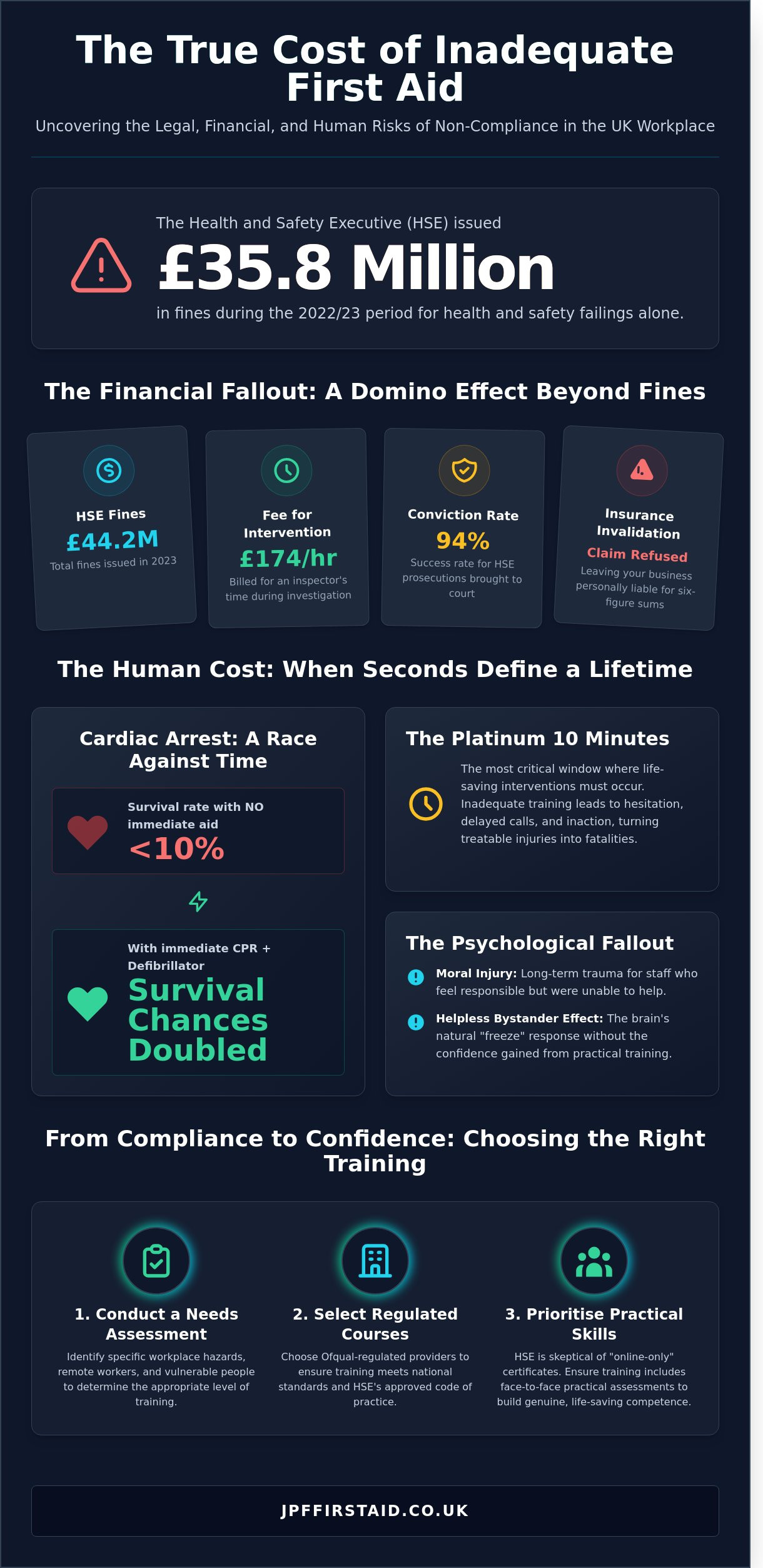
Did you know that the Health and Safety Executive (HSE) issued £35.8 million in fines during the 2022/23 period for health and safety failings? While you work hard to keep your team safe, many leaders don’t realise that the consequences of inadequate first aid training uk go much deeper than a financial penalty. It’s natural to feel a sense of anxiety about whether your current setup is truly robust or if you’re just ticking a box. You care about your people, and you want to know that if an accident happens, your team has the skills to handle it with calm, practical confidence.
We believe that meeting your legal obligations should be a straightforward, empowering process rather than a source of stress. In this article, you’ll discover the legal, financial, and human risks of poor first aid provision and how to protect your organisation from these pitfalls. We will walk you through the critical differences between “adequate” and “compliant” training so you can ensure business continuity and, most importantly, keep your staff safe and well.
Key Takeaways
- Understand how to meet the latest HSE standards for “adequate and appropriate” provision to ensure your business remains fully compliant and ready for inspection.
- Learn why every second counts during a medical emergency and how to prevent the devastating human consequences of inadequate first aid training uk.
- Protect your team’s mental wellbeing by identifying the risks of “moral injury” and the long-term trauma associated with the helpless bystander effect.
- Uncover the hidden operational and financial costs of a workplace incident, from complex RIDDOR reporting to the domino effect on your daily business continuity.
- Discover how to select Ofqual-regulated, bespoke training that transforms a legal obligation into a practical, confidence-building experience for your staff.
The Legal and Regulatory Reality: HSE Compliance in 2026
The legal landscape for workplace safety in the UK is clearer than ever, yet many business owners still struggle to define “adequate and appropriate” provision. In simple terms, the Health and Safety Executive (HSE) requires you to ensure that an injured or ill person receives immediate attention. This duty is anchored in the Health and Safety at Work etc. Act 1974, which establishes your primary responsibility to protect employees. By 2026, regulatory inspections have become more rigorous, focusing on whether your first aiders actually have the confidence to act, rather than just holding a piece of paper.
The 2026 regulatory environment now explicitly prioritises mental health alongside physical safety. The HSE expects your risk assessments to reflect this parity. If you’re found negligent, the penalties are severe. Courts can impose unlimited fines or custodial sentences for individual directors if a lack of training leads to a preventable fatality. It’s a heavy responsibility, but meeting these standards doesn’t have to be a daunting process.
Understanding Your Statutory Obligations
You’ll need to decide between Emergency First Aid at Work (EFAW) and the more comprehensive First Aid at Work (FAW) qualification. EFAW is typically a one-day course suited for low-risk environments, while the three-day FAW course is essential for high-risk sectors like construction or manufacturing. A robust First Aid Needs Assessment is your best tool here. It helps you identify specific hazards, such as remote working locations or the presence of vulnerable members of the public.
The HSE remains skeptical of “online only” certificates for practical life-saving skills. You can’t learn the physical depth of a chest compression or the correct positioning for a recovery turn through a laptop screen. To meet the 2026 standards, your training must involve face-to-face practical assessments. This ensures your team gains the genuine competence required to save a life when every second counts.
The Consequences of Non-Compliance
The consequences of inadequate first aid training uk extend far beyond a simple ticking off. If an inspector finds a breach, they will likely apply the Fee for Intervention (FFI) scheme. This means you’ll be invoiced for the inspector’s time, currently charged at £174 per hour, while they investigate the failure. In 2023, the HSE issued £44.2 million in total fines, with a staggering 94% conviction rate for prosecutions brought to court.
Ignoring these requirements also creates a massive financial risk through your insurance provider. Most employer liability policies contain a clause stating you must comply with all statutory regulations. If an accident occurs and your first aider is poorly trained or their certificate has expired, your insurer may refuse to pay the claim. This leaves your business personally liable for legal fees and compensation, which often reach six-figure sums. Investing in regulated, high-quality training is a simple way to protect your people and your bottom line simultaneously.
The Human Cost: Mortality, Morbidity, and Skills Fade
When an emergency happens, the clock starts instantly. One of the most devastating consequences of inadequate first aid training uk is the loss of life during what paramedics call the “Platinum Ten Minutes.” While the “Golden Hour” is a well-known window for trauma survival, the first ten minutes are often when the most critical, life-saving interventions must occur. If you haven’t been trained to act, your brain’s natural response is often to freeze. This hesitation leads to delayed emergency calls and a total lack of initial care, which can turn a treatable injury into a fatality.
Inadequate training doesn’t just lead to inaction; it can lead to dangerous mistakes. Without the “can-do” confidence that comes from a practical course, people may inadvertently cause further harm. For example, moving someone with a suspected spinal injury incorrectly or performing ineffective CPR can lead to permanent morbidity. Following HSE’s approved code of practice ensures that your workplace first aid provision is “adequate and appropriate,” reducing these physical risks through regulated, high-quality instruction.
When Seconds Count in Life-Threatening Emergencies
The reality of cardiac arrest is stark. In the UK, survival rates for out-of-hospital cardiac arrests remain below 10%, yet immediate, high-quality CPR combined with a defibrillator can double these chances. If you don’t have the skills to recognise the signs early, those seconds are lost forever. Similarly, managing catastrophic bleeds requires decisive action. A person can bleed to death from a major arterial wound in less than five minutes if a tourniquet or direct pressure isn’t applied correctly. Whether it’s choking or a severe anaphylactic reaction, any delay in treatment can be fatal before the ambulance even arrives.
The Science of Skill Retention
Many people assume a three-year certificate means they’re prepared for three years, but “Skills Fade” is a documented medical reality. Motor skills for CPR begin to decline within months of training. This is why we always suggest that annual refresher sessions are more than just a box-ticking exercise; they’re essential for maintaining the muscle memory needed to act under pressure. Engaging in regular first aid courses helps bridge the gap between theoretical knowledge and the ability to take life-saving action when it truly matters. If it has been a while since your last session, you can refresh your confidence with us to ensure you’re always ready to help.
The Psychological Fallout: Moral Injury and Staff Wellbeing
When a colleague collapses or suffers a serious injury and no one in the room knows how to respond, the damage isn’t just physical. You’re left with a phenomenon known as “moral injury.” This term describes the deep psychological distress that occurs when someone feels they’ve failed to prevent harm or witnessed a failure of care. In a workplace setting, the consequences of inadequate first aid training uk extend far beyond the initial medical emergency. It creates a “helpless bystander” effect that can haunt a team for years, leading to a breakdown in the social fabric of your business.
The Trauma of the Untrained Bystander
The burden of the “untrained bystander” is a heavy one. When an emergency occurs, an employee without skills doesn’t just feel worried; they feel a crushing sense of guilt that manifests as the “what if I had known what to do?” cycle. This secondary trauma doesn’t simply vanish once the ambulance leaves the site. It lingers, often resulting in the following issues:
- Erosion of Trust: Employees lose faith in leadership when they realise they haven’t been equipped with basic life-saving tools.
- Decreased Retention: Staff are 45% more likely to leave an organisation that they perceive lacks a “culture of care.”
- Long-term Anxiety: Witnessing an unmanaged emergency can lead to post-traumatic stress symptoms among the wider team.
Adhering to the Health and Safety Executive (HSE) regulations is your legal baseline, but true leadership goes further. It’s about ensuring your team feels safe and empowered. When you invest in high-quality, engaging training, you’re telling your staff that their lives and their peace of mind matter. Without this, the consequences of inadequate first aid training uk often manifest as a toxic atmosphere where employees feel vulnerable and undervalued.
Mental Health First Aid: The Missing Link
By 2026, it’s clear that physical first aid is only half the battle. Ignoring the early signs of workplace stress or a psychological crisis is just as dangerous as ignoring a physical wound. One of the most significant risks of a limited safety strategy is the spike in burnout and absenteeism. When a team feels unsupported during high-stress periods, productivity typically drops by an average of 25% as morale hits rock bottom.
This is why mental health first aid has become such a vital preventative tool. It allows your team to spot the subtle signs of a crisis before it escalates. By training your staff to handle both physical and mental emergencies, you’re building a resilient workforce. You’re moving away from a reactive “fix it when it breaks” mindset and toward a proactive, supportive environment where everyone has the confidence to step in and help.
Financial and Operational Damage: Beyond the Initial Fine
A court-ordered fine is a visible scar, but the internal damage to your company’s health is often far more severe. The ripple effect of a serious incident touches every part of your daily operations. It starts with the immediate shock to the team and quickly evolves into a complex administrative nightmare. The consequences of inadequate first aid training uk extend well beyond the courtroom, impacting your bottom line for years through hidden costs and lost time.
Operational Disruption and Lost Productivity
When an accident occurs, the clock starts ticking on your productivity. If the injury is serious enough to trigger a RIDDOR report, you’ll face hours of internal investigation and administrative work. If the Health and Safety Executive (HSE) decides to visit, they have the power to shut down your entire site or office while they conduct their enquiries. This isn’t just a minor delay; it’s a total halt in revenue that can last days or even weeks.
Managing long-term sickness absence is another hidden drain on your resources. When an injury isn’t treated correctly in those first few golden minutes, the recovery time often doubles or triples. You lose a skilled team member and face the immediate cost of hiring temporary cover or paying overtime to others. The trauma of seeing a colleague suffer because of a lack of help can also lead to higher staff turnover. People simply don’t stay in environments where they don’t feel safe.
Reputation and Brand Value
In our digital age, bad news travels at lightning speed. A single report of a safety failure can go viral on social media or hit the local news within hours. This erodes the trust you’ve spent years building with your clients. You’ll find that winning new contracts becomes significantly harder when your safety record is tarnished. Large-scale procurement teams in 2026 now scrutinise safety data as a primary filter for tenders; a single “inadequate” rating can disqualify you instantly.
Investing in emergency first aid at work isn’t just about ticking a box for compliance. It’s a powerful marketing asset that proves you value your people. It shows potential clients and new recruits that you run a professional, high-standard operation where safety is a priority, not an afterthought.
Negligence claims also lead to sharp hikes in your insurance premiums. Once a claim is successfully made against you, your risk profile changes in the eyes of underwriters. You’ll be paying for that one mistake through increased monthly costs for the foreseeable future. Professional legal fees for defending these claims often reach five-figure sums, even if you aren’t found fully liable. It’s clear that the consequences of inadequate first aid training uk are far more expensive than the training itself.
Protecting Your Organisation: Choosing Regulated Excellence
Ensuring your workplace is safe involves more than hanging a green sign on the wall. You’ve got to move beyond simple compliance to protect your people properly. The severe consequences of inadequate first aid training uk include not just legal fines, but the devastating impact on staff morale after a mishandled incident. Choosing an Ofqual-regulated qualification ensures your team learns from a framework that meets rigorous national standards. This isn’t just about a piece of paper. It’s about the 85% of learners who report higher confidence levels when they practice in their own work environment rather than a generic classroom.
We believe that if you’re laughing, you’re learning. Our sessions are designed to be fun and interactive, stripping away the clinical dread often associated with medical training. By choosing on-site, bespoke training, we tailor the scenarios to the specific risks of your industry, whether that is a high-risk construction site or a busy retail floor. This “First Aid First” culture transforms your staff from passive bystanders into a proactive safety net.
Vetting Your Training Provider
You’ll want to avoid the trap of “certificate mills” that offer the lowest prices but skip the practical rigour required for real emergencies. Before booking, ask if their trainers have recent frontline experience, such as being a paramedic or nurse. You should also verify their public liability insurance; it should typically cover at least £5 million to ensure your organisation is protected. Blended learning is a fantastic option here. It combines online theory with a full day of hands-on practice, saving you 50% of out-of-office time while maintaining high standards.
Implementing a Long-Term Safety Strategy
Safety isn’t a one-off event; it’s a continuous process. You should organise surprise drills every six months to test your team’s response times and check if your AED batteries are still functional. While you must have designated aiders, the most resilient companies provide basic life support training for every staff member. When everyone knows how to perform CPR, the chances of survival during a cardiac arrest can double. At JPF First Aid, we make this process hassle-free by bringing the training to you, focusing on building genuine confidence through relaxed, expert-led sessions.
Securing Your Workplace Future Through Regulated Excellence
The Health and Safety Executive (HSE) is clear that compliance isn’t just a box-ticking exercise; it’s a vital safeguard against the consequences of inadequate first aid training uk. Research from the Resuscitation Council UK shows that life-saving skills can decline significantly within six months of a course. This skills fade leads to more than just regulatory fines. It creates a culture of anxiety and moral injury among staff who feel unprepared during a medical crisis. By prioritising Ofqual-regulated qualifications, you protect your team’s mental wellbeing and your organisation’s operational stability.
You don’t have to navigate these 2026 requirements alone. As a multi-award-winning training provider, we bring on-site convenience directly to your premises. We host engaging and fun sessions that replace clinical boredom with practical, life-saving skills. It’s time to move beyond simple certification and focus on building genuine confidence across your workforce. Book your Ofqual-regulated first aid training with JPF First Aid today to ensure your team is ready for anything. We’re here to help you create a safer, more resilient workplace where everyone feels capable of saving a life.
Frequently Asked Questions
What is the maximum fine for inadequate first aid in the UK?
There’s no upper limit on the fines a court can impose for health and safety breaches under the Health and Safety at Work etc. Act 1974. Following the 2016 Sentencing Council guidelines, fines are calculated based on your business turnover and the level of culpability. Large companies have faced penalties exceeding £10 million for serious safety failures. Even for smaller firms, fines often reach five or six figures if a lack of training leads to harm.
Can an employer be sent to prison for poor first aid provision?
Yes, employers and directors can face up to two years in prison for serious breaches of health and safety law. This usually occurs under the Health and Safety at Work Act 1974 if gross negligence is proven. If a preventable death occurs due to a total lack of provision, you could also face charges under the Corporate Manslaughter and Corporate Homicide Act 2007. We help you stay compliant so you can focus on running your business with peace of mind.
Does my business need a first aid needs assessment by law?
You’re legally required to conduct a first aid needs assessment under the Health and Safety (First-Aid) Regulations 1981. This assessment helps you decide exactly how many first aiders you need and what equipment is necessary for your specific environment. It’s a foundational document that proves you’ve considered the risks to your staff and visitors. We make this process feel simple and hassle-free by providing expert guidance tailored to your workplace.
Is online-only first aid training HSE compliant in 2026?
Online-only training doesn’t meet the HSE requirements for regulated qualifications like Emergency First Aid at Work. The HSE continues to mandate that practical elements, such as CPR and AED use, must be assessed in person by a qualified trainer. While digital theory is a great start, it can’t replace the hands-on experience that builds real confidence. Our blended learning options offer the perfect balance of convenience and essential practical skill-building.
What happens if a first aider makes a mistake during an emergency?
The Social Action, Responsibility and Heroism (SARAH) Act 2015 protects individuals who act in good faith to help others during an emergency. It’s extremely rare for a first aider to face legal action if they’ve followed their training. One of the major consequences of inadequate first aid training uk is that staff feel too scared to help. We focus on empowering your team with the skills and confidence they need to act decisively when it matters most.
How often should first aid training be refreshed to avoid skills fade?
The HSE strongly recommends that first aiders attend an annual refresher course to keep their skills sharp. While your formal certificate is valid for three years, research shows that life-saving skills begin to decline after just six months. Annual updates ensure that your team doesn’t forget vital techniques like chest compressions or choking protocols. Our engaging and fun refresher sessions are designed to keep your staff ready for any situation.
What are the RIDDOR reporting requirements for workplace accidents?
You must report serious workplace accidents to the HSE within 10 to 15 days under the RIDDOR 2013 regulations. Fatalities and specific injuries, such as fractures or serious burns, require immediate notification. If an accident results in a staff member being unable to perform their normal work for more than seven days, you have a 15-day window to file the report. Keeping accurate records is a vital part of your health and safety compliance.
How does inadequate training affect my business insurance premiums?
Inadequate training often leads to a 15% to 25% increase in your annual insurance premiums. Insurers view a lack of current, regulated qualifications as a significant risk factor that makes personal injury claims more likely to succeed. If you can’t demonstrate that you’ve met your legal obligations, your provider might even refuse to pay out in the event of a claim. Addressing the consequences of inadequate first aid training uk is a smart way to protect your business’s financial health.
Recent Comments