

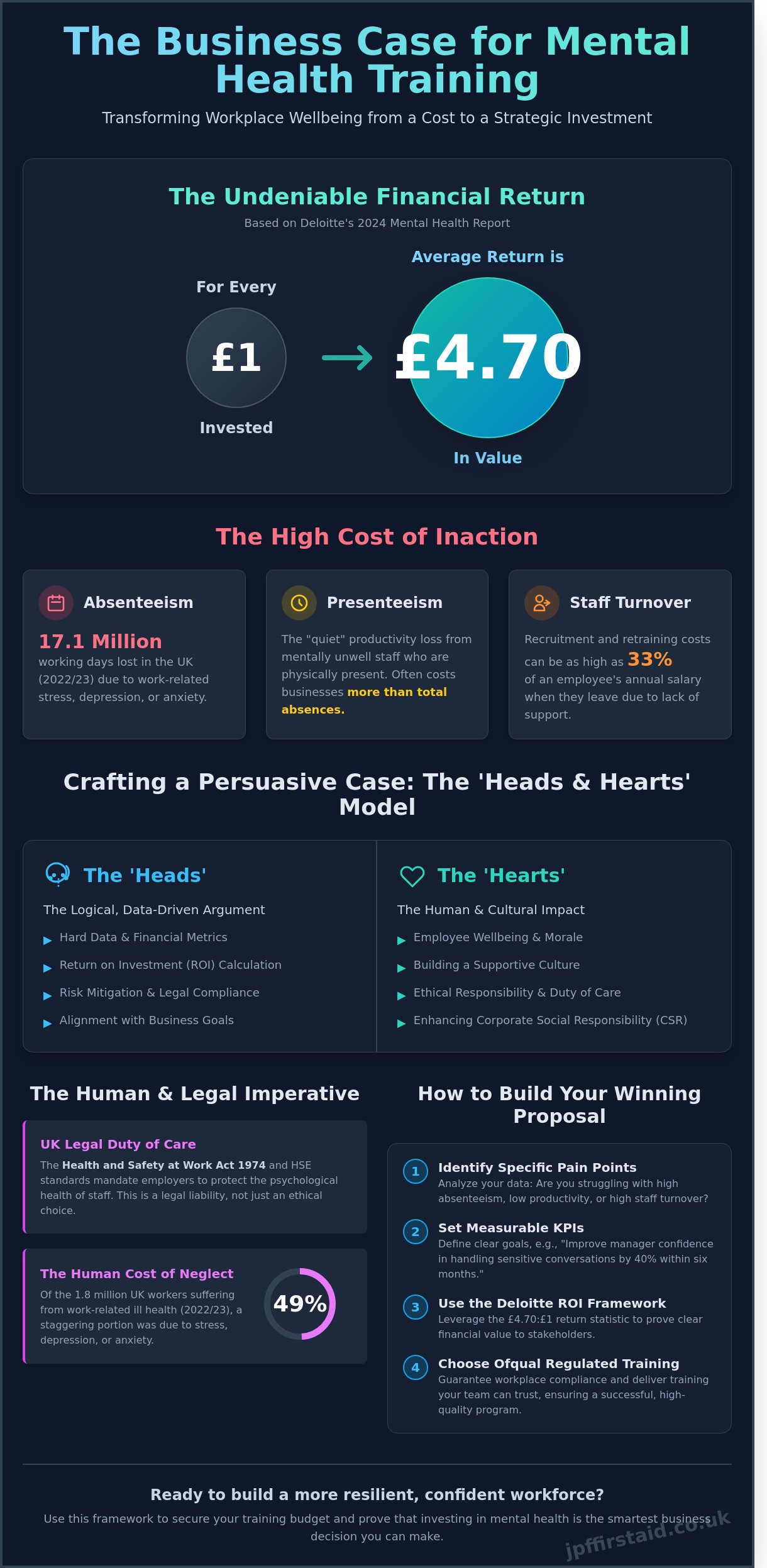
Did you know that for every £1 your company invests in staff wellbeing, you can expect an average return of £4.70? According to Deloitte’s 2024 Mental Health Report, the financial case for support is undeniable, yet many leaders still struggle to get their proposals past the boardroom door. Learning how to write a business case for workplace mental health training is no longer just a “nice to have” for your organisation; it’s a vital strategic move to protect your bottom line as we look toward 2026.
You’ve likely seen the impact of rising absenteeism or the subtle drain of “quiet quitting” within your own teams recently. It’s a heavy weight to carry when you care about your people but feel blocked by budget constraints and the difficulty of measuring “intangible” benefits. We’re here to help you turn those concerns into a professional, persuasive document that wins over even the most cautious directors. This guide provides a clear, step-by-step framework to secure your training budget and build a more resilient, confident workforce starting today.
Key Takeaways
- Learn how to transition from “nice-to-have” wellbeing ideas to a business-critical strategy that ensures your organisation remains compliant and resilient.
- Discover how to use the latest Deloitte data to calculate a clear ROI, proving the financial value of mental health support to your stakeholders.
- Master the ‘Heads and Hearts’ model to balance hard data with human impact, showing you exactly how to write a business case for workplace mental health training that wins board-level approval.
- Gain a professional, step-by-step structure for your proposal that builds immediate credibility and can be tailored to the specific needs of your industry.
- Understand why choosing Ofqual regulated qualifications is essential for guaranteeing workplace compliance and delivering training your team can truly trust.
Why a Formal Business Case for Mental Health Training is Essential
Securing a budget for staff development requires more than just a good intention. A formal business case serves as a strategic justification for resource allocation, transforming mental health support from a “nice-to-have” wellbeing initiative into a business-critical requirement. When you master how to write a business case for workplace mental health training, you provide senior leadership with a logical, evidence-based roadmap that aligns with the company’s wider commercial goals. This structured approach is the most effective way to overcome common budget objections by demonstrating that the cost of doing nothing far outweighs the price of a proactive training programme.
A well-crafted proposal does more than just ask for funds; it sets the stage for success. It allows you to establish measurable KPIs, such as a reduction in staff turnover or an increase in manager confidence scores, ensuring the training delivers a tangible return. By integrating Workplace wellness programs into your core strategy, you move away from reactive “firefighting” and toward a culture of prevention. This clarity helps stakeholders see that mental health first aid is as essential to your operations as physical first aid or fire safety compliance.
Understanding the Legal and Ethical Drivers in the UK
In the UK, the Health and Safety at Work Act 1974 dictates that employers have a clear duty of care to protect the psychological health of their staff. The HSE Management Standards specifically require businesses to assess and manage work-related stress risks. Failing to do so isn’t just an ethical oversight; it’s a legal liability. According to HSE statistics for 2022/23, 1.8 million workers suffered from work-related ill health, with 49% of those cases attributed to stress, depression, or anxiety. The cost of litigation and potential employment tribunals can be devastating for a business. Proactive, regulated training provides a “hassle-free” way to ensure compliance while building a safer, more resilient workforce.
Identifying Your Organisation’s Specific “Why”
To make your business case stick, you must identify the specific pain points within your company. Are you struggling with high absenteeism? In 2022/23, the UK lost 17.1 million working days due to work-related stress. Perhaps your issue is “presenteeism,” where staff are at their desks but unproductive due to poor mental health. You should set clear objectives for what you want the training to achieve, such as improving manager confidence in handling sensitive conversations by 40% within six months. Aligning these goals with your Corporate Social Responsibility (CSR) targets shows that your business is a “Reliable Expert Mentor” in its community, valuing people and profit in equal measure.
The ‘Heads’ of the Case: Calculating ROI and Financial Impact
To secure approval for your programme, you need to appeal to both the “Heads” and the “Hearts” of your leadership team. While the emotional wellbeing of your staff is vital, the “Heads” part of your argument focuses on cold, hard logic. Understanding how to write a business case for workplace mental health training means shifting the conversation from a “cost” to a strategic “investment.” You’re showing the board that by spending money now, the company avoids much larger, unmanaged costs later.
Analysing Absenteeism and Staff Turnover Costs
Start by identifying your current baseline. To calculate the cost of a single day of absence, don’t just look at the daily wage. You must include National Insurance contributions, pension costs, and the cost of hiring temporary cover or the lost productivity of the remaining team. Using a Mental Health Cost Calculator can help you quantify these hidden drains on your budget. When a skilled employee leaves because they feel unsupported, the financial blow is even sharper; recruitment and retraining often cost 33% of that worker’s annual salary. Presenteeism is the loss of productivity when staff are physically present but mentally unwell. This “quiet” loss often costs UK businesses more than total absences because it goes unnoticed for months.
Applying the Deloitte ROI Framework
The Deloitte 2024/2025 “Mental Health and Employers” report provides the gold standard for your evidence. Their research shows an average return of £4.70 for every £1 spent on workplace mental health interventions. This data is a powerful tool when you’re explaining how to write a business case for workplace mental health training that gets noticed. The report highlights that universal, organisation-wide training is particularly effective, often yielding a higher ROI of £6.30 compared to reactive, one-off measures.
- Short-term (0-12 months): Focus on reduced “buffer” costs and lower short-term absence rates.
- Long-term (12-24 months): Project savings based on improved staff retention and a reduction in long-term sickness claims.
- Universal Impact: Highlight that training everyone, rather than just managers, creates a supportive culture that prevents burnout before it starts.
Keep your financial data clear and avoid over-complicating the narrative with too many spreadsheets. Focus on the projected savings over a 24-month period to show you’re thinking about the company’s long-term health. If you want to ensure your training investment is practical and effective, choosing bespoke mental health training can help you target the specific needs of your workforce. By presenting these figures confidently, you transform a difficult request into a sensible, “can-do” financial decision.
The ‘Hearts’ of the Case: Evidencing Human Impact and Culture
Numbers alone rarely win over a skeptical board. While financial data provides the logic, it’s the human stories that drive the decision to invest in your people’s wellbeing. When you’re learning how to write a business case for workplace mental health training, you’ll find that spreadsheets only get you halfway. You need to show that a stressed workforce isn’t just a line item; it’s a risk to your company’s core identity. A culture of silence leads to disengagement, whereas a culture of support builds loyalty.
Evidence shows that emotional intelligence and psychological safety are now high-priority metrics for modern UK firms. You’re not just asking for a budget; you’re proposing a strategy to protect your most valuable asset. By focusing on the “heart” of the matter, you move the conversation from “what will this cost?” to “who will this save?”
Gathering Internal Sentiment and Employee Voice
Start by looking inward to find the “pain points” in your current setup. Use anonymous staff surveys to gather honest feedback without fear of repercussion. According to the 2024 Deloitte Mental Health Report, the cost of poor mental health to UK employers has reached £51 billion annually. You can humanise this figure by conducting “stay interviews” with long-term staff. These conversations help you understand what wellbeing needs aren’t being met. Anonymised testimonials or case studies from within your departments provide the emotional weight that data lacks. They turn a cold percentage into a person’s lived experience, making it much harder for leadership to ignore the need for change.
Demonstrating Long-term Cultural Resilience
Training isn’t a one-off event; it’s the foundation of a robust peer-support network. When you implement mental health first aid, you’re giving your team the practical tools to look out for one another. This proactive approach reduces workplace conflict and builds manager confidence. In 2023, the CIPD reported that 76% of UK organisations saw an increase in stress-related absence. By positioning wellbeing as a central pillar of your brand, you make your business a magnet for top British talent. It creates a “psychologically safe” environment where people feel comfortable speaking up before a minor issue becomes a crisis. This is a vital part of how to write a business case for workplace mental health training that feels relevant and urgent. You’re promising a more resilient, confident, and connected workforce that’s ready to handle the pressures of the modern market.
Step-by-Step: Writing and Structuring Your Business Case
Knowing how to write a business case for workplace mental health training is about more than just listing benefits; it is about building a professional, logical argument that secures board-level support. You need a flow that builds credibility from the first page. It’s vital to tailor your language to your specific industry. A construction firm will likely care about site safety records and fatigue, while a headteacher might prioritise staff retention and student outcomes. Don’t forget to address potential risks, such as staff downtime, and include mitigation strategies like staggered training dates to keep your operations running smoothly.
The 6-Part Business Case Structure
- Section 1: Executive Summary. This is your 60-second “hook.” State the primary ask and the expected outcome clearly. If the board only reads this page, they should understand the value proposition.
- Section 2: The Problem Statement. Use local data. Mention that poor mental health costs UK employers £51 billion annually according to the 2024 Deloitte report. Connect this to your own internal sickness figures.
- Section 3: Proposed Solution. Detail the specific first aid courses and mental health levels you recommend. Explain why a regulated qualification is better than a non-accredited talk.
- Section 4: Financial Analysis. Highlight the ROI. Current research shows an average return of £4.70 for every £1 spent on mental health support in the workplace.
- Section 5: Implementation Plan. Provide a realistic timeline for delivery. Mention whether the training will be on-site or at a neutral venue to manage logistics.
- Section 6: Conclusion and Call to Action. Summarise the long-term gains for the business culture and ask for a specific date for the decision.
Refining Your Proposal for Maximum Buy-in
Visual aids make your data digestible. Use simple bar charts to show your company’s absenteeism trends over the last 12 months. When you discuss delivery, offer options. Blended learning or distance courses can often suit tighter budgets, while in-person sessions offer the most practical, engaging experience for your team. This flexibility shows you’ve considered the company’s financial constraints and operational needs. It positions you as a partner in the business’s success rather than just a budget claimant.
Finally, emphasise the cost of doing nothing. If you don’t act, you’re essentially accepting the high costs of staff turnover and presenteeism. By following this structure, you’ll demonstrate that you aren’t just asking for a budget; you’re offering a strategic solution that builds a more resilient workforce. It’s about giving your leaders the confidence to say yes to a safer, more supportive environment.
Selecting a Training Partner to Guarantee Success
Choosing the right provider is the final, crucial step in learning how to write a business case for workplace mental health training. Your choice of partner determines whether the initiative succeeds or becomes another forgotten “tick-box” exercise. To satisfy the board, your recommendation must focus on compliance and quality. In the UK, this means prioritising Ofqual regulated qualifications. These certifications ensure that the training meets national standards, providing a level of rigour that protects your business from liability and guarantees that your staff receive accurate, up-to-date information.
A common pitfall in corporate training is the “Engagement Gap.” A 2023 industry report suggested that up to 40% of employees feel disengaged during traditional health and safety sessions if the delivery is too clinical or dry. Your business case should explain how a bespoke training partner solves this problem. By selecting a provider that tailors the content to your specific industry, you demonstrate to stakeholders that you aren’t just buying a course; you’re investing in a solution that staff will actually value and use.
The JPF First Aid Approach: Engaging and Practical
We believe that learning life-saving skills shouldn’t feel like a chore. JPF First Aid focuses on making every session engaging and fun. This isn’t just about morale. Research shows that learners retain 75% more information when they’re actively involved and enjoying the process. We replace the intimidating atmosphere of traditional medical training with a relaxed, “can-do” environment that builds genuine confidence.
To make the implementation as smooth as possible, we bring the classroom to you. Our on-site training sessions eliminate the need for staff travel, significantly reducing operational disruption and hidden costs. As a multi-award-winning provider, we offer the “Trust” factor your board requires. When you include JPF First Aid in your proposal, you’re recommending a partner with a proven track record of delivering expert, professional, and reliable training across the UK.
Finalising the Recommendation
When you’re finishing how to write a business case for workplace mental health training, be specific about the levels of instruction required. A blanket approach rarely works. Instead, match the course depth to the specific responsibilities of your team members:
- Level 1: Ideal for all staff to create a foundation of mental health awareness.
- Level 2: Designed for team leaders who need to spot the early signs of distress in their peers.
- Level 3: Comprehensive mental health first aid for supervisors and managers who will lead your internal support strategy.
This tiered approach shows the board that you’ve thought carefully about resource allocation and ROI. It proves that the training is targeted where it will have the most impact. Ready to build your case? Get a bespoke group training quote from JPF First Aid and take the first step toward a healthier, more resilient workforce.
Future-Proof Your Workforce Today
Mastering how to write a business case for workplace mental health training is the first step toward building a resilient organisation for 2026. The financial evidence is clear. According to Deloitte’s 2024 analysis, UK employers receive an average return of £4.70 for every £1 spent on mental health interventions. Beyond the balance sheet, your case addresses the 17.1 million working days lost to stress, depression, or anxiety reported by the HSE. By combining these hard statistics with a focus on human culture, you create a compelling argument that leadership can’t ignore.
You’re now ready to move from planning to action. We offer a practical, “can-do” approach that replaces clinical boredom with engaging sessions designed for the real world. As a multi-award-winning training provider, we deliver Ofqual regulated qualifications that ensure your business remains compliant and your staff feel truly supported. We’ll handle the logistics by coming to your site, making the entire process hassle-free and professional. You’ve done the hard work of building the case; now it’s time to deliver the solution.
Secure your team’s wellbeing with expert Mental Health First Aid training
You have the power to transform your workplace culture. We’re here to provide the expert guidance and confidence your team needs to thrive.
Frequently Asked Questions
How long should a business case for mental health training be?
A business case for mental health training should typically be between two and four pages long. This length provides enough space to present financial data and human impact without overwhelming your directors. If you’re learning how to write a business case for workplace mental health training, keep the executive summary to one page. This ensures busy decision makers see the vital facts and costs immediately.
What is the average ROI for workplace mental health training in the UK?
The average return on investment for workplace mental health training in the UK is £4.70 for every £1 spent. This figure comes from the 2024 Deloitte Mental Health Report, which highlights that proactive interventions offer the highest financial returns. By investing in early support, businesses reduce the £51 billion annual cost that poor mental health imposes on UK employers through turnover and presenteeism.
Do we need a business case if we are only training a small team?
You should create a business case even for a small team of five to ten people. Small businesses often feel the impact of absence more acutely because there’s less cover available for specialised roles. A simple document helps you justify the spend and ensures your training aligns with the specific needs of your staff. It also builds a foundation for a supportive company culture as you grow.
Can I include mental health training as part of our general health and safety budget?
You can include mental health training in your general health and safety budget because the Health and Safety Executive (HSE) treats mental and physical health with equal importance. Since the 2018 update to the First Aid at Work guidance, employers must consider mental health in their first aid needs assessment. Using your existing budget ensures compliance with these safety standards while streamlining your internal approval process.
What are the main objections senior leaders have to mental health training?
The main objections from senior leaders usually focus on the initial cost and the time staff spend away from their desks. You can counter this by highlighting that mental health issues caused 17.1 million lost working days in 2022/23 according to HSE statistics. Presenting the training as a tool to reduce these absences transforms the conversation from a cost into a strategic investment for the business.
How do I measure the success of the training after it has been delivered?
You can measure the success of your training by tracking sickness absence rates and using anonymous staff wellbeing surveys. Tools like the Warwick-Edinburgh Mental Wellbeing Scale (WEMWBS) provide a numerical score to track improvements over six or twelve months. When you understand how to write a business case for workplace mental health training, you’ll see that setting these Key Performance Indicators early makes the post-training review much simpler.
Is mental health first aid training a legal requirement in the UK?
Mental health first aid training isn’t a specific legal requirement in the UK, but the Health and Safety at Work Act 1974 requires employers to protect the welfare of their staff. The HSE’s updated guidance recommends that businesses consider mental health support to meet these existing duties. Providing training shows you’re taking reasonable steps to prevent workplace stress and support your team’s psychological safety and confidence.
How often should mental health training be refreshed for staff?
Staff should refresh their mental health training every three years to keep their skills sharp and their confidence high. This timeline matches the standard for physical first aid qualifications and ensures your team stays up to date with the latest support techniques. Regular refreshers prevent knowledge fade and signal to your employees that their wellbeing remains a top priority for the business year after year.
Recent Comments