

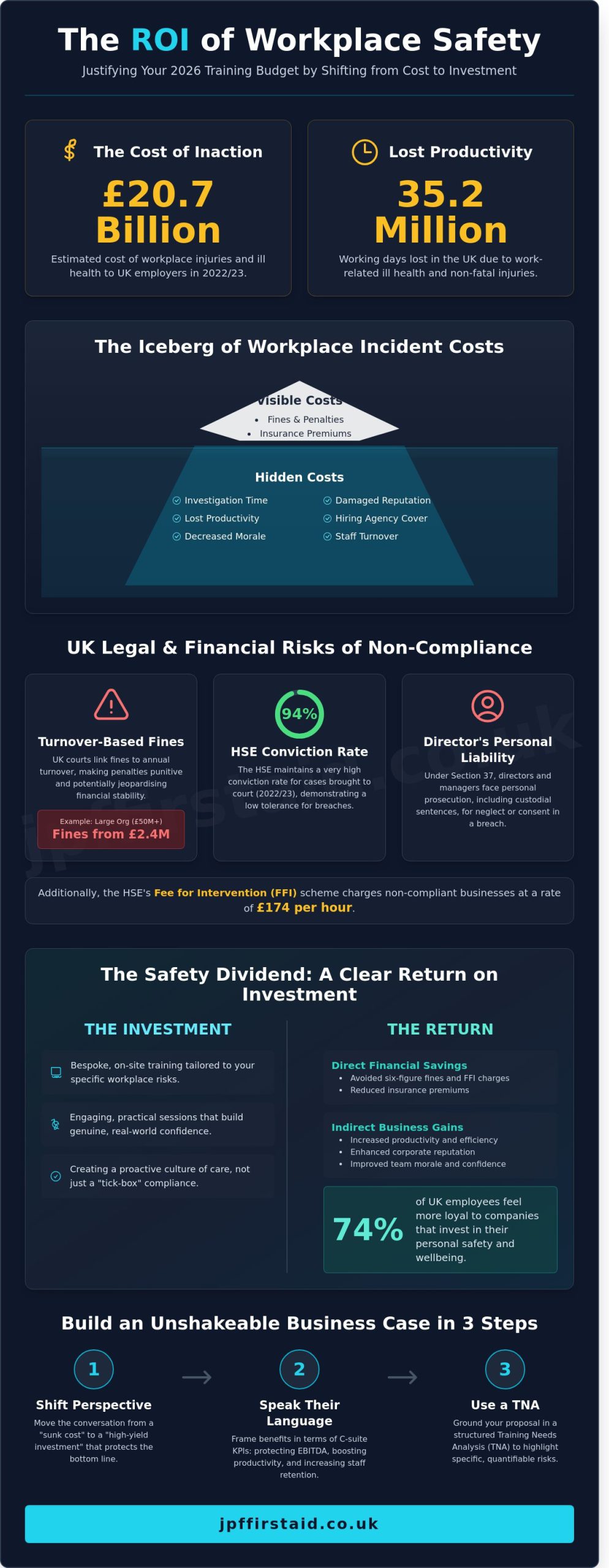
According to the Health and Safety Executive (HSE), workplace injuries and new cases of ill health cost UK employers an estimated £20.7 billion during the 2022/23 period. When you are justifying safety training costs to management, it often feels like you’re fighting an uphill battle against a “tick-box” mentality. You know that a safer workplace is a more productive one, but translating that belief into a spreadsheet that wins over the board for 2026 requires a strategic shift in perspective.
We understand it’s frustrating when vital compliance measures are treated as optional extras during budget reviews. It’s difficult to quantify the value of an accident that never happened, especially when the focus is purely on immediate expenses. This guide will help you master the art of presenting safety training as a high-yield investment rather than a simple cost centre. You’ll learn a clear framework for calculating ROI, ensuring you can secure your 2026 budget while building a genuine culture of care. We’ll walk through exactly how to turn those daunting figures into a compelling case for a safer, more confident workforce.
Key Takeaways
- Shift your strategy from basic compliance to a value-led approach that positions safety as a high-yield investment for your 2026 budget.
- Recognise the severe financial impact of UK Sentencing Council guidelines, where turnover-linked fines make justifying safety training costs to management a vital commercial necessity.
- Learn to calculate a comprehensive ROI by identifying both direct insurance savings and indirect boosts to staff retention and productivity.
- Build an unshakeable business case using a structured Training Needs Analysis (TNA) to highlight specific risks and requirements within your organisation.
- Discover the cost-efficiency of bespoke, on-site training that ensures your team gains genuine confidence through engaging, multi-award-winning sessions.
The Challenge of Justifying Safety Training Costs to Management
Many directors still view health and safety as a sunk cost. It is often seen as an annual invoice that must be paid to tick a regulatory box rather than a strategic investment. However, as we move through 2026, the conversation is shifting from simple compliance to a value-led approach. Forward-thinking leaders now recognise that Occupational safety and health (OSH) is a core pillar of operational excellence. When you position yourself as a business partner rather than a “policeman,” you can demonstrate the Safety Dividend. This is the measurable return on every £1 spent on high-quality training. We believe that training should be engaging and fun, which ensures the skills actually stick when a crisis occurs.
Understanding the Management Mindset
To succeed in justifying safety training costs to management, you must speak the language of the C-suite. Senior leaders focus on KPIs like EBITDA, productivity, and staff retention. They don’t just want to know that a course is “required”; they want to know how it protects the bottom line. According to HSE statistics for 2022/23, 35.2 million working days were lost in the UK due to work-related ill health and non-fatal workplace injuries. This represents a massive drain on productivity that any finance director would want to plug.
- Focus on EBITDA: Explain how reducing minor injuries keeps your experienced staff on the tools and avoids the cost of hiring expensive agency cover.
- Retention and Morale: 74% of UK employees state they feel more loyal to companies that invest in their personal safety and wellbeing.
- Price vs Value: A “cheap” training provider might offer a lower initial price, but if the training is dry and clinical, your staff won’t gain the confidence to act. Practical, bespoke training offers far better value by ensuring real-world competence.
The Cost of Doing Nothing
The true impact of a workplace incident is often hidden, much like an iceberg. The visible costs, such as immediate fines or insurance premiums, are only the tip. Beneath the surface lie the indirect costs: the time spent on investigations, the loss of reputation, and the drop in team morale. In 2021/22, the total cost of workplace injuries and ill health in Great Britain was estimated at £20.7 billion. By ignoring the moral, legal, and financial triangle of safety, a business risks a total structural collapse during a crisis. Safety ROI is the ratio of prevented loss to training expenditure.
Choosing a reliable expert mentor for your training needs makes the entire process hassle-free. We come to your site, work around your schedule, and provide regulated qualifications that build genuine confidence. When your team feels prepared, they work more efficiently, creating a safer and more profitable environment for everyone involved.
The True Cost of Non-Compliance: UK Legal and Financial Risks
The days of health and safety being a “slap on the wrist” exercise are long gone. Since the Sentencing Council introduced new guidelines in 2016, UK courts now calculate fines based on a company’s annual turnover rather than just the severity of the incident. For a “Large” organisation with a turnover of £50 million or more, a high-culpability breach can result in fines starting at £2.4 million. Even for smaller businesses, these penalties are designed to be “proportionate” but “punitive,” often reaching six figures for avoidable accidents. This shift in the legal landscape is the most compelling tool when justifying safety training costs to management, as a single incident can jeopardise the entire company’s financial stability.
Beyond the corporate bank account, the Health and Safety at Work etc. Act 1974 places a heavy burden on leadership. Under Section 37, directors and managers face personal liability if a breach occurs with their “consent, connivance, or neglect.” In the 2022/23 period, the HSE maintained a conviction rate of 94% for cases brought to court, with several leading to immediate custodial sentences. When you invest in training, you aren’t just ticking a box; you’re building a legal shield for the people running the business.
HSE Enforcement and Fine Structures
The financial drain begins long before a court date. Under the Health and Safety (Fees) Regulations, the HSE operates the “Fee for Intervention” (FFI) scheme. As of 2024, the rate is £174 per hour, and this is expected to rise in line with inflation through 2026. If an inspector identifies a material breach, such as a lack of valid first aid training, the clock starts ticking. You’ll be billed for every minute they spend investigating, writing reports, and following up. It’s common for these invoices to exceed £5,000 for a single investigation.
Case studies from 2023 show that UK manufacturing firms have faced fines exceeding £500,000 specifically because they failed to provide adequate refresher training. By choosing Ofqual regulated qualifications, you ensure your training meets a nationally recognised standard. This provides a “gold standard” of evidence that you’ve met your statutory duties. Using the Business Case for Safety and Health as a benchmark, it’s clear that for every £1 spent on prevention, businesses save significantly more in avoided penalties and legal fees.
Insurance Premiums and Civil Claims
Insurance underwriters are increasingly focused on “defensibility.” If a staff member is injured and your training records are non-existent or come from an unregulated provider, your Employers’ Liability insurance may not provide the protection you expect. Unregulated training is a major red flag that suggests a lack of due diligence. This can lead to hiked premiums or even a refusal to renew your policy.
Civil litigation in the UK is also becoming more expensive. The average cost of a workplace injury claim now exceeds £11,000 in legal costs alone, before any compensation is paid to the claimant. A robust training record is your best defence against these claims. It proves you took “reasonably practicable” steps to ensure safety. You can protect your business and your people by booking our regulated first aid training, ensuring your compliance is never in question. Reputational damage often lasts far longer than the financial sting; being known as an “unsafe” employer makes it 40% harder to recruit top-tier talent in competitive UK markets.
Calculating the ROI of Workplace Safety Training
Moving the conversation from “compliance cost” to “strategic investment” is the key to justifying safety training costs to management. When you look at the hard data, the financial benefits of a safe workplace far outweigh the initial price of a course. In the UK, the Health and Safety Executive (HSE) reports that workplace injuries and ill health cost businesses billions of pounds annually. You can protect your bottom line by focusing on two distinct types of savings.
Direct savings are the most visible. These include lower insurance premiums, a reduction in paid medical leave, and the avoidance of heavy HSE fines, which can easily reach six figures for serious breaches. Indirect savings, while harder to track on a balance sheet, often have a bigger impact. These involve better staff morale, reduced turnover, and the elimination of the “chaos cost” that occurs when a key team member is suddenly absent due to injury.
To help your directors visualise this, use the industry-standard ‘1:3:10’ rule of safety investment. This ratio suggests that for every £1 you spend on prevention and training, you save £3 in indirect costs such as equipment repairs or temporary staff, and £10 in direct costs like legal fees or compensation payouts. Investing in an Emergency First Aid at Work course isn’t just about meeting a legal requirement; it’s a proactive move to stop a minor incident from becoming a financial disaster.
Productivity and Staff Retention
Confidence is a quiet driver of efficiency. When your staff feel safe and know exactly how to handle an emergency, they work more fluidly and with fewer errors. A worried workforce is a slow workforce. By 2026, the UK job market has shifted significantly. Employees now prioritise their physical and psychological safety when choosing an employer. A robust safety culture strengthens your ‘Employer Branding’, making you a magnet for top talent who want to work for an organisation that values their life and health. If you don’t show you care about their safety, your best people will find someone who does.
The Mental Health Impact
The hidden drain on UK business profits isn’t just absence; it’s ‘presenteeism’, where staff are physically at work but mentally checked out due to stress or poor wellbeing. The cost of this lost productivity is often three times higher than the cost of actual sick days. Implementing Mental Health First Aid provides your team with the tools for early intervention, catching issues before they escalate into long-term absences. Proactive mental health support drastically reduces the likelihood of employees needing to file long-term disability claims for stress or burnout. By fostering an environment of awareness, you create a more resilient, loyal, and focused team.
Building a Compelling Business Case for Your Training Budget
Securing a budget for health and safety often feels like an uphill battle, but it doesn’t have to be. When you’re justifying safety training costs to management, you need to shift the conversation from “what we’re spending” to “what we’re saving.” Start by conducting a thorough Training Needs Analysis (TNA). This identifies exactly where your skills gaps lie, ensuring you aren’t paying for redundant courses. Next, gather your data. Look at the 606,000 non-fatal injuries reported to the HSE in 2023/24. How many of those happened in your specific sector? Use your own records of past incidents and near-misses to show the potential cost of inaction.
Comparing internal on-site training against public courses is your next move. While public courses are great for individuals, they often involve travel expenses and higher per-head costs. Present a ‘Total Cost of Ownership’ (TCO) that includes staff travel, cover for absent workers, and the actual course fee. Finally, align your 2026 proposal with the company’s strategic goals. If the board wants to improve staff retention by 12% by 2026, show them how a safe, well-trained workforce feels more valued and stays longer. High-quality training isn’t just a tick-box exercise; it’s a retention tool.
Data-Driven Persuasion Techniques
Visualise your risks to make them real for stakeholders. A ‘Safety Dashboard’ can turn dry spreadsheets into a clear traffic-light system for the board. Use industry benchmarks from the Labour Force Survey to show how your safety record compares to competitors. Don’t ignore near-misses. If you’ve had 45 near-misses this year, statistical models suggest a major accident is looming. Preventing that one incident saves more than just money; it saves your reputation. This proactive approach is vital when justifying safety training costs to management during budget reviews.
Maximising Budget Efficiency
Smart spending is about scale and flexibility. There is a clear financial logic in booking group training sessions at your own premises. You’ll eliminate travel time and keep your team in a familiar environment. Blended learning is another winner. It cuts ‘time off the floor’ by up to 50% by moving theory online, leaving only the practical, hands-on skills for the classroom. You can also bundle qualifications, such as First Aid, Fire Safety, and Manual Handling, to secure volume discounts that keep the finance director happy. It’s a hassle-free way to maintain compliance without draining your resources.
Ready to protect your team and your budget with a tailored plan? Get a bespoke quote for your on-site training today.
Maximising Value with JPF First Aid Training Solutions
Choosing the right training provider is the final piece of the puzzle when justifying safety training costs to management. You need a partner that doesn’t just deliver a lecture but builds genuine, life-saving competence. JPF First Aid provides multi-award-winning training designed to maximise engagement and information retention. When your staff enjoy the process, they remember the skills. This means your investment goes much further than a standard, dry classroom session, as the knowledge actually sticks when it matters most.
We focus on cost-efficiency by bringing the classroom to your doorstep. Our bespoke, on-site training sessions accommodate groups of up to 12 learners, which significantly reduces the “per-head” cost compared to sending individuals on public courses. By training on your premises, you eliminate staff travel expenses and minimise the time your team spends away from their roles. It’s a practical, logical way to keep your budget under control while ensuring your team receives high-quality, hands-on instruction in their own environment.
Compliance is often the strongest lever when justifying safety training costs to management. Every course we offer results in Ofqual regulated qualifications. This provides the legal “gold standard” that senior leadership requires for insurance purposes and Health and Safety Executive (HSE) audits. We simplify the justification process by providing clear documentation and certificates that prove your organisation is meeting its legal obligations with the most reliable training available.
A Hassle-Free Partner for 2026
Managing health and safety shouldn’t be a logistical nightmare. We act as your single point of contact for all safety qualifications, from Emergency First Aid at Work to specialised paediatric or mental health courses. Our goal is to provide the “can-do” confidence management wants to see in their workforce. We offer flexible delivery methods, including weekend or split-session training, to suit your specific operational schedule without disrupting your core business hours or productivity.
Take the Next Step
If you’re ready to secure your 2026 safety budget, we’re here to help you build the strongest possible case. You can download our ‘Manager’s Guide to Safety ROI’ to help present the financial and cultural benefits to your board. Every business has unique needs, so we recommend starting with a conversation about your specific risks, team size, and location.
Ready to protect your team and your bottom line? Contact JPF First Aid today for a tailored group training quote and see how simple and effective workplace compliance can be.
Build a Safer, More Resilient Business Today
Protecting your team isn’t just a moral duty; it’s a strategic necessity. With the Health and Safety Executive (HSE) reporting that workplace injuries and ill health cost UK employers £20.7 billion in 2022/23, the financial risk of inaction is clear. By focusing on the ROI of reduced absenteeism and full compliance with the 2016 Sentencing Guidelines, justifying safety training costs to management becomes a conversation about long-term resilience rather than a simple line-item expense. You’re moving from a tick-box exercise to building a confident, capable workforce that knows exactly how to handle an emergency.
As a multi-award-winning training provider, JPF First Aid makes this transition hassle-free. We deliver Ofqual regulated qualifications directly at your premises for groups of up to 12, ensuring your staff gain practical skills in a relaxed, engaging environment. Our expert mentors take the stress out of compliance, providing your team with the “can-do” attitude needed to save lives and protect your business interests.
Book a bespoke group training session for your team today. We’re ready to help you create a safer workplace where everyone feels protected, prepared, and valued.
Frequently Asked Questions
How do I calculate the ROI of safety training for a small business?
You can calculate your return on investment by comparing the cost of training against the potential savings from avoided incidents. The HSE reports that for every £1 spent on health and safety, businesses typically see a return of between £2 and £6. When you are justifying safety training costs to management, remember that a single workplace injury costs an employer an average of £1,400 in direct costs alone.
Is first aid training a legal requirement for all UK companies in 2026?
Yes, the Health and Safety (First-Aid) Regulations 1981 require every UK employer to provide adequate and appropriate equipment, facilities, and personnel. This law remains strictly enforced in 2026. You must conduct a risk assessment to decide if you need a simple appointed person or a fully qualified first aider to keep your staff safe and stay compliant with the law.
What are the indirect costs of a workplace accident?
Indirect costs are often 4 to 10 times higher than the direct costs of an accident. These include lost productivity when staff stop work to help, time spent on lengthy incident investigations, and the expense of hiring temporary cover. In the 2022/23 period, workplace injuries led to 3.7 million lost working days across the UK, which places a massive financial strain on any small team.
How can I reduce the cost of taking staff away from their work for training?
Booking on-site training is the most effective way to minimise downtime and eliminate travel expenses for your team. By having an expert trainer come to your premises, you ensure that staff can return to their roles immediately after the session finishes. We offer bespoke scheduling to fit your specific shift patterns, making the process of justifying safety training costs to management much easier and more practical.
Does insurance always go down if we have more first aiders?
While premiums don’t always drop immediately, a robust safety record can lead to discounts of 5% to 15% on your Employers’ Liability insurance. Insurers reward proactive risk management because it reduces the likelihood of expensive claims. By training more first aiders, you create a safer environment that helps keep your long-term premiums stable and prevents the sharp price hikes that follow a reported incident.
What happens if we fail to meet HSE training requirements?
Failure to meet your legal obligations can result in significant fines, which averaged £44,000 per conviction in 2022/23. You may also be charged a “Fee for Intervention” of £174 per hour if the HSE identifies a material breach at your workplace. Beyond the financial hit, your business could face serious reputational damage or even criminal prosecution if a lack of training leads to a serious injury.
How often should safety training be refreshed to maintain its value?
Most regulated first aid qualifications expire after 3 years, but the HSE strongly recommends an annual refresher session to keep skills sharp. Research shows that practical life-saving knowledge starts to decline significantly just 6 months after a course. Regular updates ensure your team stays confident and capable, which protects your initial investment and ensures your staff can act quickly during a real emergency.
Can mental health first aid really save the company money?
Mental health issues cost UK employers approximately £51 billion every year according to a 2024 Deloitte report. By training your staff to spot early signs of distress, you can significantly reduce the 17.1 million working days lost annually to stress and anxiety. Investing in mental health support is a smart business move that improves staff retention and cuts the high costs associated with long-term sickness absence.
Recent Comments