

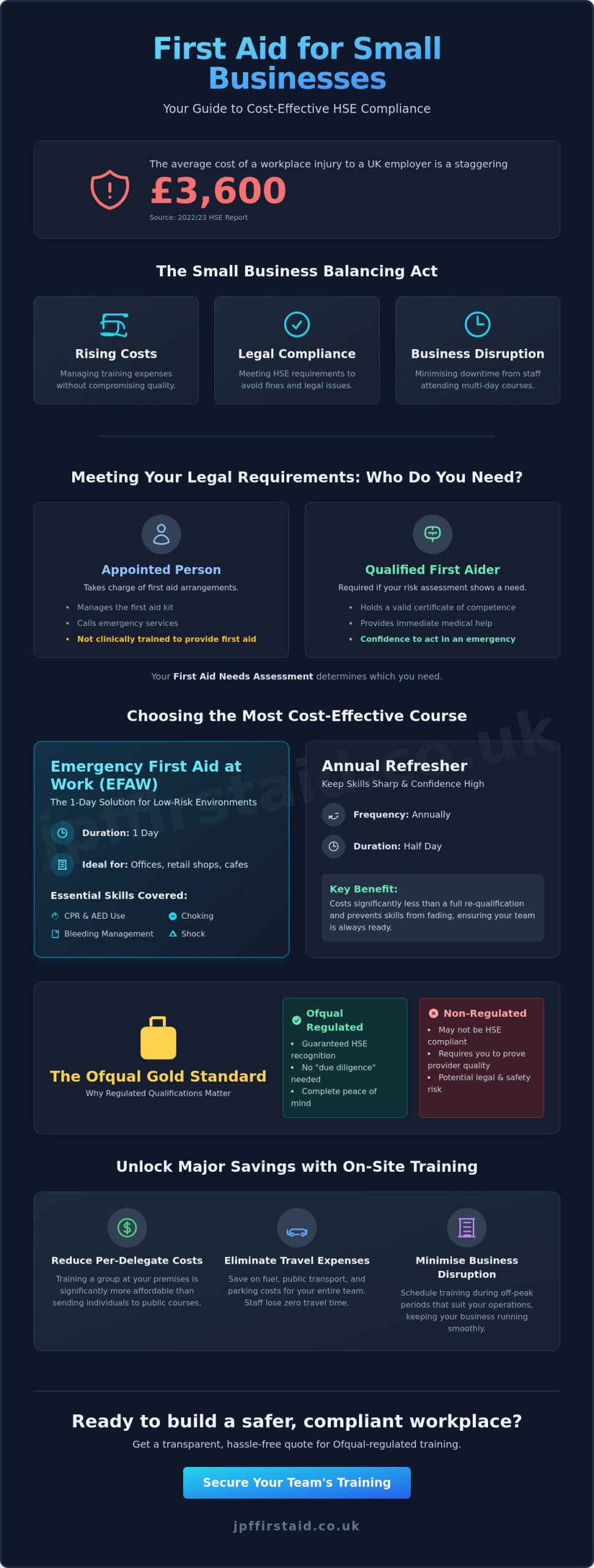
Did you know that the average cost of a workplace injury to a British employer reached £3,600 per person according to the 2022/23 HSE report? It’s a staggering figure that highlights why safety is a priority, yet many owners still feel trapped between rising per-delegate costs and the fear of failing a health and safety audit. You want to keep your team safe, but losing several staff members for multiple days while paying premium rates just isn’t sustainable for a lean operation. Finding high-quality, affordable first aid courses for small business shouldn’t feel like a compromise on safety or legal compliance.
We believe that life-saving skills should be accessible to every workplace, regardless of the size of your budget. In this guide, we’ll show you exactly how to secure Ofqual-regulated training that builds real confidence in your team while keeping your business running smoothly. You’ll discover how to navigate complex HSE requirements, choose the right course levels for your specific risks, and identify providers that offer transparent, hassle-free pricing for 2026. We’re here to help you move from feeling overwhelmed by regulations to feeling completely prepared for any emergency, all while keeping your overheads under control.
Key Takeaways
- Learn how to navigate the Health and Safety (First Aid) Regulations 1981 to ensure your business remains fully compliant without overspending on unnecessary extras.
- Understand how to identify affordable first aid courses for small business that balance budget-friendly pricing with the gold standard of Ofqual regulation.
- Uncover the hidden savings of on-site training, where hosting a session at your premises can significantly reduce per-delegate costs and eliminate staff travel expenses.
- Master practical strategies to schedule essential training during off-peak periods, ensuring your team gains life-saving confidence without disrupting your daily operations.
- Find out why partnering with a “Reliable Expert Mentor” provides the perfect balance of high-level competence and an engaging, stress-free learning environment for your staff.
Understanding Workplace First Aid Requirements for Small Businesses
The Health and Safety (First Aid) Regulations 1981 aren’t just another layer of red tape. They’re a straightforward set of rules designed to keep your team safe. In simple terms, these regulations require every UK employer to provide adequate and appropriate equipment, facilities, and personnel to ensure employees receive immediate attention if they’re injured or taken ill at work. The Health and Safety Executive (HSE) sets these standards for every business size. Whether you’re a solo founder with one part-time assistant or a growing team of 20, the law applies to you.
When you’re looking for affordable first aid courses for small business, it’s vital to remember that “affordable” must never mean “non-compliant.” Saving a few pounds on an unregulated, “off-the-books” training session can leave you legally exposed and your staff at risk. A solid understanding first aid principles is the foundation of a safe workplace, and the HSE expects you to choose training that is fit for purpose. Having a designated first aider isn’t just a “nice to have” feature; it’s a legal necessity that ensures help is always on hand.
The Minimum Legal Requirement: What You Actually Need
You don’t always need a full team of advanced medics. The law distinguishes between an “Appointed Person” and a “First Aider.” An Appointed Person takes charge of first aid arrangements, such as looking after the first aid kit and calling emergency services. However, they aren’t trained to provide clinical treatment. If your risk assessment identifies a need for someone to provide actual medical help, you need a qualified First Aider. For many small firms, the Emergency First Aid at Work (EFAW) course is the perfect entry-level standard. It’s a one-day programme that gives your staff the confidence to handle common workplace emergencies.
First Aid Needs Assessment: Don’t Overbuy Training
One of the best ways to find affordable first aid courses for small business
Choosing the Most Cost-Effective Course for Your Team
Finding the right balance between a tight budget and high-quality training is vital for any growing company. You want to ensure your team is safe without overstretching your finances. Choosing affordable first aid courses for small business starts with understanding exactly what the law requires for your specific workplace risk level. It’s about investing in skills that actually stick rather than just ticking a compliance box.
Always look for “Ofqual regulated” certifications. These provide a gold standard of quality that guarantees your certificates are recognized by the Health and Safety Executive (HSE). While non-regulated courses might look cheaper on paper, they often lead to hidden administrative burdens. You might have to spend hours proving the “due diligence” of your training provider if an inspector visits. Regulated qualifications remove that stress entirely.
Don’t wait three years to think about training again. Annual refresher sessions usually take just half a day and cost significantly less than a full re-qualification. They keep life-saving skills fresh, ensuring your staff stay confident. Even though we operate under UK HSE guidelines, international benchmarks like OSHA regulations highlight the universal necessity of having trained personnel and adequate supplies ready for medical emergencies at all times.
Emergency First Aid at Work (EFAW) – The 1-Day Solution
For many low-risk small businesses like offices, retail shops, or cafes, the 1-day EFAW course is the most budget-friendly compliant option. It focuses on the most vital life-saving skills your team needs to handle an immediate crisis. The syllabus covers essential topics including:
- CPR and AED use: How to use a defibrillator and perform chest compressions.
- Choking: Identifying and clearing airway obstructions quickly.
- Bleeding management: Controlling wounds to prevent shock.
- Shock: Treating the physical response to injury or trauma.
Blended Learning: Saving Time and Productivity Costs
Blended learning is a game-changer for businesses that can’t afford to have the whole team off-site at once. This method splits the training into two parts: an interactive online theory module followed by a shortened in-person practical assessment. It reduces the time staff spend away from their primary roles, which protects your productivity levels. You can learn more about how this works in our guide on choosing the right training style for your culture.
We’ve found that when training is engaging and fun, learners retain information much better. A 2023 industry report indicated that hands-on, relaxed training environments improve skill recall by up to 40% compared to traditional lecture-style classrooms. This leads to a safer workplace and fewer accidents overall. If you want to build a more resilient team, feel free to get a bespoke quote for your on-site training today.
On-Site vs. Public Courses: Calculating the Best Value for Money
Choosing between sending your team to a training centre or hosting a trainer at your office isn’t just about the initial booking fee. To find truly affordable first aid courses for small business, you have to account for the “hidden” drains on your budget. When you send three individual delegates to a public course, you’re paying three separate fees. You’re also paying for three sets of travel expenses, three parking tickets, and three blocks of lost productivity spent in transit.
In the UK, HMRC mileage rates sit at 45p per mile. If your staff travel 20 miles round-trip to a venue and pay £15 for city-centre parking, those extras add up fast. On-site training often operates on a flat-fee model for groups of up to 12 delegates. This structure provides the best value because the cost per head drops significantly as you fill those 12 spots. You pay for the trainer’s expertise rather than the overheads of an external classroom.
Training on your own premises offers a unique safety advantage that money can’t easily buy. We can tailor the practical scenarios to the actual layout of your shop, warehouse, or office. Learning how to manage a fall in the exact spot where a trip hazard exists makes the skills feel real. It replaces theoretical “what-ifs” with practical “here’s how we do it,” which builds genuine confidence.
When to Choose Public Scheduled Courses
Public courses are a fantastic solution for micro-businesses with only one or two employees. If you don’t have the space or the numbers for a group session, booking a single spot is the most cost-effective route to compliance. These per-delegate fees are inclusive, meaning they cover all your training materials and regulated certificates. You’ll also find that these sessions are great for networking. Your staff can share experiences with other local business owners, often learning how different industries handle similar health and safety challenges.
The “Hassle-Free” Benefit of On-Site Training
The “we come to you” approach eliminates the logistical headache of coordinating staff travel. It’s a bespoke experience where the training focuses on your specific workplace hazards. If you run a woodworking shop, we’ll spend more time on traumatic injuries; if you’re in a quiet office, we might focus on sudden cardiac arrest and AED use. This shared learning experience acts as a powerful team-building exercise. Solving problems together in a relaxed, familiar environment helps your team bond while they gain life-saving skills. It turns a mandatory compliance task into an engaging, high-energy day that boosts morale across the board.
How to Minimise Business Disruption During Training
The biggest hurdle for most UK small business owners isn’t the price tag; it’s the empty desks. We hear it all the time: “I can’t afford to have my team away for a whole day.” We understand that every hour counts when you’re running a lean operation. However, the true cost of an untrained team often hides in the shadows of long-term workplace injuries and compliance fines. According to HSE data from 2023/24, 32.5 million working days were lost due to work-related ill health and non-fatal workplace injuries. By choosing affordable first aid courses for small business that offer on-site flexibility, you can turn a logistical headache into a streamlined success.
The secret to minimising disruption lies in smart scheduling. Many of our clients book their training during traditional quiet periods, such as the post-Christmas lull in January or the mid-summer holiday weeks when client demand naturally dips. We come to your premises, which means your staff don’t waste time travelling to a distant training centre. They can stay focused on the task at hand until the moment the session begins. This “on-site” approach keeps your team close to the business while they gain the confidence to handle emergencies calmly and professionally.
Workplace Training Bundles: Maximum Efficiency
You can significantly reduce administrative overheads by adopting the “one-day safety blitz” concept. Instead of booking separate dates for different requirements, many businesses choose to group their compliance needs together. Combining fire marshal training with your first aid session allows you to tick multiple legal boxes in one go. This approach is one of the most effective ways to secure affordable first aid courses for small business because it reduces the number of days your team is in “training mode.” Dealing with a single, trusted training provider simplifies your paperwork and ensures a consistent, high-quality experience across all safety disciplines.
Mental Health First Aid: A Proactive Cost-Saving Measure
Modern safety strategies look beyond physical scrapes and burns. Integrating a mental health first aid guide into your training plan is a proactive way to protect your bottom line. When your supervisors can spot the early signs of burnout or anxiety, you reduce the likelihood of long-term staff turnover and expensive absenteeism. Supporting your team’s wellbeing creates a loyal, resilient workforce. It’s a vital component of any “affordable” strategy because the cost of recruiting a replacement in the UK can often exceed £3,000 when you factor in advertising and lost productivity.
Ready to get your team certified without the hassle? Book your on-site training session today and build a safer, more confident workplace.
Why JPF First Aid is the Ideal Partner for Small Business Compliance
Finding affordable first aid courses for small business shouldn’t mean compromising on the quality of the instruction. JPF First Aid operates as a “Reliable Expert Mentor,” bringing high-level competence to your workplace without the corporate ego often found in larger providers. With over 20 years of experience and an award-winning lead trainer at the helm, we understand the specific pressures small teams face in 2026. We’ve spent two decades refining our methods to ensure they meet the latest UK health and safety standards while remaining accessible and practical.
Our training philosophy prioritizes confidence as the ultimate outcome. While a certificate is a legal necessity, it’s useless if your staff freeze during a real-life emergency. We remove learner anxiety by making every session engaging, fun, and relaxed. By creating an environment where people feel comfortable asking questions and practicing skills, we ensure they leave ready to act. You aren’t just ticking a compliance box; you’re building a resilient team that knows exactly what to do when seconds count.
Bespoke Quotes and Transparent Pricing
Every small business is unique. A boutique cafe has different risks than a small construction firm, and your training costs should reflect your specific setup. We provide tailored quotes that fit your budget and staff numbers perfectly. We maintain a strict “no hidden fees” policy. Your quote includes all regulated certification costs and training materials, so there are no surprises when the invoice arrives. If you want a hassle-free consultation to see how we can help your business stay compliant, simply reach out to our team.
First Aid Training You Can Trust
Choosing an independent, mission-driven provider over a massive national chain offers distinct advantages. You get a personal connection and training that focuses on essential life-saving skills rather than just reading from a generic slide deck. We’re committed to your success because we care about the safety of our local business community. We don’t just teach first aid; we empower your staff to save lives with practical, hands-on experience.
The goal is simple: to provide high-quality training that fits your schedule and your budget. We come to your site to minimize disruption, ensuring your team learns in the environment where they actually work. Book your affordable small business first aid course with JPF First Aid today and give your team the skills they need to stay safe.
Take Control of Your Workplace Safety Today
Meeting your legal health and safety obligations under the Health and Safety (First-Aid) Regulations 1981 shouldn’t feel like a burden on your bottom line. By opting for on-site training, you eliminate travel expenses and significantly reduce staff downtime. We’ve shown that high-quality compliance is about finding the perfect balance between cost and professional standards. JPF First Aid brings over 20 years of industry experience directly to your doorstep, providing Ofqual regulated qualifications that exceed standard requirements.
You can secure affordable first aid courses for small business without compromising on the quality of instruction. Our multi-award-winning training provider team focuses on building real-world confidence through practical, engaging sessions that your staff will actually enjoy. We handle the technical details of certification so you can focus on growing your company. It’s about more than just ticking a box; it’s about empowering your team with life-saving skills they’ll remember.
Get a bespoke, affordable quote for your small business first aid training
We’re ready to help you create a safer, more confident workplace today.
Frequently Asked Questions
What is the cheapest first aid course for a small business?
The Emergency First Aid at Work (EFAW) qualification is typically the most affordable first aid courses for small business because it only requires one day of training. This course covers essential life-saving skills for low-risk environments like shops or offices. You’ll gain the confidence to handle CPR and minor injuries without the three-day commitment or higher costs associated with a full First Aid at Work certificate.
Do small businesses really need a qualified first aider by law?
Yes, the Health and Safety (First-Aid) Regulations 1981 require every UK employer to provide adequate and appropriate equipment, facilities, and personnel. Even if you’re a micro-business with 1 to 5 employees, you must at least have an “appointed person” to manage first aid arrangements. For most small firms, having a qualified first aider ensures you stay compliant and keep your team safe if an accident happens.
How many first aiders does a small business need in 2026?
In 2026, the number of first aiders you need depends on your risk assessment, but the HSE generally recommends 1 first aider for every 50 employees in low-risk environments. If your business has fewer than 25 staff, you might only need 1 appointed person. However, you should always account for annual leave and sickness to ensure you have 100 percent coverage during all working hours.
Is on-site first aid training cheaper than public courses?
On-site training is often more cost-effective if you have a group of 4 or more staff needing certification. By booking a private session, you avoid the individual per-head costs of public courses and eliminate travel expenses for your team. We come to your workplace, making it a hassle-free way to secure affordable first aid courses for small business while keeping the training relevant to your specific environment.
Can we do first aid training online to save money?
You can use blended learning to save time, but 100 percent online courses don’t meet HSE requirements for regulated workplace qualifications. To be a legal first aider, you must demonstrate practical skills like CPR and bandaging in person. A blended approach allows you to complete 33 percent of the theory online, followed by a fun, hands-on session to confirm your competence and build real-world confidence.
How long does a workplace first aid certificate last before it expires?
A workplace first aid certificate lasts for exactly 3 years from the date of issue. After this 36-month period, your qualification expires and you’re no longer considered a qualified first aider under UK law. To maintain your skills and compliance, you’ll need to complete a requalification course before your current certificate runs out. We recommend annual 3-hour refreshers to keep your skills sharp and your team safe.
What happens if a small business doesn’t have first aid cover?
If a small business fails to provide adequate first aid cover, they face potential prosecution by the Health and Safety Executive (HSE) and significant fines. In 2023, the average fine for health and safety breaches reached £150,000 per conviction. Beyond the financial risk, you could be held liable in a civil court if an employee suffers a permanent injury because no one was trained to help them correctly.
Does the price of a first aid course include the certificate and books?
Yes, our course prices include your regulated certificate and all necessary training manuals. You won’t face any hidden fees for your physical or digital credentials once you’ve passed the assessment. We believe in transparent pricing, so the quote you receive covers the full experience. This includes the engaging practical session and the professional handbook you’ll take home for future reference and peace of mind.
Recent Comments