

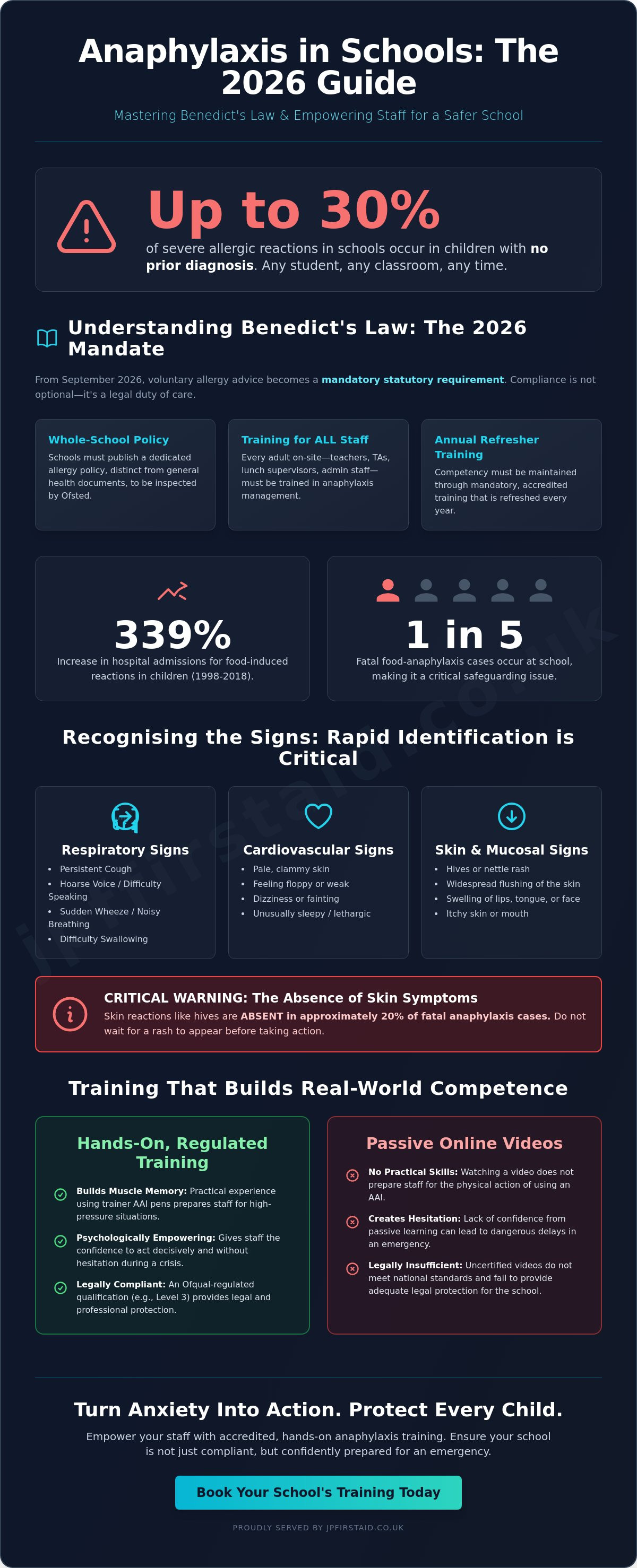
Did you know that up to 30% of severe allergic reactions in schools occur in children who have no prior diagnosis of an allergy? This means an emergency can happen in any classroom, at any time, to any student. It’s completely natural to feel anxious about your team freezing during a crisis or to feel overwhelmed by the mandatory shift to Benedict’s Law this September. You want your school to be a safe haven, but finding the right anaphylaxis training for school staff while navigating new statutory requirements often feels like a massive hurdle.
We’re here to help you turn that anxiety into action. You’ll master the essential skills and legal requirements for managing severe allergies with our comprehensive 2026 guide. Our goal is to move your team beyond simple compliance so they feel psychologically empowered to use an adrenaline auto-injector (AAI) without hesitation. We will break down the 2026 legal mandates for spare pens, explain the annual training requirements for all employees, and show you how to build a robust policy that protects every child in your care.
Key Takeaways
- Understand how Benedict’s Law transforms allergy management into a mandatory statutory requirement, ensuring your school remains fully compliant.
- Discover why hands-on anaphylaxis training for school staff is the most effective way to build the muscle memory required for high-pressure situations.
- Learn the critical differences between mild symptoms and life-threatening reactions to ensure your team responds with the appropriate level of care.
- Master the 2026 guidelines for stocking and accessing “spare” adrenaline auto-injectors, providing a vital safety net for all pupils.
- Develop a clear, actionable whole-school allergy policy that empowers your team and moves beyond simple paperwork.
Understanding the Legal Landscape: Benedict’s Law and School Compliance in 2026
September 2026 marks a turning point for school safety in England. Benedict’s Law, introduced following the tragic death of five-year-old Benedict Blythe, transforms previously voluntary allergy advice into mandatory statutory guidance. This isn’t just another box to tick. It’s a legal framework designed to protect the estimated 680,000 school children living with allergies. For headteachers and governing bodies, the duty of care now includes a specific legal obligation to ensure every adult on site knows how to save a child’s life. Providing high-quality anaphylaxis training for school staff is now a pillar of effective school leadership.
Relying on a general medical policy is no longer sufficient. Under the new rules, schools must publish a dedicated whole-school allergy policy that is distinct from other health documents. This shift reflects a growing reality: hospital admissions for food-induced reactions in children rose by 339% between 1998 and 2018. Because 1 in 5 fatal food-anaphylaxis cases occur at school, Ofsted now views allergy management as a critical component of the safeguarding inspection framework. If your staff aren’t prepared, your school isn’t just at risk of an emergency; it’s at risk of serious legal and regulatory non-compliance.
The Core Requirements of Benedict’s Law
The new legislation moves away from the idea that only a few first aiders need to be prepared. Now, anaphylaxis training for school staff must include every person who comes into contact with pupils. This includes teachers, TAs, lunchtime supervisors, and administrative staff. To maintain competency, this training must be refreshed annually. You’ll also need to identify “designated staff members” who lead your emergency protocols, ensuring there’s always a clear chain of command when seconds count. This whole-school approach acknowledges that a reaction can happen anywhere, from the playground to the library.
Anaphylaxis and Paediatric First Aid Standards
While basic awareness is a start, it doesn’t provide the level of protection required for high-risk environments. Comprehensive paediatric first aid training often includes modules on Understanding Anaphylaxis, but Benedict’s Law requires a deeper, more specialized focus. Choosing an Ofqual-regulated provider ensures your training meets the highest national standards. A Level 3 regulated qualification offers a layer of legal and professional protection that uncertified videos simply can’t match. It’s the difference between watching a demonstration and gaining the psychological empowerment to act decisively during a crisis.
Recognising the Signs: Why Rapid Identification is Critical for School Staff
In the middle of a busy lunch hour or a chaotic PE lesson, identifying a medical emergency requires more than just a quick glance. Anaphylaxis is a systemic allergic reaction that affects the entire body, often occurring within minutes of exposure to a trigger. While many people immediately think of peanuts, school environments are full of other common allergens. In fact, cow’s milk is now the most common single cause of fatal anaphylaxis in school aged children in the UK. Understanding these triggers and the science behind the reaction is the first step in effective anaphylaxis training for school staff.
The “Rapidity Factor” cannot be overstated. When a child enters anaphylactic shock, their blood pressure drops and their airways begin to narrow. Every second you spend second-guessing the symptoms is a second that the adrenaline in an auto-injector could be working to reverse the reaction. Because up to 30% of severe reactions occur in children with no known history of allergies, you can’t rely solely on a list of diagnosed pupils. You must be able to spot the signs in any child, at any time.
Symptom Progression in Young People
Symptoms in children and teenagers often follow a specific, dangerous progression. You should look for respiratory signs like a persistent cough, hoarse voice, or a sudden wheeze, alongside cardiovascular signs such as a child appearing pale, floppy, or unusually sleepy. While skin reactions like hives or swelling are common, they are absent in about 20% of fatal cases. This is a critical detail often missed in basic guides. One of the most striking psychological signs is a “sense of impending doom,” where a pupil may express a profound fear that something terrible is about to happen. If a child tells you they feel like they are going to die, take it as a serious clinical symptom.
Overcoming the “Wait and See” Trap
Staff members often hesitate to use an Adrenaline Auto-Injector (AAI) because they fear doing harm or misdiagnosing the situation. This “wait and see” approach is the greatest risk to a pupil’s life. Adrenaline administered early is life-saving and carries minimal risk even if misdiagnosed. It is a naturally occurring hormone that works rapidly to open airways and stabilise blood pressure. If you are in doubt, the safest course of action is always to administer the injector and call 999. Our interactive first aid sessions focus on building this specific clinical confidence, ensuring you feel capable of acting without hesitation. By removing the fear of making a mistake, we empower you to focus entirely on the pupil’s recovery.
Hands-On Training vs. Online Videos: Building Real-World Competence
While a one-hour video might satisfy a basic compliance checklist, it rarely prepares a teacher for the adrenaline spike of a real-world emergency. Passive learning has significant limitations when it comes to high-stress response. Reading about an Adrenaline Auto-Injector (AAI) is a world away from actually clicking a trainer device against a thigh. This physical “muscle memory” is what takes over when panic sets in. It ensures that your hands know exactly what to do even if your mind is racing. Without this tactile experience, the risk of a staff member freezing during a crisis increases significantly.
Practical workshops consistently lead to better information retention than digital modules. When you physically handle the equipment and walk through the steps, your brain encodes the information through multiple senses. Scenario-based drills allow you to practice in the corridors and classrooms where you actually work, making the skills feel relevant and attainable. Effective anaphylaxis training for school staff should bridge the gap between abstract theory and the actual environment of your school. This approach transforms a dry regulatory requirement into a lived experience that staff can recall instantly when seconds count.
The Benefits of On-Site Group Training
Booking an on-site session allows us to tailor the experience to your school’s unique layout and the specific needs of your pupils. We can discuss exactly where your “spare” pens are kept and how to reach them fastest from the playground or the canteen. This type of first aid training also builds vital team cohesion. When your whole staff practices together, everyone understands their specific role in a crisis, which reduces confusion and builds a collective sense of security across the entire campus.
Interactive Learning and Psychological Empowerment
Many people start our sessions feeling “scared of needles” or worried they might accidentally cause harm. Our expert mentors work to replace that fear with a “ready to act” mindset. We keep the atmosphere relaxed and welcoming, encouraging you to ask the “what if” questions that online videos simply can’t answer. By making the training enjoyable and interactive, we ensure that the life-saving skills stick. This psychological empowerment is the most important outcome of our sessions, moving you from a state of anxiety to a state of calm, capable preparedness.
Managing Adrenaline Auto-Injectors (AAIs) and “Spare Pens” in Schools
Benedict’s Law makes stocking “spare” adrenaline auto-injectors a legal requirement for all schools in England. These pens are a vital safety net for situations where a pupil’s own device fails, is empty, or when a reaction occurs in a child with no previous diagnosis. You’ll need to keep these spares in a central, accessible location that is known to all staff but kept out of reach of younger children. It’s about finding the balance between security and rapid retrieval. You shouldn’t lock these devices away in a cupboard where the key might be missing when seconds count.
Familiarity with different brands is a core part of anaphylaxis training for school staff. While the “Blue to the sky, orange to the thigh” mnemonic is a helpful starting point for EpiPens, brands like Jext and Emerade have distinct designs and activation times. You shouldn’t assume that knowing one means you know them all. Regularly checking expiry dates and the condition of the viewing window is also essential. An expired pen may not deliver the full dose of life-saving medication, so a monthly maintenance log is a simple but effective way to stay compliant.
Creating a Robust Allergy Policy
A strong policy is more than just a document in a drawer. It must include a clear process for identifying pupils with allergies and creating Individual Healthcare Plans (IHPs) for every at-risk student. You also need a protocol for storing spare AAIs and a schedule for mandatory annual training. Registering pupils should be done discreetly to avoid stigmatisation while ensuring every staff member knows who is at risk. Integrating these steps into your emergency first aid at work framework ensures that allergy management is a core part of your school’s safety culture.
Step-by-Step Guide to Using an AAI
When you need to act, follow these steps to ensure the medication is delivered effectively:
- Prepare: Remove the safety cap. For an EpiPen, this is the blue cap; for a Jext, it is yellow.
- Administer: Swing and push the tip firmly against the outer thigh. You’ll hear a click or feel the needle fire. Hold it in place for the time specified by the manufacturer.
- Post-Care: Lie the pupil flat with their legs raised to maintain blood pressure. If they struggle to breathe, they can sit up slightly, but never let them stand or walk.
- Call 999: Always state “anaphylaxis” clearly to the operator. If there is no improvement after five minutes, administer a second pen in the other leg.
Ready to get your team certified and compliant? Book your on-site training session today to ensure your staff are fully prepared for any emergency.
Why Choose JPF First Aid for Your School’s Anaphylaxis Training?
Selecting the right provider for your anaphylaxis training for school staff is about more than just meeting a legal checklist. You need a partner who understands that the biggest barrier to saving a life isn’t a lack of knowledge, but a psychological one. Many staff members feel a deep-seated anxiety about using a needle, even an automated one. At JPF First Aid, we don’t just teach the mechanics; we focus on psychological empowerment. Our multi-award-winning approach is designed to demystify the process and replace fear with a calm, capable attitude. We’ve helped thousands of educators move past the “needle phobia” by providing a safe, relaxed environment where they can practice until the action feels like second nature.
Our qualifications are Ofqual regulated, which means they exceed the basic compliance requirements set out by Benedict’s Law. This gives your governing body and headteacher the peace of mind that the training is robust, verified, and professional. We believe that emergency response training shouldn’t be dry or clinical. Instead, we act as reliable expert mentors, focusing on practical skills that work in the real world rather than just focusing on theory. By the end of our session, your team won’t just have a formal credential; they’ll have the confidence to act decisively when a child is in distress.
Bespoke Training Tailored to Your Environment
Every school is different, and your training should reflect that. We adapt our sessions specifically for your setting, whether you’re in a primary school, a busy secondary campus, or a specialised SEN environment. For schools with pupils who have complex needs, we provide extra focus on identifying subtle signs of distress. To make things simple for your budget, we offer a flat-rate group fee for up to 12 delegates. This allows you to train a significant portion of your team at once, ensuring that safety is a shared responsibility. Plus, our relationship doesn’t end when the session finishes; we provide ongoing support and advice whenever your school needs it.
Booking Your 2026 Training Session
As the September 2026 deadline for Benedict’s Law approaches, demand for high-quality training is increasing. It’s a good idea to book early, especially if you’re looking to schedule training during busy INSET days or staff meetings. We offer flexible delivery options, including on-site sessions that come to you or blended learning paths that combine digital theory with hands-on practice. Contact us today to get a tailored quote that meets the specific needs of your setting and your pupils. Empower your staff with life-saving anaphylaxis training today and ensure your school is a safe, compliant environment for everyone.
Secure Your School’s Safety for 2026 and Beyond
Building a future where every staff member feels ready to act is the ultimate goal of Benedict’s Law. By moving beyond basic awareness and embracing hands-on practice, you ensure your school isn’t just legally compliant but physically prepared for any emergency. You now understand how to identify rapid symptom progression and why managing “spare” pens is a critical safety net for every child in your care. These steps form the foundation of a truly resilient school community.
Choosing the right anaphylaxis training for school staff means prioritizing psychological empowerment alongside formal certification. As a multi-award-winning training provider, we offer Ofqual regulated qualifications delivered by experienced mentors who understand the unique pressures of the school environment. We’re here to help you turn anxiety into confidence, ensuring your team is ready to save lives with precision and calm. Our approach ensures that every learner feels supported throughout the entire process.
Don’t wait for the September 2026 deadline to secure your team’s skills. Book Professional Anaphylaxis Training for Your School Staff today to create a safer learning community. You’re in safe, expert hands with us, and we look forward to supporting your school’s safety journey.
Frequently Asked Questions
Is anaphylaxis training mandatory for all school staff in the UK?
Yes, from September 2026, comprehensive training is mandatory for all school staff in England who have contact with pupils. This change moves allergy safety from voluntary best practice to a statutory requirement under the new guidance. It ensures that everyone from teachers to lunchtime supervisors can recognize and react to a life-threatening reaction immediately, regardless of their role.
What is Benedict’s Law and how does it affect our school first aid policy?
Benedict’s Law is the statutory guidance coming into force in September 2026 that mandates robust allergy management in all schools. It requires your school to move beyond a general medical conditions policy and publish a dedicated, whole-school allergy policy. This document must outline specific procedures for annual training, emergency response, and the management of individual healthcare plans for at-risk pupils.
Can any member of staff administer an adrenaline auto-injector (AAI)?
Yes, any member of staff can legally administer an adrenaline auto-injector to a pupil in an emergency situation. You don’t need to be a designated first aider to act when a child is experiencing a severe reaction. Our anaphylaxis training for school staff focuses on giving every employee the practical skills and psychological confidence to use these devices without hesitation when seconds count.
How often should school staff refresh their anaphylaxis training?
Staff must undertake allergy awareness and emergency response training annually to remain compliant with the 2026 statutory guidance. This yearly refresher is essential for maintaining the “muscle memory” required to use an auto-injector correctly under pressure. Regular sessions also ensure your team is up to date with any changes in medication brands or school emergency protocols.
Do we need a specific policy for “spare” adrenaline pens in school?
Yes, your school is legally required to stock spare adrenaline auto-injectors and must have a clear policy governing their use. This policy should detail where the pens are stored, how expiry dates are monitored, and the process for using them on pupils with no prior diagnosis. It provides a vital safety net for the many children who experience their first reaction while on school grounds.
What is the difference between an EpiPen, a Jext, and an Emerade pen?
While all three devices deliver life-saving adrenaline, they differ in their physical design, needle length, and the time they must be held against the thigh. For example, the safety caps and activation steps for an EpiPen are not identical to those of a Jext or Emerade. Your staff should practice with all three brands to ensure they can operate whichever device is available in a crisis.
Will our staff be legally protected if they administer adrenaline in an emergency?
Yes, staff are legally protected when they administer adrenaline in good faith during an emergency. Statutory guidance provided under the Children and Families Act 2014 supports employees who act to save a pupil’s life. Following your school’s approved training and internal policy provides a strong layer of professional and legal protection for every member of your team during a medical event.
Can we combine anaphylaxis training with our standard paediatric first aid course?
Yes, you can choose to integrate this specialized instruction into a Level 3 Paediatric First Aid course. This two-day qualification includes a dedicated module on allergic reactions and the hands-on use of auto-injectors. It’s an efficient way to meet multiple compliance needs while ensuring your staff receive high-quality, Ofqual-regulated instruction that covers a broad range of emergency scenarios.
Recent Comments