
Did you know that when CPR is initiated within the first minute of a cardiac arrest, a child’s odds of survival increase by 91%? It is a powerful statistic, yet with over 7,000 out-of-hospital cardiac arrests occurring in infants and children each year, many parents still feel paralyzed by the fear of doing more harm than good. You likely feel that the responsibility is overwhelming, especially when trying to remember the differences between adult and paediatric techniques during a high-pressure moment. We want you to know that these feelings are completely normal, and you aren’t alone in wanting the best protection for your little ones.
This guide provides the life-saving knowledge you need to perform cpr for babies and children with absolute confidence. We’re here to replace panic with a clear, manageable skill set based on the latest 2026 guidelines. You will learn about the critical updates, such as the transition away from the two-finger compression for infants and the new alternating techniques for choking. We will provide a simple mental checklist to help you decide when to call 999 and how to act effectively, ensuring you feel empowered rather than terrified in an emergency.
Key Takeaways
- Understand the core physiological differences between adults and children, which explains why rescue breaths are often the most critical step in paediatric emergencies.
- Gain a clear mental checklist for performing cpr for babies and children, ensuring you know exactly how to adapt your technique as they grow.
- Overcome the anxiety of causing harm by learning why a child’s flexible anatomy is designed to withstand the pressure of life-saving compressions.
- Learn the vital 2026 updates for infant care, including the transition away from the two-finger compression technique to ensure maximum effectiveness.
- Find out why practising on manikins is the only way to build the practical confidence needed to act decisively when every second counts.
Understanding CPR for Babies and Children: Why It Differs from Adults
Cardiopulmonary Resuscitation (CPR) is a life-saving skill that combines chest compressions with rescue breaths to maintain a flow of oxygenated blood to the brain and other vital organs. While the basic concept is the same for everyone, the way we perform cpr for babies and children is specifically adapted to their smaller bodies and different physiological needs. Understanding these differences isn’t just about following a checklist; it’s about knowing why these changes exist so you can act with confidence during a crisis.
The most significant difference between adult and paediatric emergencies is the underlying cause of the collapse. In adults, cardiac arrest is typically a “heart problem” caused by a sudden cardiac rhythm issue. In contrast, a child’s heart is usually healthy. When a child’s heart stops, it is almost always a “breathing problem” resulting from things like choking, drowning, or respiratory infections. Because their oxygen levels drop before their heart stops, the 2026 guidelines emphasize getting oxygen into the system immediately. This is why we always start with five initial rescue breaths for young patients, whereas we might start with compressions for an adult.
To apply the correct technique, you must first identify the age of the patient. First aid standards define an “infant” as a baby under one year old. A “child” is defined as anyone from the age of one year up until they reach puberty. Once a child reaches puberty, you should follow the adult CPR protocols. Identifying these stages helps you quickly decide which physical approach to use, such as using two thumbs for an infant or one to two hands for a child.
The Vital Role of Oxygen in Paediatric Emergencies
Children have a much higher metabolic rate than adults, which means their bodies use up oxygen far more quickly. When breathing stops, their internal “oxygen tank” empties fast, leading to a rapid decline. This is why rescue breaths are the absolute priority in Pediatric Basic Life Support (PBLS). By delivering these breaths, you are manually fueling their system and protecting their brain. Paediatric CPR acts as a vital bridge that keeps a child’s body functioning until professional medical help arrives at the scene.
Preparing Your Mindset: The ‘Can-Do’ Attitude
It’s perfectly normal to feel a surge of fear when an emergency involves a child. You might worry about making a mistake, but the reality is that doing something is always better than doing nothing. In a cardiac arrest situation, the patient is already in the most serious state possible; your intervention can only help. Learning what are the first aid essentials helps strip away the complexity and focuses your mind on the primary goal: keeping oxygen moving. A calm, “can-do” attitude is your most effective tool, allowing you to follow the steps logically and give the child their best chance of survival.
Step-by-Step: How to Perform CPR on a Baby (Under 1 Year Old)
When you discover an unresponsive infant, the first few seconds are vital. Your priority is to stay calm and follow a logical sequence of actions. Start by checking for danger. Ensure the immediate environment is safe for both you and the baby before you approach. Once safety is confirmed, check for a response. You should gently tap the sole of the baby’s foot and call their name loudly. Never shake a baby; their neck muscles are not yet strong enough to support their head during vigorous movement. If they don’t respond, you must act immediately.
The next step is to open the airway using the ‘neutral position.’ Unlike adults, who require a significant head tilt, a baby’s head should remain level with their body. Tilting an infant’s head back too far can actually kink their narrow airway, making it harder for air to pass through. After positioning, look, listen, and feel for normal breathing for no more than 10 seconds. If the baby isn’t breathing or is making irregular gasping sounds, you need to begin cpr for babies and children. Start with five initial rescue breaths. Place your mouth over both the baby’s nose and mouth to create a tight seal, then blow steadily until you see the chest rise.
Following a step-by-step guide helps you maintain focus during these high-pressure moments. If you want to feel truly prepared, our Child and Infant First Aid sessions offer the hands-on practice that builds lasting confidence.
Infant Chest Compressions: Updated Techniques
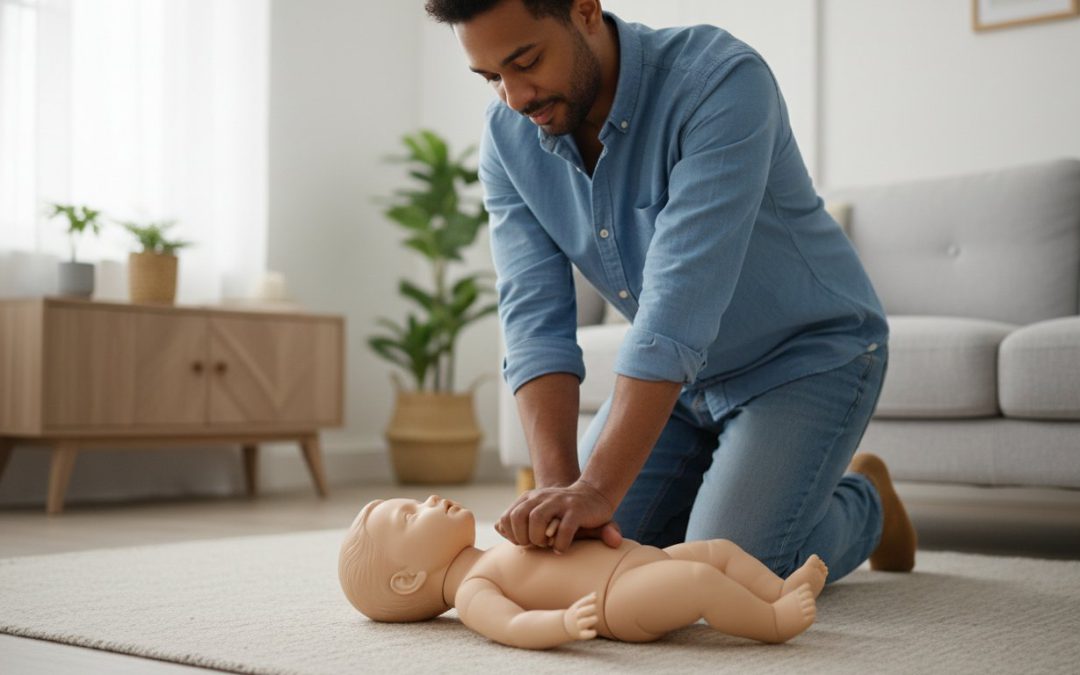
Current 2026 guidelines have moved away from the traditional two-finger technique for infant compressions. Instead, you should use two thumbs with your hands encircling the baby’s chest, or the heel of one hand for larger infants. Place your thumbs or the heel of your hand in the centre of the chest, just below the nipple line. Compress the chest by about one-third of its depth, which is approximately 4cm. Aim for a steady rate of 100 to 120 compressions per minute, keeping pace with the beat of ‘Stayin’ Alive.’
The Ratio and Calling for Help
The standard cycle is 30 chest compressions followed by 2 rescue breaths. If you are alone and don’t have a mobile phone within reach, perform one minute of CPR before stopping to call 999. If you do have a phone, put it on speakerphone immediately. This allows you to communicate with the emergency operator while keeping your hands free to continue the life-saving cycle. They will stay on the line with you, providing a reassuring voice until the paramedics arrive at your location.

Step-by-Step: How to Perform CPR on a Child (1 Year to Puberty)
As a child grows beyond their first birthday, the technique for cpr for babies and children shifts to accommodate their larger frame and developing anatomy. The primary goal remains the same: getting oxygen to the brain. First, check for danger to ensure you aren’t putting yourself at risk. Once the area is safe, check for a response by gently shaking the child’s shoulders and shouting “Hello, can you hear me?” in both ears. If there is no response, you must act quickly but calmly.
To open the airway, use the head-tilt chin-lift technique. Place one hand on their forehead and the fingertips of your other hand under the point of their chin, gently tilting the head back. This action lifts the tongue away from the back of the throat. Check for normal breathing for no more than 10 seconds by looking at the chest, listening for breath sounds, and feeling for air on your cheek. You might witness “agonal gasps,” which are infrequent, noisy, or laboured gasps. Do not mistake these for breathing; they are a sign of cardiac arrest and mean you must start CPR immediately.
According to the MedlinePlus Medical Encyclopedia, the sequence for children starts with five initial rescue breaths. Pinch the child’s nose closed, seal your mouth over theirs, and blow steadily until the chest rises. After these five breaths, begin the cycle of 30 chest compressions followed by two breaths. If you are alone, perform one minute of this cycle before stopping to call 999, though using a speakerphone while you work is always the best option.
Child Compressions: One Hand or Two?
Deciding whether to use one or two hands depends entirely on the size of the child and your own physical strength. The goal is to compress the chest by about one-third of its depth, which is approximately 5cm. If the child is small or you are strong enough to reach that depth with one hand, use the heel of one hand in the centre of the chest. For larger children or if you find your hand tiring, interlock both hands as you would for an adult. It’s vital to allow the chest to recoil fully between every compression; this allows the heart to refill with blood before the next push.
Using an AED (Defibrillator) on a Child
You can and should use an Automated External Defibrillator (AED) on a child if one is available. Most modern AEDs come with paediatric pads or a “child mode” that reduces the energy level of the shock. If only adult pads are available, you can still use them, but ensure the pads do not touch each other. For smaller children, use the “sandwich method” by placing one pad in the centre of the chest and the other in the centre of the back. Never delay starting CPR while waiting for an AED. The compressions you provide are the most important factor in keeping the child’s brain oxygenated until the device arrives.
Common Fears and Misconceptions: Why You Can’t Afford to Wait
Fear is a powerful deterrent, but when it comes to cpr for babies and children, hesitation is the only real mistake you can make. Many parents worry about the physical force required for compressions. They fear breaking a child’s ribs. It’s vital to understand that a child’s ribcage is incredibly flexible, composed of more cartilage than adult bone. While a fracture is a possibility, it’s a minor, treatable injury compared to the alternative of permanent brain damage. You aren’t hurting them; you are keeping them alive.
Another common barrier is the fear of making things worse. In a cardiac arrest scenario, the heart has stopped and the child is effectively dead without intervention. You cannot make that situation worse. Your actions are the only thing providing a chance for survival. Under the Good Samaritan Law UK, you are legally protected when you act in good faith to save a life. This legal framework ensures that fear of litigation never stands in the way of a rescue.
The bystander effect often takes hold in public spaces, where individuals assume someone else will step forward. If you see a child in distress, you must be the one to take charge. Waiting for a more qualified person can waste those first five minutes where survival odds are highest. Consider these facts when you feel hesitant:
- Bones heal, but brain cells begin to die within four minutes without oxygen.
- The law is on your side when you act to help.
- Doing something is always better than doing nothing.
What Does ‘Not Breathing Normally’ Actually Look Like?
Recognising the need for cpr for babies and children requires knowing what isn’t normal. You might see agonal gasps; these are infrequent, noisy, or snorting sounds that look like the child is trying to breathe. These are actually reflex actions of the brain and are not effective breaths. In many paediatric cases, silence and a lack of any movement are the most dangerous signs. Normal breathing for a child is regular, quiet, and effortless, occurring between 20 and 30 times per minute depending on their age, whereas an adult typically breathes 12 to 20 times per minute.
The Emotional Aftermath of Rescuing
Performing life-saving measures is a high-stress, traumatic event. Once the paramedics take over, the adrenaline will drop, and you may feel overwhelmed or doubt your actions. This is a natural response. Seeking a professional debrief or support is essential for your recovery. Understanding mental health first aid can help you and those around you process the experience and manage the emotional impact of the emergency.
Don’t let fear hold you back from being a hero; book your Paediatric First Aid Course today and gain the hands-on skills that turn panic into purpose.
Building Real-World Confidence: Why Practical Training Trumps Online Guides
Reading about life-saving techniques is a vital first step, but there’s a world of difference between understanding a concept and physically performing it. When you’re in a high-pressure situation, your brain doesn’t always recall the text you read on a screen. Instead, it relies on muscle memory. By attending a paediatric first aid course, you bridge the gap between theory and action. You get to feel the resistance of a manikin’s chest and practice the timing of your breaths until the rhythm becomes second nature.
Performing cpr for babies and children requires a level of precision that is hard to master without feedback. Our expert instructors at JPF First Aid ensure you’re placing your hands correctly and compressing to the right depth. We strip away the clinical jargon and replace it with practical, “can-do” training. We believe that learning shouldn’t be intimidating. Our sessions are designed to be engaging and fun, creating a relaxed environment where you can ask questions and build genuine trust in your own abilities.
You might wonder whether you need a full regulated qualification or a simple awareness session. If you work in childcare or a school, a Level 3 qualification is often a legal requirement for compliance. For parents and carers, an awareness session provides the core life-saving skills without the formal assessment. Both options focus on the same goal: giving you the tools to save a life. Since the 2026 guidelines were released, we’ve updated every session to include the latest evidence-based techniques.
What to Expect in a JPF Training Session
We keep our group sizes small to ensure you get plenty of one-on-one time with our qualified mentors. You’ll use the latest training equipment, including manikins that provide real-time feedback on your compression quality. We understand that life is busy. That’s why we offer flexible “on-site” solutions. We can come to your school, business, or community group at a time that suits you. You’ll leave our session with our “confidence promise.” This is the certainty that you have the skills to act decisively, not just a piece of paper.
Taking the Next Step for Your Family
Protecting your family is the most important job you have. Investing in first aid courses isn’t just for professionals; it’s a gift for new parents, grandparents, and anyone who looks after your children. Whether you book onto a public course or arrange a private session for your family circle, you’re taking a proactive step toward safety. Don’t wait for an emergency to find out if you’re ready. Empower yourself today and ensure you’re the reliable expert your child needs in a crisis.
Take the Next Step Toward Life-Saving Confidence
You now have a solid understanding of the critical steps required during a paediatric emergency. By focusing on the 2026 updates, such as prioritising rescue breaths and moving away from two-finger compressions for infants, you’ve taken the first step toward becoming a capable rescuer. We’ve explored how a child’s flexible anatomy makes rib injuries less likely and why the law protects you when you act in good faith. However, reading about cpr for babies and children is only part of the journey; true confidence comes from the physical practice that builds muscle memory.
As a multi-award-winning training provider, JPF First Aid specialises in delivering Ofqual regulated qualifications that are expert-led, engaging, and actually fun. We believe that life-saving skills shouldn’t be stressful to learn. Our practical sessions ensure you leave with the “can-do” attitude needed to protect your family in any situation.
Book Your Paediatric First Aid Course with JPF First Aid Today. You have the power to be the hero your child needs, and we’re here to help you every step of the way.
Frequently Asked Questions
How many chest compressions do you give a baby?
You should give 30 chest compressions for every 2 rescue breaths. This 30:2 ratio remains the standard for both infants and children. Before starting your first cycle of compressions, you must deliver 5 initial rescue breaths to provide an immediate boost of oxygen. This specific sequence is vital because paediatric emergencies are typically respiratory in nature rather than heart-related.
What is the ratio of compressions to breaths for a child?
The correct ratio for a child is 30 chest compressions followed by 2 rescue breaths. Just like with infants, you should always begin the process with 5 initial rescue breaths. These breaths are the most important part of cpr for babies and children because they address the lack of oxygen that usually causes the heart to stop in younger patients.
Can I use an adult AED on a baby?
You can use an adult AED on a baby if paediatric pads or a child-specific mode are not available. In this situation, you must place one pad in the centre of the chest and the other in the centre of the back. This “sandwich” technique ensures the pads don’t touch on a smaller torso, allowing the device to safely analyse the heart rhythm and deliver a shock if needed.
What should I do if I am alone and my child stops breathing?
If you are alone and don’t have a phone, perform one minute of CPR before stopping to call 999. If you have a mobile phone, dial 999 immediately and put it on speakerphone so you can follow the operator’s instructions while your hands remain free. Acting quickly is essential, as survival odds increase by 91% when help starts within the first sixty seconds of a cardiac arrest.
How deep should chest compressions be for an infant?
Chest compressions for an infant should be approximately 4cm deep, while for a child, you should aim for 5cm. In both cases, this represents about one-third of the total chest depth. It’s important to allow the chest to recoil fully between each push, as this allows the heart to refill with blood before the next compression. Proper depth ensures that blood continues to reach the brain.
Is it different if the child is choking?
Yes, the 2026 guidelines for a choking child who cannot cough or breathe recommend alternating between 5 back blows and 5 abdominal thrusts. If the child becomes unresponsive during this process, you must immediately start cpr for babies and children. The compressions will help to manually circulate oxygen and may also help to dislodge the object blocking the airway.
Do I need to do mouth-to-mouth on a child if I’m worried about germs?
Rescue breaths are much more critical for children than for adults because paediatric cardiac arrest is usually caused by a lack of oxygen. While hands-only CPR is better than nothing, providing breaths significantly increases the child’s survival odds. You can use a pocket mask or a plastic face shield to reduce germ concerns while still delivering the life-saving oxygen the child desperately needs.
How long should I continue CPR for?
You should continue CPR until a medical professional tells you to stop, the child begins breathing normally, or you become too exhausted to continue. If a second person is available, you should switch every two minutes to ensure the compressions remain high-quality and effective. Maintaining a steady rhythm is the most effective way to protect the child’s brain until the emergency services arrive at your location.
Recent Comments