

Would you know exactly what to do if a colleague collapsed in front of you right now, or would the next sixty seconds be a blur of panic? It’s a heavy thought, but for the 606,000 workers who sustained non-fatal injuries in UK workplaces according to 2023/24 HSE statistics, having a trained responder nearby is often the only thing that matters. You likely already feel the pressure to keep up with emergency first aid at work requirements, yet you might worry that a standard course will be dry, clinical, or leave your team feeling unprepared to actually step in.
We’re here to show you that training doesn’t have to be a dull exercise. This guide promises to help you master the EFAW qualification by blending strict legal compliance with the practical, life-saving skills that build genuine confidence. You’ll learn how to meet every HSE requirement through an approach that’s engaging and entirely hassle-free. We’ll break down the essential 2026 standards and explain how to transform your workplace safety from a source of anxiety into a foundation of trust.
Key Takeaways
- Understand how the Level 3 Award meets essential HSE standards to ensure your business remains fully compliant and your team stays safe.
- Master life-saving practical skills, including the ‘ABC’ of life support and how to safely manage an unconscious casualty using the recovery position.
- Learn how to use a First Aid Needs Assessment to decide if the 1-day emergency first aid at work course or the full 3-day qualification is right for your workplace.
- Prepare for a stress-free training day with our guide on what to wear and how our supportive, continuous assessment process builds your confidence.
- Discover why choosing a multi-award-winning mentor ensures your training is engaging, memorable, and far from a dry, clinical classroom experience.
What is Emergency First Aid at Work (EFAW)?
The Level 3 Award in Emergency First Aid at Work is a regulated qualification designed to give you the skills needed to handle a medical crisis with confidence. It’s an intensive, practical 1-day course that focuses on life-saving interventions. While exploring What is First Aid? provides a broad overview of general principles, this specific qualification is tailored for the British workplace. The Health and Safety Executive (HSE) sets the rigorous standards for this training, ensuring that every learner walks away with a toolkit of skills that actually work in real-world scenarios. For approximately 80% of small, low-risk businesses in the UK, this 1-day session is the gold standard because it balances essential life-saving skills with a manageable time commitment that doesn’t disrupt the working week.
The course isn’t just about ticking a box; it’s about empowerment. We focus on hands-on practice, from managing an unresponsive casualty to using a defibrillator. It’s designed to be engaging and fun, stripping away the clinical jargon to focus on what really matters: keeping someone stable until the paramedics arrive. For many UK small businesses, the emergency first aid at work certificate represents the minimum legal requirement to ensure staff safety and regulatory compliance.
The Legal Framework: Health and Safety (First-Aid) Regulations 1981
UK law is very clear about your responsibilities as an employer. The Health and Safety (First-Aid) Regulations 1981 require you to provide “adequate and appropriate” equipment, facilities, and personnel so your employees can receive immediate attention if they’re injured or taken ill at work. This isn’t a suggestion; it’s a statutory obligation. If an accident occurs and you’re found to have insufficient cover, the consequences are severe. In the 2022/23 period, the HSE prosecuted hundreds of firms for safety failings, with average fines per conviction reaching over £140,000. Beyond the financial risk, the lack of trained staff can lead to preventable tragedies that devastate workplace morale and reputation.
Choosing an Ofqual-regulated course is the simplest way to ensure you’re compliant. When your training is regulated, it means the qualification is monitored for quality and consistency. It’s “First Aid Training You Can Trust” because it meets the strict criteria set by the government’s qualification regulators. You don’t have to worry about the validity of your certificate; it’s recognized by inspectors and insurance providers across the country. We handle the technicalities so you can focus on running your business.
Who Should Attend an EFAW Course?
Identifying who needs training starts with a simple risk assessment. In many small offices, retail units, or libraries, you might only need an “Appointed Person” to take charge of first aid arrangements, like calling 999 and stocking the first aid box. However, an emergency first aid at work trained staff member goes much further. They’re the ones who step in when someone is choking or suffering a cardiac arrest. If your workplace is considered low-risk and has fewer than 50 employees, having at least one person with this 1-day qualification is usually the ideal solution.
It’s not just for those designated by their boss, either. We see a 25% increase year-on-year in individuals booking this course for their own personal confidence. Whether you’re a self-employed consultant or a parent who wants to be prepared, these skills are universal. The training environment is relaxed and supportive, ensuring that even the most nervous learner feels ready to act. You’ll leave the session not just with a piece of paper, but with the genuine belief that you could save a life if the need ever arose.
This sense of preparedness extends to other areas of life where competence and safety are key. For example, learning to drive requires a similar focus on responsibility, and many find that professional instruction from a provider like Pass4you Driving School builds the same kind of real-world confidence.
This principle applies to many skilled professions where accredited qualifications are essential. For those seeking to build a career in construction trades, for instance, intensive, hands-on courses are a popular path; you can learn more about YTA Training to see examples of such programs.
The EFAW Syllabus: What You Will Learn in One Day
The emergency first aid at work course is a fast-paced, hands-on day designed to give you the skills to save a life. We don’t just talk through theories; we put them into practice. You’ll start by mastering the Primary Survey. This is the logical sequence of Danger, Response, Airway, Breathing, and Circulation (DRABC) that helps you stay calm when an incident occurs. By following this structure, you ensure the scene is safe before you provide care, protecting both yourself and the casualty.
Managing an unconscious person is a core part of the morning session. You’ll learn how to open an airway and check for normal breathing within ten seconds. If they are breathing, we’ll show you how to place them into the recovery position to keep that airway clear. If they aren’t breathing, we move straight into Cardiopulmonary Resuscitation (CPR). Since the 2021 update to the Resuscitation Council UK guidelines, there is a heavy focus on Automated External Defibrillators (AEDs). These machines are incredibly simple to use, and we ensure every learner gets plenty of time to practice with our training units.
The afternoon shifts toward the ‘Big Four’ of workplace trauma. These are the life-threatening conditions you’re most likely to encounter in a busy environment:
- Choking: Identifying the difference between a mild and severe obstruction, then applying back blows and abdominal thrusts.
- Wounds and Bleeding: Applying direct pressure and using modern dressings to stop heavy blood loss.
- Shock: Recognising the signs of hypovolemic shock, which is a life-threatening drop in blood pressure following an injury.
- Seizures: Keeping a casualty safe during a fit and providing appropriate aftercare.
Mastering Life-Saving Skills
The Basic Life Support algorithm is the heartbeat of this course. It’s a step-by-step logic gate that tells you exactly what to do next. During the practical assessment, our instructors look for your ability to perform 30 chest compressions and two rescue breaths with confidence. “AED training is now a mandatory part of the syllabus because using a defibrillator within the first 3 to 5 minutes of collapse can increase survival rates to as high as 70%.” This hands-on approach ensures you leave feeling ready to act, not just informed. If you want to see how we make these sessions interactive, you can view our course highlights and book your spot.
Minor Injuries and Incident Reporting
While life-saving skills are vital, most workplace incidents involve minor injuries like burns, scalds, or small splinters. We teach you how to treat these effectively to prevent infection. Accuracy in your paperwork is just as important as the first aid itself. We cover the legal necessity of the Accident Book and when an injury triggers workplace compliance reporting under RIDDOR (Reporting of Injuries, Diseases and Dangerous Occurrences Regulations 2013). You’ll also learn about the Good Samaritan Law in the UK. This provides legal reassurance that as long as you act within your training and in the best interest of the casualty, the law is on your side. This knowledge removes the fear of “doing the wrong thing” and replaces it with the confidence to help.
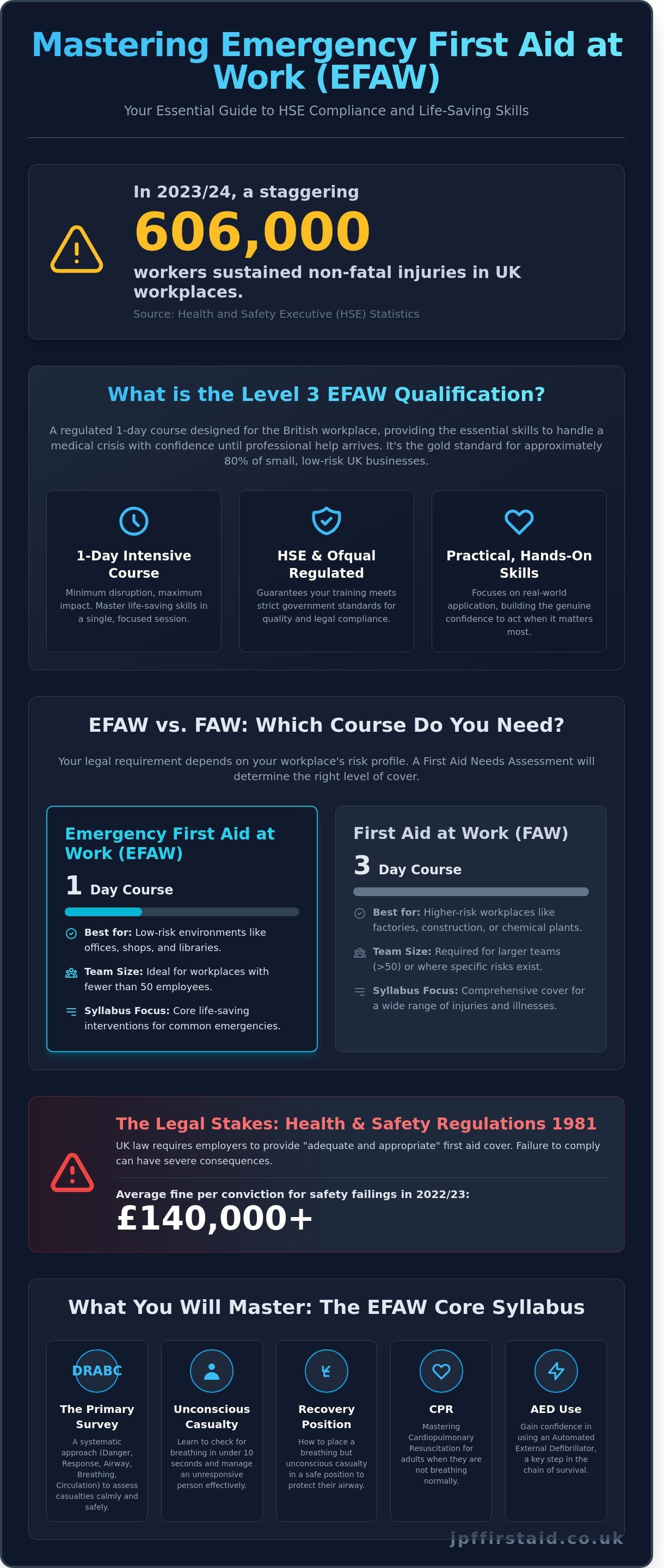
EFAW vs. FAW: Which Course Does Your Business Need?
Choosing the right level of training ensures you meet your legal obligations without overstretching your budget or your team’s time. The 1-day emergency first aid at work course is designed for low-risk environments where a rapid response to a life-threatening incident is the priority. In contrast, the 3-day First Aid at Work (FAW) qualification provides a much broader scope, covering a wider range of medical conditions and injuries. If you run a small office with fewer than 50 people, the EFAW is usually your baseline requirement. For larger teams or industrial settings, the 3-day FAW is the industry standard.
The training landscape is evolving to be more flexible for busy professionals. By January 2026, updated standards for “Blended Learning” will make the 3-day FAW course even more accessible. This shift allows your staff to complete one third of the theory online, followed by 2 days of intensive, hands-on practice with our expert trainers. It’s a hassle-free way to maintain compliance while reducing the time your team spends away from their desks or the shop floor.
Conducting a First Aid Needs Assessment
Your decision should always start with a thorough review of your specific workplace. You’ll need to look at your hazards; a workshop in Cannock using heavy machinery carries a much higher risk than a retail unit in Birmingham city centre. Don’t forget to consider your workforce vulnerabilities. If you employ staff with known heart conditions or have a workforce with an average age over 50, your requirements may increase. Location is also a vital factor. Businesses in urban West Midlands usually have quick access to paramedics, but if your site is in a more isolated part of rural Staffordshire, your first aiders need the confidence to manage a casualty for longer. You can find detailed support on this process in the HSE first aid at work guidance, which outlines how to calculate the number of first aiders you need based on your specific risk profile.
Renewal and Re-qualification Cycles
Consistency is the key to saving lives. Both the 1-day emergency first aid at work and the 3-day FAW certificates are valid for exactly 3 years from the date of assessment. However, skills can fade quickly if they aren’t used. To combat this, the HSE strongly recommends that every first aider attends a 3-hour annual refresher session. These short, engaging workshops keep your team’s “can-do” attitude sharp and ensure they don’t freeze during a real emergency. When your 3-year certificate is nearing its end, you must complete a re-qualification course before the expiry date. If your certificate expires, you may have to sit the full 3-day course again rather than the shorter 2-day re-qualification option, so keeping track of your dates is essential for staying compliant and cost-effective.
Preparing for Your Course: What to Expect on the Day
Walking into a training room can feel a little daunting if you aren’t sure what’s ahead. We want you to feel relaxed from the moment you arrive. Practicality is our priority, so your first task is choosing the right outfit. You’ll spend a significant portion of the 6-hour session on the floor practicing recovery positions and CPR on manikins. We recommend wearing comfortable trousers and trainers; avoid skirts, dresses, or restrictive suits that might hinder your movement during these hands-on exercises.
Assessment shouldn’t be a source of anxiety. At JPF First Aid, we’ve moved away from the traditional, high-pressure final exam. Instead, we use continuous observation. Our expert trainers watch your technique throughout the day, providing instant feedback and support. This method ensures you meet the standards required by the Health and Safety (First-Aid) Regulations 1981 without the “scary” atmosphere of a silent exam hall. If you’re struggling with a specific bandage or chest compression depth, we’ll stop and help you perfect it right then and there.
We know that medical scenarios can sometimes trigger an “ick” factor. Dealing with simulated blood or imagining a workplace injury can be uncomfortable for some. We handle this by keeping the atmosphere light and supportive. By the time you finish your emergency first aid at work training, you’ll find that your new-found confidence outweighs any initial squeamishness. We make our sessions engaging and fun because we believe people retain life-saving information much better when they’re enjoying the process rather than just staring at a PowerPoint slide.
The Learning Environment
Choosing where you learn is just as important as the content itself. You can join one of our scheduled classroom sessions in Birmingham or Cannock, where you’ll meet people from various industries. Alternatively, our “Coming to You” service is incredibly popular for local businesses. About 65% of our corporate clients choose on-site training because it allows us to tailor the scenarios to your specific workplace layout. We adapt every session to accommodate different learning styles and physical abilities, ensuring everyone leaves feeling capable and empowered.
Certification and Beyond
Your achievement is recognized with an Ofqual regulated certificate, which remains valid for three years. We understand that businesses need to move fast, so we aim to process and send your digital certificates within 48 hours of course completion. To maximize your training budget, 40% of our clients now choose to combine the emergency first aid at work qualification with Manual Handling or Fire Safety modules on the same day. This integrated approach doesn’t just tick a compliance box; it helps build a genuine safety culture that protects your team long after the session ends.
Ready to empower your team with skills that save lives? Book your on-site training session today and experience first aid training you can truly trust.
Why Choose JPF First Aid for Your Emergency Training?
Choosing the right provider for your health and safety requirements is about more than just finding a name on a list. You need a partner who understands the unique pressures of the West Midlands business landscape. At JPF First Aid, we’ve spent years refining an approach that moves beyond simple tick-box exercises. Our goal is to ensure that every person we train feels ready to step up when a real medical crisis occurs.
John Fogarty leads our sessions with over 20 years of hands-on experience in the industry. As your Reliable Expert Mentor, John doesn’t just read from a slide deck; he shares practical insights gained from two decades of real-world application. This depth of knowledge is why we were recognized at the West Midlands Enterprise Awards 2023. We provide multi-award-winning training that bridges the gap between theoretical knowledge and the high-pressure environment of a workplace accident.
Group bookings are a significant part of how we support local employers. We offer bespoke quotes for teams of up to 12 delegates, which often results in a 20% saving compared to individual booking rates. This makes maintaining your legal compliance both simple and cost-effective. We focus on building actual first aiders rather than just handing out certificates. When your staff completes our emergency first aid at work course, they leave with the practical confidence to handle cardiac arrests, heavy bleeding, and unconscious casualties without hesitation.
Regional Expertise, National Standards
We take immense pride in serving Cannock, Birmingham, and the surrounding areas. Our primary training base at Lichfield House in Brownhills offers a professional yet relaxed environment for learners. In 2023, we helped 87 different local businesses meet their HSE requirements through our flexible scheduling. We know that your business can’t always stop for training, so we offer evening or weekend sessions to minimize your operational downtime. Whether you come to us or we bring the training to your site, you receive the same high national standards delivered with local care.
The JPF Difference: Engaging and Fun
We’ve found that people learn best when they’re relaxed and involved. Most delegates arrive expecting a dry, clinical lecture, but they leave feeling empowered and energized. We use interactive scenarios and modern equipment to keep the energy high throughout the day. This “fun” element isn’t just for entertainment; it’s a proven way to increase information retention. If people enjoy the process, they’re 40% more likely to remember the life-saving steps months after the course has ended.
Our reputation is built on the success of our learners. Sarah, a manager at a logistics firm in Cannock, recently shared that her team felt “truly capable” for the first time after years of using other providers. We don’t just teach techniques; we foster a “can-do” attitude that removes the fear from first aid. If you’re ready to upgrade your team’s skills with a provider that cares about your specific needs, we’re here to help.
Take the first step toward a safer workplace today. Book your Emergency First Aid at Work course with JPF First Aid today and experience training that you can truly trust.
Secure Your Workplace Safety and Compliance Today
Meeting your 2026 health and safety obligations doesn’t have to be a stressful or dry experience. Choosing the right emergency first aid at work course ensures your team is ready for any incident, from minor injuries to life-threatening situations. You now understand the core EFAW syllabus and how this one-day training differs from the full three-day FAW qualification. This knowledge allows you to make an informed decision that keeps your staff safe and your business fully compliant with UK regulations.
JPF First Aid brings over 20 years of industry experience directly to your doorstep. We provide Ofqual regulated qualifications through training that’s practical, engaging, and focused on building your confidence. As a multi-award-winning training provider, we’ve spent two decades proving that life-saving skills can be learned in a relaxed and supportive environment. We’ll handle the technical details so you can focus on running your business with peace of mind.
Book Your Emergency First Aid at Work Course Now
Let’s work together to create a safer environment for your team. You’re in expert hands, and we’re ready to help you lead with confidence.
Frequently Asked Questions
Is the Emergency First Aid at Work course a legal requirement for my small business?
Yes, the Health and Safety (First-Aid) Regulations 1981 require every UK employer to provide adequate equipment and personnel to assist employees if they are injured or taken ill. For a small business with fewer than 25 staff in a low-risk environment, having at least one person with an emergency first aid at work certificate is usually the minimum standard to ensure legal compliance and safety.
How long does an EFAW certificate stay valid in the UK?
Your EFAW certificate stays valid for exactly 3 years from the date you complete your assessment. While the qualification lasts for 36 months, the Health and Safety Executive (HSE) strongly recommends that you attend a half-day annual refresher session every 12 months. This keeps your skills sharp and ensures you maintain the confidence to act quickly during a real-life medical emergency.
Can I fail an Emergency First Aid at Work course?
It’s possible to fail, but our expert trainers focus on building your confidence through continuous practical assessment rather than a stressful final exam. We make sure you can demonstrate 100% competence in essential skills like CPR and wound management. Most learners pass comfortably because our sessions are designed to be engaging, relaxed, and focused on practical success rather than complex academic theory.
What is the difference between EFAW and a Basic Life Support (BLS) course?
The main difference is the depth of training and the specific workplace focus. A Basic Life Support (BLS) course typically lasts 3 hours and focuses almost entirely on CPR and choking. In contrast, the 1-day emergency first aid at work course lasts 6 hours and covers a much broader range of incidents, including shock, burns, and minor injuries, meeting full workplace regulatory standards.
Do I need to be physically fit to complete the first aid training?
You need a basic level of agility to demonstrate CPR on a manikin at floor level, as this is a mandatory requirement for the regulated qualification. If you have specific mobility issues, please let us know before your session in Birmingham. We can often make reasonable adjustments to the training environment to ensure you can complete the practical elements safely and earn your certificate.
How many first aiders do I need for a workplace with 20 people?
For a low-risk workplace with 20 people, you need at least one trained first aider holding a valid EFAW certificate. However, you should always consider staff holidays and sickness when planning your coverage. Many businesses with 20 employees choose to train 2 or 3 people to ensure there is always a qualified responder on-site, providing a much higher level of safety for the team.
Is the AED (Defibrillator) training included in the 1-day EFAW syllabus?
Yes, Automated External Defibrillator (AED) training is a mandatory part of the EFAW syllabus following the 2016 Resuscitation Council UK guidelines. You’ll get hands-on practice with a trainer AED to ensure you feel 100% confident using the device. This is a vital skill, as using a defibrillator within 3 minutes of a cardiac arrest can increase survival rates by more than 70%.
Does JPF First Aid offer on-site training for my entire team in Birmingham?
JPF First Aid provides flexible on-site training for teams across Birmingham and the West Midlands. We bring all the necessary equipment, including manikins and medical supplies, directly to your premises to make the process hassle-free. This bespoke service allows your team to learn in their own familiar environment, which makes the 6-hour training day feel more relaxed and relevant to your specific workplace needs.
Recent Comments