
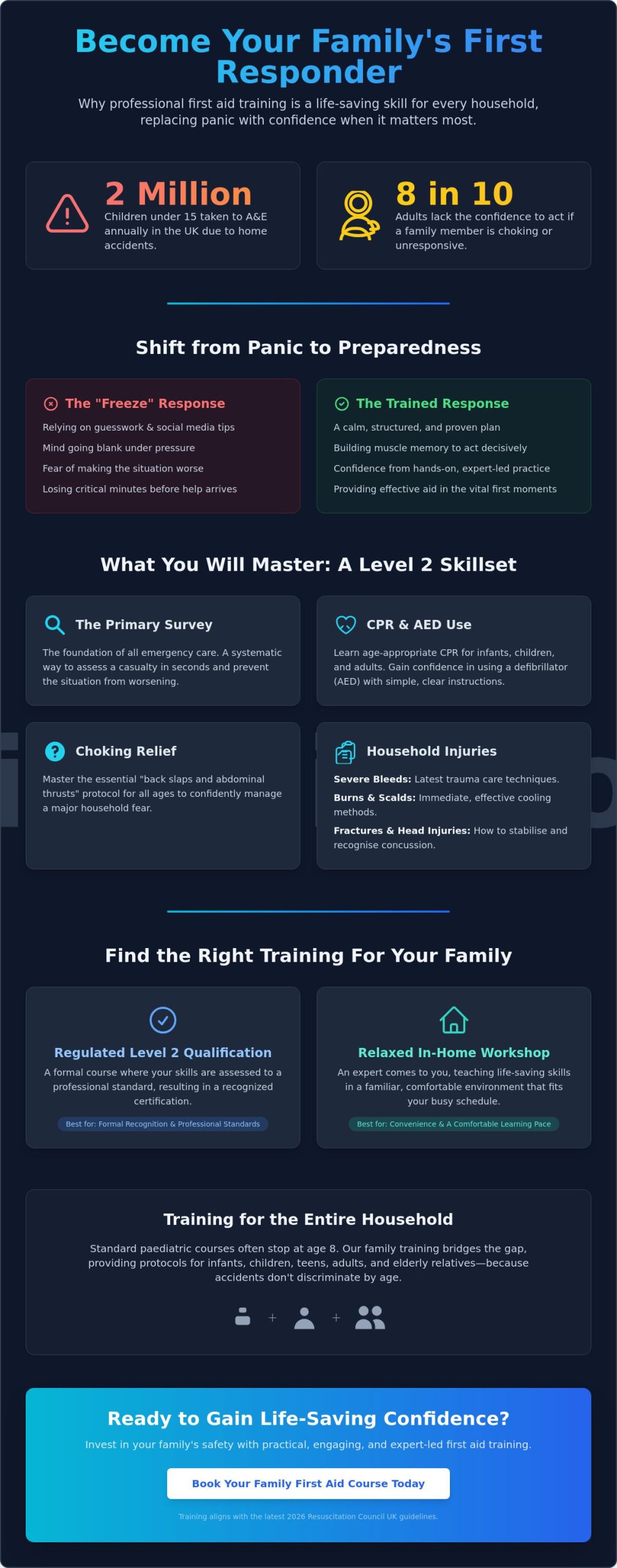
Every year, around 2 million children under the age of 15 are taken to A&E in the UK after an accident in or around the home. Despite these risks, national studies indicate that 8 in 10 adults lack the confidence to act if a family member were choking or unresponsive. You want to protect your loved ones, but it’s easy to feel overwhelmed by conflicting social media advice or the fear of freezing during a medical emergency. We understand that your schedule is packed and the thought of formal training might feel a bit clinical or intimidating.
This guide will show you how regulated family first aid training replaces that household panic with life-saving confidence through engaging, expert-led courses. You’ll discover exactly how to handle CPR and choking relief using the latest 2026 Resuscitation Council UK guidelines. We will also explain the new standards for managing life-threatening bleeding and help you decide whether a formal Level 2 qualification or a relaxed, in-home workshop is the best way to keep your family safe.
Key Takeaways
- Learn why the first few minutes of an emergency are vital and how professional training helps you stay calm when instinct alone isn’t enough.
- Master essential life-saving skills through family first aid training, including age-appropriate CPR techniques and the confident use of an Automated External Defibrillator (AED).
- Understand the difference between informal workshops and regulated Level 2 qualifications to ensure your skills are assessed to a professional standard.
- Discover how to arrange hassle-free, on-site training that fits your busy schedule by having an expert mentor come directly to your home or local group.
- Gain the peace of mind that comes from engaging, practical learning designed to replace medical anxiety with a proactive, “can-do” attitude.
Why Family First Aid Training is Essential for Every Household
When an accident happens at home, the clock starts ticking immediately. While we rely on our fantastic emergency services, the reality is that the first few minutes before help arrives are often the most critical. Research indicates that 67,135 children were admitted to hospital in 2020 due to accidents in the home, but during those initial moments, you are the primary first responder. Relying on “common sense” or half-remembered tips from a social media video often isn’t enough when adrenaline takes over. Professional family first aid training replaces that frantic guesswork with a calm, structured approach based on proven first aid principles.
Most people fear the “freeze” response, that moment where your mind goes blank because the stakes feel too high. This happens because our brains aren’t naturally wired to handle medical trauma without specific preparation. Structured learning builds muscle memory, allowing you to act decisively even when you’re worried. It’s about shifting from a state of panic to a “can-do” attitude. We don’t just teach you what to do; we help you find the confidence to actually do it. Whether it’s a toddler choking on a small toy or a grandparent showing signs of a stroke, having a clear, practiced plan makes all the difference.
The Difference Between Paediatric and Family Training
It’s a common misconception that all child-focused training is the same. Standard paediatric courses often focus exclusively on infants and children under the age of eight. While this is vital for new parents, a comprehensive family first aid training course covers the entire household. This includes adult protocols for older siblings and elderly relatives. Household hazards don’t discriminate by age. A burn from a kettle or a fall down the stairs requires specific techniques depending on the casualty’s size and physical frailty. We bridge that gap so you’re prepared for everyone under your roof.
Empowering the Whole Family Unit
Safety shouldn’t just be the responsibility of the adults. We’ve seen incredible results when teenagers and older children learn basic life support skills. It fosters a culture of safety where everyone knows how to call for help and perform basic condition checks. This shared knowledge creates a profound sense of security for everyone involved. Teenagers gain the maturity to look after younger siblings with confidence, and parents feel less isolated in their responsibility. Learning these skills together in a relaxed, engaging environment ensures that your home remains a safe haven for every generation.
What to Expect: Key Skills Covered in a Level 2 Family First Aid Course
Our family first aid training moves quickly from theory to the practical, hands-on skills you need to manage a crisis. We start with the Primary Survey. This is a simple, systematic way to assess a casualty in seconds. You’ll learn how to check for immediate danger, look for a response, and ensure the airway is clear. It is the foundation of all emergency care. By mastering these family safety skills, you ensure that your first actions are the right ones, preventing a situation from getting worse while professional help is on the way.
Cardiopulmonary Resuscitation (CPR) and the use of an Automated External Defibrillator (AED) are central to the course. We don’t just teach one method. Instead, we show you how to tailor your technique for different age groups. The pressure and depth of chest compressions vary significantly between a newborn baby, a growing child, and an adult relative. We also demystify the AED. These devices are now common in supermarkets and community centres, and we’ll show you exactly how they guide you through the process with clear, spoken instructions. It’s much simpler than most people think.
Choking is a major concern for parents and carers alike. We cover the essential “back slaps and abdominal thrusts” protocol for all ages. You will also learn to manage common but serious household injuries, including:
- Severe bleeds: Using direct pressure and the latest 2026 trauma care techniques.
- Burns and scalds: Identifying the depth of a burn and providing immediate cooling.
- Fractures and head injuries: How to keep a casualty still and recognise the signs of concussion.
Life-Saving Protocols for Common Emergencies
When a family member is unconscious but breathing, you need to protect their airway. We teach the recovery position; a simple way to roll a person onto their side to keep their tongue from blocking their throat. We also focus on identifying “silent” killers. You’ll learn to spot the early, often subtle signs of sepsis and meningitis, such as unusual lethargy or a non-blanching rash. Catching these early can be life-saving. If you’re ready to build these skills in a relaxed environment, our Family First Aid Level 2 Course offers the perfect balance of expert knowledge and practical fun.
Dealing with Sudden Illness and Allergic Reactions
Modern households often deal with complex health needs. We provide essential training on anaphylaxis and the correct use of an adrenaline auto-injector (EpiPen). You’ll also learn how to manage seizures and febrile convulsions, which are common in young children with high temperatures. Our training ensures you can also support family members through asthma attacks and diabetic emergencies, giving you a complete toolkit for home safety.
Regulated Qualifications vs. Informal Workshops: Which is Best?
When you start looking for family first aid training, you’ll quickly notice two distinct paths: informal workshops and regulated Level 2 qualifications. Many local community groups offer two-hour “attendance only” sessions. These are excellent for a basic overview, but they often lack the depth and rigorous assessment of a formal course. A regulated Level 2 Award is a recognised qualification on the Regulated Qualifications Framework (RQF). It isn’t just about sitting in a room; it’s about proving you can perform life-saving skills to a national standard. This distinction is vital because, in a real emergency, a certificate of attendance won’t give you the same level of certainty as a verified qualification.
The true value of a regulated course lies in the assessment process. During our sessions, we don’t just show you how to perform CPR or use an AED; we observe you doing it. This hands-on verification ensures your technique is effective and safe. It builds the genuine “can-do” confidence we talk about at JPF First Aid. While an informal workshop might be slightly cheaper upfront, a regulated qualification typically remains valid for three years. When you spread the cost over that period, the investment in professional, assessed training provides much better long-term protection for your family.
What Does ‘Regulated’ Actually Mean?
In the UK, “regulated” means the training is overseen by an awarding body, such as First Aid Awards (FAA), and monitored by Ofqual. This ensures that every trainer is qualified, every lesson plan is accurate, and the content is always up to date. For example, our 2026 courses strictly follow the latest Resuscitation Council UK guidelines. You’ll have the peace of mind that comes from being taught by a vetted expert who understands the gravity of the subject but keeps the atmosphere relaxed and engaging. You aren’t just getting tips; you’re getting “First Aid Training You Can Trust.”
Choosing the Right Format for Your Family
Modern families have different needs, so we offer flexible formats to suit your lifestyle. Blended learning is a fantastic option for 2026. You can complete the theoretical parts of the course online whenever you have a spare moment. Once that’s done, you join us for a focused, practical session to master the physical skills. This saves time without compromising on quality.
If you prefer a more traditional approach, classroom-based training offers the benefit of immediate, face-to-face feedback. You can ask specific questions about your home environment and get instant answers from your instructor. If you’re still weighing up your options, choosing the right first aid course comes down to finding the balance between your busy schedule and your preferred learning style. Both regulated paths ensure you walk away with the skills to act decisively.
Organising Your Training: Hassle-Free Options for Busy Families
Finding time for family first aid training can feel like a challenge between school runs, work commitments, and household chores. We believe that learning life-saving skills shouldn’t be another stressful item on your to-do list. That’s why we prioritise the “on-site” advantage. By having a qualified trainer come directly to your home, you remove the hassle of travel and childcare. It also allows us to train you in the very environment where an emergency is most likely to occur. We can look at your specific kitchen layout or the steepness of your stairs, making the practical advice feel immediately relevant to your daily life.
When you choose a provider, it’s vital to look for a balance of high-level expertise and an approachable personality. With over 20 years of experience, we know that people learn best when they’re relaxed. Our sessions are designed to be engaging and fun, stripping away the dry, clinical lectures often found in traditional medical training. We provide all the necessary equipment, including hygienic manikins and training AEDs, so you don’t need to worry about a thing. All you need is a bit of floor space and an open mind.
Private Group Training at Home
Gathering a group of friends, neighbours, or your local NCT group is often the most cost-effective and enjoyable way to learn. We offer flat-rate quotes for private groups of up to 12 people, which makes professional family first aid training very affordable when the cost is shared. These sessions are entirely bespoke. If your group consists of parents with newborns, we’ll spend more time on infant-specific choking relief and febrile convulsions. If you’re a household with teenagers or elderly relatives, we’ll pivot the focus toward trauma care and adult basic life support. It’s about making the training work for your specific family unit.
Attending a Scheduled Public Course
If you prefer to learn away from home or can’t quite get a group together, joining one of our scheduled public courses is a fantastic alternative. These sessions allow you to meet other parents and carers in your local community, sharing experiences and building confidence together. When you attend, simply wear comfortable clothing that allows you to move easily on the floor during practical exercises. For a deeper look at training specifically for younger children, you might find our Paediatric first aid training guide helpful. If you’re ready to take the next step toward total peace of mind, contact us to book your bespoke family session today.
Confidence Through Engagement: The JPF First Aid Approach
We believe that the best way to learn is by doing. Our family first aid training isn’t a lecture. It’s a hands-on experience led by John Fogarty, who brings over 20 years of practical expertise to every session. John’s approach is designed to strip away the clinical coldness often found in traditional medical education. Instead, we create a relaxed atmosphere where you can ask questions without judgment. This “engaging and fun” philosophy isn’t just for entertainment; it’s a proven way to ensure that life-saving skills are actually remembered when you need them most.
Many parents feel a natural anxiety about medical emergencies. You might worry about doing the wrong thing or causing more harm in a high-pressure situation. We tackle this “first aid anxiety” head-on by building your confidence through consistent, supported practice. By the time we finish, you won’t just have a certificate. You’ll have a calm, “can-do” attitude that allows you to act decisively. We offer total flexibility, coming to your home or chosen venue at a time that works for your family schedule. This bespoke service ensures you get exactly the training you need without the stress of a rigid classroom environment.
Multi-Award-Winning Training You Can Trust
As a trusted provider of Ofqual-regulated qualifications, we meet the highest national standards for safety and accuracy. We use high-quality manikins and the latest training AEDs to give you a realistic experience. You’ll find that “learning by doing” is far more effective than watching a screen or reading a manual. For more information on what you should have ready at home, take a look at our first aid essentials for 2026. This guide complements your family first aid training by ensuring your home kit is as prepared as you are.
Ready to Protect Your Family?
It’s never too late to learn how to save a life. Whether you are a new parent, a grandparent, or a carer, these skills are the most valuable gift you can give your family. Booking your session is simple and hassle-free. We work around your busy life to find a slot that fits your routine. Don’t wait for an emergency to happen before you decide to prepare. Take a proactive step today to ensure your home is a safe environment for everyone you love. Book your Family First Aid course with JPF First Aid and gain the confidence that comes from “First Aid Training You Can Trust”.
Build Your Life-Saving Confidence Today
Protecting your household starts with moving from uncertainty to decisive action. We have explored how a regulated Level 2 qualification provides more than just a certificate; it gives you the assessed, practical skills to handle everything from infant choking to adult basic life support. By choosing a formal course over a basic workshop, you ensure your knowledge meets the latest 2026 national standards and stays valid for three years.
At JPF First Aid, we’re here to make this transition as smooth as possible. With over 20 years of expert training experience, we specialise in delivering multi-award-winning, Ofqual regulated Level 2 qualifications directly in your home. We remove the stress of travel and complex schedules, replacing medical anxiety with an engaging, “can-do” atmosphere that ensures your new skills actually stick.
It’s time to replace your “what if” fears with the certainty of “I can.” Book Your Family First Aid Training with JPF First Aid today and take the most important step toward a safer home. You’ll feel much better knowing you’re in safe, expert hands. Let’s make your home a safer place together.
Frequently Asked Questions
Is family first aid training the same as paediatric first aid?
Family first aid training is broader than standard paediatric courses because it includes adult protocols alongside child and infant techniques. While a paediatric course focuses specifically on the needs of those under 8 years old, our family focused sessions ensure you can support everyone from a newborn to a grandparent. This comprehensive approach is essential for multi-generational households where hazards can affect anyone regardless of their age.
How long does a family first aid certificate last?
A regulated Level 2 certificate remains valid for 3 years from the date of your assessment. After this 36 month period, you’ll need to attend a refresher course to keep your skills current and your qualification active. Staying up to date is vital; especially as Resuscitation Council UK guidelines are updated to reflect the latest 2026 life-saving research and trauma care techniques.
Can children attend family first aid training sessions?
Older children and teenagers are very welcome to join our sessions to learn basic life support. We even offer a specific Student First Aid Level 2 Award designed for younger learners. Including your children in family first aid training helps create a “culture of safety” at home. It ensures they know how to call for help and perform simple condition checks if an adult is incapacitated.
Do I need any prior medical knowledge to take a Level 2 course?
You don’t need any prior medical knowledge or experience to enrol in a Level 2 course. These qualifications are designed as foundational, entry-level training for anyone who wants to learn. We use everyday language and practical demonstrations to make the content accessible. We ensure you feel like a reliable expert in your own home without needing a background in healthcare or science.
What is the difference between a regulated course and a 2-hour workshop?
The main difference is the level of verification and the weight the certificate carries. A regulated course involves a formal assessment to ensure you can physically perform skills like CPR to a national standard. Informal workshops are often “attendance only” and don’t provide the same three-year qualification or the peace of mind that comes with Ofqual oversight and monitored training standards.
Can you deliver first aid training at my house for a group of friends?
Yes, we specialise in delivering on-site training at your home for private groups of up to 12 people. This is a hassle-free way to learn with friends, neighbours, or NCT groups in a relaxed environment. We bring all the necessary equipment, including manikins and training AEDs, so you can focus on building confidence without ever leaving your living room.
Is an AED (defibrillator) covered in family first aid training?
Training on the safe use of an Automated External Defibrillator (AED) is a standard and crucial part of our family first aid training. Since 2021, AED instruction has been a mandatory component of all regulated first aid courses. We show you exactly how these devices work and how they provide clear, spoken instructions to guide you through a cardiac emergency with total confidence.
What happens if I fail the assessment on a regulated course?
Failing an assessment is very rare because our “engaging and fun” approach focuses on supportive, hands-on learning. If you struggle with a specific skill, our expert trainers will work with you until you feel capable. We prioritise your success and your ability to save a life over the pressure of a formal exam, providing a relaxed and encouraging path to qualification.
Recent Comments