

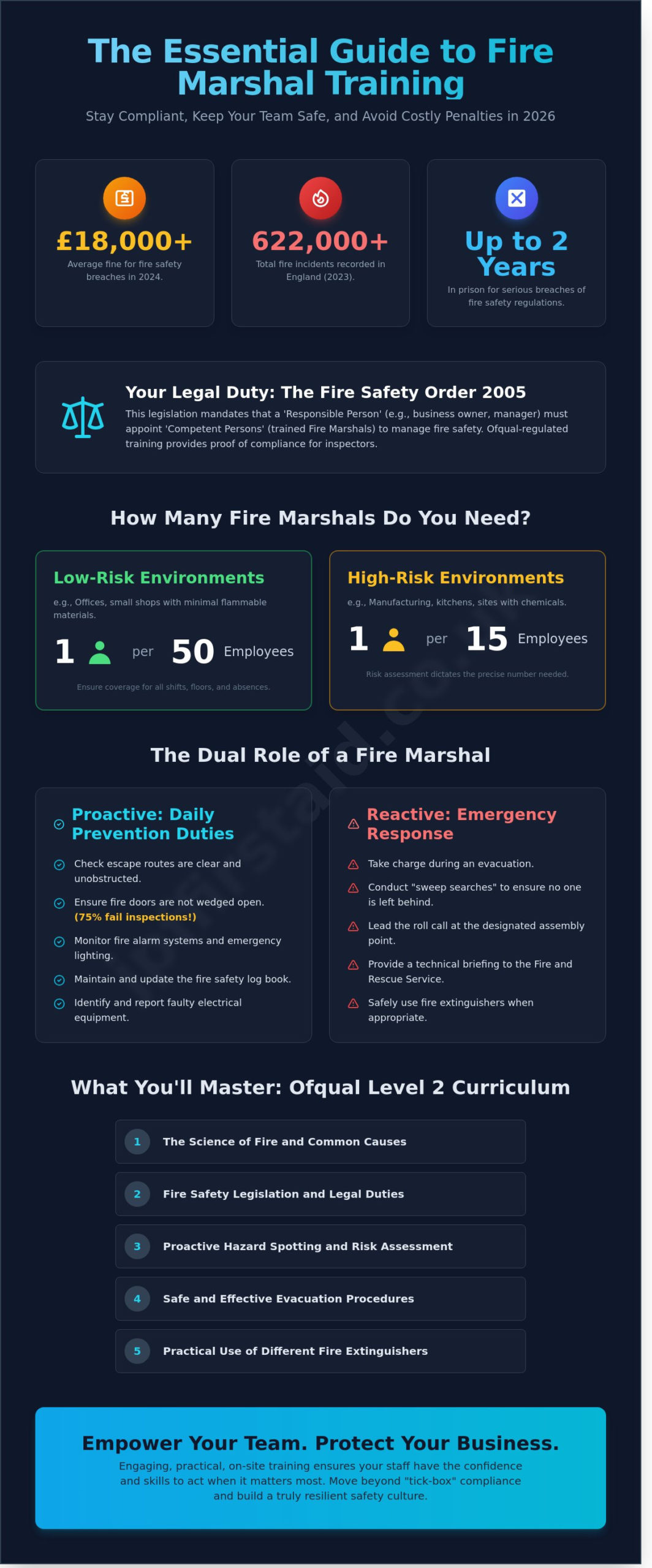
If a fire inspector walked through your front door at 9:00 AM tomorrow, would you feel truly confident or reach for the panic button? You aren’t alone if the 2005 Regulatory Reform (Fire Safety) Order feels more like a source of stress than a safety manual. Most UK business owners understand they need fire marshal training to appoint a “competent person” on-site, yet the fear of failing an unexpected inspection remains a constant worry. It’s frustrating when you want to do the right thing but feel stuck behind walls of dry jargon, especially when 2024 data shows that average fines for fire safety breaches have now exceeded £18,000.
We believe that safety education shouldn’t be a “tick-box” exercise that puts your staff to sleep. This guide is your roadmap to mastering the 2026 legal requirements while building a team that’s genuinely ready to lead. You’ll learn exactly how many marshals you need, what their daily duties involve, and how our hassle-free booking process brings expert training directly to your door. We’re going to move past the theory and focus on the practical, life-saving skills that give you and your employees total peace of mind.
Key Takeaways
- Understand your legal obligations and why fire marshal training is essential for meeting UK safety regulations and protecting your workforce.
- Clarify the specific roles and daily proactive responsibilities that distinguish a fire marshal from a fire warden in a workplace setting.
- Learn why practical, engaging sessions lead to better knowledge retention and confidence compared to standard online delivery methods.
- Get a breakdown of the Ofqual regulated Level 2 curriculum, covering everything from the science of fire to safe evacuation procedures.
- Discover how to access flexible, hassle-free training options in the West Midlands that bring expert life-saving skills directly to your venue.
What is Fire Marshal Training and Why is it Legally Required?
Fire marshal training is a regulated qualification that equips your team with the practical skills needed to protect your workplace. It’s far more than a simple certificate; it’s a vital safety programme focused on preventing fires and managing emergency evacuations with total confidence. By understanding What is a Fire Marshal, you can see how this role bridges the gap between daily fire prevention and high-pressure emergency response. In 2023, the Home Office recorded over 622,000 fire incidents in England alone. Having trained staff on-site ensures your business doesn’t become another statistic.
The core purpose of this training is twofold. First, it teaches your staff how to identify and eliminate fire hazards before they ignite. Second, it provides the “can-do” attitude required to lead others to safety during a fire. We make the process straightforward and engaging, ensuring your team leaves the session feeling empowered rather than overwhelmed. Our fire marshal training focuses on real-world application, so your staff know exactly what to do when the alarm sounds.
The Legal Framework: Regulatory Reform (Fire Safety) Order
The Regulatory Reform (Fire Safety) Order 2005 is the primary piece of legislation governing fire safety in England and Wales. It places a legal duty on the “Responsible Person” to ensure the safety of everyone on the premises. If you’re a business owner or manager, this likely means you. You’re legally required to appoint “competent persons” to assist with fire safety measures. Failing to provide adequate fire marshal training can lead to severe penalties, including unlimited fines or up to two years in prison. Using Ofqual-regulated courses ensures you have the necessary proof of compliance for fire inspectors.
Who Should Attend Fire Marshal Training?
You should select staff members who are reliable, calm under pressure, and usually present at your site. Your specific risk level determines how many marshals you need. For example, a low-risk office might require one marshal for every 50 employees, whereas a high-risk manufacturing plant often needs one for every 15 people. It’s vital to have diverse representation across all floors and departments. This ensures that during an evacuation, every corner of your building is accounted for. We recommend training enough staff to cover holidays, sickness, and shift patterns to maintain 100% safety coverage at all times.
Fire Marshal vs. Fire Warden: Roles and Responsibilities
You’ve likely heard the terms Fire Marshal and Fire Warden used interchangeably around the office. In the UK, there isn’t a strict legal distinction between the two, though some larger organisations choose to split the roles. Usually, a Warden handles the day-to-day “housekeeping” while a Marshal takes charge during an actual emergency. Regardless of the title, the goal is the same: ensuring your business stays compliant with UK government fire safety regulations.
In 2023, the Home Office recorded over 11,800 fires in non-residential buildings across England. This statistic isn’t meant to cause alarm, but it does highlight why fire marshal training is so vital. A trained marshal transforms your safety culture from a passive “hope for the best” approach to an active, confident strategy. They don’t just wait for an alarm; they work to ensure it never needs to sound in the first place.
Day-to-Day Fire Prevention Duties
Prevention is the most effective way to save lives. On a daily basis, your marshal acts as the eyes and ears of the building. This includes checking that fire doors aren’t wedged open, as a 2022 FDIS inspection found that 75% of fire doors failed to meet required standards. Your marshal will also monitor the fire alarm system, update the fire log book, and ensure escape routes stay clear of clutter. By identifying hazards like faulty electrical equipment or blocked exits early, they stop small risks from becoming major incidents.
Emergency Response and Evacuation Procedures
When the alarm sounds, the role shifts from proactive to reactive. Your marshal takes charge by conducting “sweep searches” of toilets and storage areas to ensure no one is left behind. They lead the roll call at the assembly point and, crucially, provide a technical briefing to the Fire and Rescue Service the moment they arrive. While fire marshal training teaches the safe use of extinguishers, it also instils the confidence to know when a fire is too large to tackle. Their priority is always the safe movement of people, not the salvage of property.
If you want to empower your team with these life-saving skills, we offer bespoke training sessions that bring our expert mentors directly to your site in Birmingham or Cannock. It’s a simple way to build a safer, more prepared workplace today.
Choosing the Right Course: Online vs. In-Person Training
Deciding how to deliver your fire marshal training depends on your team’s specific needs and your operational schedule. While digital platforms offer convenience, data from educational psychologists suggests that 80% of learners retain information more effectively when they participate in interactive, hands-on sessions. We believe that learning shouldn’t be a chore. When sessions are engaging and fun, your staff feel more confident to act during a real emergency. This isn’t just about ticking a box; it’s about building a culture of safety where everyone feels empowered.
The Case for In-Person, Practical Training
In-person training allows your team to build vital muscle memory. Picking up a fire extinguisher and feeling the weight and discharge pressure is a world away from clicking a mouse. Our expert trainers provide site-specific advice, walking your corridors to identify particular risks unique to your Birmingham or Cannock premises. This level of detail aligns with the standards for workplace fire safety training recommended by the London Fire Brigade. We replace the “boredom factor” with a relaxed, conversational atmosphere where no question is too small. It turns a compliance task into a team-building exercise that builds genuine competence and trust among your staff.
Blended Learning: The Modern Middle Ground
Blended learning is an excellent solution for busy organisations. It splits the course into two parts: independent online study followed by a face-to-face practical assessment. This method can reduce time away from the desk by up to 50% without sacrificing high standards. It’s ideal if your schedule is tight but you still want the reassurance of a physical demonstration. You get the flexibility of digital learning paired with the authority of a regulated qualification, making it a popular choice for 2024 compliance requirements.
Booking a group session on-site is often the most cost-effective route for West Midlands businesses. For example, while an individual delegate might cost £95 at a public venue, a dedicated group booking for up to 10 staff members can lower the cost per person to approximately £50. This “hassle-free” approach ensures everyone receives the same consistent message at the same time. It simplifies your health and safety administration while ensuring your team stays protected and prepared.
What is Covered in an Ofqual Regulated Fire Safety Course?
When you sign up for an Ofqual regulated Level 2 Fire Safety Principles course, you aren’t just sitting through a lecture. You’re gaining a recognised qualification that meets the requirements of the Regulatory Reform (Fire Safety) Order 2005. At JPF First Aid, we focus on turning complex safety theory into practical confidence. Our fire marshal training ensures every learner walks away with the ability to protect their colleagues and their workplace effectively.
Technical Knowledge and Fire Science
Understanding how fire behaves is the first step in preventing it. We break down the “Fire Triangle,” which consists of heat, fuel, and oxygen. If you remove just one of these elements, the fire cannot survive. You’ll learn how fire spreads through buildings via convection, conduction, and radiation. This knowledge helps you spot risks, such as blocked vents or poorly stored combustible materials, before they become a hazard.
We also cover the six distinct classes of fire. This is vital because using the wrong extinguisher can be dangerous. For instance, using water on a Class F fat fire can cause a fireball. You’ll learn to identify:
- Class A: Combustible solids like wood, paper, and textiles.
- Class B: Flammable liquids such as petrol or oil.
- Class C: Flammable gases like propane or butane.
- Class D: Combustible metals.
- Class F: Cooking oils and fats.
- Electrical: Fires involving live equipment (not a formal class, but requires specific handling).
Practical Skills and Equipment
Our fire marshal training gives you the hands-on skills to act decisively. You’ll learn the British Standard (BS EN3) colour coding for extinguishers, such as Cream for Foam or Black for CO2. Beyond equipment, we look at the psychology of an evacuation. Studies in fire safety behaviour show that up to 80% of people may delay their evacuation to finish a task or wait for social confirmation from others. As a fire marshal, your role is to break this “social inhibition” and lead people to safety.
You’ll practice conducting a safe floor sweep. This involves checking every room, including toilets and store cupboards, without putting your own life at risk. We teach you how to communicate clearly under pressure, ensuring your team stays calm and follows the established fire plan without hesitation.
Book Your Fire Marshal Training with JPF First Aid
Choosing a training partner is about more than just ticking a compliance box. You need a provider that understands the unique pressures of running a business in the West Midlands. At JPF First Aid, we’ve built our reputation on being the Reliable Expert Mentor for hundreds of local firms. We don’t do dry, boring lectures. Instead, we deliver fire marshal training that’s engaging, practical, and designed to build genuine confidence in your staff.
Our approach prioritises your success. We believe that life-saving skills are best taught in a relaxed, supportive atmosphere where questions are encouraged. By blending professional certification standards with accessible language, we ensure every delegate leaves feeling empowered. It’s this commitment to quality and person-centred learning that makes us the region’s favourite choice for workplace safety. We take the anxiety out of emergency response training, replacing it with a calm, can-do attitude.
Our On-Site Training Solutions
We make compliance easy by bringing the classroom to your front door. If you have a team to train, our on-site sessions are the most cost-effective and efficient choice. We offer flat-rate pricing for groups of up to 12 delegates, ensuring your budget remains predictable. Because we’re at your venue, we can tailor the content to your specific building layout and industry hazards. You don’t need to worry about logistics. We bring all the necessary equipment and training materials to your site, making the entire process hassle-free.
Join a Scheduled Public Course
Public courses are an excellent option for small business owners or individuals who need to refresh their skills. We host regular sessions at professional training centres in Cannock, Birmingham, and across Staffordshire. These courses offer a welcoming environment where you can learn alongside professionals from various sectors. It’s a great way to access expert fire marshal training without needing to fill an entire group booking. Each session is kept to a manageable size to ensure you get the personal attention you deserve.
Ready to get started? Contact JPF First Aid today to request a bespoke quote for your team. We’ll help you find the right date and location to suit your schedule, providing you with First Aid Training You Can Trust every step of the way. Whether you need a one-off session or a long-term training partner, we’re here to help your business stay safe and compliant.
Secure Your Workplace Safety for 2026 and Beyond
Meeting the requirements of the Regulatory Reform (Fire Safety) Order 2005 is a non-negotiable part of running a responsible UK business. By 2026, the demand for clear, practical emergency protocols will only increase, making it essential to distinguish between basic awareness and the specific duties of a fire warden. Choosing fire marshal training that carries an Ofqual regulated Level 2 qualification ensures your team meets national standards while gaining the practical skills needed to lead a safe evacuation. It’s about more than just a certificate; it’s about the peace of mind that comes from knowing your people are protected.
We pride ourselves on being a multi-award-winning training provider that prioritises your team’s confidence. Our expert trainers use their real-world experience to transform what could be a dry subject into a session that’s actually enjoyable. We’ve helped thousands of learners move past the anxiety of emergency response by providing clear, hassle-free solutions that we can deliver directly at your premises. You don’t have to navigate complex safety regulations alone when you have a reliable mentor by your side.
Book your engaging and fun Fire Marshal training today and take the stress out of your health and safety compliance. We’re ready to help you build a safer, more prepared workplace today.
Frequently Asked Questions
How many fire marshals do I need for my business?
You need at least one fire marshal for every 50 people in a low-risk environment like an office. If your business is high-risk, such as a restaurant or factory, this ratio increases to one marshal for every 15 employees. You must also account for shift patterns and annual leave. This ensures someone is always on-site to lead an evacuation safely under the Regulatory Reform (Fire Safety) Order 2005.
Does fire marshal training expire in the UK?
Fire marshal certificates typically expire after 3 years to ensure your skills remain sharp. While the law doesn’t specify a date, the Fire Protection Association recommends a full refresher course every 36 months. We also suggest annual 1-hour practice sessions to keep your confidence high. Staying up to date ensures you’re ready to act if a real emergency happens at your Birmingham or Cannock site.
What is the difference between a fire warden and a fire marshal?
There is no legal difference between these roles in the UK; the terms are often used interchangeably. Some larger organisations use wardens for daily floor checks and marshals to lead the actual evacuation. Our fire marshal training covers both sets of responsibilities. This ensures you’re fully equipped to handle fire risk assessments and emergency procedures without any confusion during a crisis.
Is fire marshal training a legal requirement for small businesses?
Yes, fire safety training is a legal requirement for all UK businesses under the Regulatory Reform (Fire Safety) Order 2005. Even if you only have 2 or 3 employees, you must appoint a competent person to manage fire safety. Failing to provide this training can lead to heavy fines or prosecution. It’s a vital part of your business compliance and keeps your team safe every day.
Can I do fire marshal training online?
You can complete the theory online, but we highly recommend a face-to-face session for the best results. Our practical training builds real confidence because you’ll actually handle equipment rather than just watching a screen. We bring the training to your premises in Cannock or Birmingham, making it a hassle-free way to learn. It’s much more engaging and fun when you’re learning with your colleagues in person.
How long does a fire marshal training course take?
A standard fire marshal training course usually takes between 3 and 4 hours to complete. This half-day session fits perfectly into a morning or afternoon, so it won’t disrupt your entire working day. We focus on the essential skills you need, from using extinguishers to managing a roll call. It’s a fast, efficient way to gain a regulated qualification without sitting through days of dry theory.
Will I get a certificate after completing the fire marshal course?
You’ll receive a formal certificate immediately after successfully completing your course with us. This document proves your competence to local authorities and insurance providers who may ask for evidence of your fire safety measures. We provide a digital copy for your records and a high-quality printed version. It is a “First Aid Training You Can Trust” badge of honour that builds your professional profile.
What should I wear to a practical fire safety training session?
Wear comfortable, casual clothing and flat, closed-toe shoes like trainers for your session. You’ll likely be moving around or practising with fire extinguishers, so avoid high heels, skirts, or expensive suits. We provide all the necessary safety gear for the practical elements. It’s a relaxed atmosphere where you can focus on learning life-saving skills without worrying about your outfit getting a bit of dust on it.
Recent Comments