

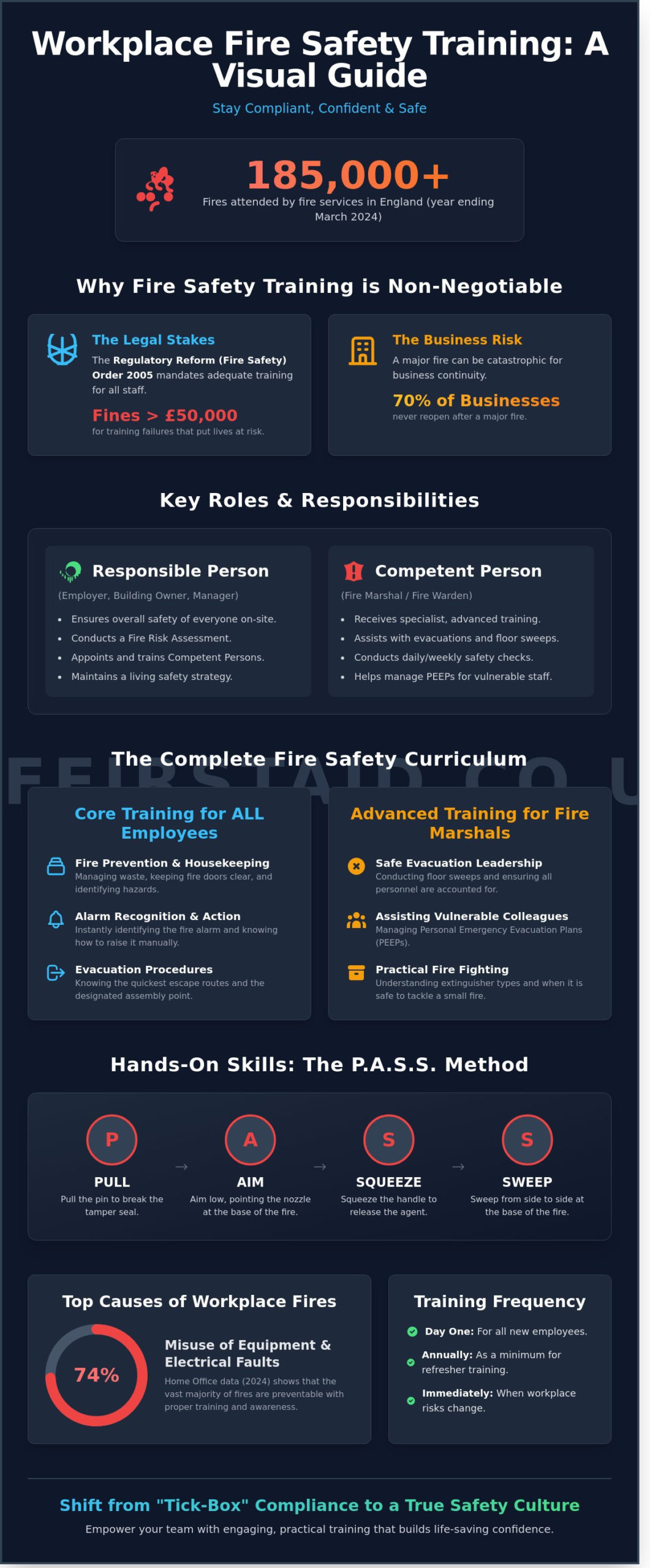
Did you know that the Home Office reported fire services attended over 185,000 fires in England alone during the year ending March 2024? It’s a sobering figure that highlights why fire safety training for employees is far more than just a bit of paperwork. You likely feel the weight of the Regulatory Reform (Fire Safety) Order 2005 and worry that a single oversight could lead to heavy fines or, worse, an unsafe workplace. It’s completely normal to feel overwhelmed by the technical jargon or to worry that training will be a dull, disruptive chore for your team.
We’re here to take that stress away. This guide provides everything you need to know about staying compliant in 2026, from the specific legal requirements to the essential content your team needs to stay safe. You’ll discover how to choose a training programme that’s practical, engaging, and entirely hassle-free. We’ll walk you through the certification process and show you how to build a workforce that feels calm and capable in an emergency, ensuring your business stays protected and your staff stay confident.
Key Takeaways
- Master your legal duties under the Regulatory Reform (Fire Safety) Order 2005 to ensure your organisation remains fully compliant and safe.
- Explore the core curriculum for fire safety training for employees and learn how to adapt the content to match your specific workplace hazards.
- Compare delivery methods to find out why hands-on, on-site training provides a more engaging and practical experience than standard distance learning.
- Determine exactly how often your team requires refresher training and which internal changes should trigger an immediate update to your safety skills.
- Shift your focus from simple “tick-box” compliance to building a genuine safety culture that empowers your staff with life-saving confidence.
Understanding Your Legal Obligations for Workplace Fire Safety Training
Keeping your team safe is your most important job as a business owner. It’s not just about ticking a box; it’s about building a culture of confidence where everyone knows exactly what to do in an emergency. In 2026, the expectations for fire safety training for employees have evolved. The Fire and Rescue Service now looks for evidence of genuine competence rather than just a signed attendance sheet from a generic briefing. Failing to meet these standards carries heavy penalties. During the 2023/24 period, UK courts issued unlimited fines to several firms, with some penalties exceeding £50,000 for training failures that put lives at risk.
The Regulatory Reform (Fire Safety) Order 2005 Explained
The Regulatory Reform (Fire Safety) Order 2005 is the primary legislation for non-domestic fire safety in England and Wales. Under this law, you’re required to provide adequate safety training to every member of your staff. For new starters, this must happen during their induction on day one. Your long-term team members need regular refreshers, especially if your building layout changes or you introduce new equipment. Since 70% of businesses that experience a major fire never reopen, this training is a vital investment in your company’s future.
Identifying the Responsible Person in Your Organisation
Every workplace has a “Responsible Person,” which is usually the employer, the building owner, or the person who manages the premises. If that’s you, you’re legally tasked with ensuring the safety of everyone on-site. You don’t have to do it all alone. You should appoint “competent persons,” such as Fire Marshals, who receive extra training to assist with evacuations and daily safety checks. Your training strategy must be a living document that links directly to your Fire Risk Assessment. If your 2025 assessment highlighted specific risks like chemical storage or complex exit routes, your fire safety training for employees must cover those exact points to remain compliant.
- Day One Inductions: Essential for all new staff before they start work.
- Refresher Training: Required at least annually or when workplace risks change.
- Fire Marshal Training: Specialist coaching for those with extra responsibilities.
Moving into 2026, the focus has shifted toward practical, engaging sessions. Dry, clinical presentations are being replaced by hands-on learning that builds real skills. When your team feels expert and prepared, the anxiety of an emergency disappears. We believe that training should be a positive, confidence-building experience that leaves your staff feeling empowered and ready to act.
What Should Fire Safety Training for Employees Actually Cover?
Effective fire safety training for employees isn’t a generic tick-box exercise. It’s a vital tool that transforms a nervous team into a prepared, capable unit. Home Office data from 2024 shows that 74% of workplace fires were caused by misuse of equipment or electrical faults. This highlights why your training must be bespoke to your specific office layout and the unique risks of your industry. We focus on building confidence so your staff don’t just know the rules, they know how to act when every second counts.
The Essential Training Curriculum
Every member of your team needs a solid foundation in fire prevention. This starts with “good housekeeping” behaviours, such as managing waste and ensuring fire doors aren’t propped open. Your staff must instantly recognise the sound of the alarm and know the quickest escape routes to the designated assembly point. We teach them exactly how to raise the alarm and the precise protocol for calling the emergency services. It’s about making these actions second nature.
Advanced Training for Fire Marshals and Wardens
Designated Fire Marshals require a deeper level of expertise to lead during a crisis. Their role involves conducting safe floor sweeps and ensuring everyone has cleared the building. A critical component is managing Personal Emergency Evacuation Plans (PEEPs). With 16 million disabled people currently living in the UK, according to 2024 DWP figures, your Marshals must be trained to assist vulnerable colleagues effectively. They also learn the discipline of regular equipment checks and maintaining accurate safety logs.
Practical skills are where the real confidence is built. We don’t just talk about fire extinguishers; we explain the specific types, like CO2 or Foam, and when it’s safe to use them. You’ll learn the “PASS” method (Pull, Aim, Squeeze, Sweep) in a controlled, supportive environment. If you want to ensure your team is fully compliant while keeping the atmosphere relaxed and engaging, our bespoke fire safety courses can be delivered right at your premises. We keep the technical jargon to a minimum and focus on the hands-on skills that save lives. This approach ensures your business meets the Regulatory Reform (Fire Safety) Order 2005 without the stress of dry, academic lectures.
Comparing Delivery Methods: On-Site, Blended, and Distance Learning
Choosing how to deliver fire safety training for employees isn’t just a tick-box exercise. A generic video won’t tell your team where the specific fire assembly point is or how to navigate a cramped stairwell in the dark. According to 2024 workplace safety reports, 42% of employees felt unprepared during a real emergency because their training was too theoretical. You need a method that matches your building’s layout and your team’s busy schedule.
The Power of On-Site Training
There’s no substitute for walking your actual escape routes. When we visit your premises, we don’t just talk about fire doors; we test them with you. This hands-on approach builds genuine confidence. Your staff learn to spot hazards in their own workspace, like a blocked exit in your specific stockroom or a propped-open fire door in the canteen. It’s also a massive time-saver. You don’t have to pay for 12 people to travel across town. We bring the expertise to your door, keeping your operations running smoothly while we work.
Blended and Distance Learning for Modern Workforces
Modern businesses often struggle to get everyone in one room at the same time. Blended learning solves this by pairing independent remote study with a shorter, expert-led practical assessment. It’s a flexible way to ensure your fire safety training for employees meets Ofqual-regulated standards without losing a full day of productivity. Pure distance learning works well for low-risk environments or as a refresher for individual new starters. We ensure every format remains engaging and far from a dry, clinical experience.
Cost-efficiency depends heavily on your headcount and business structure. For a small startup with 5 staff, individual distance learning modules at roughly £35 per person are highly economical. However, once you reach 10 to 12 employees, a dedicated on-site session at a flat rate of approximately £495 becomes much cheaper per head. You’ll often save 20% compared to sending staff to external venues. Plus, the bespoke advice you get for your specific premises acts as a vital safety check for your business.
- On-Site: Best for teams needing practical familiarity with their own building.
- Blended: Ideal for shift workers or multi-site retail businesses.
- Distance: Perfect for low-risk office inductions and remote staff.
Frequency and Refresher Training: How Often Is Enough?
Fire safety isn’t a one-off tick-box exercise. Skills get rusty. Confidence fades. While the law requires you to provide “adequate” training, the 2005 Regulatory Reform (Fire Safety) Order doesn’t set a hard expiry date on certificates. However, industry best practice in the UK points toward a 12-month refresher cycle. This ensures your team stays sharp and ready to act without hesitation.
When to Organise Refresher Training
Annual training is the gold standard for high-risk environments like kitchens, care homes, or industrial units. For lower-risk offices, a two-year gap might suffice, but you must trigger immediate retraining if certain “change events” occur. If you move to a new office, install a new piece of heavy machinery, or restructure your floor plan, your old fire safety protocols become obsolete. New staff members need training during their induction, and any employee promoted to a Fire Warden role requires specialist instruction immediately. This prevents “skill fade,” a documented phenomenon where emergency response accuracy drops by as much as 40% after just six months without practice.
The Importance of Regular Fire Drills
You’re legally required to carry out at least one fire drill every year. These shouldn’t feel like a nuisance or a disruption to your workday. Instead, treat them as a live rehearsal. A well-executed drill identifies bottlenecks in your evacuation route and tests whether your Fire Wardens can lead with authority. After every drill, you must record the results in your safety logbook. Include the following details to remain compliant:
- The date and time of the evacuation.
- The total time taken to clear the building (aim for under 2.5 to 3 minutes).
- Any difficulties encountered, such as blocked exits or faulty alarm sounders.
- Specific outcomes for staff with Personal Emergency Evacuation Plans (PEEPs).
Recording these details provides a clear audit trail for fire inspectors and helps you tailor future fire safety training for employees. When your team knows exactly what to do, panic disappears. We focus on building this instinctive reaction during our sessions, making the process practical rather than academic. You’ll find that regular practice turns a high-stress event into a calm, managed procedure.
Ready to refresh your team’s skills? Book an engaging fire safety training session today to keep your business compliant and your staff confident.
Building a Safety Culture: Why Engaging Training Beats a Tick-Box Exercise
Compliance often feels like a chore. In 2026, UK regulations demand more than just a signed sheet of paper; they require evidence of competence. We believe in moving from compliance-led sessions to confidence-led safety. When you invest in fire safety training for employees, the goal isn’t just to avoid a fine. It’s to ensure your team knows exactly what to do when the alarm sounds. JPF First Aid takes a different approach. We make the content engaging and, dare we say, fun. This method reduces the 45% of workplace anxiety typically linked to emergency uncertainty, replacing fear with a practical can-do spirit. We focus on hassle-free solutions that fit your schedule, not ours.
Making Training Memorable and Practical
We don’t just read from a slide deck. We use real-world scenarios tailored to your specific industry, whether you run a busy warehouse or a quiet office. Our trainers are approachable experts who understand that people retain 75% more information through practical application than through passive listening. By creating a relaxed environment, we strip away the intimidation factor. Your team leaves feeling capable, not overwhelmed. This approachable style is why 98% of our learners report feeling significantly more prepared for a real-life emergency. We encourage questions and hands-on participation to ensure the knowledge sticks long after the session ends.
Next Steps: Securing Your Workplace with JPF First Aid
Ready to upgrade your workplace safety? You can book a bespoke group session for up to 12 delegates at your own premises. This on-site convenience saves you time and ensures the training is relevant to your actual fire exits and hazards. Many clients find it’s more cost-effective to bundle fire safety with first aid or manual handling courses, creating a comprehensive safety package for the year.
- Expert Trainers: Qualified professionals who bring the subject to life.
- Bespoke Delivery: Content that reflects your specific workplace risks.
- Hassle-Free Booking: We come to you, anywhere in the UK.
Enquire about our Fire Safety Qualification Courses today to secure your 2026 dates and build a team that’s prepared for anything. Investing in fire safety training for employees is the most reliable way to protect your people and your business assets.
Protect Your Business and Your People
Meeting your legal obligations under the Regulatory Reform (Fire Safety) Order 2005 doesn’t have to be a daunting task. Effective fire safety training for employees transforms a simple compliance exercise into a robust safety culture that protects your staff and your premises. By choosing Ofqual regulated qualifications, you ensure your team receives training that meets rigorous national standards. Remember that refreshing these skills every 12 months keeps safety protocols fresh and reduces the risk of panic during a real emergency.
As a multi-award-winning training provider, JPF First Aid specialises in making safety education both practical and enjoyable. We skip the dry, academic lectures in favour of an engaging and fun delivery style that builds genuine confidence. Our team brings the classroom to you, providing hassle-free on-site sessions tailored to your specific workplace layout. You’ll gain peace of mind knowing your business is fully compliant and your people are truly prepared.
Book your hassle-free on-site Fire Safety training with JPF First Aid. We’re here to help you create a safer, more confident workplace for everyone.
Frequently Asked Questions
Is fire safety training for employees a legal requirement in the UK?
Yes, providing fire safety training for employees is a mandatory requirement under the Regulatory Reform (Fire Safety) Order 2005. This legislation dictates that every employer must provide adequate safety training for all staff members. You’re responsible for ensuring your team understands the specific fire risks in your building and knows how to follow emergency evacuation procedures to stay safe.
How often should employees receive fire safety training?
You should deliver refresher training at least once every 12 months to ensure your staff remain competent and confident. If your workplace layout changes or you introduce new high-risk equipment, you must provide additional training immediately. We recommend conducting full fire drills every 6 months so that evacuation routes become second nature for everyone in the building.
Do new starters need fire safety training on their first day?
Yes, all new employees must receive a fire safety induction on their very first day before they start work. You need to show them the location of fire exits, how to trigger the alarm, and where the assembly point is located. This immediate instruction ensures they’re protected from their first hour on the job, and it helps build a positive safety culture from the outset.
What is the difference between a fire marshal and a fire warden?
In most UK businesses, the terms fire marshal and fire warden refer to the same role and carry the same responsibilities. These designated individuals manage day-to-day fire prevention tasks, such as checking that fire doors aren’t blocked, and lead the evacuation if the alarm sounds. Some larger organisations use “wardens” for floor-clearing duties and “marshals” to coordinate the final headcount at the assembly point.
Can fire safety training be done online or must it be in person?
You can use both online and in-person methods to meet legal standards, but practical training is far more effective for building real-world confidence. Our on-site sessions are engaging and fun, allowing your team to handle real equipment rather than just clicking through slides. We come to your premises, which eliminates the 15 percent productivity loss usually caused by staff travelling to external training centres.
How many fire marshals does my business legally need?
The number of marshals you need depends on your risk level, but a common benchmark is one marshal for every 50 employees in a low-risk office. If you run a high-risk site like a restaurant or factory, you’ll need one marshal for every 15 people. You must always have enough cover for holidays and sickness, so most small businesses find that appointing at least two marshals ensures constant compliance.
Do I need to keep a written record of all fire safety training?
Yes, you must keep a formal logbook that records the date of the training, the names of attendees, and the specific topics covered. Fire and Rescue Service inspectors will ask to see this documentation during any unannounced visit to verify you’re meeting your legal duties. We provide clear certification for all our learners, making it easy for you to maintain a “hassle-free” digital or paper trail for your records.
What happens if I fail to provide fire safety training for my staff?
Failing to provide fire safety training for employees can lead to unlimited fines or a prison sentence of up to 2 years for the business owner. In 2023, several UK firms faced six-figure penalties for neglecting these basic safety duties. Perhaps more importantly, your business insurance is likely to be invalidated if a fire occurs and you cannot prove your staff were trained to respond correctly.
Recent Comments