

What if the biggest risk to your business isn’t a lack of paperwork, but a team that freezes during a medical emergency? You likely already believe that keeping your people safe is a top priority, yet the process of staying compliant often feels like a complex puzzle. It’s frustrating to juggle staff schedules while trying to figure out if you need a 1-day EFAW or a full 3-day FAW qualification. Finding a reliable first aid course birmingham shouldn’t involve endless stress or sending your team to a cold, clinical classroom miles away from the office.
We’re here to show you that workplace training can be both professional and genuinely engaging. This 2026 guide will help you master the essentials of selecting the right qualification to ensure 100% HSE compliance. You’ll learn how our on-site training solutions can save your business up to 20% in travel costs while building real life-saving confidence in your staff. We’ll preview the key differences between regulated certifications and provide a clear, hassle-free path to booking training that your team will actually enjoy.
Key Takeaways
- Understand the legal requirements of the Health and Safety Regulations 1981 to ensure your business stays compliant with Ofqual-recognised training.
- Identify whether EFAW, FAW, or Paediatric qualifications are right for your team when booking a first aid course birmingham to meet your specific workplace needs.
- Compare the cost-effectiveness of on-site group training versus external venues to find a hassle-free solution that fits your business schedule.
- Master our 5-point due diligence checklist to confidently select a training partner that provides expert, reliable, and practical life-saving skills.
- Discover how engaging, hands-on training can replace anxiety with the “can-do” attitude needed to handle medical emergencies effectively.
What is a Regulated First Aid Course and Why is it Essential?
When you look for a first aid course birmingham, you’ll find two distinct paths: regulated qualifications and certificates of attendance. A regulated course is one that is officially recognized by Ofqual, the government department that regulates qualifications in England. This recognition means the training has been vetted for quality, accuracy, and consistency. It isn’t just a piece of paper; it’s a guarantee that your staff have met a national standard of competence through a rigorous assessment process.
The legal backbone of this training is the Health and Safety (First-Aid) Regulations 1981. These rules require every employer to provide “adequate and appropriate” equipment, facilities, and personnel to ensure their employees receive immediate attention if they are injured or taken ill at work. While an attendance certificate shows someone sat through a presentation, a regulated qualification proves they can actually perform life-saving skills. Before booking, it’s useful to review the basic principles of What is First Aid? to understand the gravity of the “Three P’s”: preserving life, preventing worsening, and promoting recovery.
Within your business structure, the “First Aider” is a vital role. This person isn’t just a name on a rota; they are the calm head in a crisis who bridges the gap between an accident occurring and the paramedics arriving. We focus on building their confidence so they feel ready to act, rather than just reciting theory from a book. This practical approach ensures that when an emergency happens, your team knows exactly what to do without hesitation.
The Role of the Health and Safety Executive (HSE)
The HSE is the national regulator for workplace health and safety. While they no longer approve individual training providers, they set the strict standards you must follow. Every business must conduct a “First Aid Needs Assessment” to determine how many first aiders are required based on specific workplace risks. Choosing the right first aid course birmingham ensures your business remains compliant while placing the responsibility for selecting a competent, high-quality provider on the employer.
The Consequences of Non-Compliance
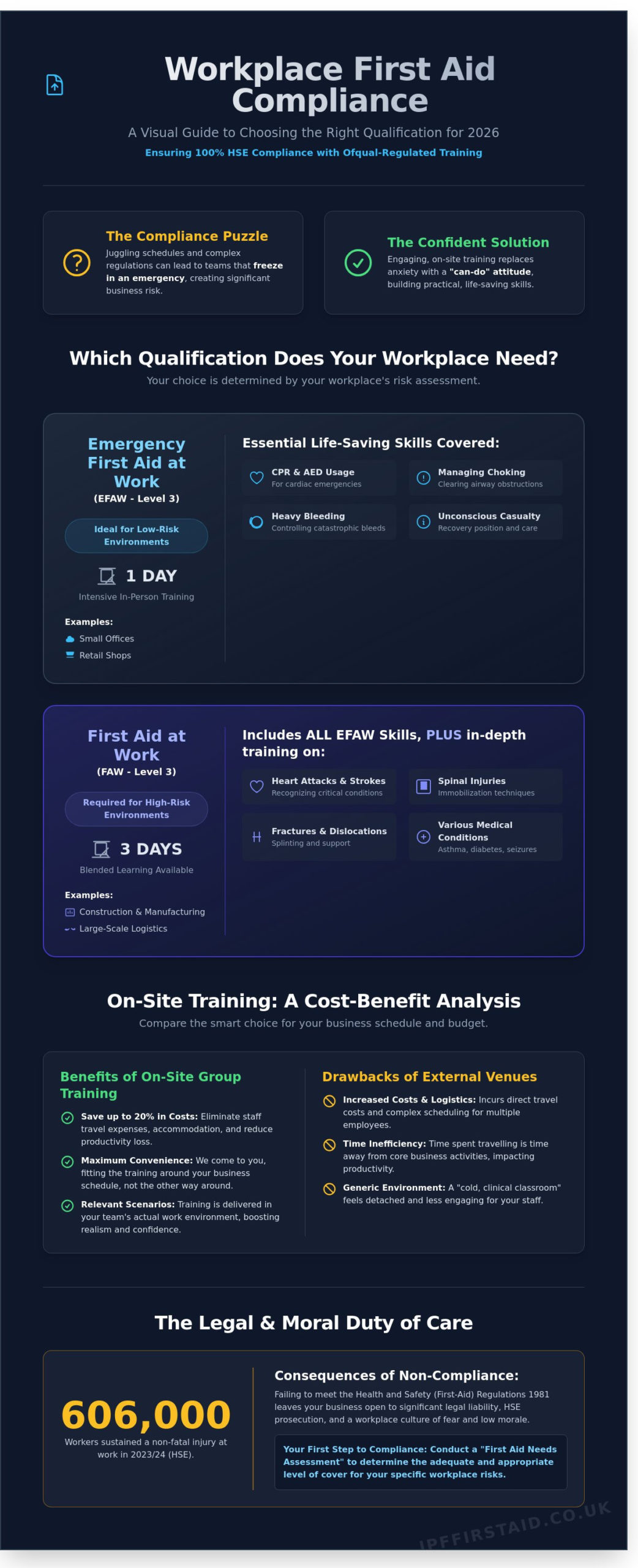
In the 2023/24 period, the HSE reported that 606,000 workers sustained a non-fatal injury at work in Great Britain. Failing to provide adequate first aid training leaves your business open to significant legal liability and potential prosecution under the 1981 Act. Beyond the financial risks, poor provision creates a culture of fear and lowers workplace morale, as staff don’t feel protected. An employer holds a legal and moral duty of care to ensure the safety and physical well-being of every staff member while they are at work.
Choosing the Right Qualification: EFAW vs. FAW and Paediatric Care
Selecting the correct training depends entirely on your specific work environment and the level of risk your team faces daily. Whether you manage a quiet office in the city centre or a busy warehouse near the M6, your risk assessment is the starting point for safety. It’s about more than just ticking a box; it’s about giving your staff the confidence to act when every second counts.
Emergency First Aid at Work (Level 3)
The EFAW is a streamlined, one-day course designed for low-risk environments. It focuses on essential life-saving skills including CPR, using an AED, managing heavy bleeding, and treating an unconscious casualty. This qualification is ideal for small offices or retail units where the 1981 regulations suggest basic cover is sufficient. The certificate remains valid for 3 years, though we always suggest a quick annual refresher to keep those vital skills fresh in your mind. Finding a local first aid course birmingham ensures your team gets this practical experience without the stress of a long commute.
Full First Aid at Work (Level 3)
High-risk sectors like construction, manufacturing, or large-scale logistics require the comprehensive 3-day FAW course. This syllabus goes much deeper, covering complex medical conditions such as heart attacks, strokes, spinal injuries, and fractures. Understanding the legal requirements for workplace first aid is a core part of this training, ensuring you stay fully compliant with national safety standards. To make things easier for your business, we offer a blended learning option. This allows your team to complete 1 day of theory online, meaning they only need to spend 2 days in the classroom for practical assessments. It’s a hassle-free way to maintain high safety standards while minimizing downtime.
Specialist Training: Paediatric and Mental Health
Schools, nurseries, and childminders must meet specific Ofsted and EYFS requirements. The 12-hour Paediatric First Aid qualification is the gold standard here, focusing on infants and children who have different physiological needs than adults. In 2026, we’re also seeing a massive shift toward Mental Health First Aid (MHFA). Since 25 percent of UK adults will experience a mental health issue each year, having a trained advocate on-site is becoming just as vital as having a physical first aider. Many businesses now choose to bundle these specialist courses together for better value and more comprehensive protection. If you’re unsure which level your team needs, you can view our full course breakdown to help you decide.
On-Site Training vs. External Centres: A Cost-Benefit Analysis
Deciding where to host your first aid course birmingham usually comes down to your headcount and your budget. If you have a team of 6 to 12 people, booking an on-site trainer is almost always the most cost-effective route. Most providers charge a flat day rate for group bookings, which can save a Birmingham business up to 40% compared to buying individual seats at a public centre. Beyond the spreadsheet, having a trainer come to you is completely hassle-free. You don’t need to worry about staff getting lost in city centre traffic or claiming mileage for travel to a distant venue. Before you book, it’s wise to review the HSE advice on how to evaluate a training provider to ensure your chosen course meets all legal standards for your specific industry.
The Advantages of On-Site Group Training
On-site training cuts out the 45-minute commute across the city for your staff. This keeps them on the premises and ready to work immediately before or after the session. Learning in your actual workplace allows us to point out specific risks, like a particular piece of warehouse machinery or a high-traffic kitchen area. It builds massive confidence when a team practices a simulated emergency in the very room where a real one might happen. You also get to pick the dates. This means you won’t lose 25% of your workforce on a day when you have a major project deadline or a scheduled site inspection.
When to Choose a Public Scheduled Course
Public courses are the perfect solution for smaller businesses or when you’ve just hired one new starter. You pay a simple per-delegate fee, which typically ranges from £80 to £160 depending on whether it’s a one-day or three-day qualification. These sessions are great for networking. Your staff will meet people from different sectors, from construction to retail, which often leads to a broader perspective on safety. It’s a structured, professional environment that takes the pressure off you to provide a dedicated training space. If you only need to certify 1 or 2 people, this is the most logical and budget-friendly path to compliance for your first aid course birmingham.
A 5-Point Checklist for Evaluating a First Aid Training Provider
Selecting a first aid course birmingham is a serious decision that goes beyond simple compliance. It’s about ensuring your team has the skills to act when every second counts. You must perform due diligence to find a partner who takes this responsibility as seriously as you do. Don’t settle for a dry, PowerPoint-heavy session that leaves staff watching the clock. Instead, look for training that is engaging and fun. When learners are relaxed and involved, they retain information much more effectively. A quality provider offers bespoke advice, tailoring the scenarios to your specific workplace risks rather than delivering a generic, one-size-fits-all presentation.
1. Accreditation and Regulation
You need to know your certificates are worth the paper they’re printed on. Always verify if the provider offers Ofqual-regulated qualifications. These certifications are the gold standard and ensure you meet the Health and Safety (First Aid) Regulations 1981. Check for affiliations with respected bodies like the First Aid Industry Body (FAIB). This isn’t just a formality; it ensures your training is recognized by insurers and health and safety inspectors. In 2024, many businesses faced issues because their “cheap” training didn’t meet these rigorous standards. Stick to regulated paths to keep your business protected.
2. Trainer Experience and Pedagogy
The best instructors aren’t just teachers; they’re practitioners. Look for trainers with real-world experience in the emergency services or healthcare sectors. They bring life-saving stories that make the theory stick. Ask about their teaching style. It should be hands-on, practical, and designed to build muscle memory. A 2023 study indicated that practical simulation improves skill retention by 75% compared to passive learning. Check for recent student testimonials. If they mention feeling a boost in “confidence,” you’ve likely found a provider who prioritizes the learner’s ability to actually perform under pressure.
3. Flexibility and Convenience
Your business doesn’t stop just because training is required. A reliable partner understands this and offers flexible solutions that fit your schedule. Ask if they provide on-site training at your location to save on travel time and expenses. Blended learning is another vital tool; it allows staff to complete theory online, reducing classroom time by up to 33%. Whether you need a first aid course birmingham at your office or a weekend session to avoid disrupting a Monday-to-Friday production line, your provider should be willing to accommodate your specific operational needs.
Ready to secure high-quality, regulated training for your team? Get a bespoke quote for your workplace training and ensure your staff are prepared for any emergency.
Why JPF First Aid is the Trusted Choice for Life-Saving Skills
Choosing a first aid course birmingham shouldn’t be a box-ticking exercise that your staff dreads. JPF First Aid acts as your reliable expert mentor, providing award-winning training that’s actually enjoyable. Our founder started this business with a clear mission: to replace boring, PowerPoint-heavy lectures with practical, life-saving skills. Since our launch, we’ve built a reputation on a relaxed atmosphere where every learner feels comfortable asking questions. We don’t just teach the manual; we share the passion and real-world experience needed to save lives.
Our “hassle-free” promise means we handle the logistics so you don’t have to. From providing a clear, transparent quote within 24 hours to delivering digital certifications quickly after the course, we keep the administration simple. You’ll find our approach professional yet approachable, ensuring that your first aid course birmingham is the most productive day of your year.
Bespoke Training Solutions for Every Sector
Every workplace has unique risks. A primary school needs different skills than a high-risk construction site. We’ve provided tailored sessions for over 450 schools and businesses across the West Midlands, ensuring the content is relevant to your specific environment. You can maximize your team’s time by booking workplace training bundles. Combining Basic Life Support with Fire Safety training in one visit often reduces your training downtime by 20% while ensuring full legal compliance across multiple areas.
Building Confidence, Not Just Compliance
Compliance is the legal floor, but confidence is our actual goal. We prioritize a “can-do” attitude over simple memorization. By using the latest 2024-spec AED trainers and high-fidelity manikins, you get hands-on experience that feels real. More than 6,000 learners have used our courses to move past the anxiety of emergency response. You won’t just leave with a certificate; you’ll leave knowing exactly what to do when a life is on the line. Join the thousands of local professionals who trust JPF First Aid to deliver skills that stick.
- Expert Mentorship: Training led by passionate, qualified professionals.
- Modern Equipment: Hands-on practice with the latest medical manikins and AED units.
- Flexible Delivery: We come to your venue to minimize disruption to your workday.
- Proven Results: Over 98% of our students report a significant increase in their confidence to act.
Take the Next Step Toward a Safer 2026
Securing your workplace’s safety for the 2026 calendar year starts with more than just a certificate; it requires the genuine confidence to act when every second counts. You’ve now seen how selecting the right Emergency First Aid at Work (EFAW) or full First Aid at Work (FAW) qualification ensures you meet specific HSE requirements. Opting for a regulated first aid course birmingham provides the absolute peace of mind that your training meets the rigorous national standards set by Ofqual.
JPF First Aid is a multi-award-winning provider dedicated to transforming dry, clinical sessions into something truly memorable. Our highly experienced trainers use a fun and relaxed approach to build your skills without any of the typical classroom stress. Whether we bring the training to your specific business site or you join us at an external centre, you’ll receive practical, life-saving knowledge that sticks. Don’t leave your legal compliance to chance.
Book your engaging and professional first aid training with JPF First Aid today. We’re here to help you become the calm, capable responder your team deserves.
Frequently Asked Questions
How long does a first aid certificate last in the UK?
Your first aid certificate remains valid for 3 years from the date of issue. While the Health and Safety Executive doesn’t mandate annual training, they strongly recommend a 3 hour refresher course every 12 months. This keeps your skills sharp and ensures you don’t lose confidence when facing a real emergency. We provide clear expiry reminders so you never miss a compliance deadline.
Is first aid training a legal requirement for my small business?
Yes, the Health and Safety (First-Aid) Regulations 1981 require all employers to provide adequate equipment and personnel to assist employees if they’re injured or become ill at work. Even if you only have 1 employee, you must conduct a risk assessment. For a low-risk office with fewer than 25 people, you’ll need at least one appointed person to take charge of first aid arrangements.
What is the difference between EFAW and FAW qualifications?
Emergency First Aid at Work (EFAW) is a 6 hour course completed in 1 day, focusing on life-saving skills for low-risk environments. The full First Aid at Work (FAW) qualification takes 18 hours over 3 days. It covers a wider range of medical conditions like heart attacks and fractures. Choosing a first aid course birmingham with us ensures you get the right level of training for your specific workplace hazards.
Can I do a first aid course online or through distance learning?
You can complete the theoretical part of your training online through a blended learning model, but practical assessment must happen in person. To meet Health and Safety Executive requirements, you must demonstrate skills like CPR and the recovery position to a qualified instructor. Our blended options allow you to do 6 hours of home study followed by practical, hands-on training to ensure you’re fully compliant.
How many first aiders do I need for my workplace?
The number of first aiders depends on your specific risk assessment and staff count. For low-risk workplaces like shops or offices with 25 to 50 employees, you need at least 1 EFAW trained person. If you have more than 50 people, you’ll need 1 FAW trained person for every 100 staff members. High-risk sites like construction zones require 1 FAW trained person for every 25 employees to ensure safety.
Do you provide on-site first aid training at our premises?
We certainly do, as flexibility is a core part of our service. We specialize in bringing our engaging and fun training directly to your business premises anywhere in the West Midlands. This “we come to you” approach saves your team travel time and allows us to tailor the scenarios to your actual work environment. Booking a first aid course birmingham on-site is a hassle-free way to get your entire team certified.
How do I renew an expired First Aid at Work certificate?
You must complete a 2 day First Aid at Work Requalification course before your current 3 year certificate expires. If your certificate has already lapsed by more than 1 month, you’ll likely need to attend the full 3 day course again. We recommend booking your renewal at least 3 months in advance to ensure your workplace remains legally covered and your staff stay confident in their life-saving skills.
Is paediatric first aid training different from standard workplace first aid?
Paediatric first aid is specifically designed for those caring for infants and children, such as nursery staff or childminders. It follows Ofsted and Early Years Foundation Stage requirements, focusing on child-specific issues like choking, meningitis, and febrile convulsions. While standard workplace first aid focuses on adult physiology, our 12 hour paediatric course provides the specialized knowledge needed to protect the youngest members of our community.
Recent Comments