

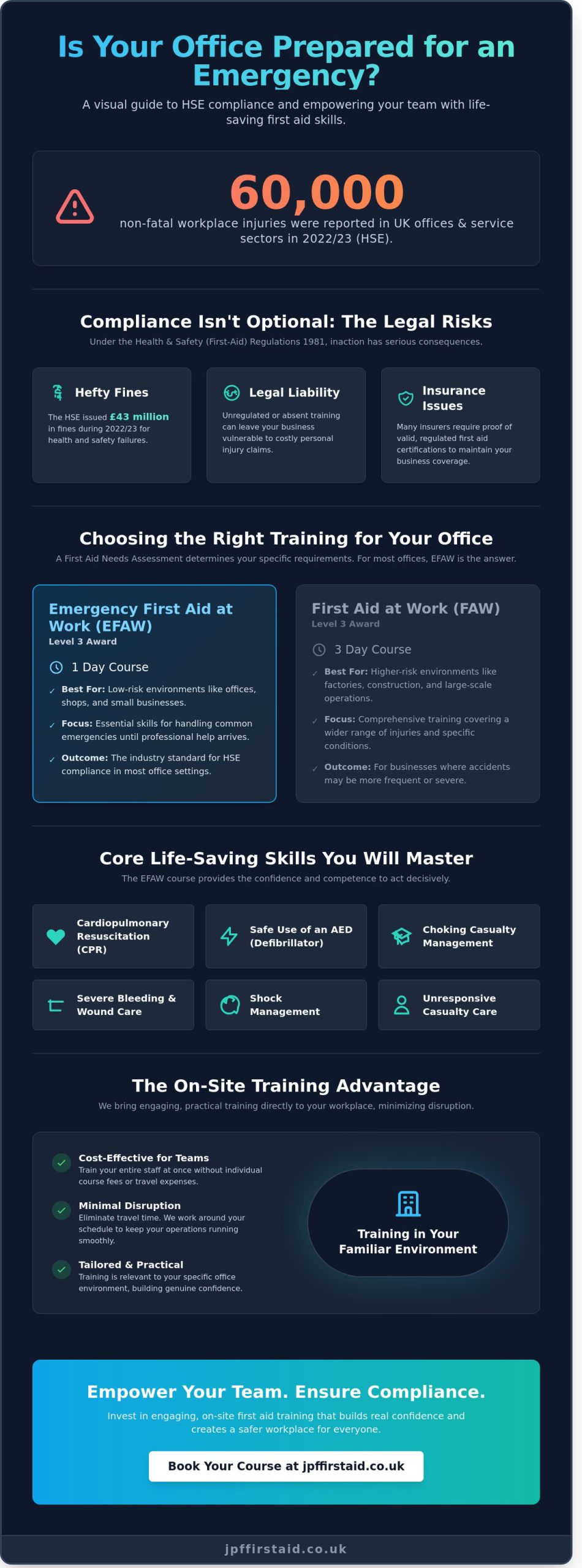
Would your team know exactly what to do if a colleague collapsed in the breakroom tomorrow, or would they spend those first critical seconds searching for a manual? It’s a sobering thought, especially when you consider that the Health and Safety Executive (HSE) reported 60,000 non-fatal workplace injuries in the UK office and service sector during the 2022/23 period. You likely already agree that providing a first aid course for office staff is a vital legal necessity, but the thought of coordinating schedules or sitting through a dry, clinical lecture probably feels like a massive drain on your working week.
I’m here to promise you that training doesn’t have to be a dull box-ticking exercise that puts everyone to sleep. You can master your safety requirements and empower your team with life-saving skills through engaging, regulated training that actually builds their confidence. This complete 2026 guide explains how to achieve full HSE compliance with minimal disruption to your daily operations. We’ll explore how flexible, on-site sessions can transform your workplace into a prepared, resilient environment where every employee feels ready to act in a crisis.
Key Takeaways
- Understand how to meet your legal obligations under the Health and Safety (First-Aid) Regulations 1981 while boosting team morale through a proactive culture of safety.
- Discover the essential skills covered in a first aid course for office staff, including life-saving CPR techniques and how to confidently operate an Automated External Defibrillator (AED).
- Learn how to conduct a professional First Aid Needs Assessment to determine whether your team requires the standard one-day EFAW or the more comprehensive three-day FAW qualification.
- Explore the practical benefits of hassle-free on-site training that eliminates travel time and provides cost-effective, bespoke solutions for your entire office.
- Find out how an engaging and fun training atmosphere replaces clinical boredom with genuine confidence, ensuring your staff are truly ready to act when it matters most.
Why Every Office Needs a Dedicated First Aid Strategy
You have a moral and legal responsibility to ensure your team stays safe while they are at work. Under the Health and Safety (First-Aid) Regulations 1981, UK employers must provide adequate and appropriate equipment, facilities, and personnel to ensure employees receive immediate attention if they are injured or taken ill. While an office is often viewed as a low-risk environment, emergencies do not wait for a convenient time or location. Choosing the right first aid course for office staff is the first step in moving beyond simple compliance toward a culture of genuine care.
A proactive safety strategy does more than satisfy an inspector. It boosts employee morale because your team knows you value their well-being. Understanding basic First aid principles allows your staff to act with clarity during high-pressure moments. Whether it is a sudden cardiac arrest, a choking incident in the breakroom, or a simple slip in the hallway, having a trained responder on-site can be the difference between a minor incident and a tragedy. When your team feels prepared, the entire atmosphere of the workplace becomes more confident and secure.
Legal Requirements for UK Offices
The Health and Safety Executive (HSE) requires every workplace to conduct a first aid needs assessment. For most small to medium offices, this means having at least one appointed person or a worker with a regulated qualification. Simply having someone who thinks they know what to do is a significant legal risk. If an incident occurs and your first aider lacks a valid, regulated qualification, your business could face severe consequences.
- Fines: The HSE issued £43 million in total fines during the 2022/23 period for various health and safety failures.
- Legal Liability: Unregulated training can leave you vulnerable to personal injury claims if a response is handled incorrectly.
- Insurance Implications: Many professional indemnity and liability providers require proof of valid certifications to maintain your coverage.
The Business Case for First Aid Training
Effective training reduces downtime. When minor injuries are managed correctly in-house, it prevents unnecessary trips to A&E and keeps your team productive. Beyond the numbers, employees view life-saving skills as a major workplace benefit. It builds their confidence and ensures they feel capable of helping colleagues or even family members outside of work. In a modern office setting, your duty of care is a commitment to ensuring every staff member returns home in the same healthy condition they arrived in.
We make the process of getting certified hassle-free by coming to your location. Our first aid course for office staff is designed to be practical, relaxed, and even fun, ensuring your team learns through doing rather than just listening. This approach creates a can-do attitude that transforms your office into a safer, more resilient workplace. By investing in professional training, you are not just following the law; you are building a team that is ready for anything.
Understanding the Emergency First Aid at Work (EFAW) Syllabus
The Emergency First Aid at Work (EFAW) Level 3 award is the industry standard for low-risk environments. If you work in a typical office, this one-day qualification is usually exactly what the Health and Safety Executive (HSE) requires. It’s the most popular first aid course for office staff because it packs essential life-saving knowledge into a single, high-impact day. You’ll learn to handle the specific incidents that occur in professional settings, from minor trips to serious medical emergencies. Most office-based businesses choose this route because it balances comprehensive training with a minimal time commitment.
While UK standards are set by the HSE, looking at international benchmarks such as OSHA first aid requirements shows that professional first aid training is a global necessity for workplace safety. The EFAW syllabus focuses on immediate response. You’ll master how to manage a casualty who is unresponsive, deal with heavy bleeding, and provide shock management. It’s about giving you the tools to act quickly before paramedics arrive. We focus on practical, real-world scenarios rather than just reading from a textbook.
Core Life-Saving Skills Covered
We break down the primary survey using the DRABC acronym: Danger, Response, Airway, Breathing, and Circulation. This systematic approach ensures you don’t miss anything vital during a high-pressure moment. Many people feel nervous about using an Automated External Defibrillator (AED), but the course makes this simple and even fun. You’ll spend time with training units that talk you through every step. Our practical sessions aren’t just about watching; you’ll get hands-on with manikins to perfect your CPR technique in a relaxed, supportive environment that builds your confidence. You’ll also practice managing choking incidents and applying bandages to control bleeding, ensuring you leave with a “can-do” attitude.
Assessment and Certification
You won’t face a scary formal exam. Assessment happens throughout the day through practical demonstrations and a straightforward multiple-choice paper. This approach keeps the atmosphere light while ensuring every delegate meets the required standard. Once you pass, your certificate stays valid for three years. We always recommend choosing Ofqual regulated qualifications to ensure your business remains fully compliant with national standards. This certification provides the peace of mind that your team has been trained by experts. If you want to build a safer workplace, you can book a session for your team today to keep everyone protected.
Choosing the Right Training for Your Office Environment
Selecting the perfect first aid course for office staff begins with a thorough First Aid Needs Assessment. You shouldn’t just guess how many people to train; you need to look at the unique variables of your workplace. Think about your specific floor layout. If your team is spread across three floors, a single first aider on the ground floor won’t be able to respond quickly enough to a crisis on the top level. You also need to account for your hybrid workforce or those working remotely, as they still require protection under UK health and safety laws.
The Health and Safety Executive (HSE) suggests having at least one person trained for every 50 employees in a low-risk environment, but this is a baseline minimum. You must ensure you have enough cover for holidays, sickness, and off-site meetings. If your primary first aider is away on a two-week break, who steps in? We recommend training at least two people even in small offices to ensure you’re never left without a qualified responder. This approach builds a culture of safety and ensures compliance stays hassle-free.
Don’t forget to account for specific risks like staff with known medical conditions. If you have employees with severe allergies, diabetes, or physical disabilities, your training needs to reflect that. We focus on giving your team the confidence to handle these specific scenarios, moving beyond theory into practical, life-saving skills.
EFAW vs. FAW: Making the Decision
The 1-day Emergency First Aid at Work (EFAW) course is usually the sweet spot for small, low-risk offices. It covers the essentials like CPR, choking, and wounds. However, if your staff numbers exceed 50 or your needs assessment identifies complex risks, the 3-day First Aid at Work (FAW) qualification becomes the requirement. The FAW course dives much deeper into managing fractures, chest injuries, and poisoning. We make these sessions practical and relaxed, ensuring you gain the skills to handle serious incidents without feeling overwhelmed by technical jargon.
Mental Health First Aid in the Office
A modern workplace requires more than just bandages and AEDs. Companies are increasingly prioritising mental health first aid to support their teams effectively. In 2023, statistics showed that 17.1 million working days were lost in the UK due to work-related stress, depression, or anxiety. By training your staff to spot the early signs of burnout and distress, you create a safer, more supportive culture. This training works in harmony with physical first aid, giving your designated responders the confidence to provide holistic support. We focus on making this learning experience engaging and fun, so your team leaves feeling empowered to help their colleagues every day.
Planning Your On-Site First Aid Training
Organising a first aid course for office staff shouldn’t feel like a logistical nightmare. Bringing the training directly to your workplace eliminates the stress of staff travel and keeps your team in a familiar environment. It’s often the most cost-effective route for teams of six or more, as flat-rate group bookings avoid the high per-head costs of external venues. You also gain the unique advantage of practicing life-saving skills exactly where an emergency would happen, whether that’s in the boardroom or the staff kitchen. This context helps staff remember what to do when it matters most.
Scheduling is another major win for on-site sessions. Instead of being tied to a training provider’s rigid calendar, you can pick a date that suits your business cycle. If Tuesday mornings are your quietest time, that’s when we’ll be there. This flexibility ensures your business stays productive while your team gains the skills they need to stay safe. It’s a practical, “can-do” approach to compliance that puts your needs first.
Preparing Your Office for Training Day
To ensure a smooth, engaging session, you’ll need a clear space for practical work. A standard meeting room usually works perfectly. You should aim for roughly 4 square metres of floor space per person to allow everyone to practice CPR comfortably on the floor. Don’t worry about the heavy lifting; the trainer brings all the necessary equipment, from manikins to bandages, making it a completely hassle-free experience for you. To manage staff cover, many offices split their training into two groups across different days. This keeps your operations running while ensuring every person gets the 100% focus they need to build real confidence.
Public Courses vs. Private Group Bookings
If you only have one or two employees needing certification, sending them to a scheduled public course is a smart, budget-friendly choice. However, for larger teams, a private booking is superior because it’s bespoke. We can tailor the scenarios to your specific office layout or industry risks. For example, if your office is spread across multiple floors, we can discuss response times and AED placement specific to your building. This level of detail is vital for meeting HSE requirements and ensuring your first aid course for office staff is truly effective. You can learn more about these standards in our Emergency First Aid at Work: The Complete 2026 Guide.
Ready to get your team certified without the stress? Book your on-site first aid training today and let us handle the details for you.
Building Staff Confidence with JPF First Aid
Choosing the right first aid course for office staff isn’t just about ticking a box for the Health and Safety Executive (HSE). It’s about ensuring your team feels capable when every second counts. At JPF First Aid, our philosophy centres on making training engaging and fun. We’ve found that when learners are relaxed, they retain significantly more information than they do in a stiff, clinical environment. John Fogarty brings over 20 years of experience to every session, delivering life-saving knowledge with a calm, can-do attitude that settles even the most nervous participants.
Our “First Aid Training You Can Trust” promise means you never have to worry about compliance. Every course we deliver is Ofqual regulated and meets the strict standards of the HSE Health and Safety (First Aid) Regulations 1981. This professional backing, combined with an approachable atmosphere, creates a learning environment where staff feel safe to ask questions and practice skills until they’re second nature. By removing the anxiety often associated with medical emergencies, we empower your employees to act decisively rather than hesitating in a crisis.
The JPF Difference: Engaging and Practical
We’ve moved away from the era of endless, dry PowerPoint slides. Instead, our sessions focus on hands-on, scenario-based learning that mimics real office emergencies. Office managers frequently tell us that our practical approach is what sets us apart. One feedback report from a client firm noted that 98% of their staff felt “completely confident” to act as a first aider immediately after the session. John acts as your Reliable Expert Mentor, guiding your team through high-pressure scenarios with a steady hand and a wealth of real-world knowledge. This practical focus ensures that a first aid course for office staff results in genuine skill, not just a piece of paper.
- Scenario-based learning: We use realistic office setups to practice response times and casualty care.
- Retention-focused: Interactive games and practical demonstrations replace boring lectures.
- Expertise: John Fogarty’s background ensures every tip is grounded in years of professional experience.
Next Steps: Securing Your Office Safety
Securing high-quality training for your team is a straightforward, hassle-free process. We offer bespoke quotes tailored to your specific headcount and office risks, ensuring you don’t pay for more than you need. The booking journey is simple: send us an initial enquiry, we’ll discuss your requirements, and then we’ll bring the training directly to your site at a time that suits your schedule. Once the course is complete, your certificates are processed quickly to keep your records up to date. Don’t leave your workplace safety to chance. Build a safer, more confident office today by getting in touch for your personalised quote.
Future-Proof Your Office Safety Today
Ensuring your workplace meets the Health and Safety (First-Aid) Regulations 1981 isn’t just about ticking a compliance box for 2026; it’s about building a culture where your team feels protected. You’ve seen how a structured Emergency First Aid at Work (EFAW) syllabus provides the essential skills needed to handle common office incidents. By choosing a bespoke on-site first aid course for office staff, you eliminate the hassle of travel while ensuring your team learns in the environment where they actually work.
We make the process simple. As a multi-award-winning training provider, JPF First Aid delivers Ofqual regulated qualifications that are practical and easy to remember. Our sessions for groups of up to 12 people focus on building real-world confidence through engaging, hands-on practice. You don’t have to worry about dry or clinical lectures here. We’ll help you transform your health and safety requirements into a positive, team-building experience that genuinely saves lives.
Book an engaging first aid course for your office staff today and give your team the skills they need to act with confidence. You’re in safe hands.
Frequently Asked Questions
How many first aiders do I legally need in a small office?
You need at least one appointed person to take charge of first aid arrangements if your office has fewer than 25 employees. For offices with 25 to 50 staff members, the Health and Safety Executive (HSE) guidelines state you must have at least one person trained in Emergency First Aid at Work (EFAW). We recommend assessing your specific layout, as having coverage for holidays and sickness ensures you stay compliant and your team stays safe.
Does an office first aid certificate expire?
Yes, a first aid certificate for office staff expires exactly three years from the date of issue. To maintain your status as a qualified first aider, you must complete a requalification course before the three-year period ends. The HSE also strongly recommends an annual half-day refresher to keep your life-saving skills sharp and your confidence high, as practical knowledge can fade over 36 months.
Can we do first aid training online for office staff?
You can complete the theoretical part of your training online, but the HSE requires face-to-face practical assessments for a first aid course for office staff to be fully valid. This blended learning approach combines the convenience of digital modules with a 1-day practical session. Purely online courses without a hands-on element rarely meet the rigorous standards needed for workplace compliance in the UK.
What is the difference between EFAW and FAW for an office?
The main difference is the duration and depth of the training. Emergency First Aid at Work (EFAW) is a 1-day course lasting 6 hours, designed for low-risk environments like standard offices. First Aid at Work (FAW) is a comprehensive 3-day course totalling 18 hours of instruction. While EFAW covers life-threatening emergencies, FAW includes more detailed training on specific illnesses and complex injuries like heart attacks or fractures.
What should be in a standard office first aid kit in 2026?
Your kit should meet the BS 8599-1:2019 standards, which remains the benchmark for UK workplaces in 2026. A standard small office kit must include 20 assorted waterproof plasters, 2 sterile eye pads, 4 triangular bandages, and 6 safety pins. You also need 6 medium and 2 large sterile wound dressings, 10 cleansing wipes, and at least 3 pairs of disposable gloves to ensure hygienic treatment.
Do we need a defibrillator (AED) in our office by law?
There is currently no UK law that mandates every office must have an Automated External Defibrillator (AED). However, the Resuscitation Council UK emphasizes that using an AED within 3 to 5 minutes of collapse can increase survival rates from 6% to over 70%. Many modern health and safety assessments now include an AED as a vital tool for providing a gold standard of care to employees.
Is mental health first aid mandatory for UK offices?
Mental health first aid isn’t a legal requirement under the Health and Safety (First-Aid) Regulations 1981, but the HSE updated its guidance in 2019 to suggest employers should consider it. You’re legally required to assess the mental health risks in your workplace just as you do physical ones. Adding a trained mental health first aider helps you support the 1 in 4 people in the UK who experience mental health issues annually.
Recent Comments