

Choosing the wrong course doesn’t just waste your training budget; it could leave your business legally exposed when an inspector arrives. It’s a common frustration because the jump between various first aid qualifications often feels like a maze of jargon and red tape. You likely want to ensure your team is safe without getting bogged down in confusing Level 2 versus Level 3 terminology. Since the Health and Safety Executive (HSE) shifted due diligence responsibilities to employers, the pressure to choose the right regulated provider has never been higher.
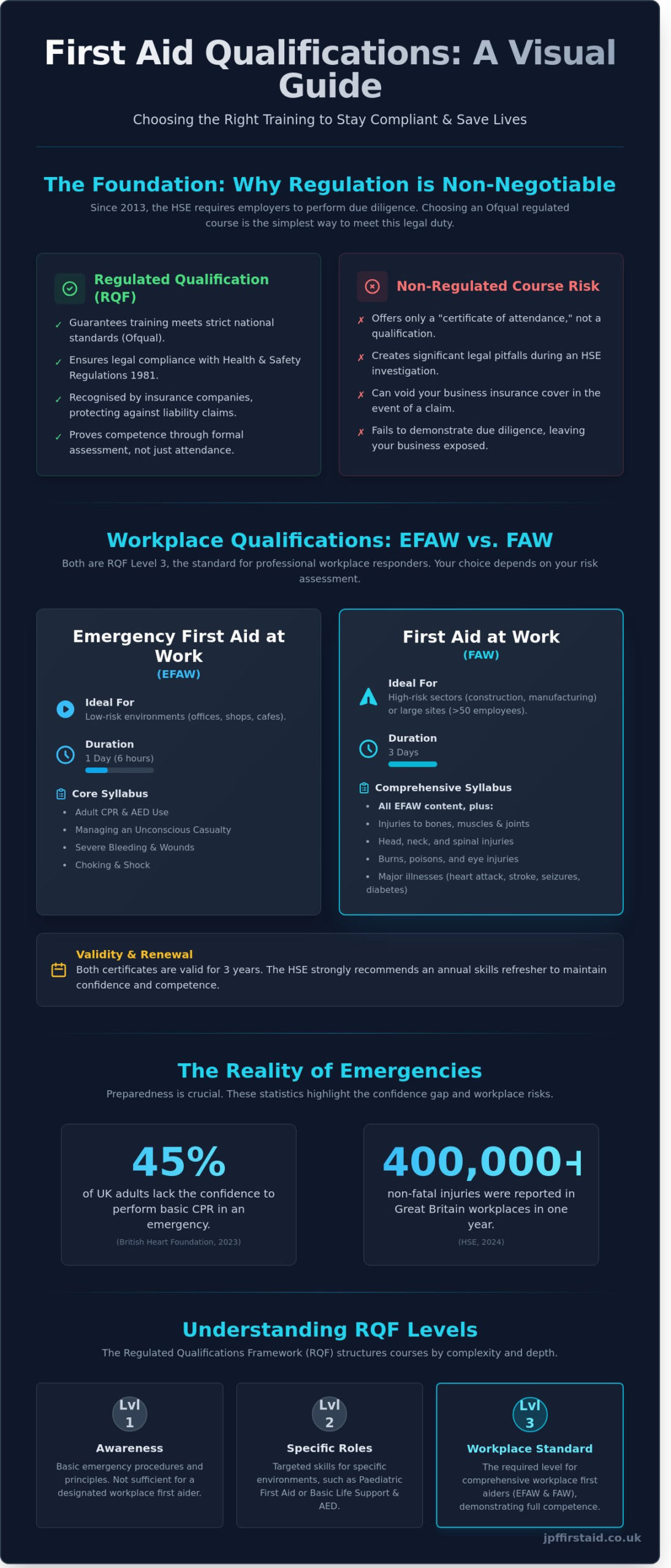
We understand that the thought of a formal assessment can feel a bit daunting. You’re not alone; a 2023 British Heart Foundation study found that 45% of UK adults lack the confidence to perform basic CPR in an emergency. That’s why we’re here to show you that gaining these skills is actually an engaging, practical, and even fun experience. This guide will help you discover exactly which qualification you need to stay compliant, save lives, and build your confidence in any emergency. We’ll break down the 2026 standards, explain how to choose a trusted provider, and show you how to maintain your certificate with zero hassle.
Key Takeaways
- Understand the importance of Ofqual regulation and how it guarantees your training meets the highest national standards for life-saving care.
- Clear up the confusion between EFAW and FAW to ensure you choose the right first aid qualifications to keep your specific workplace compliant and safe.
- Explore why specialist paediatric and mental health training are essential additions to your toolkit for supporting specific groups and modern wellbeing.
- Learn how to distinguish between qualification Levels 1, 2, and 3 to find the perfect fit for your role and level of responsibility.
- Gain practical advice on managing certificate expiry and using annual refreshers to keep your skills sharp and your confidence high.
What is a First Aid Qualification and Why is Regulation Essential?
A first aid qualification is a formal recognition that you possess the practical skills and theoretical knowledge required to preserve life during a medical emergency. It is far more than just sitting through a presentation. These first aid qualifications act as a benchmark for safety, ensuring that when an accident happens, the responder acts with competence and speed. This standardisation is vital because it links directly to the Health and Safety (First Aid) Regulations 1981. These laws require UK employers to provide “adequate and appropriate” equipment and personnel to ensure employees receive immediate attention if they are injured or taken ill at work.
You might see some providers offering a “certificate of attendance.” It is vital to understand that this is not the same as a regulated qualification. An attendance certificate simply proves you were in the room. A regulated qualification proves you were assessed against national standards and found to be competent. Since the Health and Safety Executive (HSE) ceased individual provider approvals in October 2013, the responsibility for verifying training quality shifted to the employer. Choosing regulated training is the simplest way to meet this legal obligation.
The Role of Ofqual and the RQF Framework
The Regulated Qualifications Framework (RQF) provides a clear structure for first aid qualifications in the UK. Ofqual, the government department that regulates qualifications, oversees this framework to ensure every course meets a strict national standard. When your certificate carries the Ofqual logo, it means an external awarding organisation has verified the trainer, the lesson plans, and the assessment methods. This external verification gives you peace of mind that the training is robust. For employers, using RQF-accredited courses drastically reduces the due diligence burden. You don’t need to spend hours auditing a training provider’s internal processes because the regulator has already done that work for you.
Why ‘Cheap’ Non-Regulated Courses Can Be a Risk
Opting for the lowest price point often leads to unrecognised training that lacks formal assessment. This creates significant legal pitfalls. If a serious incident occurs in your workplace, the Health and Safety Executive or a court of law may investigate the validity of your staff’s training. Many insurance companies now explicitly require evidence of regulated qualifications before they will honour a liability claim. If your team holds unrecognised certificates, you might find your insurance cover is void when you need it most. It is always better to invest in high-quality training that builds genuine confidence rather than just ticking a box with a cheap alternative.
Due diligence is the process of a business owner taking reasonable steps to ensure a training provider is competent and the qualification is fit for purpose.
Workplace First Aid Qualifications: EFAW vs. FAW
Choosing the right first aid qualifications for your team doesn’t have to be a headache. Under the Health and Safety (First-Aid) Regulations 1981, you’re legally required to provide “adequate and appropriate” cover for your staff. For the vast majority of UK workplaces, this boils down to two specific Level 3 certificates. While both are regulated qualifications, they serve very different needs depending on your daily operations.
To decide which path to take, you must first complete a thorough risk assessment. You’ll need to consider factors like the nature of your work, the number of employees, and how close you are to the nearest hospital. In 2024, the HSE reported over 400,000 non-fatal workplace injuries in Great Britain, proving that even “safe” jobs carry risks. Both of the following options sit at Level 3 on the Regulated Qualifications Framework (RQF), which is the industry standard for professional workplace responders.
Emergency First Aid at Work (Level 3)
This qualification is the perfect entry point for low-risk environments such as small retail units, corporate offices, or cafes. It’s designed to give you the confidence to act quickly when every second counts. The core syllabus focuses on life-saving essentials, including:
- Adult CPR and the use of an Automated External Defibrillator (AED)
- Managing an unconscious casualty
- Treating severe bleeding and wounds
- Responding to choking and shock
This is a one-day course, usually involving six hours of contact time. Once you pass, your certificate stays valid for three years, though the HSE recommends annual “skills refreshers” to keep your knowledge sharp.
First Aid at Work (Level 3)
For high-risk sectors like construction, manufacturing, or large-scale warehouses with over 50 employees, the full First Aid at Work course is the gold standard. It provides a much deeper level of training, covering everything in the EFAW syllabus plus complex injuries and major medical emergencies. You’ll learn to manage fractures, spinal trauma, chest injuries, and sudden illnesses like heart attacks or strokes.
The initial qualification takes three days to complete. Because the skills are so comprehensive, we focus on hands-on practice to ensure you feel truly prepared. We make these sessions engaging and practical, so you leave feeling ready for anything. When your certificate approaches its three-year expiry, you can take a shorter two-day re-qualification course to maintain your status as a lead first aider.
As your business grows or your risk profile changes, moving from EFAW to the full FAW ensures you stay compliant. Upgrading your first aid qualifications is a proactive way to protect your most valuable asset: your people.
Specialist Qualifications: Paediatric and Mental Health First Aid
You can’t apply adult logic to a toddler or a colleague in the middle of a mental health crisis. While general first aid qualifications provide a solid foundation, they don’t account for the unique physiological needs of infants or the complex psychological requirements of the modern workforce. Since the 2024 update to the Early Years Foundation Stage (EYFS) statutory framework, the demand for specific, regulated training has surged. You’ll find that blended learning, which combines online theory with a practical classroom day, now accounts for over 55% of specialist certifications in the UK. This approach offers a flexible way to stay compliant without losing two full days on-site.
Paediatric First Aid (Level 3)
The 6-hour Emergency Paediatric course is a great start for some, but it doesn’t meet the full Ofsted requirements for most early years settings. To be fully compliant with EYFS 2024 standards, at least one person with the full 12-hour Level 3 Paediatric First Aid qualification must be present at all times when children are on the premises. This deeper dive gives you the confidence to handle life-threatening conditions specific to little ones. You’ll master skills including:
- Febrile convulsions: Which affect roughly 3% of children under the age of five.
- Meningitis and sepsis awareness: Crucial for early detection in non-verbal infants.
- Specific choking protocols: Differentiating techniques for infants under one year versus older children.
- Chronic conditions: Managing sickle cell crisis and diabetic emergencies in a school environment.
First Aid for Mental Health (Levels 1-3)
Mental health issues currently account for 50% of all work-related ill health in the UK according to recent HSE statistics. Having a designated responder isn’t just a “nice to have” bonus; it’s a vital part of your modern duty of care. A Level 1 Awareness course takes just half a day and helps break the stigma across your entire team. If you want to take a leadership role, the Level 3 Supervisor qualification empowers you to create a robust mental health action plan. You aren’t training to be a therapist. You’re learning to spot signs of anxiety or depression early and signpost colleagues to professional help. Integrating these responders into your existing first aid team ensures your business treats physical and mental wellbeing with the same level of professional gravity.
Understanding the Qualification Levels: 1, 2, and 3
When you’re looking at different first aid qualifications, the numbers 1, 2, and 3 refer to the Regulated Qualifications Framework (RQF). These levels aren’t just arbitrary labels; they indicate the depth of knowledge you’ll gain and the level of responsibility you’re prepared to handle. A Level 1 qualification is generally an “awareness” session lasting about 4 hours. It’s perfect for people who aren’t designated first aiders but want to understand basic principles, such as staying safe at an accident scene and how to effectively call the emergency services. It’s about being a helpful bystander rather than a primary responder.
Level 2: Basic Life Support and Student Training
Level 2 training focuses on the most critical, time-sensitive life-saving skills. We spend a lot of time on high-quality CPR and the confident use of an Automated External Defibrillator (AED). This level is a fantastic fit for community groups, secondary school students, or staff working in very low-risk environments where a full workplace qualification might feel like overkill. Because the British Heart Foundation reports that 72% of cardiac arrests happen in the home, this training provides essential skills for your personal life too.
The Basic Life Support algorithm follows a clear, logical sequence: check the scene for danger, assess the casualty’s responsiveness, shout for help, and start chest compressions immediately if they aren’t breathing normally. We make sure this process becomes second nature through relaxed, practical practice. You’ll leave the session feeling capable rather than confused, knowing exactly how to keep someone’s heart pumping until the paramedics arrive.
Level 3: The ‘Gold Standard’ for Responders
Level 3 is the professional benchmark for workplace and paediatric compliance in the UK. This includes the 1-day Emergency First Aid at Work (EFAW) and the comprehensive 3-day First Aid at Work (FAW) courses. You’ll find the practical assessments are more rigorous because you’re training to be the lead responder. We’ll help you master complex skills like managing catastrophic bleeding, identifying heart attacks, and dealing with bone or joint injuries. It’s about giving you the tools to take charge of a situation with total autonomy.
Holding a Level 3 award offers significant career benefits. It proves to employers that you’ve met the strict standards set by the Health and Safety Executive (HSE) and are capable of protecting your team. In a competitive job market, being the person who can provide “First Aid Training You Can Trust” makes you a valuable asset to any business. Our sessions are designed to be engaging and fun, ensuring you walk away with the genuine confidence to act when it matters most.
How to Maintain and Renew Your First Aid Qualifications
Earning your certificate is just the beginning of your journey as a lifesaver. Skills fade is a documented reality that affects every learner, regardless of their initial talent. Research from the Resuscitation Council UK indicates that CPR skill retention can drop significantly within just seven months of completing a course. Without regular practice, the “can-do” attitude you felt in the classroom can quickly turn into hesitation during a real emergency. Most first aid qualifications in the UK expire after 36 months, but waiting three years to refresh your knowledge is a risk that 22% of UK businesses are no longer willing to take.
Managing the Three-Year Cycle
You should book your re-qualification course at least three months before your current certificate expires. This proactive approach prevents a gap in your legal cover, ensuring you remain compliant with the Health and Safety (First-Aid) Regulations 1981. It’s vital to understand the difference between your options:
- Annual Refresher: A three-hour session designed to keep your skills sharp between full certifications.
- Re-qualification: A condensed version of the original course, taken every three years to renew the official certificate.
- Progression: Moving from Emergency First Aid at Work (EFAW) to the full First Aid at Work (FAW) as your business grows beyond five employees or moves into higher-risk activities.
Keep a digital training log for your organisation to track these dates. Recent 2024 compliance audits suggest that 18% of SMEs fail HSE inspections simply due to lapsed paperwork or expired certificates.
Why Choose JPF First Aid for Your Qualifications?
We believe that learning to save a life shouldn’t feel like a dry, clinical chore. Our sessions are built on 20 years of frontline experience, ensuring every student leaves with genuine confidence rather than just a piece of paper. We provide Ofqual regulated first aid qualifications that meet all legal requirements while keeping the atmosphere relaxed, engaging, and even fun. Whether you need on-site group training at your premises or want to join one of our public courses, we make the process hassle-free. We act as your expert mentor, guiding you through the complexities of compliance with a steady hand.
Book your next first aid qualification with a provider you can trust
Take Charge of Your Workplace Safety Strategy
Navigating the landscape of UK safety standards doesn’t have to be a headache. Whether you’re selecting an EFAW course for a low-risk office or a Level 3 FAW for a high-risk construction site, your choice ensures legal compliance and workplace safety through 2026. Remember that maintaining your skills is a continuous journey; refreshing your knowledge every 3 years is the industry standard for keeping your team protected. Choosing the right first aid qualifications is about more than ticking a box. It’s about building a culture of care and readiness.
At JPF First Aid, we’ve been bridging the gap between clinical theory and practical confidence since 2005. As a multi-award-winning training provider, we offer 100% Ofqual regulated course options that swap boring lectures for engaging, hands-on learning. We’ll even come to your venue to make the process completely hassle-free. You’ll leave our sessions not just with a certificate, but with the genuine belief that you can handle an emergency when it matters most.
Secure your Ofqual regulated first aid qualification today and join the thousands of learners who trust our expert mentors to deliver training that actually sticks. You’re in safe hands.
Frequently Asked Questions
How long does a first aid qualification last in the UK?
Most workplace first aid certificates remain valid for exactly 3 years from the date of your assessment. After this 36-month period, your qualification expires and you’re no longer legally covered to act as a designated first aider. To keep your skills sharp, the HSE recommends attending a half-day annual refresher course during the intervening years. We’ll send you reminders so you never miss a renewal date.
What is the difference between a Level 2 and Level 3 first aid qualification?
The main difference lies in the depth of training and the total course duration. A Level 2 Emergency First Aid at Work (EFAW) course lasts 6 hours and covers basic life-saving skills for low-risk environments. In contrast, a Level 3 First Aid at Work (FAW) qualification requires 18 hours of training over 3 days. It includes advanced topics like heart attacks, strokes, and spinal injuries for higher-risk workplaces.
Can I get a first aid qualification entirely online?
You cannot get a regulated workplace first aid qualification entirely online because the HSE requires a practical, face-to-face assessment. While “blended learning” allows you to complete 1/3 of the theory through a digital portal, you must attend a physical session for hands-on skills like CPR. We ensure these practical sessions are engaging and relaxed, so you’ll feel confident applying your knowledge in a real emergency.
How many first aiders do I need in my workplace?
Your requirements depend on your specific risk assessment and staff numbers. For low-risk offices with fewer than 25 employees, you need at least one “Appointed Person.” If you have 25 to 50 staff, you’ll need one person with an EFAW qualification. For larger teams of over 50, you must have one person with a full FAW qualification for every 100 employees on site at any given time.
What happens if my first aid certificate expires?
Once your certificate expires, you’re no longer a qualified first aider and shouldn’t perform designated duties. You typically have a 28-day grace period after the expiry date to complete a shorter requalification course. If you miss this window, you’ll have to sit the full 3-day course again. We’ll help you stay compliant by booking your refresher well before your current certificate runs out.
Is the Emergency First Aid at Work qualification enough for a school?
An EFAW course isn’t sufficient for most schools because it focuses primarily on adult casualties. The Department for Education and Ofsted require staff to hold a 12-hour Paediatric First Aid qualification if they work with children under 5. For schools with older students, a combination of EFAW and specific paediatric training is the best fit. We can help you design a bespoke plan that meets these 2026 standards.
Do I need a separate qualification to use a defibrillator (AED)?
You don’t need a separate certificate to use an Automated External Defibrillator (AED). Since 2017, AED training has been a mandatory part of all standard first aid qualifications in the UK. We include hands-on practice with trainer units in every course. This ensures you’re comfortable and confident using a defibrillator long before you ever have to use one in a real-life situation.
Are JPF First Aid qualifications recognised by the HSE and Ofsted?
Yes, all our regulated first aid qualifications meet the strict criteria set by the HSE and Ofsted. We provide certificates through nationally recognised awarding bodies, ensuring your training is legally compliant and valid across the UK. Our expert trainers deliver this high-level instruction in a fun and approachable way, taking the stress out of your health and safety obligations while building your confidence.
Recent Comments