
What if you could replace manufactured trust exercises with the real-world confidence that comes from knowing your colleagues can act in a crisis? While many businesses view compliance as a dry, mandatory hurdle, using first aid training as a team building activity transforms a legal requirement into a powerful bonding experience. It’s time to move past boring PowerPoint slides and invest in a day that actually matters to your staff’s safety and your company’s culture.
You likely feel the pressure of balancing a tight training budget while trying to keep a hybrid or disconnected team engaged. It’s a common challenge, but you don’t have to choose between workplace safety and team morale. In this article, you’ll discover how turning certification into a collaborative event builds genuine trust and ensures your team feels psychologically empowered to handle emergencies. We’ll explore the practical benefits of this dual approach, from meeting the latest HSE mental health recommendations to creating a more cohesive, confident workforce.
Key Takeaways
- Learn how simulating emergency scenarios creates shared vulnerability, helping your team build authentic trust and clearer communication.
- Discover why first aid training as a team building activity is a more effective way to foster a mission-driven culture than traditional office exercises.
- Compare the benefits of Emergency First Aid at Work versus Mental Health First Aid to determine which best supports your current workplace needs.
- Follow our practical guide to planning an interactive training day that balances legal requirements with an enjoyable, collaborative atmosphere.
- Understand how tailored, on-site sessions empower your staff with the psychological confidence to protect one another in real-world situations.
Beyond Trust Falls: Why First Aid Training is the Ultimate Team Building Activity
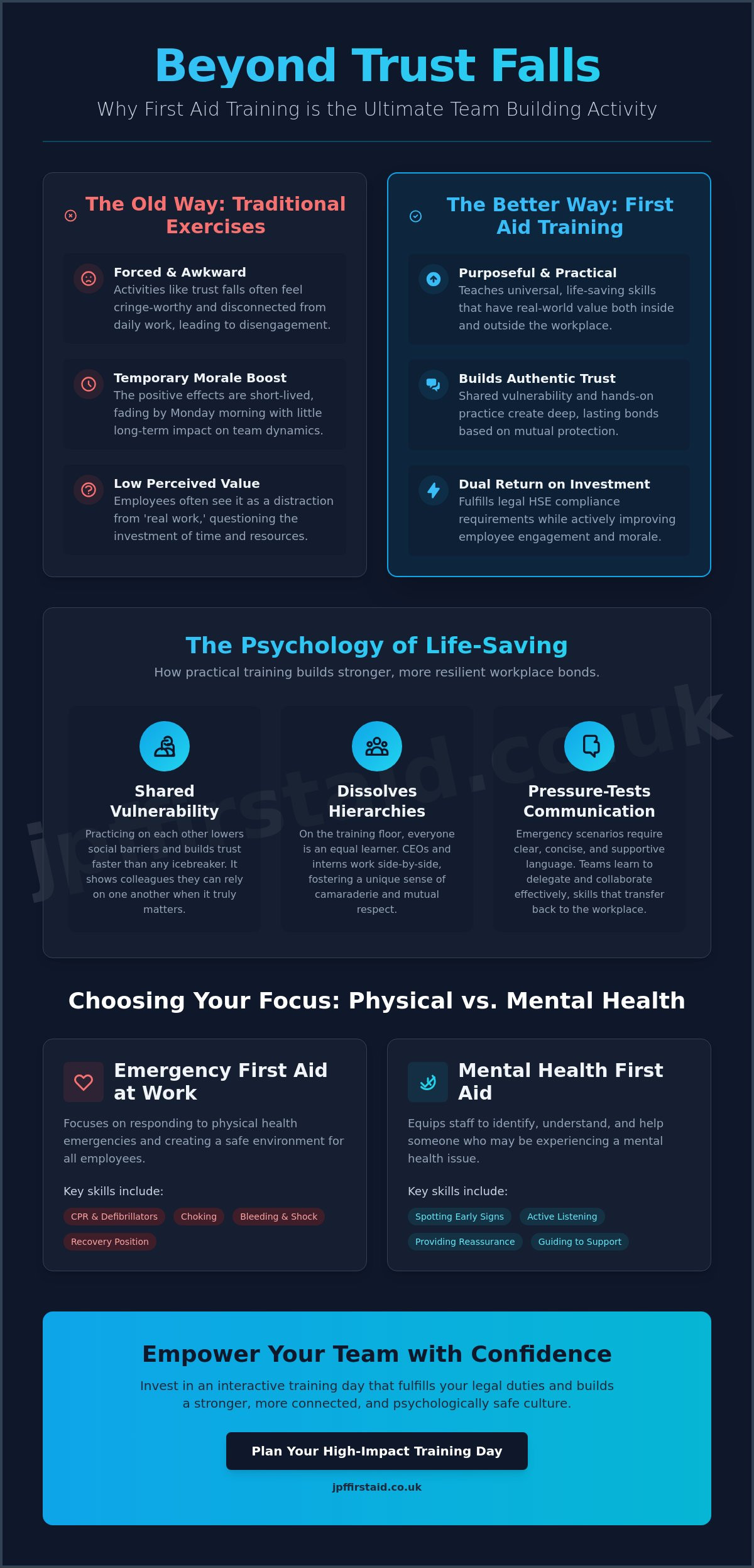
Most team building days end with a pile of discarded name tags and a temporary boost in morale that fades by Monday morning. Traditional exercises often feel like a performance, providing a quick laugh but little long-term value. Choosing first aid training as a team building activity changes this dynamic entirely. It moves your team away from manufactured games and toward a shared, mission-driven culture focused on mutual protection and competence.
This approach combines accredited safety training with collaborative group dynamics. You aren’t just ticking a box for compliance; you’re investing in a day that matters to your staff’s lives outside the office. When you shift from a “tick-box” mentality to a purpose-driven event, you create a dual return on investment. You meet your legal HSE requirements while simultaneously improving employee engagement scores. Real-world skills like first aid training create more lasting bonds than escape rooms because the stakes are grounded in reality. You aren’t just building a team; you’re building a network of capable responders who trust each other’s ability to act in a crisis.
The Problem with Traditional Team Building
Let’s be honest about the “cringe factor” of many corporate away days. Activities like icebreakers or trust falls can feel forced and irrelevant to the daily grind. Many employees see these sessions as a distraction from their actual work rather than a way to improve it. This creates a disconnect between HR goals and employee interest. Purposeful training solves this problem. It replaces the awkwardness of forced fun with the gravity of life-saving skills. Your staff will appreciate that you’re spending their time on something useful, practical, and deeply respectful of their role within the company.
Why First Aid Training Resonates
First aid resonates because it offers universal value. It’s a skill that benefits the individual, their family, and their community, not just the business. Learning to help others taps into intrinsic human motivation and empathy. It’s hard to feel disconnected from a colleague when you’ve spent the afternoon practicing how to save their life. This process creates a psychological safety net within the workplace. When a team knows they can protect one another, it lowers anxiety and builds authentic, grounded trust. It’s an empowering experience that leaves everyone feeling more capable and confident in their own abilities.
By the end of the session, your team won’t just have a certificate. They’ll have a new perspective on their colleagues. They’ll see each other as reliable partners who can keep a cool head when it matters most. That’s a foundation for teamwork that no manufactured game can replicate.
The Psychology of Life-Saving: How Training Builds Stronger Workplace Bonds
Using first aid training as a team building activity works because it bypasses the surface-level small talk found in most corporate events. When you ask a colleague to help you practice a recovery position or apply a pressure bandage, you’re entering a space of shared vulnerability. These physical, practical interactions lower social barriers faster than any standard icebreaker. It builds an authentic level of trust that can only come from knowing your team is looking out for one another’s physical well-being.
In a training environment, hierarchies naturally dissolve. When you’re all on the floor learning the correct depth for chest compressions, it doesn’t matter if you’re the CEO or a new intern. Everyone is an equal learner. This shared experience levels the playing field and creates a unique sense of camaraderie. You aren’t just learning a skill; you’re experiencing what researchers often call the “helper’s high.” The collective achievement of mastering life-saving techniques releases oxytocin, which is the hormone responsible for social bonding. This leaves your team feeling more connected, supportive, and grounded in a shared purpose.
Enhancing Team Communication Skills
Clear communication is the heartbeat of effective emergency response. During our sessions, we use the Primary Survey framework to teach teams how to assess situations and delegate tasks under pressure. This structure forces participants to use clear, concise, and supportive language to ensure help arrives quickly. Practicing these protocols helps eliminate the bystander effect and ensures everyone knows their role. By giving and receiving feedback during practical assessments, your staff learns to communicate with the same precision they’ll need for daily tasks. Effective emergency protocols improve daily project management by teaching teams how to transmit vital information without the clutter of unnecessary jargon.
Building Collective Confidence
The transformation from “I don’t know what to do” to a confident “We’ve got this” is powerful to witness. A relaxed, interactive training environment uses positive reinforcement to turn anxiety into capability. Individuals who might usually stay in the background often find themselves stepping up as leaders during simulated scenarios. This shift isn’t just about the credential; it’s about psychological empowerment. Exploring various first aid courses allows you to tailor this confidence-building experience to your team’s specific environment. If you want to see your team’s dynamics improve while gaining vital skills, consider how on-site training could fit into your next development day.
Choosing Your Focus: Physical vs. Mental Health First Aid for Teams
Selecting the right focus for your session depends on your team’s specific environment and current challenges. If your staff works in a high-risk setting like a warehouse or a busy production floor, physical safety is your priority. However, if you manage a remote team facing digital burnout, emotional resilience might be the more pressing need. Choosing first aid training as a team building activity allows you to address these specific needs directly, whether you’re tackling physical risks or workplace stress.
You don’t have to stick to just one path. Many modern businesses find success with a hybrid approach, combining basic life-saving skills with wellbeing awareness for a truly holistic team day. This versatility ensures your training budget is used efficiently, meeting legal obligations while also answering the call for better employee support. By identifying whether your team’s “pain points” lean toward physical safety or mental exhaustion, you can tailor a day that leaves everyone feeling genuinely cared for and better prepared.
Physical First Aid: Practical Problem Solving
For high-energy teams that enjoy hands-on learning, emergency first aid at work provides an excellent baseline. This isn’t just about sitting in a classroom; it’s an interactive experience where your staff can engage in casualty simulations and bandage races. These activities turn a serious subject into an engaging challenge that requires coordination, quick thinking, and collaborative problem-solving. Investing in basic life support training is essential for creating a safe office environment where everyone feels protected. It gives your team a tangible sense of security, knowing that help is always within arm’s reach, which naturally boosts workplace confidence.
Mental Health First Aid: Building Empathy
In modern workplaces, mental health first aid has become a leading trend for a reason. Stress, depression, and anxiety accounted for 964,000 work-related ill health cases in 2024/2025 according to the Health and Safety Executive. This training focuses on developing active listening and non-judgmental support skills as a group. When you choose this path, you’re following the latest HSE recommendations to consider mental health in your first aid needs assessment. You’re fostering a culture where it’s okay to speak up and support one another, building the deep emotional intelligence and inclusivity vital for long-term team retention and happiness.
To decide which course fits your current needs, consider these common workplace scenarios:
- High physical risk: Opt for Level 3 First Aid at Work to ensure comprehensive safety coverage and legal compliance.
- High-stress or remote environments: Focus on mental health qualifications to build emotional resilience and connection.
- General office settings: A hybrid approach combining basic life support with mental health awareness often provides the best balance of safety and wellbeing.
Planning a High-Impact First Aid Team Day: Logistics and Practicalities
Planning a successful day isn’t just about picking a date on the calendar. It requires a clear understanding of your organizational needs and how they align with specific certification requirements. Integrating first aid training as a team building activity requires a logical approach to ensure you get the best results for your investment. By following a structured plan, you can transition smoothly from identifying a need to seeing your team act with newfound confidence.
The first step is to identify your primary goal. Are you looking for full compliance with the First Aid at Work (Level 3) qualification, or is this more about wellbeing and basic awareness? Once your goal is clear, selecting the right course becomes much easier. You’ll also need to decide on a venue. Hosting the session on-site at your office is often the most convenient and cost-effective choice, but taking the team to a neutral “away day” space can help people switch off from their daily emails and focus entirely on the skills at hand.
Setting the right tone before the day begins is vital for staff buy-in. Inform your team that the session will be interactive, relaxed, and far from a dry, clinical lecture. Finally, plan for the follow-up. Skills can fade over time, so consider how you’ll keep the knowledge alive. The HSE recommends annual refresher training, which is a perfect opportunity to get the team back together and maintain those strong bonds.
Maximising Group Engagement
To keep energy high and ensure everyone gets enough hands-on practice, the ideal group size is usually up to 12 participants. This allows your instructor to provide personalized feedback and handle different learning styles effectively. You should also consider the physical abilities of your team. A good trainer will adapt practical exercises so that everyone can participate comfortably. We often use gamification, such as friendly competitions during bandage practice or a “CPR Olympics,” to keep the atmosphere lighthearted while reinforcing serious skills. This approach ensures that the learning sticks and the team remains engaged from start to finish.
Meeting Regulatory Standards
While the day should be enjoyable, it must still result in a valid, Ofqual regulated certificate to meet your legal obligations. Choosing an experienced trainer who understands corporate culture is vital. They can balance the “team building” aspect with the precise requirements of the Health and Safety (First-Aid) Regulations 1981. For most businesses, flat-rate group quotes for on-site training are more efficient than paying per head for public courses. This allows you to train your whole team in their own environment, making the scenarios feel much more relevant to their daily lives. Ready to book your team’s next development session? Explore our on-site group training options and find the perfect fit for your business.
Empowering Your Workforce with JPF First Aid’s Interactive Training
At JPF First Aid, we believe the most effective learning happens when you feel relaxed and supported. Our philosophy centers on making life-saving skills accessible to everyone, regardless of their previous experience. By using first aid training as a team building activity, we help you move away from the traditional “death by PowerPoint” approach. Instead, we focus on hands-on, scenario-based learning that keeps your team engaged and active throughout the day. This interactive style ensures that information isn’t just heard; it’s practiced and retained.
We understand that every business has different needs. That’s why our on-site training is tailored to fit your specific industry risks and your company’s schedule. Whether you’re in a high-risk environment requiring a full Level 3 First Aid at Work qualification or a corporate office looking for mental health awareness, we adapt our scenarios to reflect your real-world challenges. Our ultimate goal is psychological empowerment. You won’t just leave with a certificate; you’ll leave with the courage to act when it matters most. This confidence is what transforms a group of colleagues into a capable, unified team of responders.
Why Teams Trust JPF First Aid
John Fogarty leads our award-winning training with over 20 years of experience in the field. This deep knowledge allows him to strike a delicate balance between the seriousness of the subject and a welcoming, approachable atmosphere. We provide mobile delivery, which means we bring all the necessary equipment and expertise directly to your doorstep. This flexibility eliminates the logistical stress of travel, allowing your staff to focus entirely on building their collective confidence in a familiar environment.
Our sessions are designed to remove the anxiety often associated with emergency response. We replace that fear with a calm, capable attitude by breaking down complex procedures into manageable, logical steps. This mentor-led approach ensures that every learner feels they’re in safe hands, fostering an environment where it’s okay to ask questions and practice until you’re comfortable. It’s this commitment to reliability and student success that makes JPF First Aid a trusted partner for businesses across the community.
Ready to Transform Your Team?
Partnering with a mentor-like training provider offers long-term benefits for your workplace culture. You gain a reliable partner who cares about your specific needs and the safety of your staff. If you’re ready to see how first aid training as a team building activity can transform your workforce, we’re here to help you take the next step. We can provide a bespoke quote that aligns with your unique goals, whether you’re focusing on physical safety, mental wellbeing, or a combination of both. Book your bespoke team first aid training session today and invest in the bonds that truly save lives.
Invest in a Safer, More Connected Future
Building a team that works well together requires more than just shared goals; it requires the mutual trust that only comes from knowing you’re safe in each other’s hands. By choosing first aid training as a team building activity, you replace manufactured icebreakers with practical skills that provide lasting value to your staff and your business. Whether you focus on physical life-saving techniques or mental health support, you’re creating a culture where people feel truly protected and empowered to act.
As a multi-award-winning training provider, JPF First Aid offers Ofqual regulated qualifications delivered directly at your workplace. We provide flat-rate group quotes for on-site training, making it easy to fit essential safety certification into your development budget. You’ll leave the session with more than just a credential; you’ll have a more cohesive team that’s ready to support one another in any crisis.
Book your bespoke team first aid training session today and give your workforce the confidence they deserve. You’re just one day away from building a stronger, safer community within your office.
Frequently Asked Questions
Is first aid training actually fun enough for a team building activity?
Yes, it is highly engaging because it focuses on interactive, hands-on simulations rather than dry lectures. We use practical activities like bandage races and “CPR Olympics” to keep energy levels high and encourage friendly competition. Learning a life-saving skill provides a deeper sense of satisfaction and purpose than a standard office game, making the experience both enjoyable and memorable for everyone involved.
Can we get a formal qualification like ‘Emergency First Aid at Work’ during a team day?
Yes, you can earn a full Emergency First Aid at Work (Level 3) qualification during your session. Our training is Ofqual regulated, which means your team building effort results in a legally recognized certificate that meets HSE requirements. This dual-purpose approach is an efficient use of your training budget, as it combines essential workplace compliance with a meaningful group bonding experience.
What is the best group size for a first aid team building session?
We recommend a maximum group size of 12 participants per instructor to ensure the best possible experience. This smaller ratio ensures that everyone gets enough time to handle the equipment and receive personalized feedback from the trainer. It keeps the session interactive and allows for better collaborative dynamics, ensuring no one feels left out during the practical exercises.
Do we need to provide our own equipment for the training?
No, we provide all the necessary professional equipment, including adult and paediatric manikins, training AEDs, and bandages. Our mobile delivery service means we bring the expertise and the gear directly to your workplace or chosen venue. You only need to provide a suitable room with enough floor space for the team to practice their practical skills comfortably.
Is mental health first aid suitable for a team building event?
Yes, mental health first aid is an excellent choice for a team building event, especially for remote or high-stress teams. It focuses on developing active listening and building emotional intelligence as a group. Using first aid training as a team building activity in this way helps reduce stigma and fosters a more inclusive, supportive workplace culture where colleagues feel safe looking out for one another.
How long does a first aid team building session typically last?
The duration depends on the specific course you choose, ranging from a few hours for a basic awareness session to three days for a full qualification. An Emergency First Aid at Work course takes one full day, while a basic life support session can be completed in a morning or afternoon. We can help you select a timeframe that fits your business schedule and training goals.
Can the training be tailored to our specific workplace risks?
Yes, we specialize in tailoring our scenarios to match the specific risks found in your particular industry. Whether you work in a school, a construction site, or a corporate office, we adapt the practical exercises to feel relevant to your daily environment. This ensures your team learns how to handle the exact emergencies they are most likely to encounter in their specific roles.
What happens if some team members are nervous about the practical elements?
We create a reassuring and professional atmosphere designed to put everyone at ease from the moment the session starts. Our instructors are expert mentors who focus on building confidence rather than putting people on the spot. We adapt the training to suit different physical abilities and comfort levels, ensuring that every team member feels psychologically empowered and supported throughout the day.
Recent Comments