

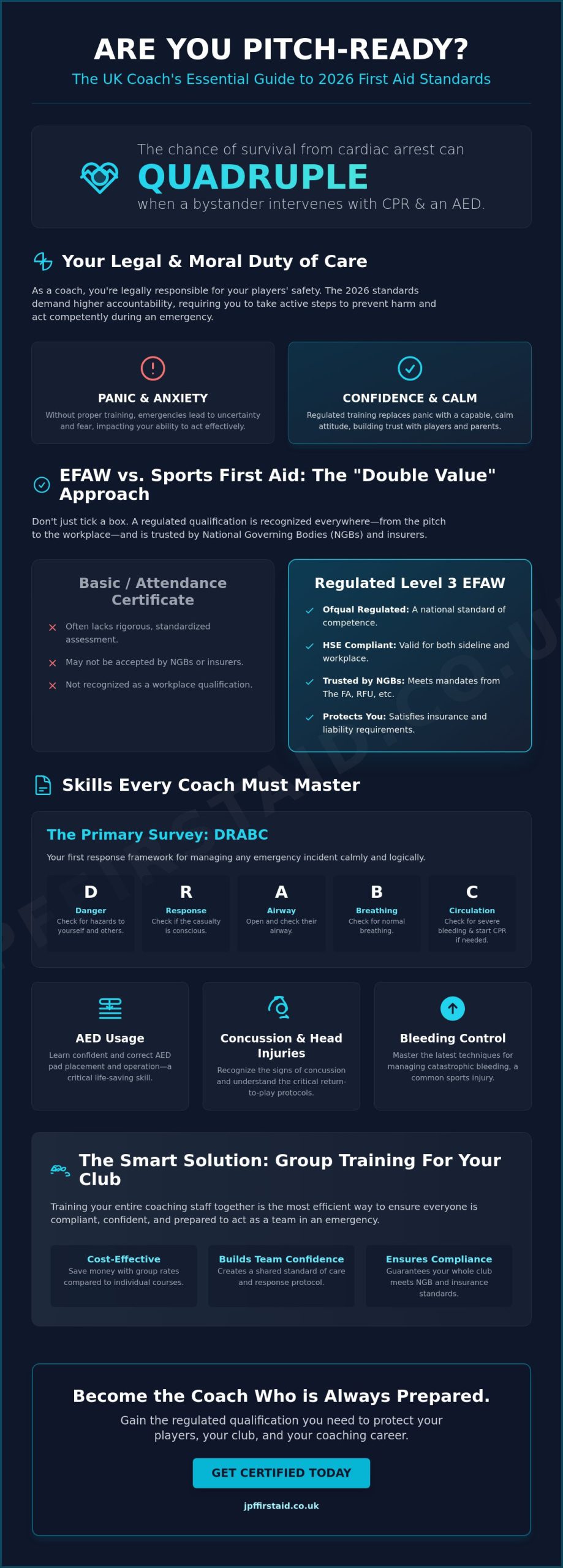
Did you know that the chance of survival for someone experiencing a cardiac arrest can quadruple simply because a bystander like you stepped in with CPR and an AED? As a coach, you’re the first line of defense for your athletes, yet it’s easy to feel anxious about whether you’re truly prepared for a pitch-side emergency. Between balancing busy schedules and trying to decipher the latest NGB requirements, finding the right first aid training for sports coaches uk can feel like a secondary hurdle you just don’t have time for.
We understand that you want to feel capable and calm when it matters most, rather than just ticking a compliance box. This guide is designed to give you total clarity on the 2026 Resuscitation Council UK updates, including the latest techniques for bleeding control and AED placement. You’ll learn how to master the essential first aid requirements for your specific sport and gain the confidence to handle injuries effectively. We will walk through the differences between EFAW and sports-specific qualifications to ensure your certificate is valid for both the workplace and the sidelines.
Key Takeaways
- Understand your legal duty of care as a lead or assistant coach to ensure you’re meeting 2026 safety standards on the pitch.
- Learn the critical differences between a standard Level 3 EFAW and sports-specific training, including how to handle concussions and return-to-play protocols.
- Navigate the specific first aid training for sports coaches uk mandates set by major bodies like the FA, RFU, and England Netball.
- Master the Primary Survey (DRABC) and AED usage to manage both the casualty and the crowd during high-pressure game-day incidents.
- Discover why group training for your entire club is a more efficient and cost-effective way to build team confidence and compliance.
The Essential Role of First Aid in the UK Sports Coaching Duty of Care
When you step onto the pitch, you aren’t just there to run drills or improve technique. You’re assuming a legal duty of care for every player in your squad. In 2026, the UK sporting landscape has shifted toward higher accountability. It’s no longer enough to hope for the best. Duty of care means taking active, reasonable steps to prevent foreseeable harm. If an injury occurs, you’re expected to act with competence. This is where the principles of first aid become your most valuable coaching tool, ensuring you can stabilize a situation until professional help arrives.
The legal expectations often vary depending on your specific role within the club. Lead coaches generally carry the primary responsibility for the safety of the session and the emergency action plan. However, assistant coaches and even community volunteers are increasingly required to hold valid certifications. National Governing Bodies (NGBs) are moving toward a mandatory model where anyone leading a group must have completed first aid training for sports coaches uk. This ensures a safety net is always present, even if the primary coach is the one who needs assistance or is busy managing the rest of the team.
General first aid courses are a great start, but sports environments have unique risks that office-based training might overlook. A typical course might not spend enough time on concussion protocols, return-to-play decisions, or the specific mechanics of impact injuries. These are high-stakes scenarios where minutes matter. By choosing a regulated qualification, such as the Level 3 Emergency First Aid at Work (EFAW), you’re ensuring that your skills are tailored to the reality of the sideline. You’ll be ready to handle the specific physical demands and common injuries seen in high-contact or high-intensity UK sports.
Legal Requirements and Civil Liability for Coaches
Holding a regulated certificate is your best defense against potential claims of negligence. To meet the legal standard of reasonable care, you must demonstrate that you acted as any trained, competent person would in that situation. Most insurance providers now insist on seeing proof of first aid training for sports coaches uk before they’ll provide full liability coverage. It’s a straightforward step that protects your coaching career and your club’s financial future.
The Emotional Impact of Emergency Readiness
Beyond the legalities, there’s a massive psychological benefit to being prepared. We’ve seen how expert training replaces panic with a calm, capable attitude. When you know exactly what to do during a high-contact session, your own anxiety levels drop significantly. This confidence is contagious. Parents and participants feel much safer when they see a coach who is visibly prepared for the unexpected. It builds a culture of trust and reliability that allows everyone to focus on the game.
Choosing the Right Qualification: EFAW vs. Sports First Aid
Choosing the right first aid training for sports coaches uk often feels like a puzzle. Do you need a course that focuses purely on the pitch, or one that satisfies your employer’s requirements? Most coaches find the best solution is a “Double Value” approach. This involves gaining a regulated qualification that covers both bases. By opting for a course that aligns with the HSE First Aid at Work Regulations, you ensure your skills are recognized in any professional setting, not just on the field. It’s about being prepared for a cardiac arrest in the gym just as much as a collision on the grass.
The distinction between a regulated qualification and a simple “attendance certificate” is critical. Attendance certificates might be cheaper, but they often lack the rigorous assessment required by National Governing Bodies (NGBs). In contrast, an Ofqual-regulated course provides a benchmark of quality that insurers and sports associations trust. When you hold a Level 3 Award, you’re proving that you’ve been assessed by an expert and have met a specific national standard of competence.
Understanding Level 3 Award in Emergency First Aid at Work
This qualification is the industry standard for the majority of UK coaching roles. It provides a solid foundation in life-saving techniques that apply regardless of your environment. In our emergency first aid at work sessions, we focus on the high-impact skills you’ll actually need in a crisis. You’ll learn to perform effective CPR, manage severe bleeding, and deal with unresponsive casualties. These are the “big” skills that save lives during those vital minutes before an ambulance arrives.
When is a Sports-Specific Course Necessary?
While the Level 3 EFAW covers the essentials, certain environments demand a more specialized focus. If you coach high-risk sports like rugby, boxing, or MMA, you might need training that includes advanced trauma care. These sessions dive deeper into concussion protocols, spinal injury management, and return-to-play decisions. However, even in these specialized fields, Basic Life Support remains the foundation. You can’t manage a complex sports injury if you haven’t mastered the basics of keeping someone breathing. If you’re unsure which path fits your club’s needs, we can help you find the right training solution for your specific sport.
Ultimately, your first aid training for sports coaches uk should give you the confidence to act. Whether you’re dealing with a scraped knee or a life-threatening emergency, the right qualification ensures you aren’t just a bystander. You’re a trained professional capable of managing the situation with a calm, capable attitude.
Navigating National Governing Body (NGB) First Aid Requirements
Every sport in the UK has its own rulebook for safety. While the core life-saving skills remain the same, the specific mandates from National Governing Bodies can vary significantly. For instance, if you’re involved in football, you need to be aware of the 2026 updates. From 1 March 2026, the FA requires learners to complete their specific ‘Introduction to First Aid in Football’ within three months of enrollment. This shift toward tighter windows for compliance shows how seriously major bodies are taking pitch-side safety.
Other organizations like the RFU or England Netball have their own strict standards. In rugby, the high-contact nature of the game means lead coaches often need more than just a basic certificate. They require training that specifically addresses the trauma risks associated with the sport. For netball and other court-based activities, the focus might shift toward managing common ligament injuries alongside basic life support. Regardless of your sport, your first step should always be a “First Aid Needs Assessment.” This is a simple review of your club’s activities, the number of participants, and the distance to the nearest AED. It helps you determine if one first aider is enough or if your assistant coaches also need to be qualified.
Common Standards Across UK Sporting Bodies
Most UK sporting bodies follow a few universal rules. Certificates generally have a three-year validity period before you need a refresher. For a qualification to be recognized for first aid training for sports coaches uk, it typically requires at least six contact hours of learning. Blended learning is now widely accepted by most NGBs. This allows you to complete theory modules online before attending a hands-on practical session. It’s a flexible way to fit essential training into a busy coaching schedule.
Verifying Training Providers and Qualifications
Don’t fall into the trap of “online-only” certificates. While the theory can be learned on a screen, you can’t learn to save a life without practicing on a manikin. To ensure your qualification is recognized by your NGB and your insurer, look for providers regulated by Ofqual. Certificates issued through First Aid Awards (FAA) provide the level of authority that clubs and governing bodies trust. Taking the time to verify your provider ensures you aren’t wasting money on a certificate that won’t be accepted. If you’re feeling overwhelmed by the options, we have a detailed guide on choosing the right training to help you make an informed decision.
Ultimately, the goal is to ensure that your first aid training for sports coaches uk is both compliant and practical. When you meet your NGB’s standards, you aren’t just following the rules. You’re proving to your players and their families that their safety is your top priority. It’s a professional standard that sets great coaches apart from the rest.
Pitch-side Reality: Skills Every UK Coach Must Master
The pitch-side reality is often chaotic. Unlike a quiet classroom, you’re usually dealing with vocal parents, distressed teammates, and a match clock that’s still running. This is why first aid training for sports coaches uk focuses so heavily on the Primary Survey (DRABC). It’s your mental checklist to stay focused when adrenaline is high. You aren’t just assessing the casualty; you’re managing the “crowd” too. By delegating tasks, like asking a specific parent to call 999 or clear a path for the ambulance, you regain control of the environment and ensure the player gets the help they need.
In 2026, there’s a massive push for AED (Defibrillator) accessibility in community sports. Statistics from the Resuscitation Council UK show that AEDs are currently used in under 10% of out-of-hospital cardiac arrests where CPR is attempted. We want to help coaches change that. Having an AED nearby and knowing how to use it can quadruple the chance of survival. For minor injuries like sprains, the advice is also evolving. While many grew up with RICE (Rest, Ice, Compression, Elevation), modern protocols like PEACE & LOVE emphasize long-term recovery and soft tissue management. The golden rule for 2026 remains: if a player is unresponsive, call 999 immediately before you even begin assessing their breathing.
Concussion Awareness and “If In Doubt, Sit Them Out”
Concussions are often subtle. You might not see a loss of consciousness, but you’ll notice a player feeling “foggy,” becoming irritable, or acting out of character. Your role as a coach is to prioritize safety over the final score. The “If In Doubt, Sit Them Out” rule is non-negotiable for 2026 compliance. Always document these incidents in your club’s accident book. Accurate records protect the player’s health and provide a clear history for medical professionals if symptoms persist after the game.
Basic Life Support: The Ultimate Safety Net
If the worst happens, high-quality chest compressions are the most important intervention you can provide. Don’t worry if you’ve never used a defibrillator before. Modern AEDs provide clear, step-by-step voice instructions that anyone can follow in a crisis. Mastering these skills through basic life support training ensures you’re never just a bystander. If you want to ensure your whole team is ready for game day, book a practical session for your club today and gain the confidence to lead with safety in mind.
Bespoke First Aid Solutions for UK Sports Clubs and Coaches
Training as a single unit is often the most effective way to prepare for a real-world emergency. When your entire coaching staff undergoes training together, you develop a shared language and a consistent response plan. Instead of individual coaches having different ideas about how to handle a pitch-side incident, your whole team moves as one. This collective readiness is exactly what we focus on when delivering first aid training for sports coaches uk. We don’t just teach you how to pass an assessment; we help you build a culture of safety that permeates every training session and match day.
Our approach at JPF First Aid is designed to be the opposite of a dry, clinical classroom experience. We believe that people learn best when they’re relaxed and engaged. That’s why our sessions are interactive, hands-on, and tailored to the specific sport you coach. If you’re a netball club, we’ll spend more time on court-side ligament injuries and sudden collapses. If you’re a football team, we’ll incorporate the latest 2026 FA compliance standards into our scenarios. By using blended learning, we also respect your time. You can complete the essential theory modules online at your own pace, leaving our in-person time focused entirely on the practical skills that save lives.
Group Bookings vs. Individual Delegate Places
For most clubs, booking a private group session is far more cost-effective than sending coaches to individual public courses. We offer flat-rate pricing for groups of up to 12 delegates, which significantly reduces the cost per person. We also understand that coaching isn’t a 9-to-5 job. To make compliance as easy as possible, we offer flexible scheduling, including evening and weekend sessions. We bring the training to your clubhouse or local facility, so your coaches don’t have to travel across the county to get qualified.
Empowering Coaches Beyond the Credential
Our mission goes beyond handing out certificates. We want to turn “first aiders” into confident “first responders” who don’t hesitate when a crisis occurs. This psychological empowerment is a core part of every course we lead. Once your training is complete, our relationship doesn’t end there. We provide ongoing support and automated certificate renewal reminders to ensure your club never falls out of compliance. It’s about being a reliable partner for your club’s long-term safety goals. Ready to empower your team and ensure you’re fully prepared for the season ahead? Book a private group session today and give your coaches the skills they need to lead with confidence.
Lead Your Team with Safety and Confidence
You now have a clear roadmap for 2026 compliance. From understanding the FA’s specific training windows to mastering the DRABC survey under pressure, you’re ready to lead your team safely. Choosing a regulated Level 3 qualification ensures you meet both workplace and sporting standards, giving you the “double value” needed for a busy coaching career. Securing the right first aid training for sports coaches uk is about more than just a certificate; it’s about the safety of your players and your own peace of mind.
We’re here to help you bridge the gap between classroom theory and pitch-side reality. As a multi-award-winning training provider, JPF First Aid offers Ofqual regulated qualifications that National Governing Bodies trust. We specialize in bespoke on-site training for sports clubs, bringing the learning directly to your facility at a time that suits your schedule. Our sessions are interactive and designed to build your confidence as a first responder. Book Your Sports First Aid Training with JPF First Aid today. You’ve got the skills to make a difference, and we’re proud to help you master them.
Frequently Asked Questions
Is an Emergency First Aid at Work (EFAW) certificate enough for sports coaching?
Yes, for the majority of community and school-based coaching roles, a Level 3 EFAW is the accepted industry standard. It provides the essential life-saving skills needed to manage an incident until paramedics arrive. You should always check with your specific National Governing Body, as high-contact sports like rugby may require additional trauma-specific modules alongside your EFAW qualification to meet their highest safety tiers.
How long does a sports first aid certificate last in the UK?
Most first aid certificates for sports coaches in the UK are valid for exactly three years. After this period, your qualification expires and you’ll need to attend a requalification course to remain compliant with your NGB and insurance provider. It’s a good idea to book your refresher training at least one month before your current certificate expires to avoid any gaps in your coaching eligibility.
Does my first aid training need to be Ofqual regulated?
Choosing an Ofqual-regulated qualification is the best way to ensure your training is recognized by insurers and sporting bodies. Regulated courses meet a strict national standard for quality and assessment. While unregulated “attendance certificates” exist, they often fail to meet the rigorous compliance requirements set by major UK sports associations. Holding a regulated Level 3 Award gives you and your club the necessary legal protection.
Can I do my sports first aid training entirely online?
No, you cannot complete a valid first aid training for sports coaches uk qualification entirely online. While you can study theory modules through blended learning, a practical, in-person assessment is mandatory to prove you can perform life-saving skills like CPR. Sporting bodies require this hands-on verification to ensure you have the physical competence and confidence to act during a pitch-side emergency.
What should be in a UK sports coach’s first aid kit in 2026?
Your 2026 kit should focus on immediate trauma management and hygiene. Essential items include sterile dressings, triangular bandages, nitrile gloves, and saline pods for wound irrigation. You should also include a foil blanket for shock management and a pocket mask for CPR. Don’t include clinical medications like painkillers or antiseptic creams, as these fall outside the remit of standard first aid provision in a coaching context.
Do I need a separate certificate for paediatric first aid if I coach children?
It depends on the age of your athletes and your specific NGB rules. If you primarily coach children under the age of eight, an Emergency Paediatric First Aid (Level 3) qualification is often recommended. This training covers specific physiological differences, such as infant CPR techniques. For coaches working with teenagers and adults, a standard EFAW certificate is usually the most appropriate and versatile choice for your needs.
What happens if I perform first aid and something goes wrong?
In the UK, you are protected by the Social Action, Responsibility and Heroism (SARAH) Act 2015 as long as you act within the scope of your training. This law encourages people to help in emergencies by considering the context of their actions. By maintaining a valid first aid training for sports coaches uk certificate, you demonstrate that you’ve taken reasonable steps to provide competent care, which significantly mitigates your legal risk.
How often should sports coaches attend first aid refresher training?
While your full certificate lasts three years, the Health and Safety Executive (HSE) strongly recommends attending an annual refresher session. These short, practical updates help you maintain muscle memory for critical skills like CPR and AED use. Staying sharp with yearly practice ensures you don’t feel overwhelmed if a real-life emergency occurs on the pitch, keeping your confidence levels high throughout the season.
Recent Comments