

Your current first aid certificate could be a legal liability if your provider hasn’t met the Health and Safety Executive’s strict due diligence requirements. In 2026, simply hiring a trainer isn’t enough to satisfy an inspector or protect your staff. We understand the pressure of trying to balance your budget while avoiding dry, clinical sessions that leave your team feeling bored. You need a reliable way to verify your provider. Using a robust first aid training supplier evaluation checklist is the only way to ensure your workplace remains fully compliant and your staff feel ready to act.
It’s frustrating when you spend money on training only to realise your team still feels panicked during a real emergency. You deserve a partner who makes the process hassle-free and builds genuine confidence. By following this guide, you’ll master the due diligence process and create a defensible audit trail that satisfies any legal scrutiny. We’ll walk you through the precise steps to evaluate training quality, clarify the regulated vs independent debate, and ensure you’re investing in life-saving skills you can trust.
Key Takeaways
- Understand your legal duty as an employer and how to navigate the HSE’s due diligence requirements to keep your workplace fully compliant.
- Use our first aid training supplier evaluation checklist to verify that your trainers possess both formal teaching qualifications and current real-world experience.
- Discover why opting for Ofqual-regulated qualifications can significantly reduce your workload by providing a pre-verified standard of quality and safety.
- Learn the “gold standard” for practical logistics, ensuring your team has the right environment and equipment ratios for effective, hands-on learning.
- Find out how a confidence-led approach transforms mandatory training into an engaging and fun experience that empowers your staff to act in an emergency.
Why You Need a First Aid Training Supplier Evaluation Checklist
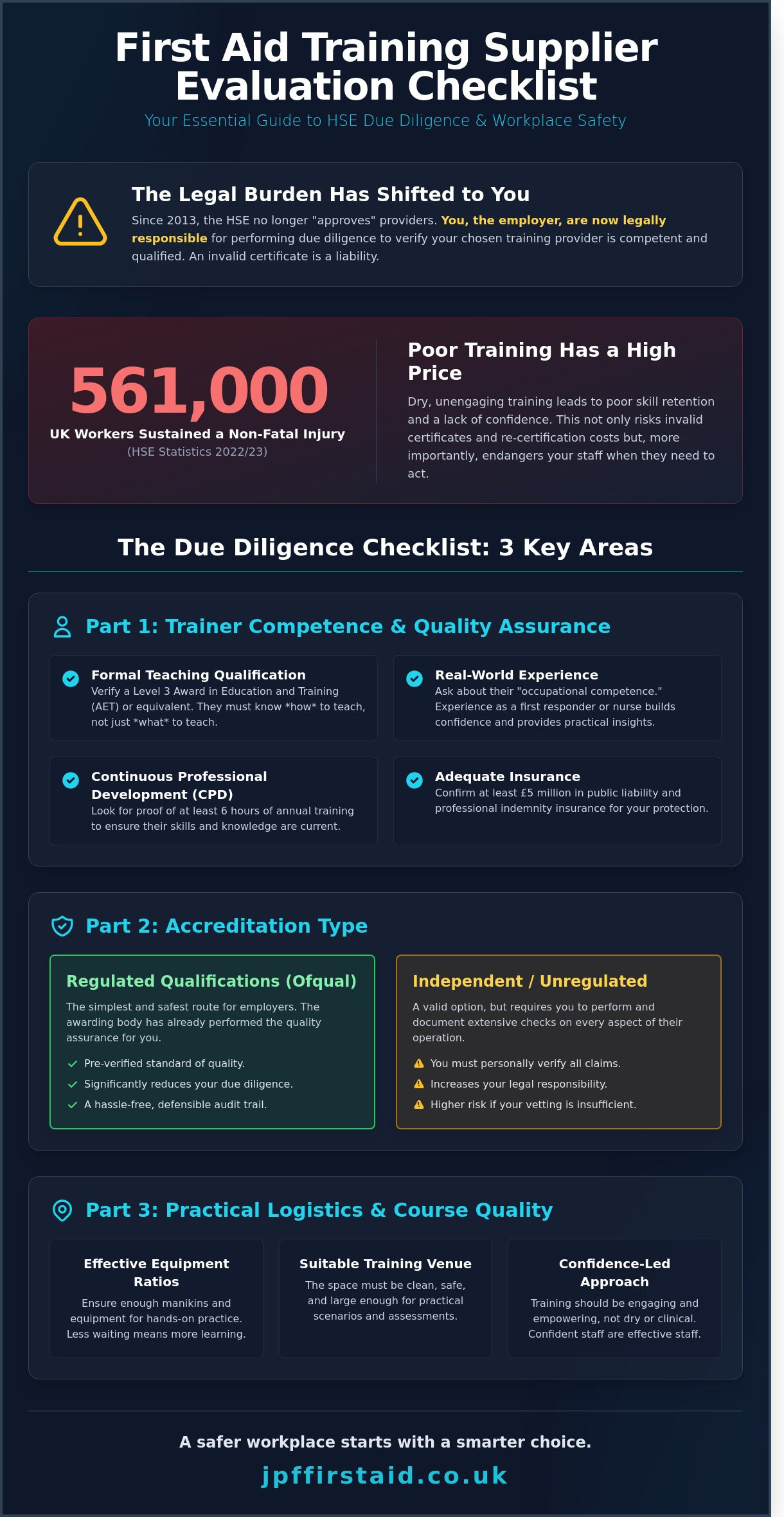
You might assume that all first aid certificates carry the same weight. Unfortunately, that isn’t the case. Since the Health and Safety Executive (HSE) stopped “approving” training providers in October 2013, the burden of proof has shifted entirely to you, the employer. You’re now the one responsible for ensuring your chosen trainer is actually qualified to teach life-saving skills. This is why a structured first aid training supplier evaluation checklist is your best friend when it’s time to book a course. It’s about more than just compliance; it’s about making sure your team has the confidence to act when every second counts. Using a first aid training supplier evaluation checklist isn’t just a hurdle; it’s a shield that protects your business and your people.
The Legal Framework: HSE and GEIS3
The Health and Safety (First-Aid) Regulations 1981 state that you must provide “adequate and appropriate” equipment, facilities, and personnel. To help you navigate this, the HSE published the GEIS3 document. This guide acts as the gold standard for selecting a provider. Following it ensures you’ve performed your due diligence. In the context of workplace safety, due diligence is your documented process of verifying that a training supplier is competent, holds the correct qualifications, and follows current clinical guidelines. Without this trail of evidence, you’re vulnerable during a health and safety audit.
The Financial and Human Cost of Poor Training
Choosing the cheapest option often leads to hidden costs. If an audit reveals your training provider didn’t meet HSE standards, your certificates could be declared invalid. This forces you to pay for immediate re-certification for your entire team. There’s a human cost, too. According to HSE statistics for 2022/23, 561,000 workers sustained a non-fatal injury at work. If your training was dry or clinical, your staff might lack the memory retention to help. High-quality, engaging training ensures:
- Better Retention: Employees remember their skills during high-pressure emergencies.
- Increased Morale: Staff feel valued and confident, which improves the workplace atmosphere.
- Efficiency: Reduced downtime because incidents are handled quickly and correctly.
- Reliability: A hassle-free experience that keeps your business running smoothly.
By focusing on quality rather than just the lowest price, you create a safer environment. Expert-led sessions that are practical and relaxed make a world of difference. You want your team to leave a course feeling empowered, not just holding a piece of paper. This proactive approach saves money in the long run and, more importantly, saves lives.
Evaluating Trainer Competence and Quality Assurance
You need to know that the person teaching your staff can perform under pressure. A robust first aid training supplier evaluation checklist must prioritise the person at the front of the room, not just the logo on the certificate. You’re looking for a mentor who brings the subject to life, making the training feel relevant and manageable rather than clinical or scary.
Beyond certifications, ask about “occupational competence.” This means the trainer has real-world experience, perhaps as a first responder, nurse, or designated workplace first aider. They should be able to tell you how a bandage feels when it’s wet or how to manage a crowd during a cardiac arrest. This practical insight builds the confidence your team needs to act when every second counts.
What Qualifications Should a Trainer Have?
Don’t be afraid to ask for paperwork. A professional trainer will be happy to show you their credentials. At a minimum, they should hold a Level 3 Award in Education and Training (AET) or an equivalent teaching and assessing qualification. This ensures they don’t just know the subject; they know how to teach it to different types of learners.
- Current Certification: The trainer must hold a valid certificate for the first aid courses they are teaching. You can’t teach what you haven’t mastered yourself.
- CPD Logs: Look for proof of Continuing Professional Development (CPD). In 2026, a dedicated professional should document at least 6 hours of annual training to keep their skills sharp.
- Insurance: Verify that the provider carries at least £5 million in public liability insurance and specific professional indemnity coverage. This protects your business if advice given during the session is called into question later.
Quality Assurance Systems Explained
Quality assurance is the safety net that ensures your training meets national standards. Most reputable providers work with an Awarding Organisation (AO). These bodies provide external moderation, meaning an independent person regularly checks the trainer’s work, paperwork, and teaching methods. This oversight is vital for maintaining emergency first aid at work standards across the UK.
Internal Quality Assurance (IQA) is the company’s own process for self-improvement. Ask your potential supplier how they handle student feedback. A transparent provider will show you their 2025 satisfaction rates or explain how they’ve adjusted their courses based on learner suggestions. If a supplier can’t explain their IQA process, they might be cutting corners on compliance. You can always contact a trusted expert to see how a high-quality IQA process looks in practice. This level of scrutiny ensures your first aid training supplier evaluation checklist identifies a partner who values excellence as much as you do.
Accreditation Types: Regulated vs. Independent Providers
Accreditation is the backbone of your safety strategy. In the UK, the training landscape is split between Ofqual-regulated qualifications, voluntary sector bodies like the Red Cross, and independent trainers. Each has its merits, but the level of due diligence you must perform changes based on your choice. The First Aid Quality Partnership (FAQP) helps maintain these standards, ensuring that whether you choose a large national body or a local expert, the core life-saving skills remain consistent. Every reputable provider must align their teaching with the 2021 UK Resuscitation Council guidelines. This ensures your team learns the most effective, evidence-based techniques available today. It’s about more than just a certificate; it’s about the confidence to act when it matters most.
The Ofqual Advantage for Employers
Regulated qualifications offer a streamlined route to workplace safety. When you select a course regulated by Ofqual, you’re essentially outsourcing your legal due diligence to a government-recognised body. These qualifications, such as the Level 3 Award in First Aid at Work, meet all HSE requirements automatically. It’s helpful to understand the distinction between the players involved. An Awarding Organisation creates the syllabus and monitors quality, whereas the training provider is the company that visits your site to teach the class. This dual-layer system provides a “hassle-free” guarantee that your training is up to scratch, allowing you to focus on your business while the experts handle the compliance.
- Automatic Compliance: Regulated courses satisfy HSE requirements without extra paperwork.
- Standardised Levels: Level 3 qualifications provide a clear benchmark for staff competency.
- Quality Assurance: External moderators regularly check the training provider’s standards.
Evaluating Independent Training Providers
If you opt for an independent provider that isn’t part of a regulated framework, your first aid training supplier evaluation checklist becomes your most important tool. The HSE requires you to prove the provider is competent. You’ll need to manually verify their insurance, the trainer’s teaching credentials, and their internal quality monitoring. You must also confirm their syllabus covers the full HSE curriculum exactly. Check that every certificate issued includes a clear expiry date and the name of the training body. While independent providers often offer bespoke, flexible sessions, the responsibility for verifying their expert status rests on your shoulders. Taking the time to verify these details ensures your staff receive training that is engaging, practical, and legally compliant.
Don’t be afraid to ask for proof of a trainer’s annual refresher training or their internal quality assurance (IQA) records. A transparent provider will be happy to share these documents to prove they are delivering First Aid Training You Can Trust. Whether the session is for a small office or a large industrial site, the goal is to ensure your team leaves feeling relaxed and ready to save a life.
Practical Logistics: Venues, Equipment, and Ratios
The physical environment where your team learns can make or break the effectiveness of the course. When you use your first aid training supplier evaluation checklist, start by looking at the numbers. The Health and Safety Executive (HSE) recommends a maximum ratio of one trainer to 12 students. If a provider tries to squeeze 15 or 20 people into a single session, the quality of individual feedback drops significantly. You want a classroom that is well-lit, ventilated, and large enough for everyone to kneel comfortably during CPR practice.
Hygiene is equally critical for a safe learning experience. In 2026, top-tier providers follow strict protocols for resuscitation manikins. This includes using individual face pieces or replaceable lungs for every student. While some providers share one manikin between four people, the gold standard is a one-to-one ratio. This maximizes “hands-on” time and builds the muscle memory needed to save a life. Ask your potential supplier exactly how many manikins they bring and how they sanitize equipment between sessions.
On-Site vs. Off-Site Training Considerations
Choosing bespoke first aid training at your own premises offers huge logistical advantages. It removes travel time for your staff and allows the trainer to tailor scenarios to your specific workplace hazards. If you host the session, ensure your room provides at least 4 square meters of clear floor space per student for practical exercises. For those with tight schedules, blended learning is a fantastic 2026 solution. It combines online theory with a shorter, high-impact practical session; this approach can save you up to 50% of classroom time without compromising on safety standards.
Equipment and Training Materials
Effective basic life support training relies on modern, well-maintained kit. Check if your supplier uses the latest AED trainers that provide real-time depth and rate feedback. Every student should also walk away with a high-quality reference manual. These guides act as a vital safety net when they are back on the job. High-quality training isn’t just about watching a slideshow; it’s about having the right tools in your hands. Including equipment quality on your first aid training supplier evaluation checklist ensures your team feels confident and prepared.
Ready to host a session that your team will actually enjoy? Contact JPF First Aid today to book your on-site training.
The JPF First Aid Approach: Confidence-Led Compliance
Choosing a provider isn’t just about ticking boxes on a first aid training supplier evaluation checklist; it’s about finding a partner that ensures your team can act when it counts. JPF First Aid exceeds all Health and Safety Executive (HSE) due diligence requirements by providing Ofqual-regulated qualifications that meet the highest industry standards. Since our founding, we’ve focused on an “Expert Mentor” philosophy. This means we don’t just lecture you. We guide you through the process, ensuring every learner feels supported and capable. Our award-winning service has helped over 500 businesses across the UK achieve full compliance while building genuine, real-world confidence in their staff. We bring the training directly to your business premises, offering nationwide flexibility that fits your specific operational schedule.
Why “Fun” Matters in First Aid
Scientific studies in educational psychology show that relaxed students retain up to 25% more information than those in high-stress or boring environments. We’ve ditched the dry, clinical PowerPoint presentations that often make annual training feel like a chore. Instead, we use practical scenarios and hands-on practice to make the skills stick. Our trainers create an atmosphere where it’s okay to ask questions and practice techniques until they become second nature. Feedback from our 2024 sessions shows that 98% of our learners felt “significantly more confident” after our sessions. We transform the “dreaded” mandatory training into a genuine highlight of the year, ensuring your team leaves with smiles and life-saving skills they won’t forget.
Simplified Compliance for Your Business
Managing health and safety shouldn’t be a full-time job for your HR or operations team. Our Ofqual-regulated courses are designed to simplify your first aid training supplier evaluation checklist by providing clear, verifiable certification that stands up to any inspection. We offer bespoke training bundles that combine first aid, fire safety, and manual handling into one streamlined package. This approach reduces administrative overhead and ensures all your compliance needs are met in one go. Whether you’re a small local office or a large industrial site, we tailor our delivery to your specific risks and environment. Contact us today to discuss your bespoke training needs and let us handle the complexities of your workplace safety requirements with our hassle-free, expert-led solutions.
Take Control of Your Workplace Safety Standards
Choosing the right partner for your team’s safety shouldn’t feel like a gamble. By using a first aid training supplier evaluation checklist, you now have the tools to verify trainer competence and ensure your business meets the rigorous standards required for 2026. Remember that opting for Ofqual-regulated qualifications as standard provides a level of quality assurance that independent providers often lack. It’s the difference between a simple attendance certificate and meeting the full criteria set out by the Health and Safety (First-Aid) Regulations 1981.
At JPF First Aid, we believe training should be as engaging as it is essential. As a multi-award-winning provider, we bring real-world emergency experience directly to your venue; this ensures your team learns from experts who’ve lived the scenarios they teach. We keep our student-to-trainer ratios strictly managed to guarantee every learner gets the hands-on practice they need to feel truly capable. You’ll get a hassle-free experience that transforms a mandatory requirement into a genuine boost for your company culture.
Book your hassle-free workplace first aid training with JPF First Aid and give your team the skills they need to act with certainty.
We’re looking forward to helping you build a safer, more prepared workplace today.
Frequently Asked Questions
Do I legally have to use an Ofqual-regulated first aid training provider?
No, you aren’t legally forced to use an Ofqual-regulated provider, but the Health and Safety Executive (HSE) requires you to prove your chosen trainer is competent. Choosing a regulated provider saves you time because they’ve already met strict standards for quality and assessment. If you go with a non-regulated trainer, you’ll need to complete a detailed due diligence check to satisfy the 1981 Regulations.
How often should I review my first aid training supplier evaluation checklist?
You should review your first aid training supplier evaluation checklist at least once every 12 months. Regular reviews ensure your training partner still meets the latest Health and Safety Executive standards and matches your current workplace risks. If your staff numbers grow by 20% or you move to a more hazardous site, update your checklist immediately to keep your compliance records accurate and your team safe.
Can first aid training be done entirely online in the UK?
No, you can’t complete workplace first aid training entirely online because the HSE requires practical, hands-on assessment. While blended learning is popular, allowing you to do part of the theory online, you must attend an in-person session for the physical skills. For example, a 3-day First Aid at Work course must include at least 18 hours of guided learning, with significant time dedicated to practical CPR and bandaging.
What is the difference between a “certificate of attendance” and a “regulated qualification”?
A regulated qualification is a formal certificate issued by an Awarding Organisation like Qualsafe, while a certificate of attendance only proves a student sat in the room. Regulated qualifications meet the high standards set by Ofqual or the SQA. This gives you peace of mind that your first aiders have passed a rigorous assessment. Most businesses prefer regulated certificates because they automatically satisfy HSE due diligence requirements without extra paperwork.
How many first aiders does my business need in 2026?
Your staff numbers depend on your specific risk assessment under the Health and Safety (First-Aid) Regulations 1981. In a low-risk office with 25 to 50 employees, you need at least one person with an EFAW certificate. If you run a high-risk construction site with over 5 employees, you must have at least one person trained in the full FAW course. Always plan for extra cover to account for annual leave or sickness.
What should I do if a supplier cannot provide proof of their internal quality assurance?
You should choose a different provider if they can’t show clear proof of their internal quality assurance. The HSE GEIS3 guidance states that non-regulated providers must have a robust system to monitor their trainers and verify assessments. Using the first aid training supplier evaluation checklist helps you spot these gaps early. If a supplier fails this part of your check, they likely won’t meet the legal requirements for workplace safety.
Does the HSE ever visit businesses to check their first aid training records?
Yes, HSE inspectors can visit your premises to check your first aid records during a routine inspection or following an incident. If you can’t provide valid training certificates, your business could face a Fee for Intervention (FFI). As of April 2024, this cost is £174 per hour for the time the HSE spends identifying and correcting the breach. Keeping your records organised ensures you avoid these unnecessary and expensive penalties.
Is paediatric first aid training different from standard workplace first aid?
Yes, paediatric training is a specialised course designed for those caring for infants and children. While standard workplace first aid covers adults, the 12-hour Paediatric First Aid (PFA) course is a legal requirement for nursery staff under the 2024 EYFS framework. It covers specific child-related emergencies like choking and meningitis. We ensure these sessions are engaging and practical, giving you the confidence to handle any emergency involving little ones.
Recent Comments