

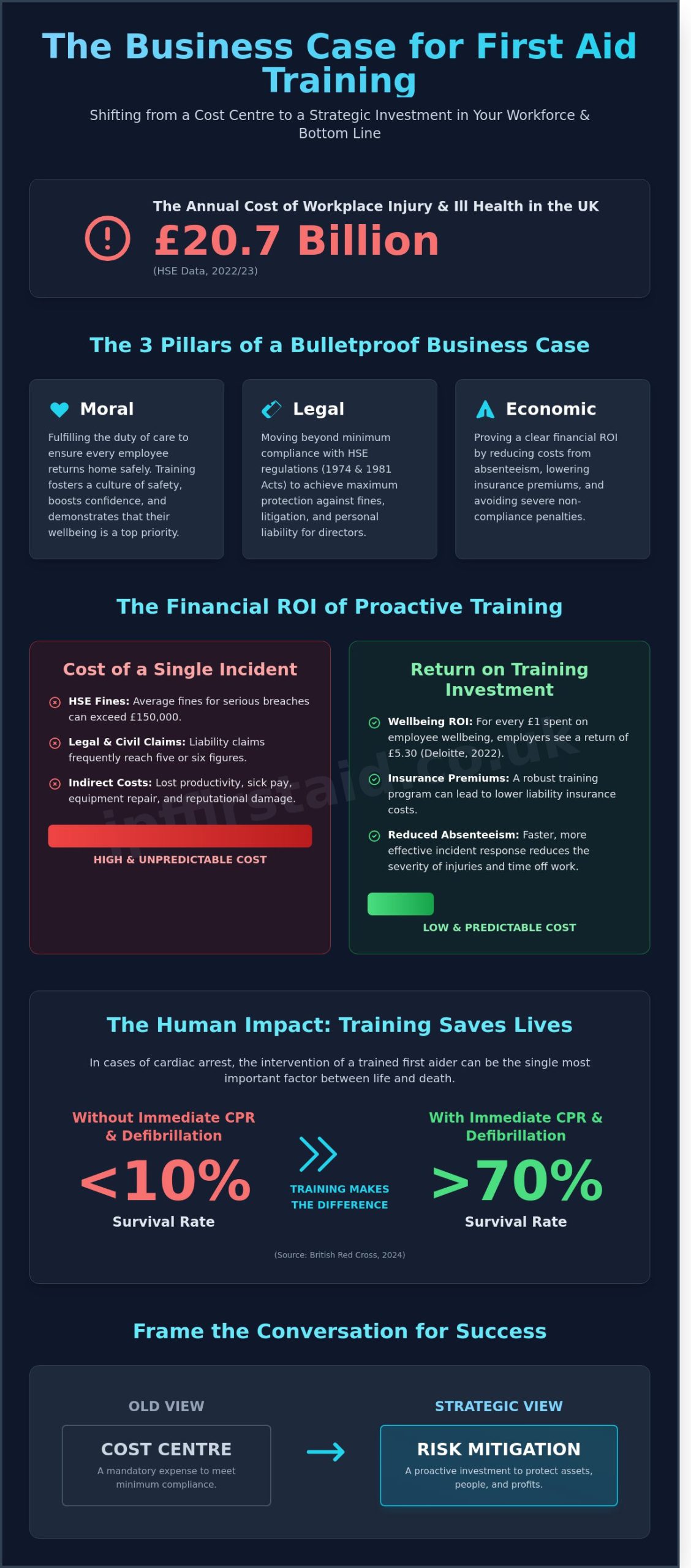
Did you know that workplace injuries and ill health cost UK employers an estimated £20.7 billion in the 2022/23 period? As we move toward 2026, these costs continue to climb, making it more important than ever to protect your workforce. Learning how to create a business case for first aid training is no longer just a “nice to have” skill for safety officers; it’s a vital financial strategy to protect your bottom line.
You probably already know that keeping your team safe is the right thing to do. However, it’s often difficult to justify a safety budget when you’re facing pressure to minimize spend on non-revenue activities. It’s frustrating when “soft” benefits like employee confidence don’t seem to carry weight with senior stakeholders who are focused on spreadsheets. We understand that struggle, and we’re here to help you bridge that gap.
This guide will show you how to transform those moral obligations into a data-driven argument that proves the financial ROI of expert training. We’ll provide you with a structured document template, hard cost-saving data, and the confidence to present your case to the board. By the end of this article, you’ll have everything you need to secure your budget and ensure your team stays in safe, expert hands.
Key Takeaways
- Learn how to shift your safety budget from a “cost centre” to a “risk mitigation” strategy that appeals directly to your Finance Director’s priorities.
- Discover how to create a business case for first aid training that addresses 2026 standards, including the critical economic impact of Mental Health First Aid.
- Master a step-by-step structure for your proposal, ensuring you use the right data and accident logs to build an unshakeable argument for investment.
- Identify why selecting an Ofqual-regulated training partner is a key factor in your legal defensibility and the long-term success of your safety programme.
- Gain the tools to prove both the financial and moral ROI of your training, moving beyond simple compliance to foster a culture of confidence and care.
Understanding the Foundations of a First Aid Business Case
A business case is more than a simple request for funds. It’s a strategic justification for an investment based on its commercial and human benefits. When you’re learning how to create a business case for first aid training, you shouldn’t rely solely on the “it’s a legal requirement” angle. While true, that approach often leads to the smallest possible budget allocation. To secure the resources your team deserves, you need to present a holistic argument that speaks to the heart of the business.
Successful cases in 2026 rest on three core pillars:
- Moral: Your duty of care to ensure every employee returns home safely.
- Legal: Staying compliant with UK regulations to avoid fines and litigation.
- Economic: Proving that training reduces costs related to absenteeism and insurance premiums.
Before you start writing, identify your internal stakeholders. You’ll likely need sign-off from the Finance Director, who cares about the bottom line; the HR Manager, who focuses on employee wellbeing; and the Operations Lead, who needs to ensure training doesn’t disrupt daily workflows. Tailoring your message to these different perspectives is the secret to a successful approval.
The Moral Argument: Beyond the Balance Sheet
Building a culture of care starts with showing your team that their safety is a priority. According to 2023 data from the Health and Safety Executive (HSE), 1.8 million workers suffered from work-related ill health. When employees feel safe and valued, retention rates improve. A 2022 study by Deloitte found that for every £1 spent on wellbeing, employers see a return of £5.30. First aid training provides a psychological safety net, giving your staff the confidence to handle emergencies. A 2024 British Red Cross report highlighted how immediate CPR and defibrillation can increase survival rates from less than 10% to over 70%. Quick response times prevent minor accidents from becoming life-altering tragedies.
The Legal Reality: HSE Compliance in 2026
The Health and Safety (First-Aid) Regulations 1981 remain the baseline for UK workplaces. However, simply meeting the minimum requirements is a risky strategy. Understanding how to create a business case for first aid training involves explaining the personal risks to leadership. Under the Health and Safety at Work etc. Act 1974, directors can face personal liability and even custodial sentences for gross negligence. In 2023, the average fine for health and safety breaches reached significant figures, often exceeding £150,000 for serious convictions. A robust business case ensures you aren’t just compliant but fully protected against litigation and reputational damage. It moves the conversation from “minimum compliance” to “maximum protection.”
Calculating the ROI: The Financial Argument for Training
Your Finance Director likely views every line item as either a cost or an investment. To win approval, you must shift the perception of first aid from a “cost centre” to a vital tool for risk mitigation. When you’re learning how to create a business case for first aid training, your most persuasive data points will involve protecting the company’s bank balance. In 2023/24, the Health and Safety Executive (HSE) reported that 604,000 workers sustained a non-fatal injury at work. Each incident carries a price tag that goes far beyond a few bandages.
Think of first aid training as a proactive shield. It doesn’t just meet a legal requirement; it actively reduces the financial fallout from accidents. Insurance providers often look favourably on businesses that exceed minimum compliance levels. By demonstrating a robust ratio of trained responders, you can often negotiate better terms on liability premiums. Proving that your team has the confidence to act quickly can also be a decisive factor in defending against civil liability claims, which frequently reach five or six figures.
Direct Costs of Non-Compliance vs. Training Investment
The gap between the price of a training course and the cost of a mistake is vast. If an accident occurs and the HSE finds your provision lacking, the “Fee for Intervention” is just the beginning. Legal fees, equipment repair, and the hundreds of hours spent on internal investigations quickly drain resources. While the average cost per delegate for a regulated qualification is a modest investment, it stands in stark contrast to the potential £100,000 plus fines that companies face for negligence. Choosing bespoke on-site training ensures you meet these legal obligations without the hassle of travel costs or extended downtime.
Productivity and Absenteeism Benefits
Immediate medical attention directly impacts recovery times. When a colleague receives correct treatment within those first “golden minutes,” the severity of the injury often lessens. This leads to a faster return-to-work and reduces long-term absenteeism. According to the ONS, 185.6 million working days were lost to sickness or injury in 2022. Even a 2% reduction in these lost days across a mid-sized department represents a significant saving.
- The Ripple Effect: One serious accident stops production for an entire team, not just the injured person.
- Staff Retention: Employees stay longer at companies that visibly value their physical safety.
- Peace of Mind: In high-risk sectors like construction or manufacturing, 85% of workers report feeling more focused when they know a qualified first aider is nearby.
By framing your request around these hard numbers, you move the conversation from “what we have to spend” to “what we can’t afford to lose.” It’s about building a resilient workforce that feels safe, valued, and ready to handle any emergency with a calm, can-do attitude.
Addressing Modern Risks: Mental Health and Evolving Safety Standards
By 2026, the definition of workplace safety has expanded far beyond physical hazards. When you look at how to create a business case for first aid training today, you cannot ignore the psychological wellbeing of your team. Traditional first aid keeps people safe from physical injury, but Mental Health First Aid (MHFA) protects them from the silent crises that impact your bottom line every day. A modern business case must treat mental and physical health as two sides of the same coin.
The economic reality is stark. Data following the Thriving at Work framework shows that poor mental health costs UK employers approximately £51 billion annually. A significant portion of this loss stems from presenteeism, where employees are physically at their desks but unable to function effectively due to distress. By integrating MHFA into your training schedule, you provide a holistic safety net. This approach gives your designated responders the confidence to spot early warning signs, potentially preventing long-term absence before it starts.
The Business Case for Mental Health First Aid
Investing in mental health support is a strategic move to reduce staff turnover and boost morale. Statistics indicate that employees are 63% more likely to remain loyal to an organisation that prioritises their psychological safety. There is also a growing body of legal precedent suggesting that an employer’s duty of care extends to preventing foreseeable psychological harm. You can link these training initiatives directly to your company’s ESG (Environmental, Social, and Governance) goals. This proves to your stakeholders that you are committed to sustainable, ethical people management rather than just ticking a compliance box.
Future-Proofing Your First Aid Requirements
Your workforce demographics are shifting. With an ageing population, the UK workforce now includes a higher percentage of employees over the age of 50, which naturally increases the risk of age-related medical emergencies like heart attacks or strokes. Your 2026 business case must reflect this reality. At the same time, the rise of hybrid working means your first aid provision must be more flexible than ever. You need to ensure that remote staff feel supported and that your on-site responders are prepared for a variety of environments.
To ensure you are meeting all current legal standards while preparing for these shifts, you should consult our Emergency First Aid at Work: The Complete 2026 Guide to Workplace Compliance. A well-rounded plan ensures you’re ready for any scenario. When you understand how to create a business case for first aid training that reflects these modern risks, you move from simple compliance to true organisational resilience. We can help you build that confidence with practical, engaging sessions that your team will actually enjoy.
Step-by-Step Guide to Writing Your Business Case
Winning over senior management requires a document that is both logical and evidence-based. You shouldn’t guess your requirements; instead, start by gathering hard data from your own workplace. Review your accident logs from the last 12 to 24 months to identify recurring injury types. Check your training matrix for certificate expiry dates to see how many staff members are currently out of compliance. According to the Health and Safety Executive (HSE), 606,000 workers sustained a non-fatal injury at work in 2023/24. Using your local data alongside these national figures makes your proposal much harder to ignore.
A strong business case often includes an “Options Appraisal” to show you’ve considered every angle. You should present three clear paths:
- Do Nothing: Highlight the high risk of legal non-compliance and the potential for life-threatening delays during an emergency.
- Minimum Compliance: Meeting the bare legal requirements, which might leave gaps in specialized areas like paediatric care or AED usage.
- Best Practice: Implementing bespoke, on-site training that builds genuine confidence and covers your specific workplace risks.
The Executive Summary and Problem Statement
Your opening needs to be punchy. It’s the first thing a busy director will read, so don’t bury the lead. Identify a specific safety gap immediately, such as “40% of our designated first aiders will have expired credentials by December 2025.” Focus heavily on the “Risk of Inaction.” If an incident occurs and your team isn’t prepared, the financial and reputational fallout could be permanent. You should align your training goals with the company’s broader mission. If your business values “Employee Wellbeing,” then providing regulated qualifications is a direct way to prove that commitment.
Cost-Benefit Analysis and Recommendation
Present your numbers with total transparency. You need to balance the cost of training fees and staff time against the potential savings from reduced absenteeism or lower insurance premiums. We recommend bespoke group training delivered on-site. It’s usually the most cost-effective recommendation because it eliminates staff travel expenses and keeps your team in a familiar environment where they feel relaxed. This approach is a vital part of how to create a business case for first aid training that resonates with budget holders.
Define what success looks like six months after the session. Set clear KPIs such as achieving 100% compliance across all departments and reaching a 95% staff confidence rating in using an AED. This results-oriented focus shows that you’re looking for a long-term solution, not just a tick-box exercise.
If you’re ready to secure your team’s safety with an expert partner, you can book your hassle-free on-site first aid training today.
Choosing the Right Training Partner to Support Your Case
The final step in understanding how to create a business case for first aid training is selecting a provider that reinforces your proposal’s credibility. Your choice of partner is a risk-mitigation factor in itself. Opting for a provider that offers Ofqual regulated qualifications ensures your business remains legally defensible. These certifications meet the strict standards set by the Health and Safety Executive (HSE), providing a clear paper trail of compliance that protects your organisation during audits or inspections. When you present your case to the board, being able to guarantee that the training meets national regulatory standards removes a significant layer of corporate risk.
JPF First Aid acts as your reliable expert mentor throughout this process. We don’t just deliver a syllabus; we provide a “can-do” atmosphere that removes the anxiety often linked to emergency response. By choosing a partner that focuses on high-quality, professional standards, you demonstrate to stakeholders that you’re prioritising the long-term safety and resilience of the workforce. It’s about moving beyond a “tick-box” exercise to find a solution that offers genuine value to every employee.
The Value of Engaging and Practical Training
Boring training is a wasted investment. If your employees spend six hours staring at a screen without participation, they won’t retain the life-saving skills they need. Research into adult learning suggests that engagement is the primary driver of knowledge retention. Poor retention rates mean that in a real emergency, hesitation takes over. We ensure our sessions are relaxed, fun, and hands-on. Our goal is for every person to leave with genuine confidence, knowing they can handle a crisis effectively. For a deeper look at what makes a course effective, check out our guide on First Aid Courses in 2026: The Complete Guide to Choosing the Right Training.
Bespoke Solutions for Your Organisation
A one-size-fits-all approach rarely works for complex businesses. Whether you’re managing a high-risk warehouse or a busy retail space, your training should reflect your specific environment. We offer bespoke solutions that tailor course content to your industry’s particular hazards, such as specific injury risks or manual handling concerns. This relevance makes the training more impactful for your staff and more valuable for your business case.
Logistically, we make the process hassle-free by coming to you. On-site training reduces staff travel time and eliminates external venue hire costs, which are key figures to include when you’re calculating the ROI for your proposal. It’s a practical, logical way to get your team certified without disrupting your daily operations. This flexibility shows the decision-makers that you’ve considered the operational impact as well as the safety benefits. To get started, contact JPF First Aid today for a bespoke quote to include in your business case.
Secure Your Workplace Safety Strategy Today
Building a robust argument for safety is about protecting both your team and your bottom line. You’ve seen that integrating mental health awareness and physical response training is vital for modern risk management. When you master how to create a business case for first aid training, you present a clear path to organizational resilience. Recent HSE statistics for 2023/24 show that 441,000 workers sustained a non-fatal injury at work, highlighting the constant need for prepared responders. By partnering with JPF First Aid, you’re choosing a multi-award-winning training provider that delivers Ofqual regulated qualifications. Our expert-led sessions focus on building genuine confidence through engaging, fun practical work. We make the process hassle-free by bringing the expertise directly to your site. You’re ready to turn these insights into a compelling proposal that secures the resources your team deserves.
Download our Workplace First Aid Requirements Checklist to start your business case
You’ve got the tools to make a real difference. We’re here to help you every step of the way.
Frequently Asked Questions
How long should a business case for first aid training be?
A professional business case should typically span 2 to 4 pages to remain effective and readable. Decision makers often spend less than 5 minutes reviewing internal proposals, so brevity is your best friend. You’ll need enough space to cover the executive summary, cost-benefit analysis, and compliance requirements without overwhelming your reader. Focus on high-impact data like the 2024 Health and Safety Executive (HSE) statistics to keep the content relevant and punchy.
Can I use “reduced insurance premiums” as a guaranteed benefit in my business case?
You shouldn’t list reduced insurance premiums as a guaranteed benefit because every provider has different criteria. While some insurers offer discounts of 5% to 10% for robust safety protocols, others don’t adjust rates based on training alone. Instead, frame it as a potential cost saving and mention that you’ll consult your specific broker. This approach shows you’re being realistic while still highlighting the financial upside of learning how to create a business case for first aid training.
Do I need a separate business case for Mental Health First Aid?
It’s best to create a separate case for Mental Health First Aid (MHFA) because the primary drivers differ from physical first aid. Physical training focuses on immediate life-saving and HSE compliance, whereas MHFA targets the 17.1 million working days lost to stress and anxiety in 2023. By separating them, you can tailor your arguments to specific departmental budgets, such as HR for mental health and Operations for physical safety. This ensures your goals remain clear and measurable.
What is the most common reason a first aid business case is rejected?
The most common reason for rejection is a failure to demonstrate a clear return on investment (ROI). If you don’t show how the 2026 training schedule prevents specific costs, like the £1,200 average daily cost of a workplace injury, your proposal might look like an optional extra rather than a necessity. Ensure you emphasize that compliance isn’t just a box-ticking exercise; it’s a way to protect your team and your bottom line simultaneously.
How do I calculate the cost of staff downtime for training?
You calculate downtime by multiplying the average hourly wage of your attendees by the total duration of the course. If you’re sending 10 staff members on a 6-hour Emergency First Aid at Work course, and their average hourly rate is £15, your downtime cost is £900. When you understand how to create a business case for first aid training, you’ll see that including these precise figures builds trust with your finance team. It shows you’ve considered the full impact on productivity.
Is it better to present one option or multiple training options in the case?
You should present three distinct options to give your stakeholders a sense of control over the budget. Offer a “Minimum Compliance” route, a “Best Practice” middle ground, and a “Comprehensive Safety” package that might include extra equipment or specialized paediatric modules. Providing these choices prevents a simple “yes” or “no” decision. It moves the conversation toward which level of safety is right for your specific workplace culture.
How often should I update my first aid business case?
You need to review and update your business case every 12 months to account for staff turnover and legislative changes. In 2025, many UK businesses found their risk assessments were outdated due to hybrid working shifts, which changed the required ratio of first aiders to staff. A yearly refresh ensures your training remains fit for purpose. It also ensures you’re always ready to present a confident, professional case to your leadership team whenever a renewal date approaches.
Recent Comments