

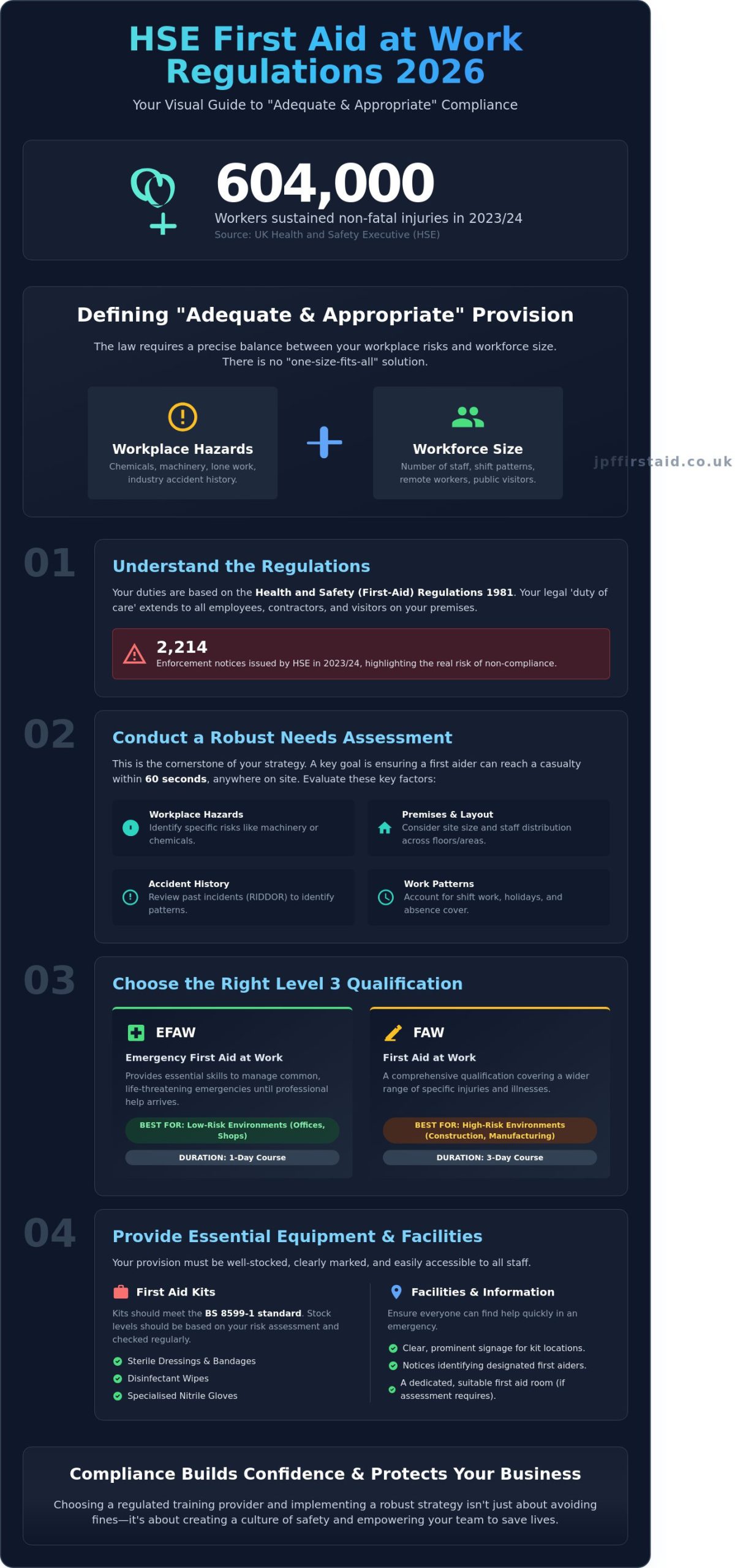
If the HSE visited your premises tomorrow, could you explain exactly why your first aid provision is “adequate and appropriate” without a hint of hesitation? It’s a question that keeps many UK business owners awake, especially as the hse first aid at work regulations 2026 demand total clarity in workplace safety. You likely agree that while the wording of the law often feels vague, the pressure to avoid legal action is very real, especially when you consider that 604,000 workers sustained non-fatal injuries in 2023/24 according to HSE statistics.
We’re here to help you move past the confusion and gain total peace of mind. This guide provides a clear, expert breakdown of your compliance requirements, ensuring you feel confident in every decision you make. We’ll walk you through the practical differences between EFAW and FAW courses, show you how to conduct a robust risk assessment, and explain how to achieve hassle-free certification that empowers your team to save lives.
Key Takeaways
- Learn how to navigate the “adequate and appropriate” legal requirements of the 1981 Regulations to ensure your business stays protected throughout 2026.
- Discover the essential steps for conducting a robust needs assessment that identifies the unique hazards of your specific workplace environment.
- Master the distinctions between EFAW and FAW certificates to guarantee you have the right number of qualified personnel to meet hse first aid at work regulations 2026.
- Identify the mandatory equipment and facilities needed to meet the BS 8599-1 standard, from sterile dressings to specialised nitrile gloves.
- Understand the benefits of bespoke on-site training and how choosing a regulated provider can build genuine life-saving confidence in your team.
Understanding the Health and Safety (First-Aid) Regulations 1981 in 2026
The Health and Safety (First-Aid) Regulations 1981 remain the gold standard for workplace safety in the UK. Even as we look toward the specific requirements of the hse first aid at work regulations 2026, these core rules haven’t lost their relevance. They mandate that every employer provides “adequate and appropriate” equipment, facilities, and personnel to ensure employees receive immediate attention if they’re injured or taken ill at work. The Health and Safety Executive (HSE) acts as the primary watchdog for these standards, operating under the legal framework established by the Health and Safety at Work etc. Act 1974.
If you don’t meet these standards, the risks go far beyond a simple fine. Non-compliance can lead to heavy legal liability, prosecution by the HSE, and significant damage to your business reputation. Most importantly, it compromises the wellbeing of your team. In 2023/24, the HSE issued 2,214 enforcement notices across various sectors, proving that they take these obligations seriously. Staying compliant with the hse first aid at work regulations 2026 isn’t just about avoiding a penalty; it’s about creating a culture where your staff feel safe, valued, and protected every time they clock in.
Defining “Adequate and Appropriate” for Your Workplace
There’s no “one size fits all” answer when it comes to first aid provision. A high-risk environment, such as a construction site or a manufacturing plant, requires a far more robust setup than a small, quiet office. You must consider the nature of your work, the history of accidents in your industry, and any specific hazards like chemicals or heavy machinery. This assessment ensures your first aid response is tailored to the actual dangers your team faces daily.
Provision is “adequate and appropriate” when it strikes a precise balance between the specific hazard levels of your industry and the total number of staff members on your site.
The Employer’s Legal Duty of Care
Your responsibility as an employer doesn’t stop at your full-time staff. You have a legal duty of care toward contractors and members of the public who visit your premises. This means your first aid arrangements must be robust enough to handle anyone who might be on-site at any given time. Clear communication is a vital part of this duty. You must use prominent signage to show where first aid kits are kept and who the designated first aiders are.
It’s essential that first aid information is accessible to everyone in the building, including those with disabilities or visitors who aren’t familiar with your layout. We recommend placing clear, easy-to-read notices in communal areas like kitchens, lift lobbies, and reception desks. When people know exactly where to turn in an emergency, it builds confidence and ensures that life-saving help is never more than a few moments away.
Conducting a Robust First Aid Needs Assessment
Your first aid needs assessment is the bedrock of your entire health and safety strategy. It’s a practical tool that ensures your provision is tailored to the actual risks your team faces every day. To remain compliant with the hse first aid at work regulations 2026, you must move beyond a “one size fits all” approach. A small accountancy firm in a city centre has vastly different requirements compared to a manufacturing plant operating heavy machinery 24 hours a day.
Start by identifying the specific hazards present in your environment. In high-risk settings, such as construction or forestry, the potential for severe injury is much higher, requiring more advanced training like the three-day First Aid at Work (FAW) qualification. For low-risk offices, an Emergency First Aid at Work (EFAW) certificate is often the standard. You also need to consider your workforce distribution. If your staff are spread across a large warehouse or multiple floors, a single first aider isn’t enough. You should aim for a response time where a first aider can reach a casualty within 60 seconds, regardless of where they are on the site.
Modern working patterns also demand that you account for staff who aren’t always under your roof. If 20% of your team works remotely or you have lone workers visiting clients, your assessment must include them. This might mean providing personal first aid kits or ensuring they have access to mobile communication to call for help instantly.
Key Factors to Evaluate During Your Assessment
You must look closely at your organisation’s accident history. Reviewing your RIDDOR reports from the last 24 months will reveal patterns; for instance, if you’ve seen a 10% increase in minor lacerations, your first aid kits should be stocked accordingly. Proximity to emergency services is another critical factor. If your business is located in a rural area where an ambulance might take 20 minutes to arrive, your internal first aid team becomes the primary lifesaver during the “golden hour” of response. This process is simplified when you refer to the HSE Guidance on First-Aid Regulations, which provides the official framework for these decisions. Finally, consider the specific health needs of your team, such as known allergies or heart conditions, to ensure your first aiders are prepared for every eventuality.
Reviewing and Updating Your Assessment
Maintaining compliance with the hse first aid at work regulations 2026 requires an annual review of your assessment. However, certain triggers should prompt an immediate update. If you introduce new machinery, change your shift patterns, or move to a new premises, your old assessment becomes obsolete. Documenting every finding is vital. A written record serves as your evidence of HSE compliance and helps you track exactly when your team needs a refresher. Keeping your bespoke first aid training aligned with these updates ensures your staff always feel confident and ready to act in an emergency.
EFAW vs. FAW: Choosing the Right Level 3 Qualification
Choosing the right training isn’t just about ticking a compliance box. It’s about making sure your team feels ready to act when the pressure is on. To stay aligned with the hse first aid at work regulations 2026, you’ll need to decide which level of training fits your specific environment. This decision starts with Conducting a First Aid Needs Assessment to evaluate your site’s unique risks, the number of employees you have, and any specific hazards present.
For very small, low-risk businesses with fewer than five people, the HSE suggests you might only need an “Appointed Person.” This role involves taking charge of first aid arrangements, such as restocking the kit and calling 999 during an emergency. While they don’t legally require a formal qualification, most modern employers choose at least a 1-day course to ensure the individual has the confidence to help. For any team larger than this, or for businesses with higher risks, a regulated qualification becomes a necessity.
Selecting Ofqual regulated qualifications is the best way to ensure your training is valid and high-quality. It gives you peace of mind that the curriculum meets the rigorous standards required by the HSE. We always recommend checking for this regulation to avoid the hassle of unrecognised certificates.
Level 3 Emergency First Aid at Work (EFAW)
The Level 3 EFAW is a 1-day course perfect for low-risk settings like retail units, small offices, or libraries. It focuses on the most critical life-saving skills. Your team will learn how to handle an unconscious casualty, perform CPR, and use an AED. It’s a practical, hands-on day that turns anxiety into action. You can find more details in our guide on emergency first aid at work.
Level 3 First Aid at Work (FAW)
The 3-day FAW course is the comprehensive solution for high-risk industries like manufacturing, warehousing, or construction. It provides deeper knowledge for your designated lead first aiders. This syllabus covers advanced topics including spinal injuries, fractures, and the treatment of chemical burns. Under the hse first aid at work regulations 2026, having these advanced skills on-site is vital for workplaces with significant machinery or hazardous materials where professional help might be minutes away.
Essential First Aid Kits and Facilities
Having the right equipment on hand is the cornerstone of effective emergency response. To stay compliant with the hse first aid at work regulations 2026, your kits must meet the BS 8599-1 standard. This British Standard ensures your supplies are appropriate for the specific size and risk level of your workplace. You don’t want to find an empty box or an expired bandage during a crisis, so your provision needs to be both robust and regularly maintained.
A standard workplace kit should include at least the following:
- Sterile plasters in assorted sizes
- Sterile eye pads and individually wrapped triangular bandages
- Safety pins and disposable nitrile gloves (avoid latex to prevent allergic reactions)
- Large and medium-sized sterile unmedicated wound dressings
- Cleansing wipes and adhesive tape
For larger sites or high-risk environments, a dedicated first aid room is often a necessity. This space should be easy to access, well-lit, and contain a sink with running water. Assigning a specific person to conduct a monthly inventory check is the best way to manage your stock. They should look for damaged packaging and check expiry dates on sterile items to ensure everything remains fit for use. If a kit is used, it must be replenished immediately to maintain your level of cover.
Beyond the Standard Kit: Additional Equipment
Your risk assessment might highlight the need for specialised gear. If your team works with heat, a dedicated burn station with cooling gels is vital. In high-risk industries like construction, catastrophic bleed kits containing tourniquets and haemostatic dressings are now standard practice. We also strongly recommend installing an Automated External Defibrillator (AED). With over 30,000 out-of-hospital cardiac arrests in the UK every year, an AED is a life-saving investment. Always store these in a cool, dry, and central location that’s clearly accessible to everyone.
Signage and Record Keeping
Legal compliance under the hse first aid at work regulations 2026 requires clear signage featuring a white cross on a green background. These signs must guide people to the nearest kit or treatment area without confusion. You also need to maintain an Accident Book to record every intervention. Under the Data Protection Act 2018, you must ensure this data is stored securely. Use an Accident Book with perforated, tear-out pages so that individual medical details remain confidential and are not visible to others who use the book later.
Ensuring Compliance with Professional Training
Choosing a training provider is a decision that goes far beyond simple legal box-ticking. While the hse first aid at work regulations 2026 set the standard for what you must achieve, the quality of instruction determines how your team reacts during a genuine cardiac arrest or severe injury. You’re investing in the safety of your staff, so the provider’s expertise is just as vital as the qualification itself. A certificate proves attendance, but professional training ensures competence.
On-site training offers a distinct advantage for busy UK businesses. By hosting sessions at your own premises, trainers can create bespoke scenarios tailored to your specific environment. Whether you’re managing a high-risk warehouse in Manchester or a corporate office in London, practicing in the spaces where accidents actually happen builds muscle memory that generic classroom settings can’t match. For teams that can’t afford long stretches away from their desks, blended learning provides a modern solution. This approach combines flexible online theory with focused practical assessments, ensuring you meet the hse first aid at work regulations 2026 without compromising productivity.
Shifting your company’s mindset from a “tick-box” mentality to a genuine culture of safety is the ultimate goal. Statistics from the British Heart Foundation show that early CPR and defibrillation can more than double the chances of survival. When first aid is treated as a vital life skill rather than a chore, employee confidence grows. This proactive approach reduces workplace anxiety and demonstrates that you value your people’s well-being above basic legal compliance.
The JPF Approach: Engaging, Fun, and Reassuring
We’ve moved away from the dry, clinical style of traditional medical training. Our sessions are designed to be practical and hands-on, focusing on building the confidence you need to act when every second counts. JPF First Aid trainers bring multi-award-winning expertise to every course, ensuring the atmosphere remains relaxed and encouraging. We believe that if you enjoy the learning process, you’re far more likely to remember the skills during an emergency. You’ll leave our sessions feeling empowered, not overwhelmed.
National Coverage for Your Business
Managing first aid requirements across multiple UK sites shouldn’t be a headache. We offer hassle-free booking for companies with a nationwide presence, providing a consistent standard of training from Cornwall to Aberdeen. You can choose from scheduled public courses for individual staff members or private group sessions delivered at your location. Our flexibility ensures your business stays compliant on your own terms. Book your 2026 first aid training with the experts today and ensure your team is ready for anything.
Future-Proof Your Workplace Safety Today
Navigating the hse first aid at work regulations 2026 doesn’t have to be a stressful experience for your business. By conducting a robust needs assessment and choosing the correct Level 3 qualification, you ensure your team is ready for any emergency. Whether you require the one-day Emergency First Aid at Work (EFAW) or the full three-day First Aid at Work (FAW) course, meeting the Health and Safety (First-Aid) Regulations 1981 is about more than just legal compliance. It’s about empowering your staff with life-saving skills they’ll actually remember.
JPF First Aid is a multi-award-winning training provider with expert trainers who bring over 20 years of experience to every session. We offer Ofqual regulated qualifications that are practical, engaging, and far from dry. We’ll come directly to your site to provide a hassle-free experience that builds genuine confidence in your learners. Don’t leave your safety standards to chance when expert help is just a click away.
Secure your workplace compliance—book your First Aid at Work course now
We’re here to help you create a safer, more prepared environment where everyone feels looked after. You’re in safe hands, and we’re ready to support you every step of the way.
Frequently Asked Questions
Do I legally need a first aider if I only have two employees?
Yes, you must have at least one “Appointed Person” to meet your legal obligations under the Health and Safety (First-Aid) Regulations 1981. Even with a tiny team of two, someone must take charge of first aid arrangements, such as looking after the kit and calling 999. For many small businesses, putting one person through an Emergency First Aid at Work course is the best way to ensure you’re covered and your staff feel safe.
How often do first aid at work certificates need to be renewed?
You must renew your first aid at work certificates every three years to stay compliant with UK law. The HSE also strongly recommends that you attend a three-hour annual refresher session to keep your life-saving skills sharp. We make these sessions engaging and practical, ensuring you don’t lose the confidence needed to act in a real emergency between your main qualification dates.
What is the difference between an Appointed Person and a First Aider?
An Appointed Person manages first aid equipment and emergency contacts, while a First Aider is someone who has completed a regulated qualification to provide hands-on medical treatment. You don’t need formal training to be an Appointed Person, but you aren’t allowed to administer first aid. To meet the hse first aid at work regulations 2026, most employers find that having a fully trained First Aider is the most reliable way to protect their workforce.
Does my business need a defibrillator (AED) to be HSE compliant?
The HSE doesn’t currently make AEDs a universal legal requirement, but your mandatory first aid risk assessment might show that you need one. If your workplace has 100 or more visitors daily or employs staff in high-risk roles, installing a defibrillator is a sensible, life-saving move. We can include AED training in your bespoke on-site course so your team feels completely comfortable using this vital kit.
Can I do my first aid at work training entirely online in 2026?
No, you cannot get a fully regulated first aid qualification through online learning alone because the HSE requires face-to-face practical assessments. You can use “blended learning” to cover some theory online, but you must demonstrate skills like CPR and wound dressing in person. This ensures your training is far from dry or clinical, giving you the “can-do” attitude that only comes from hands-on practice with an expert mentor.
What should be the minimum contents of a workplace first aid kit?
Your first aid kit should contain at least 20 individually wrapped sterile plasters, 2 sterile eye pads, 4 triangular bandages, and 6 safety pins. You also need 6 medium wound dressings, 2 large wound dressings, and 3 pairs of disposable gloves as per the BS 8599-1 standard. It’s a simple, hassle-free way to ensure you have the basic tools to manage an injury until professional help arrives.
Are mental health first aiders now a legal requirement under HSE rules?
Mental health first aiders aren’t a standalone legal requirement, but the HSE has required employers to consider mental health in their first aid risk assessments since 2018. You have a duty of care to support the psychological well-being of your staff just as much as their physical safety. Adding mental health awareness to your training plan is a brilliant way to build a supportive, professional culture that looks after the whole person.
Who is responsible for first aid if we share an office building?
You are legally responsible for your own employees, but the hse first aid at work regulations 2026 allow you to share first aid provision with other businesses in the building. You must have a written agreement in place that clearly outlines who provides the equipment and the trained personnel. This collaborative approach is often the most efficient way for small firms in shared hubs to stay compliant while keeping costs down.
Recent Comments