

What if the biggest risk to your business isn’t the emergency itself, but the moment your team freezes in uncertainty? You’ve likely invested in safety training before, only to worry that those skills might vanish the second a real crisis hits. It’s a common concern, especially when you consider that OSHA penalties for serious violations have reached up to $16,131 as of 2026. You want a workforce that acts with calm authority, not a group of bystanders waiting for someone else to take the lead.
We believe that improving employee confidence in emergencies is about more than just a certificate on the wall. It is about building a culture of genuine care and psychological readiness that moves beyond dry, tick-box exercises. This guide will show you how to meet the new 2026 mandatory mental health training requirements while transforming workplace anxiety into decisive action. You’ll learn how to empower your team with practical skills, from First Aid at Work to Fire Safety, ensuring they feel like capable partners in every situation.
Key Takeaways
- Understand why confidence acts as the essential bridge between theoretical knowledge and taking decisive action when it matters most.
- Discover how to build “muscle memory” through the three pillars of workplace resilience, ensuring safety skills become second nature for your staff.
- Compare the benefits of classroom-based and blended learning to find the best strategy for improving employee confidence in emergencies.
- Learn how the SARAH Act 2015 and Good Samaritan principles provide legal protection for team members who act in good faith.
- See how interactive, enjoyable training sessions can replace workplace anxiety with a lasting culture of genuine care and competence.
The Psychology of Response: Why Improving Employee Confidence in Emergencies is Vital
Improving employee confidence in emergencies is the missing link in most corporate safety plans. You can have the most expensive first aid kits and the latest defibrillators, but they’re useless if your team is too afraid to touch them. Confidence acts as a bridge. It takes the theoretical knowledge learned in a classroom and turns it into life-saving action when the pressure is on. Without this psychological readiness, even the best-trained staff might find themselves unable to move when a crisis occurs.
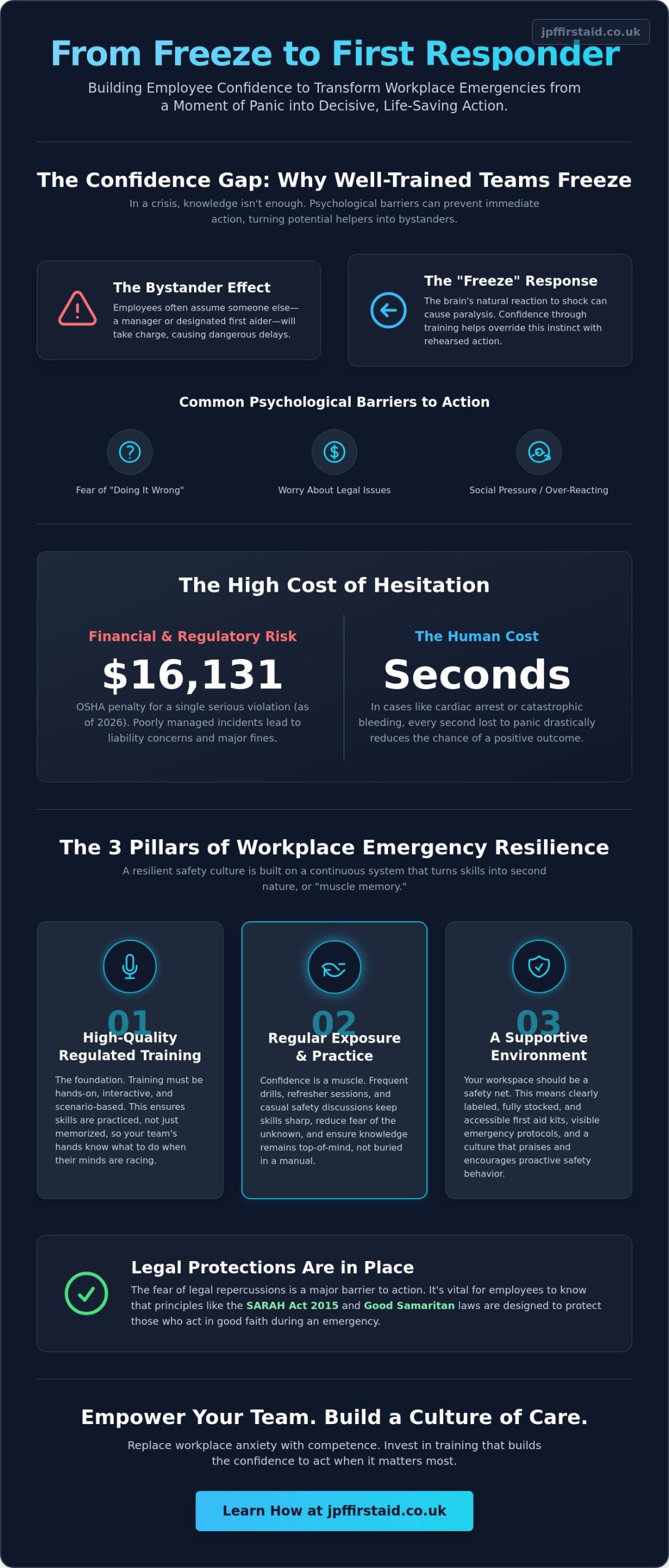
In many workplaces, the Bystander Effect takes hold during a crisis. This psychological phenomenon occurs when individuals don’t offer help because they assume someone else will step in. In a professional environment, this often manifests as looking toward a manager or a designated first aider who might not be immediately available. When you focus on improving employee confidence in emergencies across your entire staff, you break this cycle of hesitation and ensure that help is immediate.
When a crisis hits, the human brain triggers a “freeze, flight, or fight” response. In a modern office or warehouse, the “freeze” response is the most common hurdle. Employees often feel paralyzed by the gravity of the situation. By building a culture of competence, you replace that paralysis with a rehearsed, calm reaction. This doesn’t just save lives; it builds a stronger sense of security that improves employee retention and fosters a genuine safety culture where people feel looked after.
The Cost of Hesitation in the Workplace
In medical emergencies like cardiac arrest or a catastrophic bleed, time is your greatest enemy. Every second spent wondering what to do is a second lost for the casualty. Poorly managed incidents don’t just carry a heavy emotional toll for the team; they lead to significant liability concerns and potential regulatory fines. Confidence is the primary tool used to reduce the “panic window,” allowing your team to move from shock to solution in seconds rather than minutes.
Psychological Barriers to Emergency Action
The number one reason people don’t help is the fear of “doing it wrong.” Your team might worry about causing more harm or facing legal repercussions. There is also the social pressure of not wanting to look foolish or “over-react” in front of peers. Effective first aid courses must address these psychological barriers directly. Training needs to be interactive and reassuring, proving to learners that they are capable of making a difference without needing to be a clinical expert.
The Three Pillars of Workplace Emergency Resilience
Building a resilient workplace isn’t about a single day of training. It’s a continuous process that requires a reliable structure. Improving employee confidence in emergencies happens when you move beyond theory and create a system that supports the learner long after the instructor has left the building. To achieve this, we focus on three specific pillars: high-quality regulated training, regular exposure, and environmental support. These elements work together to move life-saving skills from short-term memory into long-term muscle memory.
- Pillar 1: High-Quality, Regulated Training. This is the foundation. It prioritises hands-on practice so that your team’s hands know what to do even when their minds are racing.
- Pillar 2: Regular Exposure. Confidence is a muscle that needs exercise. Frequent drills, casual discussions, and refresher sessions keep the subject approachable and top-of-mind.
- Pillar 3: Environmental Support. Your physical workspace should act as a safety net. This includes clearly labelled, accessible kits and simple, visible protocols that guide action during a crisis.
When these pillars are in place, the “panic window” shrinks. Your employees stop being bystanders and start being active participants in your safety culture. This holistic approach ensures that the investment you make in training actually translates to better outcomes during a real-world incident.
Knowledge: Moving Beyond the Tick-Box Exercise
Many businesses treat safety as a boring tick-box exercise. They sit employees in a room for a lecture and hope for the best. This approach rarely helps with improving employee confidence in emergencies because it doesn’t feel real. Instead, interactive, scenario-based learning makes the experience engaging and memorable. For example, achieving emergency first aid at work compliance through an Ofqual-regulated course provides a higher baseline for trust. These courses ensure that learners don’t just hear the information; they demonstrate they can use it.
Repetition: The Power of the Refresher
Technical skills can degrade significantly within just six months of a course. Waiting three years for a renewal is a gamble you don’t have to take. We advocate for annual skills updates to keep knowledge fresh. You might try “First Aid Minutes” in team meetings to discuss a specific piece of equipment or a safety scenario. This type of consistent emergency response training ensures the team stays sharp. Since basic life support training relies heavily on physical rhythm and technique, frequent practice is the only way to remain truly effective. If your team is approaching their renewal date, our First Aid At Work Re-qualification is a great way to maintain that vital momentum.
Comparing Training Methods for Maximum Skill Retention
Improving employee confidence in emergencies depends heavily on the method of delivery, not just the content itself. While many organisations look for the fastest or cheapest route to compliance, the real goal is retention. 100% in-person classroom training remains the gold standard for building team bonds. It allows your staff to ask questions in real-time and share the experience with colleagues, creating a collective sense of readiness. When people learn together, they’re more likely to support one another during a real incident.
Blended learning has become a popular choice for 2026, offering a balance between online theory and in-person practical sessions. This flexibility is great for busy schedules, but we must be careful not to rely on screens alone. Distance learning works well for facts and figures, yet it falls short when building physical confidence. You can’t feel the resistance of a chest compression or the weight of a fire extinguisher through a mouse click. Our sessions are designed to be enjoyable and interactive because a relaxed learner is a confident learner. By reducing the stress of the classroom, we ensure the knowledge sticks when the pressure rises.
The Role of Hands-On Practice
Actually performing CPR on a manikin is an irreplaceable part of the learning journey. It turns a scary, abstract concept into a physical skill that your team “owns.” We use AED trainers to demystify life-saving technology, showing your staff that these devices are designed to help, not hinder. Role-playing workplace-specific scenarios is another vital tool. When employees can visualise a response in their own canteen or loading bay, they’re much less likely to freeze when a crisis occurs. Following established OSHA emergency preparedness guidelines ensures these practical exercises meet the highest safety standards.
Tailoring Training to Your Specific Risks
A warehouse environment requires a different confidence-building approach than a quiet accounting office. We believe in bespoke training that uses your company’s actual equipment and follows your specific protocols. This familiarity breeds competence. If your team knows exactly where the nearest kit is and how to use it, their anxiety levels drop. Additionally, mental health first aid training is essential for improving employee confidence in emergencies involving non-physical crises. Learning how to support a colleague through a panic attack or a mental health episode is just as vital as physical first aid in creating a truly resilient workplace culture.
Addressing Legal Fears and the Bystander Effect
Legal anxiety is often the quietest but strongest barrier to action in the workplace. Improving employee confidence in emergencies requires dismantling the myth that helping someone could lead to a courtroom battle. In the UK, the legal system is designed to protect those who step up in a crisis. The Social Action, Responsibility and Heroism (SARAH) Act 2015 specifically requires courts to consider whether a person was acting for the benefit of society or demonstrated a heroic intervention. This means if you act in good faith to help a colleague, the law is firmly on your side.
Beyond the legalities, we must address the “gross” factor. A fear of blood, needles, or serious illness is a natural human response that can cause even the bravest person to hesitate. We don’t ignore this in our sessions. Instead, we use interactive tools and honest discussions to help employees move past the initial shock. We also emphasize the importance of the responder’s well-being after the event. This is where a staff member trained in Supervising First Aid for Mental Health (Level 3) becomes invaluable, providing the emotional support needed to process the experience.
The Legal Reality vs. The Myth
It’s a reassuring fact: there has never been a successful prosecution in the UK of a first aider who acted in good faith while trying to save a life. The law expects a “Standard of Care” consistent with your specific level of training. You aren’t expected to be a clinical expert; you’re expected to be a capable, caring colleague. To stay within the scope of your training, follow these simple principles:
- Only perform techniques you have been taught in your course.
- Always ask for consent if the casualty is conscious.
- Hand over to emergency professionals as soon as they arrive on the scene.
- Record the details of the incident and your actions accurately.
Building Psychological Safety
Psychological safety means your team feels empowered to act without fear of being judged if things don’t go perfectly. Management plays a huge role here by signalling that “trying your best” is the priority. When leadership values action over perfection, improving employee confidence in emergencies becomes much easier. A structured post-incident debriefing is also vital. It allows the team to talk through what happened in a safe environment, reinforcing their competence and ensuring no one carries the emotional weight of the crisis alone. If you want to give your team the legal and practical peace of mind they deserve, consider booking our First Aid At Work (Level 3) course today.
Implementing a Safety Culture with JPF First Aid
Improving employee confidence in emergencies starts with choosing a partner who understands that safety is about people, not just paperwork. At JPF First Aid, we don’t believe in dry, lecture-heavy sessions that leave learners feeling overwhelmed. Instead, we follow a philosophy that is enjoyable, interactive, and reassuring. Since 2005, John Fogarty has been sharing his expertise to help teams feel capable rather than anxious. This deep experience translates directly into a training style that prioritises the learner’s success and emotional readiness.
When you choose on-site group training, you’re doing more than just meeting a regulatory requirement. You’re building a “unit” of responders who know how to work together in their own environment. This approach helps your business move from a simple compliance mindset to a true preparedness mindset. You aren’t just checking a box for an auditor; you’re partnering with a mentor who cares about the specific needs of your community and your staff. This collective confidence ensures that if an incident occurs, your team won’t look around for a leader. They’ll already have the skills to become one.
Bespoke Training for National Workplaces
We understand that every workplace has a unique layout and different sets of risks. That’s why we offer complete flexibility through our mobile delivery. We bring the equipment and the expertise to your site, ensuring that the training feels relevant to your specific surroundings. Whether you’re a single local business or a national organisation, JPF First Aid maintains consistent training standards across the UK. Our multi-award-winning status isn’t just a badge of honour; it’s a tool for boosting employee buy-in. When staff know they’re receiving top-tier instruction, they’re more likely to engage with the material and retain those vital skills.
Your Next Steps to a Confident Workforce
The first step in improving employee confidence in emergencies is to audit your current culture. Don’t just check the expiry dates on your certificates. Talk to your team and ask them honestly if they feel brave enough to act today. If there’s hesitation, it’s a sign that they need more than just a refresher; they need a confidence boost. You can book a private group session for your entire team to build that shared resilience, or check our individual public course fees if you only have a few staff members who need training. Remember, you don’t need to be a doctor to save a life. You just need the right mentor, a bit of practice, and the belief that you can make a difference.
Transform Your Workplace Into a Resilient Community
Building a safe environment is about much more than meeting the latest 2026 regulatory standards. It’s about ensuring every member of your team feels capable of stepping up when a crisis occurs. Improving employee confidence in emergencies requires a shift from passive classroom listening to interactive, hands-on practice that builds lasting muscle memory. By dismantling legal myths and focusing on psychological readiness, you move your staff beyond hesitation and toward a culture of genuine care.
JPF First Aid is a multi-award-winning training provider that has been delivering mentor-led instruction since 2005. We offer Ofqual regulated qualifications that are designed to be engaging and accessible, ensuring the learning sticks. Whether you’re looking for mental health support or physical first aid skills, we provide the expert guidance your team needs to feel truly empowered.
Empower your team with expert training—book your course with JPF First Aid today. You can turn workplace anxiety into decisive action; we’re here to help you make that transition smoothly and with total confidence.
Frequently Asked Questions
How can I tell if my employees are actually confident in their first aid skills?
You can gauge confidence by observing how your team reacts during unannounced drills or by asking simple, scenario-based questions in meetings. If employees can’t immediately point to the nearest defibrillator or hesitate when asked who the designated first aider is, their confidence may be low. Real confidence is visible when staff members speak calmly about procedures and feel comfortable checking the contents of first aid kits without being prompted by management.
Can an employee be sued for giving first aid in the UK?
There has never been a successful prosecution of a workplace first aider in the UK who acted in good faith. The law, specifically through the SARAH Act 2015, is designed to protect those who intervene for the benefit of society. As long as your staff act within the scope of their training and don’t attempt advanced medical procedures they haven’t been taught, they’re legally safe. This reassurance is vital for removing the fear of litigation.
What is the best way to improve skill retention after a first aid course?
The most effective method for improving employee confidence in emergencies is to implement annual refresher sessions rather than waiting three years. Research shows that technical skills can begin to fade within six months. By introducing monthly “First Aid Minutes” or quarterly hands-on reviews, you keep the knowledge fresh and accessible. This consistent exposure ensures that when a real crisis occurs, your team relies on muscle memory rather than trying to recall a lecture.
How often should employees practice emergency drills?
We recommend conducting full evacuation drills at least twice a year, but smaller skills-based practices should happen more frequently. Ideally, your team should engage in “tabletop” discussions or quick equipment checks every month. This keeps safety protocols from becoming distant memories. Regular, low-stress exposure to emergency scenarios ensures that the correct response becomes a natural habit. It also allows you to identify and fix any gaps in your current emergency plan before a real crisis happens.
Does mental health first aid training improve general emergency confidence?
Yes, mental health first aid training significantly boosts overall confidence by teaching staff how to manage the emotional shock of a crisis. It provides the tools to support a casualty who is panicking and helps the responder process their own feelings after the event. By addressing the psychological side of emergencies, you create a more resilient team that is less likely to freeze when faced with the stress of a physical injury or workplace accident.
What should be included in a workplace emergency response protocol?
A robust protocol must include clear reporting steps, designated evacuation roles, and the precise locations of all first aid and fire safety equipment. It should also outline how to handle specific risks relevant to your site, such as chemical spills or machinery accidents. Ensure these documents are easy to read and accessible to everyone, not just management. A good protocol acts as a calm, step-by-step guide that supports your team when their adrenaline is high.
Are online-only first aid courses enough to build employee confidence?
Online-only courses are excellent for learning theory, but they rarely provide the physical confidence needed to act in a real crisis. Improving employee confidence in emergencies requires the weight and feel of a real manikin or the voice prompts of an AED trainer. Without that hands-on experience, employees often feel a “disconnect” between what they’ve read on a screen and what they need to do with their hands. Blended learning offers the best of both worlds.
What is the Good Samaritan Law and how does it apply to my staff?
The Good Samaritan principle is a legal concept that protects individuals who provide reasonable assistance to those who are injured or in peril. In the UK, this works alongside the SARAH Act to ensure that people who act in good faith aren’t penalised for trying to help. It applies to your staff by providing a safety net that encourages them to step forward. Knowing they’re protected helps them focus on the casualty rather than worrying about legal consequences.
Recent Comments