

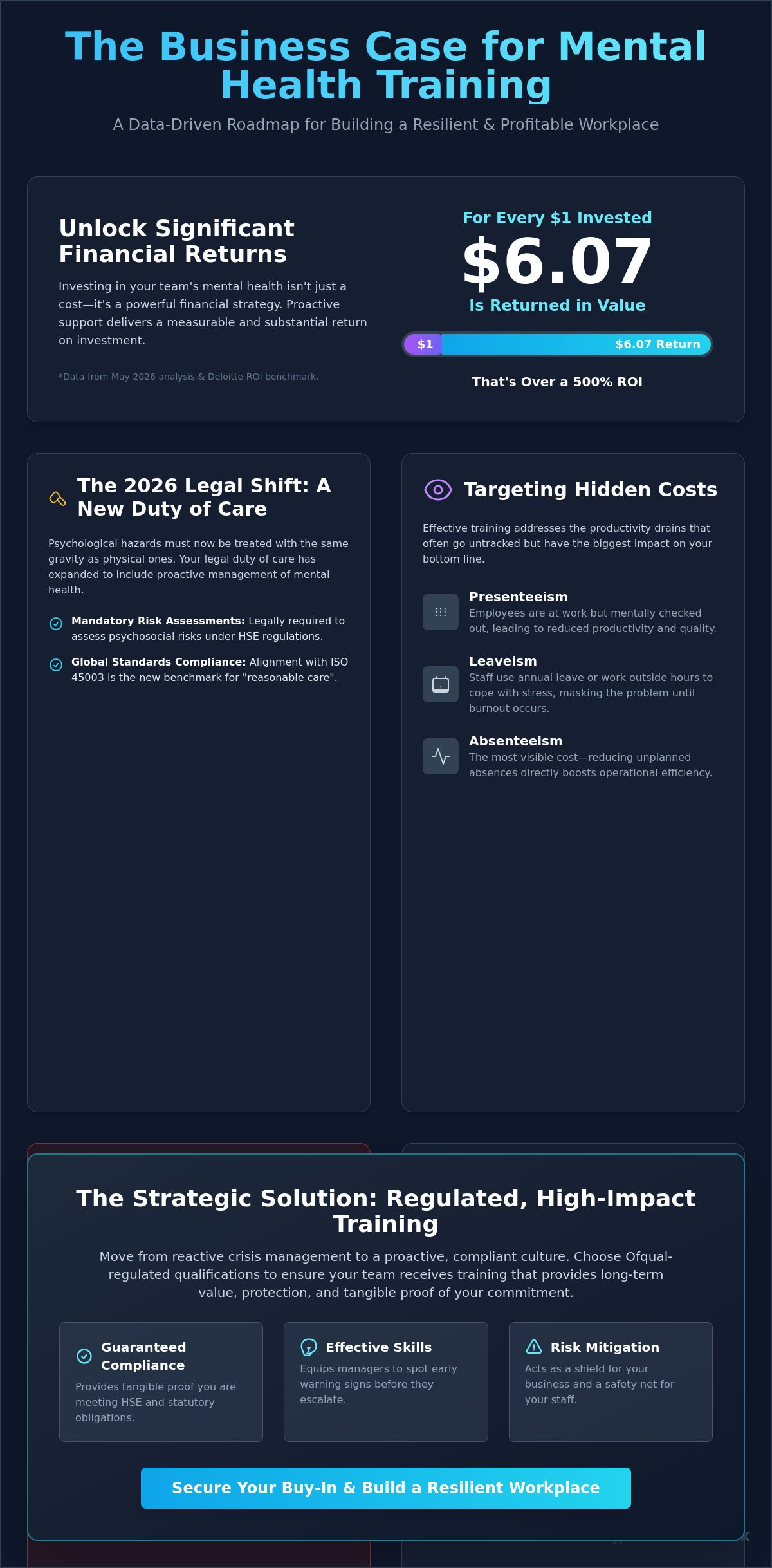
Did you know that for every dollar your company invests in mental health initiatives, you could see a return of up to $6.07? This May 2026 analysis proves that supporting your team isn’t just the right thing to do; it’s a powerful financial strategy. You’re likely already feeling the strain of rising absenteeism and the constant pressure to retain talent in a shifting market. It’s stressful to manage these risks while trying to stay ahead of evolving compliance standards and HSE expectations.
We want to empower you with the tools to lead this change confidently. This guide shows you exactly how you can succeed in making the business case for mental health training by presenting a data-driven, high-ROI argument to your board. You’ll discover a clear framework for securing stakeholder buy-in and reducing staff turnover. By the end, you’ll have a roadmap to build a resilient workplace culture where your employees feel safe, valued, and ready to perform at their best.
Key Takeaways
- Understand how the shift toward mandatory mental health risk assessments impacts your legal duty of care and compliance obligations in 2026.
- Learn how to identify and quantify the hidden costs of presenteeism and leaveism to demonstrate a clear financial return to your board.
- Follow our practical, step-by-step framework for making the business case for mental health training by aligning your proposal with existing corporate ESG goals.
- Discover why building a culture of psychological safety is your most effective strategy for attracting and retaining top talent in a competitive market.
- Identify why choosing Ofqual-regulated qualifications ensures your team receives high-impact, interactive training that provides long-term value and protection.
The Evolving Regulatory Landscape: Mental Health as a Legal Duty in 2026
The days of viewing mental health support as a simple “perk” or a box-ticking exercise are over. In 2026, the Health and Safety Executive (HSE) and global regulatory bodies have solidified the expectation that psychological hazards must be treated with the same gravity as physical ones. You’re no longer just managing “well-being”; you’re managing safety. This shift means that your duty of care now explicitly includes protecting employees from Occupational stress and burnout. If you aren’t conducting regular mental health risk assessments, you’re leaving your organization vulnerable to more than just bad reviews. Understanding this legal transition is an essential step when making the business case for mental health training.
Understanding Your 2026 Legal Obligations
The Management of Health and Safety at Work Regulations require you to assess all risks to your staff. In 2026, this mandate covers psychological safety as a core component. Ignorance is no longer a defense in modern employment tribunals. Judges now look for evidence of proactive management, such as the implementation of ISO 45003 standards. This global standard provides a framework for managing psychosocial risks, and failing to align with these guidelines can suggest a lack of “reasonable care.” By training your team through a regulated course, such as the First Aid for Mental Health (Level 2), you provide tangible proof that your business is meeting its statutory obligations.
The Risk of Inaction: Litigation and Penalties
The financial cost of neglecting workplace psychological hazards is climbing. We’re seeing a sharp rise in stress-related personal injury claims, where employees successfully argue that their employer failed to provide a safe working environment. These legal battles are expensive, but the damage doesn’t stop at the courtroom door. Poor mental health culture directly impacts your employer liability insurance premiums. Insurers are increasingly looking for evidence of robust training programs, like Supervising First Aid for Mental Health (Level 3), before offering competitive rates. Proving that you have a structured response to mental health is a core pillar of making the business case for mental health training to your leadership team. It transforms training from an optional expense into a vital risk-mitigation strategy that protects both your people and your bottom line.
- Legal Compliance: Meeting HSE expectations for psychological risk assessments.
- Risk Mitigation: Reducing the likelihood of costly personal injury claims.
- Insurance Benefits: Potentially lowering premiums through proven proactive management.
- Reputational Safety: Avoiding the public fallout of employment tribunals.
We’re here to help you move from reactive crisis management to a proactive, compliant culture. It’s about giving your managers the confidence to spot early warning signs before they escalate into legal or operational liabilities. When you choose a regulated qualification, you’re investing in a shield for your business and a safety net for your staff.
Quantifying the ROI: The Financial Argument for Mental Health Training
Numbers speak louder than words in the boardroom. While the moral argument for support is clear, making the business case for mental health training requires a hard look at the balance sheet. According to the Deloitte ROI benchmark, employers can expect an average return of £5 for every £1 spent on mental health interventions. However, more recent data from May 2026 shows that behavioral health services can deliver a projected ROI of over 500%, with some employers seeing about $6.07 returned for every $1 invested. This isn’t just about avoiding costs; it’s about unlocking hidden value within your workforce.
When you present your proposal, you must account for the “hidden costs” that drain your budget. Absenteeism is easy to track, but “presenteeism” (employees working while unwell) and “leaveism” (using holiday time to recover from stress) are far more damaging. These behaviors often go unnoticed until productivity drops or a key team member resigns. By establishing a strong business case for mental health, you shift the focus from reactive spending to proactive investment. This reduces recruitment costs, as 69% of employees in 2026 state that mental health benefits are a deciding factor in staying with a company.
Absenteeism vs. Presenteeism: The Real Cost Drivers
Presenteeism is often two to three times costlier than total absence. When staff are mentally disengaged but physically present, the quality of work suffers and mistakes increase. Early intervention is the key. Training your team to recognize early signs of distress prevents short-term stress from spiraling into long-term sick leave. It’s much more cost-effective to support an employee through a difficult week than it is to replace them after they’ve reached a breaking point. If you’re looking for a place to start, our Awareness of First Aid for Mental Health (Level 1) course provides the foundational knowledge your managers need to spot these subtle shifts.
Measuring Success: KPIs for Mental Health Initiatives
To prove the value of your program, you need to track the right metrics. Monitor your occupational health referrals and staff turnover rates over a 12-month period to see the impact of your efforts. You’ll likely see a positive shift in your “Glassdoor” sentiment scores as employees feel more supported and valued. Research from April 2026 confirms that investing in mental health first aid yields a 507% ROI by significantly reducing productivity losses associated with untreated anxiety and depression. Tracking these KPIs ensures that making the business case for mental health training remains a continuous, data-driven success story for your organization.
- Reduction in Presenteeism: Improved focus and accuracy in daily tasks.
- Lower Turnover: Saving thousands in recruitment and onboarding costs.
- Decreased Sickness Absence: Fewer disruptions to project timelines.
- Enhanced Reputation: Becoming an employer of choice in a competitive market.
The Human Capital Advantage: Beyond the Balance Sheet
While the financial ROI is compelling, the true value of making the business case for mental health training lies in the people who drive your business forward. In 2026, building psychological safety isn’t an optional extra; it’s the bedrock of a high-performing team. When your employees feel safe to share ideas or admit they’re struggling without fear of judgment, innovation flourishes. A supportive culture reduces the stigma that often forces people to suffer in silence. This allows for early intervention before a minor stressor becomes a major crisis that disrupts your entire operation.
Attracting and Retaining Top Talent
The recruitment landscape has changed. As of May 2026, 69% of employees say that mental health benefits are very or extremely important when deciding to accept or stay at a job. For Gen Z and Millennial workers, this is a non-negotiable requirement. They’re looking for employers who show a visible commitment to wellbeing. By highlighting your investment in staff training, you’re not just filling roles; you’re building a brand that top talent wants to join. This proactive approach helps stop the “brain drain” caused by burnout in high-pressure environments. As noted in The Business Case for Mental Health in the Workplace, companies that prioritize these initiatives see a marked increase in engagement and a decrease in voluntary turnover.
Empowering Your Leadership Team
Managers often feel like they’re walking on eggshells when it comes to staff wellbeing. They don’t want to say the wrong thing, so they often say nothing at all. Regulated training, such as our First Aid for Mental Health (Level 2), shifts their role from policing performance to supporting people. It gives them the practical skills to handle difficult conversations with confidence and empathy. They learn how to recognize the 30% of employees experiencing “silent burnout” who might otherwise go unnoticed until it’s too late. It’s about giving your leaders a toolkit for success.
This psychological empowerment works hand-in-hand with physical safety protocols. Just as your team knows how to respond to a physical injury after completing emergency first aid at work, they should feel equally capable of responding to a mental health crisis. When these two areas of training overlap, you create a holistic safety net. This combined approach is a powerful asset when making the business case for mental health training, as it demonstrates a comprehensive strategy for protecting your organization’s most valuable asset: its human capital.
- Innovation: Psychological safety allows for creative risk-taking.
- Retention: Meeting the expectations of the 2026 workforce.
- Leadership: Managers become confident mentors rather than just supervisors.
- Holistic Safety: Mental and physical health are treated with equal importance.
Building Your Internal Pitch: A Step-by-Step Framework for Stakeholder Buy-in
Securing approval for a new budget line requires more than just good intentions. You need a structured, evidence-based approach that speaks the language of your directors. When making the business case for mental health training, your goal is to transition the conversation from “employee well-being” to “operational resilience.” By following a clear, five-phase framework, you can demonstrate that this investment is a strategic necessity for 2026.
- Phase 1: Gathering Evidence. Collect internal data from engagement surveys and exit interviews to highlight current pain points.
- Phase 2: ESG Alignment. Connect your proposal to existing Environmental, Social, and Governance goals.
- Phase 3: Tiered Training. Select appropriate levels, such as Awareness of First Aid for Mental Health (Level 1) for all staff and Supervising First Aid for Mental Health (Level 3) for leadership.
- Phase 4: Scenario Analysis. Contrast the “best-case” scenario of a 5:1 ROI against the “worst-case” of legal claims and 30% “silent burnout” rates.
- Phase 5: Data-Backed Rebuttals. Prepare to answer objections about cost or time by citing the $6.07 return for every dollar spent.
Step 1: Audit Your Current Workplace Climate
You can’t solve a problem you haven’t measured. Start by establishing a baseline using anonymous feedback tools to identify “hotspots” where stress-related turnover is highest. With 59% of workers reporting that their job negatively impacts their mental health, it’s likely your team is already feeling the strain. Use this data to prove the demand for professional support is real and urgent. This internal evidence makes your pitch personal to your organization rather than just a generic industry trend.
Step 2: Crafting the Financial Presentation
Your slide deck should follow a logical flow: Problem, Financial Impact, Proposed Solution, and ROI. Use the “Deloitte Multiplier” to project how reducing absenteeism and presenteeism will save the company money over the next 12 to 24 months. To maximize efficiency, consider a holistic approach to safety. “Investing in a combined safety package that includes fire marshal training and mental health support ensures we meet our legal fire safety obligations while simultaneously tackling the £45 billion annual cost of workplace mental ill-health.”
We’re ready to help you build a compelling proposal that your board can’t ignore. If you need help choosing the right qualifications to include in your pitch, view our full range of regulated training courses and let’s start protecting your team today.
Strategic Implementation: Choosing Regulated, High-Impact Training
Once you’ve secured buy-in, the final step in making the business case for mental health training is choosing how to deliver it. The quality of the program you select determines whether your investment leads to real cultural change or just becomes another forgotten “tick-box” exercise. To ensure long term knowledge retention, you need a model that fits your business’s unique rhythm. Whether you prefer face to face sessions or a blended learning approach, the focus must remain on practical application and psychological empowerment. Implementation is where your strategic planning transforms into a resilient workforce.
Quality Matters: Regulated vs. Non-Regulated Courses
Not all training is created equal. Ofqual regulated qualifications offer a level of protection and authority that unlisted or “in-house” certificates simply cannot match. When you choose a nationally recognized qualification, you’re ensuring that your provider meets rigorous standards for assessment and delivery. This adds genuine value to your employees’ professional portfolios and provides your board with peace of mind. High quality training like First Aid for Mental Health (Level 2) ensures that your staff aren’t just listening to a lecture. They’re gaining skills that are scrutinized for excellence by external awarding bodies.
Why JPF First Aid is Your Strategic Partner
We believe that learning about serious subjects doesn’t have to be a dry or intimidating experience. Our “expert mentor” approach is designed to alleviate the anxiety often associated with emergency response. We make our sessions interactive and engaging, which is a powerful way to reduce employee resistance. When people enjoy the learning process, they’re much more likely to remember what to do when a real crisis occurs. We don’t just teach theory. We empower your team to act with confidence and empathy in every situation.
Our training is flexible and mobile. We come to your site to deliver tailored group sessions that address the specific challenges of your industry. This personalized service ensures that the training feels relevant and immediate for every learner. By choosing a partner that values practicality over complex academic phrasing, you’re reinforcing the message that your company cares about its community and its individuals. Ready to take the next step? Book a consultation to build your custom training plan and let’s make your workplace a safer, more supportive environment for everyone.
- Expert Guidance: Reassuring, professional instructors who humanize the subject matter.
- Flexibility: Mobile delivery that fits around your operational requirements.
- Engagement: Interactive sessions that ensure long term skill retention.
- Reliability: Regulated qualifications that meet the highest industry standards.
Secure Your Organization’s Future with Strategic Mental Health Training
You now have the data and the framework needed to transform your workplace culture. By shifting from reactive crisis management to proactive, regulated training, you protect your business from legal risks while unlocking a significant return on investment. The 2026 workforce expects psychological safety as a standard, not a luxury. Making the business case for mental health training is your opportunity to lead with confidence and empathy, ensuring your team feels supported and empowered to succeed.
As a multi-award-winning training provider, we’re here to help you every step of the way. We deliver Ofqual regulated qualifications through tailored group training at your premises, making the entire process convenient and interactive. You don’t have to navigate these complex regulatory changes alone. We’ll provide the expert guidance your managers need to recognize early warning signs and act decisively.
Take the first step toward a healthier, more productive workplace today. Download our Workplace Mental Health ROI Calculator and Book Your Training to see the difference professional support can make for your bottom line. We’re ready to help you build a safer future for your entire community.
Frequently Asked Questions
Is mental health training a legal requirement for UK businesses in 2026?
Mental health training isn’t currently a standalone legal mandate for all UK businesses, but you have a clear statutory duty to assess and manage psychological risks. The HSE expects you to treat mental health with the same priority as physical safety. Failing to provide adequate support can lead to legal complications under existing health and safety legislation if an employee’s health suffers due to workplace stress.
How much does mental health first aid training typically cost per employee?
The cost of training varies depending on the level of qualification you choose and the number of staff attending. Generally, group sessions delivered at your premises are more cost-effective than individual bookings. When making the business case for mental health training, remember that the initial investment is often far lower than the cost of a single stress-related tribunal claim or a month of absenteeism.
How do I measure the ROI of mental health training after it is completed?
You can measure ROI by tracking key performance indicators such as sickness absence rates and staff turnover before and after the training. Many organizations also monitor the number of internal peer support interactions and changes in employee engagement scores. Comparing these figures against your training expenditure allows you to calculate a tangible financial return based on saved recruitment and productivity costs.
What is the difference between an Employee Assistance Programme (EAP) and mental health training?
An Employee Assistance Programme (EAP) provides reactive support, such as counseling, once a problem has already occurred. In contrast, mental health training is a proactive strategy that empowers your team to spot early warning signs and intervene before a crisis escalates. While EAPs are valuable, training builds a supportive culture where staff feel safe to seek help much earlier in the process.
Can mental health training be delivered via distance learning or blended learning?
Yes, we offer flexible delivery models including blended learning to suit your business needs. This approach combines independent online study with interactive sessions led by an expert instructor. It’s an excellent way to minimize time away from daily tasks while still ensuring your team gains the practical skills and confidence needed to support their colleagues effectively.
How many Mental Health First Aiders does my business need?
There is no fixed legal ratio, but a common recommendation is to have one trained individual for every ten to twenty employees. You should consider the size of your organization, the nature of your work, and whether you have multiple sites or shift patterns. Ensuring you have enough coverage means support is always available, even during holidays or busy periods.
What happens if an employee refuses to engage with mental health training?
You cannot force an employee to engage with mental health training, but you can create an environment where they feel comfortable doing so. Focus on the benefits of personal empowerment and psychological safety rather than just compliance. Most staff find that our interactive and relaxed sessions alleviate the anxiety often associated with these serious subjects, making them much more likely to participate willingly.
How often do mental health first aid certificates need to be renewed?
Most mental health first aid certificates are valid for three years. We recommend regular refresher sessions to ensure your team’s knowledge remains current and their confidence stays high. Staying up to date with the latest standards is a vital part of making the business case for mental health training as a long-term, sustainable strategy for your organization.
Recent Comments