
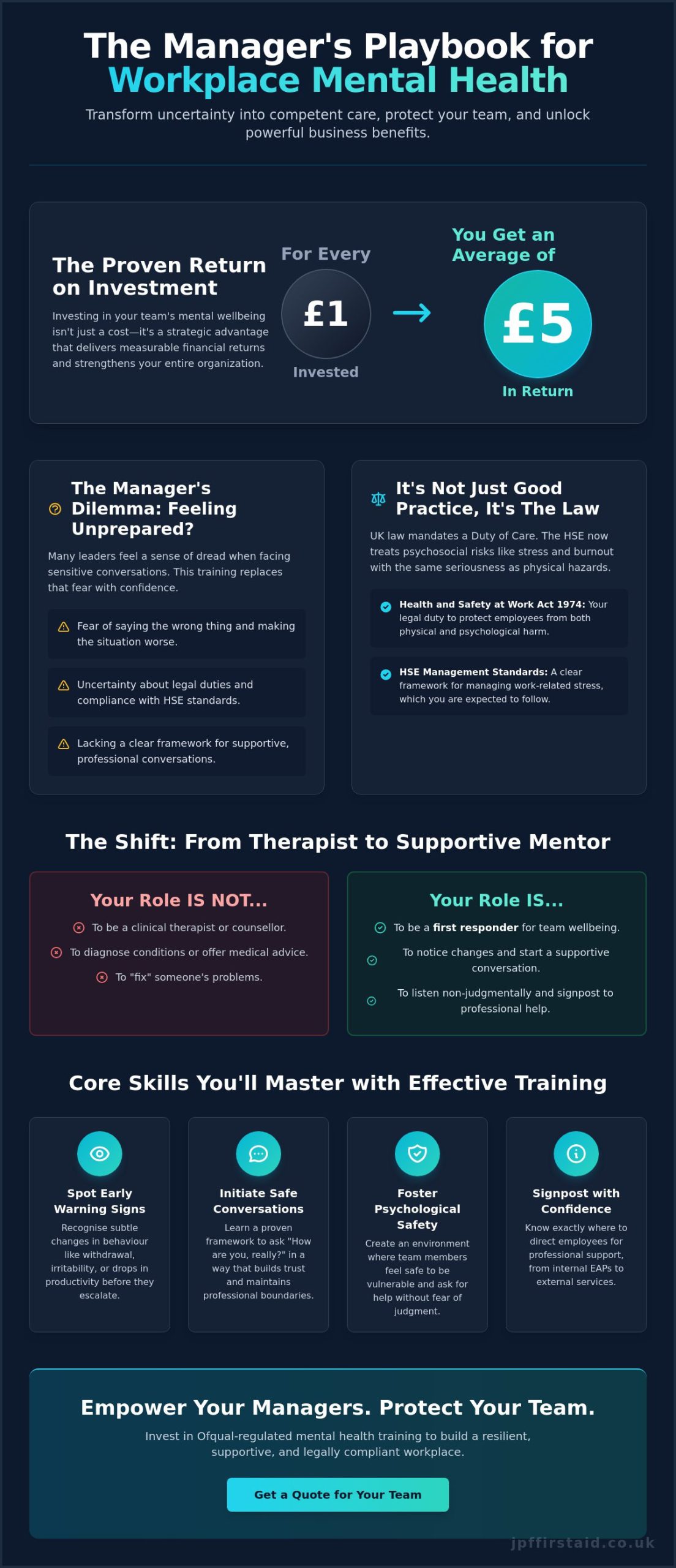
Did you know that for every £1 your organization invests in staff mental health, you see an average return of £5? Despite this clear benefit, many leaders still feel a sense of dread when a team member brings up a personal struggle. You want to be supportive, but the fear of saying the wrong thing or failing your legal duty of care can be paralyzing. It’s common to feel a lack of confidence during sensitive 1-on-1 conversations, especially as the HSE now expects employers to manage psychosocial risks like stress and burnout with the same diligence as physical hazards. Effective mental health awareness training for managers isn’t about turning your leadership team into therapists; it’s about giving them the tools to listen and the knowledge to signpost correctly.
This guide will equip you with the practical skills needed to support employee wellbeing and ensure your business remains compliant with the latest regulatory focus. We’ll show you how a structured approach can reduce absenteeism, lower staff turnover, and provide a clear framework for handling mental health in the workplace. You’ll discover how to move from a reactive “crisis mode” to a proactive culture of support that protects both your people and your organization’s future. It’s time to replace uncertainty with competence and care.
Key Takeaways
- Understand why mental health awareness training for managers is an essential operational skill that moves beyond basic HR compliance.
- Learn how to select the right Ofqual-regulated qualification level based on your company’s size and the specific needs of your leadership team.
- Master a five-step framework for initiating “How are you, really?” conversations that build trust while maintaining clear professional boundaries.
- Gain clarity on your legal obligations under the Health and Safety at Work Act to effectively manage psychosocial risks like workplace stress.
- Identify the core curriculum elements required to spot early signs of burnout and signpost employees toward professional support with confidence.
Understanding the Role of Managers in Workplace Mental Health
Managing a team involves more than just hitting targets and tracking KPIs. It’s about ensuring the people driving those results are healthy, supported, and engaged. In 2026, mental health awareness training for managers has evolved from a optional HR initiative into a core operational skill. You are essentially the first responder for your team’s wellbeing. This doesn’t mean you need a medical degree; it means you need the confidence to recognize when someone is struggling before it impacts their life and your business performance. Think of yourself as a mentor who provides a bridge between a struggling employee and the professional support they might need.
UK law is very clear on your responsibilities. Under the Health and Safety at Work Act 1974 and the Management of Health and Safety at Work Regulations 1999, you have a legal “Duty of Care” to protect employees from both physical and psychological harm. The HSE’s Management Standards provide a clear framework for managing work-related stress, and failing to meet these standards can lead to serious legal repercussions. This intersection of law and wellness is a key part of Occupational Health Psychology, which focuses on creating a safe and productive environment for every worker. Beyond the legalities, the financial impact is significant. Mental health issues cost the UK economy £85 billion annually. By investing in training, you aren’t just ticking a box; you’re protecting your bottom line and your people.
The Shift from Clinical Knowledge to Practical Support
One of the biggest hurdles managers face is the fear of overstepping boundaries. You might worry that you’ll say the wrong thing or that you’re expected to act as a therapist. Let’s be clear: your role is not to diagnose or provide clinical treatment. The goal of mental health awareness training for managers is to help you notice subtle changes in behavior, start a supportive conversation, and signpost the individual to professional help. This creates “psychological safety,” where team members feel they won’t be punished or humiliated for admitting they’re struggling. When people feel safe, they’re naturally more creative and resilient.
Why Managers are the Frontline of Corporate Wellbeing
HR departments are often removed from the day-to-day realities of your team. You’re the one who notices when a normally punctual employee starts arriving late or when a top performer’s output suddenly drops. These are often the first signs of burnout or anxiety. By acting as a proactive mentor rather than a reactive administrator, you can intervene early. Good management is directly linked to reduced workplace stress. When you have the skills to handle these moments with empathy and professionalism, you empower your staff to recover and thrive rather than letting a small issue spiral into a long-term absence.
What Does Effective Mental Health Awareness Training Cover?
Effective mental health awareness training for managers moves beyond clinical definitions of disorders. It focuses on the human experience of work. You don’t need to be a doctor to see that a colleague is struggling. Instead, you need the skills to identify changes in their baseline behaviour. This training helps you lead by example, showing your team that it’s okay to not be okay. By fostering an environment of non-judgmental listening, you break the stigma that often prevents people from seeking help early. It’s about building a culture where support is the default, not the exception.
A robust course curriculum covers the spectrum of mental health, from common stress to more complex conditions like depression and anxiety. It aligns with global standards, such as the Surgeon General’s Framework for Workplace Mental Health, which emphasizes that work should be a place where people can flourish. You’ll learn how to hold space for someone in distress without feeling the pressure to “fix” them. This empowers you to act as a supportive mentor rather than a clinical expert. When you understand these core concepts, you can fulfill your duty of care with genuine confidence.
Recognising Early Warning Signs and Behavioural Changes
You know your team better than anyone else. This familiarity allows you to spot red flags that HR might miss. A sudden drop in productivity is an obvious sign, but withdrawal or irritability are often earlier indicators. In a remote or hybrid setting, these signs manifest differently. You might notice someone keeps their camera off more frequently or becomes unusually quiet on video calls. Training teaches you to look for these psychological and physical shifts, such as fatigue or a change in appearance, so you can offer support before a situation reaches a crisis point.
Mastering the Art of Signposting
Signposting is the most critical skill for any manager. It’s the process of guiding an employee toward professional help while maintaining your professional relationship. You’ll learn how to highlight internal resources, like Employee Assistance Programmes (EAPs) or internal Mental Health First Aiders. You’ll also become familiar with external charities like Mind or the NHS. The key is to signpost gently. You want the employee to feel supported, not pushed away or treated like a problem to be solved. If you’re ready to build these skills, our First Aid for Mental Health (Level 2) course provides the practical foundation you need.
Choosing the Right Level: Awareness vs. First Aid for Managers
Selecting the appropriate course for your team isn’t just about picking a title; it’s about matching the training to the specific responsibilities of your leadership team. In the UK, mental health qualifications are Ofqual-regulated, ensuring that the skills your managers learn meet national standards for quality and reliability. When you invest in mental health awareness training for managers, you need to decide whether your goal is to create general understanding across the whole office or to equip specific leaders with deeper intervention skills. Think of it as building a toolkit where different levels of expertise work together to support the whole organization.
Blended learning has become a favorite for many businesses in 2026. It combines the flexibility of distance learning with expert-led assessments, allowing your managers to study at their own pace without sacrificing the quality of their certification. This approach respects their busy schedules while ensuring they still gain the practical confidence needed to handle real-world situations. Whether you’re a small local business or a large corporation, a tiered approach to training ensures that no one is overwhelmed and everyone is prepared.
Level 1 Awareness vs. Level 2 First Aid for Mental Health
The “Awareness of First Aid for Mental Health (Level 1)” course is the perfect starting point for all staff members. It provides a baseline understanding of what mental health is and how to reduce stigma in the workplace. It’s a shorter time commitment, making it an efficient way to get everyone on the same page. However, for those who will be designated as the primary points of contact for struggling employees, the “First Aid for Mental Health (Level 2)” qualification is the standard. This level goes deeper into specific conditions and provides a clear framework for providing initial support. It’s the difference between knowing that a problem exists and having the confidence to step in and help.
Level 3: Supervising First Aid for Mental Health
For senior leaders, HR professionals, and department heads, the “Supervising First Aid for Mental Health (Level 3)” course is the gold standard. This level is specifically designed for those who have the authority to influence company culture and implement wellbeing policies. It moves beyond individual support to look at the bigger picture, including how to manage the mental health of an entire team. You can explore the full range of these qualifications through our dedicated Mental Health First Aid resources. By training your senior staff at Level 3, you ensure that your mental health strategy is led by people who truly understand the complexities of psychological safety and regulatory compliance. This top-down approach is the most effective way to create a resilient, supportive work environment.
Implementing Training: How Managers Can Apply Skills Immediately
Completing your mental health awareness training for managers is a significant first step; however, the real impact happens when you return to your team. The transition from theory to practice can feel daunting, but it doesn’t have to be. Your goal is to create a culture where wellbeing is woven into daily operations. This starts with how you handle the “small” moments, like a weekly check-in or a casual chat in the breakroom. By applying a structured approach, you can move from feeling uncertain to acting as a confident, supportive mentor for your staff.
Before you start a conversation, setting the scene is vital. Privacy and timing are your two best tools. Never initiate a sensitive discussion in an open-plan office or right before a high-pressure deadline. Use the “How are you, really?” approach. We often ask people how they are as a greeting, and the standard response is “fine.” Asking a second time with genuine intent signals that you are actually listening and that it’s safe for them to be honest. For remote teams, schedule a specific video call that isn’t about tasks or KPIs. This gives the employee the space they need to open up without the distraction of a mounting to-do list.
The “Difficult Conversation” Protocol
When you sit down with a direct report, follow a simple three-part protocol to keep the conversation productive. First, ask open-ended questions. Instead of “Are you stressed?”, try “I’ve noticed you’ve seemed a bit quiet lately; how are things going for you?”. Second, practice the 80/20 rule. You should be listening 80% of the time and talking only 20%. This ensures the employee feels heard rather than lectured. Finally, respond with validation. Avoid the urge to “fix” the problem immediately. Simply acknowledging their feelings with a phrase like “That sounds incredibly challenging” can be more powerful than any piece of unsolicited advice.
Balancing Performance Management with Wellbeing
Managers often struggle when mental health begins to impact performance. You still have a business to run, but you also have a duty of care. The key is to discuss performance through the lens of support. If KPIs are slipping, ask what “reasonable adjustments” could help. This might include flexible start times, temporary task changes, or more frequent breaks. It’s about finding a middle ground that keeps the employee engaged while they recover. Always maintain your boundaries; if a situation becomes too complex, it’s time to involve HR or senior management. If you’re ready to lead your team with this level of expertise, consider enrolling in our Supervising First Aid for Mental Health (Level 3) course.
Supporting others can be emotionally taxing. You must prioritize your own self-care to avoid burnout yourself. Don’t take the employee’s burden home with you. Use the signposting skills you’ve learned to ensure they have professional support, which allows you to remain their manager rather than their therapist. By protecting your own mental space, you ensure you’re always ready to support your team when they need you most.
Why JPF First Aid is the Partner for Managerial Training
Choosing a training provider is about more than just finding a name on a list. It’s about finding a partner who understands the unique pressures you face as a leader. At JPF First Aid, our philosophy is simple: we take serious, often intimidating topics and make them approachable, interactive, and even enjoyable. We believe that you learn best when you’re engaged and relaxed. When you invest in mental health awareness training for managers with us, you aren’t just sitting through a lecture. You’re participating in a confidence-building experience designed to leave you feeling empowered to support your team effectively.
Our lead trainer, John Fogarty, brings over 20 years of experience to every session. This deep well of knowledge means our training is grounded in real-world scenarios rather than just theory. We offer total flexibility to suit your business rhythm, whether you prefer on-site group sessions at your premises or the convenience of distance learning. Our “Confidence Guarantee” ensures that every delegate leaves the course not just with a regulated qualification, but with the practical skills to handle sensitive conversations with ease. You’ll feel like you’re in safe, expert hands from start to finish.
Interactive Learning vs. Passive E-Learning
Many managers have experienced the frustration of “click-through” e-learning courses. While these might check a compliance box, they often fail to build the empathy and communication skills needed for people management. Mental health is a sensitive topic that requires a human touch. That’s why our sessions prioritize role-playing and group discussions. These interactive elements allow you to practice your response in a safe environment before you’re faced with a real-life situation. Building a relationship with a trainer who understands the UK corporate landscape ensures the advice you receive is relevant and actionable.
Tailored Solutions for Your Organisation
Every workplace has its own unique culture and specific challenges. We don’t believe in a one-size-fits-all approach. JPF First Aid adapts our training to your specific industry, ensuring the examples and scenarios we discuss resonate with your managers. To make the process as straightforward as possible, we offer flat-rate group quotes for teams of up to 12 delegates. This provides excellent value while keeping the learning environment intimate and productive. If you’re ready to transform how your leadership team handles wellbeing, book your team’s Mental Health Awareness Training today. Let’s work together to create a more resilient and supportive workplace for everyone.
Take the Lead on Workplace Wellbeing
Investing in your leadership team is the most effective way to protect both your people and your business. We’ve explored how mental health awareness training for managers transforms “difficult” conversations into genuine opportunities for support and growth. By choosing the right Ofqual regulated qualification level, you ensure your managers have the practical tools to fulfill their duty of care without feeling overwhelmed. Your leaders don’t need to be experts in psychology; they simply need the confidence to listen and the knowledge to signpost correctly.
As a multi-award-winning provider with over 20 years of industry experience, JPF First Aid is here to help you navigate these sensitive topics with ease. We make the learning process interactive and enjoyable, ensuring your team leaves feeling truly empowered rather than just certified. Ready to create a healthier, more productive environment? Book Professional Mental Health Training for Your Managers today. You’re making a vital commitment to your team’s future, and we’re here to support you every step of the way.
Frequently Asked Questions
How long does mental health awareness training for managers take?
The duration of the course depends on the specific qualification level you choose for your leadership team. A Level 1 Awareness course typically takes half a day, while the more in-depth Level 2 First Aid for Mental Health requires one full day of study. For senior leaders undertaking the Level 3 Supervising course, you should plan for two days of interactive learning to cover policy creation and culture management.
Is mental health training for managers a legal requirement in the UK?
While there isn’t a single law that names a specific course, you have a clear legal duty of care under the Health and Safety at Work Act 1974. The HSE now explicitly requires employers to assess and manage psychosocial risks such as workplace stress. Implementing mental health awareness training for managers is one of the most effective ways to demonstrate you’re meeting these regulatory standards and protecting your staff from psychological harm.
What is the difference between a Mental Health First Aider and a Manager with awareness training?
A Mental Health First Aider is a designated individual trained to provide initial support and guide people toward professional help across the entire company. A manager with awareness training focuses on applying these skills specifically within their own team. While both roles involve signposting, managers use their training to monitor daily performance changes and maintain a supportive atmosphere during 1-on-1 interactions.
Can mental health training be delivered online for remote teams?
Yes, we offer distance learning and blended options that are specifically designed for remote and hybrid workforces. These sessions remain highly interactive, using digital platforms to facilitate group discussions and practical exercises. This ensures your managers gain the same level of confidence and psychological empowerment as they would in a face-to-face setting without the logistical challenges of travel.
How often should managers refresh their mental health awareness training?
It’s best practice for managers to refresh their skills every three years to stay current with evolving workplace trends and regulations. Most regulated certificates are valid for this period, but many organizations choose to hold shorter annual “top-up” sessions. Regular refreshing ensures your leadership team doesn’t lose the confidence needed to handle sensitive conversations effectively as new challenges arise in the workplace.
What are the most common signs of poor mental health in the workplace?
Poor mental health often shows up as a noticeable shift in an employee’s “baseline” behavior or performance. You might see a normally punctual person starting to arrive late, or a top performer suddenly struggling to meet deadlines. Other red flags include irritability, social withdrawal, or appearing unusually fatigued. In remote settings, look for colleagues who stop turning their cameras on or become silent during team calls.
Does this training count towards CPD (Continuing Professional Development) points?
Yes, all our mental health qualifications are Ofqual regulated and contribute toward your managers’ formal CPD requirements. These courses provide a recognized credential that validates the professional growth of your staff. This not only benefits the individual’s career but also ensures your business is led by people who meet high national standards for competence and care.
How much does it cost to train a group of managers in mental health awareness?
We offer flat-rate group quotes for teams of up to 12 delegates to ensure the process is simple and transparent for your budget. The final cost depends on the qualification level you select and whether you prefer on-site delivery or distance learning. Since every business has different needs, we recommend contacting us directly so we can provide a tailored quote that fits your specific requirements.
Recent Comments