
Did you know that 1 in 4 adults in England will experience a mental health problem this year, according to 2023 NHS Digital data? If you’re worried that saying the wrong thing might make a colleague’s crisis worse, you’re not alone. Many business owners feel stuck between wanting to help and fearing the legal or emotional fallout of overstepping. It’s about being prepared. Mastering mental health first aid isn’t about becoming a therapist; it’s about having the practical tools to bridge the gap between distress and professional support.
You already understand that a healthy team is your greatest asset, but the uncertainty around UK workplace regulations can make taking action feel daunting. This guide will show you exactly how the MHFA framework empowers you to recognise and respond to signs of mental ill-health with genuine confidence. We’ll break down the latest 2026 legal requirements, show you how to start those difficult conversations, and explain how to signpost professional help without overstepping your role.
Key Takeaways
- Understand the vital role of an MHFAider as a reassuring first point of contact, providing immediate support without the need to be a professional therapist.
- Master the ALGEE framework, a gold-standard action plan that gives you a reliable and practical safety net for any mental health intervention.
- Learn why mental health first aid is just as straightforward and essential as physical first aid, helping you respond to a crisis with a calm and confident attitude.
- Discover how to identify the subtle physical and behavioural signs of common conditions like anxiety and depression to offer help before a situation escalates.
- Gain insights into implementing a successful wellbeing strategy in your organisation by choosing empathetic people to lead your workplace support system.
What is Mental Health First Aid and Why Does it Matter?
When you see someone trip and fall, your immediate instinct is to help. You check for injuries, offer a hand, and stay until they’re steady. Mental Health First Aid (MHFA) follows this exact same logic. It’s the initial assistance given to a person developing a mental health problem, experiencing a worsening of an existing condition, or in a mental health crisis. You aren’t training to be a therapist or a professional counsellor. Instead, you’re learning to be a vital first responder who can identify early warning signs and provide immediate, practical support.
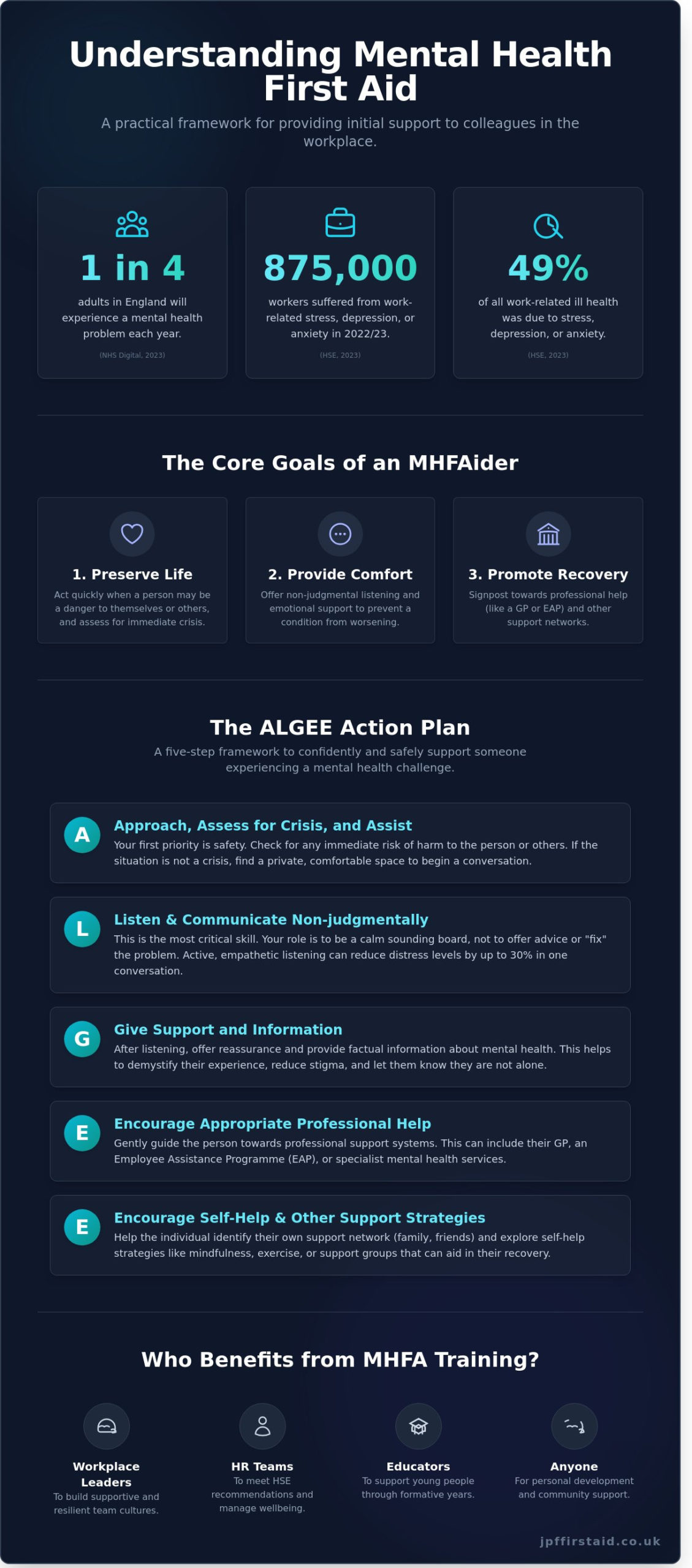
The Health and Safety Executive (HSE) reported that 875,000 workers suffered from work-related stress, depression, or anxiety in 2022/23. This accounted for 49% of all work-related ill health. Early intervention isn’t just a nice gesture; it’s a practical necessity that prevents a manageable situation from spiralling into a long-term crisis. We believe in the “Parity of Esteem.” This means treating mental health with the same level of urgency and professional care as a physical injury. Just as every office has a designated physical first aider, having a trained mental health first aid responder ensures that your team feels safe and supported from every angle.
The Core Goals of an MHFAider
An MHFAider’s role is built on three clear pillars that provide a roadmap for support. You’re there to be a steady hand in a storm, not a clinical expert. Your primary objectives include:
- Preserving life: Acting quickly when a person may be a danger to themselves or others.
- Providing comfort: Offering non-judgmental listening and support to prevent the condition from worsening.
- Promoting recovery: Signposting the individual toward professional help, such as a GP or an Employee Assistance Programme (EAP), and helping them tap into their own support networks.
Who is Mental Health First Aid Training For?
Training isn’t reserved for medical professionals. In 2024, MIND reported that 1 in 4 people in the UK experience a mental health problem each year. This makes the skills essential for workplace leaders and HR teams looking to meet HSE recommendations for wellbeing. It’s also vital for educational professionals and parents who support young people through formative years. Whether you’re interested in community support or personal development, our training gives you the confidence to handle sensitive conversations with a calm, “can-do” attitude. We make the process engaging and relaxed, ensuring you walk away with practical skills you can actually use.
The Core Framework: How the Mental Health First Aid Action Plan Works
You don’t need a medical degree to make a massive difference in someone’s life. The Mental Health First Aid Action Plan, known as ALGEE, serves as the global gold standard for initial intervention. It’s a safety net designed to catch people before they fall into a deeper crisis. While the steps are listed in a specific order, they aren’t a rigid checklist; you can jump between them depending on the situation’s urgency. The framework provides you with the confidence to stay calm when things feel heavy. At its heart, every stage relies on non-judgemental listening to ensure the person feels safe and heard.
ALGEE is the universal mnemonic used by MHFAiders to remember the five essential steps for providing support to someone experiencing a mental health challenge.
Breaking Down the ALGEE Steps
- A: Approach, assess for crisis, and assist. This is about safety first. You’ll check if the person is at immediate risk of harm to themselves or others. If there isn’t an immediate crisis, you simply find a private, relaxed space to talk.
- L: Listen and communicate non-judgementally. This is the most vital skill in the toolkit. You aren’t there to fix the problem or offer “pull yourself together” advice. Instead, you act as a calm sounding board. Data from 2023 workplace studies suggests that active, non-judgemental listening can reduce emotional distress levels by 30% in a single conversation.
- G: Give support and information. Once the person feels heard, you offer emotional support and factual information. This helps demystify what they’re feeling and reduces the stigma often associated with mental health first aid interventions.
Encouraging Professional and Self-Help
E: Encourage appropriate professional help. You’ll help the individual navigate their options, whether that’s booking a GP appointment, contacting a therapist, or using a 24/7 crisis line. In the UK, early intervention can reduce the duration of mental health absences by 25%, making it a vital step for workplace wellbeing. You don’t provide the therapy yourself, but you act as the bridge to those who can.
E: Encourage other supports. Recovery isn’t just about doctors; it’s about community. You’ll encourage them to reach out to family, friends, or explore self-care strategies like exercise or mindfulness. Building this confidence to support others starts with practical training that makes these steps feel like second nature.
Parity of Esteem: Comparing Mental and Physical First Aid
For decades, physical first aid has been the gold standard in UK workplaces. However, the Health and Safety Executive (HSE) updated its guidance in 2018 to ensure employers treat mental health with the same level of importance as physical safety. By 2026, this “parity of esteem” has become a vital part of workplace compliance. You don’t need a medical degree to help someone in distress. Just as you’d use DRABC (Danger, Response, Airway, Breathing, Circulation) to manage a physical injury, Mental Health First Aid (MHFA) uses the ALGEE framework to guide your response.
Many people worry that supporting a mental health crisis is “harder” than patching up a cut. This is a common misconception. While the tools are different, the objective remains the same: stabilisation and referral. In 2024, the HSE reported that 875,000 workers suffered from work-related stress, depression, or anxiety. This figure proves that being prepared for a psychological emergency is just as practical and necessary as knowing how to use a defibrillator. It’s about being that first point of contact who can prevent a situation from worsening.
The Similarities in Response
Both types of first aid require a calm, controlled approach. You are the steady hand in a chaotic moment. Your priority is always safety, both for yourself and the person in distress. You’ll learn to provide clear, concise handovers to professional services. This ensures that the individual gets the right care without delay. Both roles focus on the immediate “here and now” rather than long-term treatment or clinical diagnosis.
The Key Differences in Application
Physical first aid often involves manual skills like bandaging or chest compressions. Mental health first aid relies heavily on your ears and your voice. Active listening is your most powerful tool. You aren’t fixing a broken limb; you’re providing a safe space for someone to be heard. Recovery timelines also differ significantly. A physical wound might heal in a predictable 10 to 14 days. Mental health recovery is non-linear and requires a more flexible approach to support. Our training gives you the confidence to navigate these differences without feeling overwhelmed, ensuring you feel like a capable, reliable mentor for your colleagues.
Identifying the Signs: Common Triggers and Behaviours to Watch For
Recognising when a colleague or friend is struggling isn’t about providing a clinical diagnosis. It’s about noticing shifts in their baseline. Stigma remains the biggest hurdle to early intervention. Research from the Mental Health Foundation shows that 75% of people with mental health issues don’t receive any professional treatment, often due to the fear of being judged. When you apply mental health first aid, your goal is to bridge that gap by spotting the warning signs early. The most important thing to look for isn’t a specific symptom, but rather a deviation from how that person normally acts.
Physical and Emotional Indicators
Mental health struggles often manifest physically before they become obvious emotionally. You might notice a colleague looking exhausted or mentioning they haven’t slept well for weeks. Watch for unexplained physical aches, sudden changes in appetite, or a lack of personal grooming that seems out of character. Emotionally, look for increased irritability, a noticeable drop in self-confidence, or a “flat” affect where the person seems disconnected. Cognitive signs like “brain fog” or an inability to focus on simple tasks are also common red flags that suggest someone is overwhelmed.
Behavioural Changes in the Workplace
In a professional setting, the most significant indicator is a change in a person’s usual habits. A 2024 report by Deloitte found that presenteeism costs UK employers approximately £28 billion every year. This occurs when staff are at their desks but unable to function due to poor mental health. You should be alert to the following changes:
- Social withdrawal: Avoiding team catch-ups, keeping the camera off during calls, or sitting alone during breaks.
- Performance drops: Missing deadlines, making uncharacteristic errors, or struggling to make simple decisions.
- Attendance patterns: Frequent short-term absences, arriving late, or staying much later than usual to “catch up.”
If you spot these changes, start a conversation in a private, neutral space. Use non-confrontational, open-ended questions like, “I’ve noticed you’ve been a bit quieter than usual lately, how are things?” Don’t worry about having all the answers. Your role isn’t to fix the problem; it’s to listen without judgment and offer a path toward professional support. Taking ten minutes to check in can prevent a situation from reaching a breaking point. Effective mental health first aid empowers you to act with confidence when it matters most.
How to Implement Mental Health First Aid in Your Organisation
Implementing a wellbeing strategy isn’t just about ticking a compliance box; it’s about shifting the DNA of your workplace. For a mental health first aid programme to succeed, it requires a top-down approach. According to a 2024 report by Deloitte, UK employers see an average return of £4.70 for every £1 spent on mental health interventions. This ROI is highest in companies where leadership actively participates. When directors and senior managers speak openly about stress and resilience, it dissolves the “stigma wall” that often prevents employees from seeking help until they reach a crisis point.
Choosing the right individuals to step into the role of an MHFAider is equally critical. You shouldn’t simply assign the role to the most senior person or the head of HR. Instead, look for staff members who demonstrate high levels of empathy, active listening skills, and professional discretion. A 2025 workplace survey revealed that 68% of employees feel more comfortable discussing personal struggles with a peer than a direct supervisor. By selecting empathetic volunteers from all levels of the business, you create a more accessible and trusted support network.
Choosing the Right Training Provider
The quality of your training directly impacts the safety of your staff. You need a partner that moves beyond theory to provide practical, life-saving skills. JPF First Aid specialises in delivering mental health first aid training that is actually engaging and fun, stripping away the clinical coldness often found in health and safety courses. When selecting a provider, ensure they offer:
- Trainers with real-world experience who can handle sensitive topics with a “can-do” attitude.
- Regulated qualifications (Level 1, 2, or 3) that are recognised by Ofqual.
- A relaxed learning environment that builds genuine confidence rather than just providing a certificate.
Supporting the Supporters
Being an MHFAider is a significant responsibility that can be emotionally taxing. It’s vital to establish a “support for the supporters” framework. In 2026, leading organisations are implementing monthly peer debrief sessions where first aiders can discuss their experiences in a safe, confidential space. This prevents burnout and ensures your team stays resilient. You should also regularly promote your MHFAiders through internal newsletters and office signage so their presence is always known. If you’re ready to transform your workplace culture, you can Book a regulated Mental Health First Aid course today and gain the skills to protect your most valuable asset: your people.
Building a Resilient Culture for Your Team in 2026
The landscape of workplace wellbeing is shifting rapidly. By 2026, the parity between physical and mental health will be a standard requirement for any successful organization. You’ve explored how identifying early triggers and applying a structured 5-step action plan can prevent minor issues from becoming major crises. Implementing mental health first aid isn’t just a box-ticking exercise; it’s a commitment to the safety and confidence of every person on your team.
We’ve helped hundreds of businesses achieve this through our multi-award-winning training, including 2 recent industry accolades for excellence. Our Ofqual regulated qualifications ensure your staff receive the highest standard of certification available in the UK. JPF First Aid sessions are expert-led, engaging, and fun, because we know that people learn best when they’re relaxed and involved. We don’t believe in dry, clinical lectures. Instead, we focus on practical skills that stick and build genuine confidence.
Empower your team with Mental Health First Aid training you can trust
Taking this step today means your team will have the tools they need to support one another for years to come. You’re in safe hands with us.
Frequently Asked Questions
Is mental health first aid a legal requirement for UK employers?
Currently, mental health first aid isn’t a strict legal requirement under the Health and Safety (First Aid) Regulations 1981. However, the Health and Safety Executive updated their guidance in October 2018 to state that employers should consider mental health alongside physical first aid in their needs assessments. While you won’t face a fine specifically for lacking a responder, failing to support staff wellbeing can lead to claims under the Equality Act 2010.
What is the difference between Level 2 and Level 3 Mental Health First Aid?
Level 2 is a one-day introductory course that gives you a solid foundation in spotting signs of distress. It’s perfect for general staff awareness across your team. In contrast, the Level 3 qualification takes two full days and qualifies you as a Lead Mental Health First Aider. This advanced level covers 15 different mental health conditions and teaches you how to implement a positive wellbeing culture across your entire organisation.
How long does a mental health first aid certificate last?
Your mental health first aid certificate remains valid for three years from the date of issue. After this 36-month period, you’ll need to attend a refresher course to keep your skills sharp and stay updated on the latest clinical guidelines. We recommend booking your renewal at least 60 days before your current certificate expires. This ensures your workplace remains compliant and your confidence in handling difficult conversations stays high.
Can I do mental health first aid training online?
Yes, you can complete your mental health first aid training through our interactive online classrooms. These sessions aren’t just dry videos; they’re live, instructor-led workshops that use digital platforms to facilitate real group discussions. Since 2020, over 70% of our learners have chosen this flexible route. It offers the same regulated qualification as our face-to-face sessions while saving your business travel time and extra costs.
What happens if I make a mistake as a mental health first aider?
You aren’t a doctor or a therapist, so you won’t be held to a clinical standard of care. As long as you act in good faith and follow the training provided, your employer’s liability insurance typically covers your actions. The role is about guided signposting rather than providing a diagnosis. We focus on building your confidence so you feel safe and supported while helping others through their most difficult moments.
How many mental health first aiders does my workplace need?
There isn’t a fixed legal ratio, but the HSE suggests your provision should match your physical first aid needs. For most businesses, we recommend training 1 mental health first aider for every 10 to 50 employees depending on your specific risk level. If you have 100 staff members, having 10 trained responders ensures there’s always someone available across different shifts or departments to provide immediate, local support.
What is the ALGEE action plan in MHFA?
ALGEE is the five-step action plan used to provide consistent support to someone in need. It stands for: Approach the person and assess for risk, Listen non-judgmentally, Give support and information, Encourage professional help, and Encourage other supports. This framework acts as your mental checklist. It ensures you don’t miss vital steps when you’re helping someone who might be experiencing a panic attack or a period of high anxiety.
Does mental health first aid training cover suicide prevention?
Yes, suicide prevention is a core component of the regulated syllabus. You’ll learn how to ask direct questions about suicide, which research shows can actually reduce the risk of someone acting on their thoughts. The training provides a structured 4-step crisis intervention model to keep someone safe until professional emergency services arrive. We give you the practical tools and the right words to handle these sensitive situations with calm professionalism.
Recent Comments