

Would your current first aid certificates stand up to a snap inspection by the Health and Safety Executive (HSE) tomorrow? It’s a question that keeps many of the 5.5 million small business owners in the UK awake, especially since the employer is legally responsible for proving a training provider’s “due diligence.” You’ve likely felt the frustration of trying to decode the difference between Level 2 and Level 3 qualifications while worrying that your next training day will be another dry, boring lecture. Choosing ofqual regulated first aid courses removes that burden entirely, providing an immediate stamp of quality that inspectors and employers trust implicitly.
You deserve to feel confident that your compliance is handled and your team is truly prepared for an emergency. This 2026 guide explains exactly why Ofqual regulation matters for your legal safety and how to select the qualification that fits your specific workplace. We’ll simplify the technical requirements and show you how first aid training can be an engaging, practical, and even fun experience that builds real-world skills. From national recognition to hassle-free certification, here is everything you need to know to get your team qualified with total peace of mind.
Key Takeaways
- Understand how the Regulated Qualifications Framework (RQF) guarantees your training meets the highest national standards for safety and quality.
- Learn why choosing ofqual regulated first aid courses simplifies your HSE due diligence, ensuring your business stays fully compliant without the hassle.
- Discover how to select the right RQF level for your specific workplace risks, from quiet offices to high-intensity construction sites.
- Demystify the legal responsibilities of an employer to ensure your chosen training provider offers the protection and authority your team deserves.
- Find out how to build genuine life-saving confidence through an engaging learning experience that balances professional rigour with a relaxed atmosphere.
What Are Ofqual Regulated First Aid Courses?
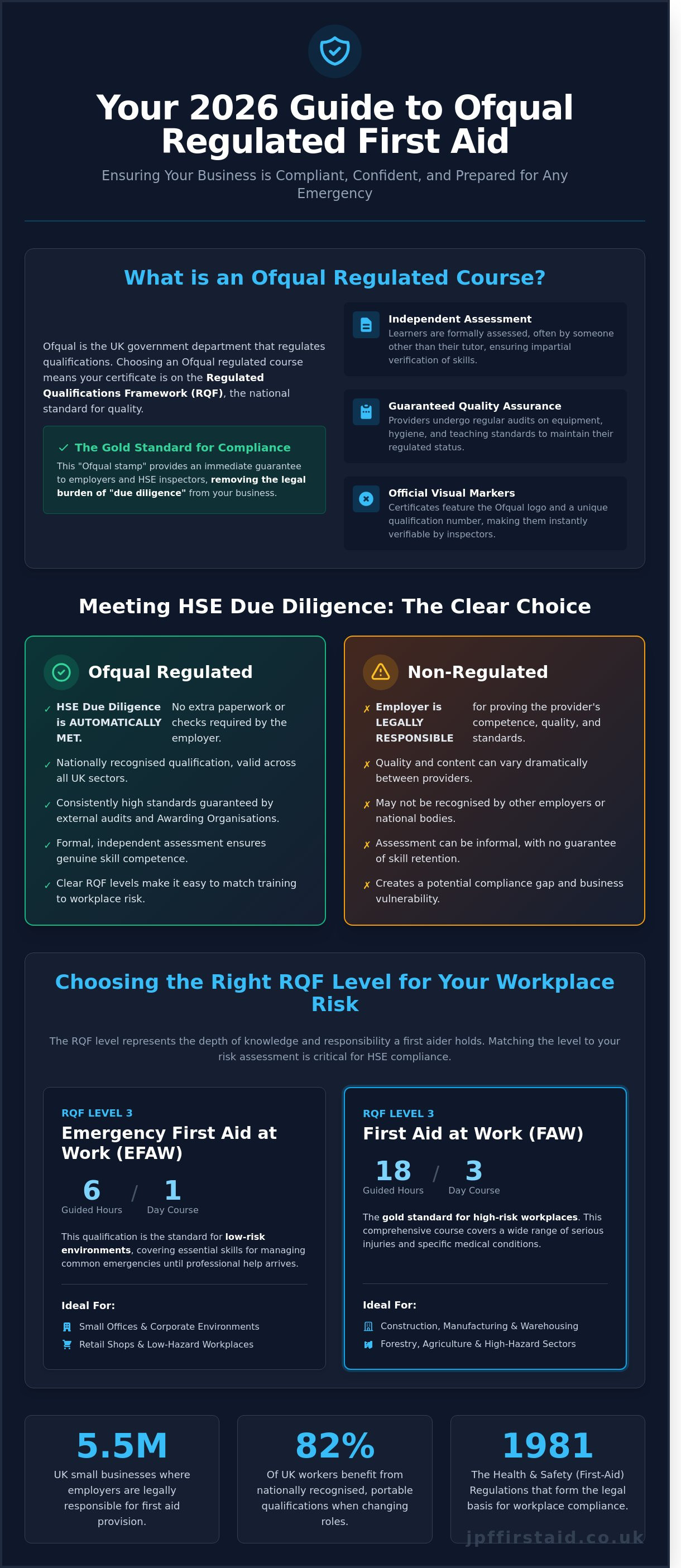
When you’re looking for training that protects both your staff and your business, you’ll likely encounter the term “regulated.” In the UK, this refers to oversight by Ofqual, the non-ministerial government department that regulates qualifications, examinations, and assessments in England. Choosing ofqual regulated first aid courses means you’re opting for a qualification that sits officially on the Regulated Qualifications Framework (RQF), a system that categorises all national qualifications by their level and size.
These courses aren’t just designed by a single trainer; they’re developed and monitored by Awarding Organisations (AOs). These AOs act as the gatekeepers of quality, ensuring that every training centre delivers the same high standard of life-saving knowledge. Think of the “Ofqual stamp” as the gold standard for UK first aid. It provides an immediate guarantee to employers that the training meets the rigorous requirements set out in the Health and Safety (First-Aid) Regulations 1981. This removes the “due diligence” headache for business owners, as the regulator has already done the heavy lifting for you.
The Anatomy of a Regulated Qualification
A regulated course is built on a specific structure that ensures consistency. You’ll notice two key metrics: Guided Learning Hours (GLH) and Total Qualification Time (TQT). For instance, a standard Level 3 First Aid at Work course typically requires 18 GLH. This ensures your team spends the necessary time practicing CPR and wound management rather than rushing through a slide deck.
- Independent Assessment: Learners must pass a formal assessment that’s often verified by someone other than their direct tutor.
- Quality Assurance: Training providers undergo regular audits to ensure their equipment, like manikins and AED trainers, is modern and hygienic.
- Visual Markers: Your certificate will proudly display the Ofqual logo and a unique qualification number, making it easy for inspectors to verify.
Why Regulation Matters in 2026
In the current safety climate, consistency is everything. A Level 3 Award in London is identical to one in the West Midlands, ensuring that skills are transferable across the country. An Ofqual regulated course is a nationally recognised qualification that meets strict government-set standards for assessment and delivery. This portability is vital for the 82% of UK workers who may change roles or sectors, as their ofqual regulated first aid courses remain valid and respected by every new employer. It’s a hassle-free way to ensure your compliance is bulletproof while giving your team the genuine confidence to act in an emergency.
The RQF Framework: Understanding First Aid Levels
The Regulated Qualifications Framework (RQF) provides a clear, tiered structure for your safety training. It’s designed to help you match a learner’s skills to the specific risks in your environment. When you browse ofqual regulated first aid courses, you’ll notice the levels range from 1 to 3. This number isn’t just a label. It represents the depth of knowledge and the level of responsibility a first aider can confidently shoulder. Typically, as the level increases, so does the course duration and the complexity of the medical scenarios covered.
The Health and Safety (First-Aid) Regulations 1981 require employers to provide adequate and appropriate equipment and personnel. Choosing the wrong level creates a compliance gap that could leave your business vulnerable during an inspection or, worse, an actual emergency. For instance, a small retail shop has different needs than a construction site with 50 employees. Matching the RQF level to your specific risk assessment is the only way to ensure you’re fully compliant and your team is truly safe.
Level 3: The Workplace Standard
Level 3 qualifications are the backbone of UK workplace safety. The most common choice is the Level 3 Award in First Aid at Work (FAW). This is a comprehensive 18-hour course delivered over three days. It’s the gold standard for high-hazard environments like manufacturing or forestry. In contrast, the Emergency First Aid at Work (EFAW) is a 6-hour, one-day course. While the EFAW is brilliant for low-risk offices, it doesn’t cover the extensive range of illnesses and injuries found in the full three-day programme. If you manage a large team or work with dangerous machinery, the HSE guidance almost always points toward the full Level 3 FAW to bridge the safety gap.
Level 2 and Specialist Qualifications
Level 2 awards often focus on specific, targeted skills. These include Student First Aid or Basic Life Support, which are perfect for schools or as annual refreshers. However, specialist sectors require their own regulated pathways. For example, if you work in early years childcare, you must meet Ofsted and EYFS requirements. This usually means completing a Level 3 Paediatric First Aid course. Mental health has also seen a shift in 2024, with levels now ranging from Level 1 (Awareness) to Level 3 (Supervising First Aid for Mental Health). Each level builds the confidence needed to handle sensitive situations without overstepping professional boundaries.
Summary of Levels Comparison
While Level 2 focuses on basic life-saving interventions, Level 3 covers a broader range of medical conditions and incident management. To identify the level you need, start by checking your industry regulator’s specific handbook. For example, the 2024 EYFS statutory framework explicitly lists the paediatric requirements for nurseries. If you’re still unsure which path to take, we can help you find the perfect training match for your specific workplace needs.
Regulated vs. Non-Regulated: Meeting HSE Due Diligence
Under the Health and Safety (First-Aid) Regulations 1981, you have a legal duty to provide adequate and appropriate equipment and personnel to help your employees if they are injured or taken ill at work. Since the Health and Safety Executive (HSE) stopped individual provider approvals in October 2013, the burden of proof for quality shifted directly to you, the employer. Choosing ofqual regulated first aid courses is the most straightforward way to ensure you meet these legal obligations without spending hours on administrative paperwork.
Due diligence is the process of taking reasonable steps to ensure a training provider is competent. When you select a provider, you must perform due diligence for first-aid training to satisfy inspectors that your staff are truly capable of saving a life. If you choose a non-regulated provider, you are personally responsible for auditing their internal processes. If you choose a regulated course, that audit has already been completed by an external government body.
The Employer’s Due Diligence Checklist
The HSE sets out four main criteria for choosing a provider: trainer competence, quality assurance systems, teaching standards, and syllabus content. If you opt for a non-regulated provider, you’re responsible for manually checking their insurance, their trainers’ teaching qualifications, and their internal monitoring processes every year. This creates a significant paper trail for your HR department to manage.
- Trainer Competence: Regulated providers must prove their trainers hold specific teaching and assessing qualifications.
- Quality Assurance: An Awarding Organisation (AO) performs regular external audits on the training centre.
- Syllabus Content: The curriculum is mapped to current UK Resuscitation Council guidelines by default.
An Ofqual regulated provider satisfies all these criteria automatically. The certificate carries the Ofqual logo, which acts as a “gold standard” seal of approval that health and safety inspectors recognise instantly.
Cost vs. Value: The Long-term Perspective
You might notice a slight price difference, often ranging between £10 and £25 per person, when booking ofqual regulated first aid courses compared to unaccredited ones. This covers the registration and certification fees charged by the Awarding Organisation to maintain high standards. While non-regulated or “in-house” certificates might seem cheaper today, they carry a hidden risk if an accident occurs and your first aid provision is challenged in court.
An unaccredited certificate may not stand up to scrutiny during a formal investigation, potentially leaving your business liable for thousands of pounds in fines. Investing in a regulated qualification ensures your certificate is recognised nationwide and stays valid for the full three-year period. You can find more details on Choosing the Right Training to see which level fits your specific workplace risk assessment and budget.
How to Choose the Right Regulated Course for Your Sector
Choosing the right training isn’t just about ticking a box for a certificate. It’s about ensuring your team has the skills to act when a real emergency happens. Your starting point is always the First Aid Needs Assessment. This is a legal requirement under the Health and Safety (First-Aid) Regulations 1981. This assessment looks at your specific workplace hazards, the number of employees you have, and how spread out your site is. It helps you decide exactly which ofqual regulated first aid courses your team needs to stay compliant and safe.
To identify a genuine provider, look for the logo of a recognised Awarding Organisation like Qualsafe Awards on their website. Genuine providers will always be happy to share their centre number and qualification details. At JPF First Aid, we focus on making this process hassle-free by bringing the training to you, ensuring the content is relevant to your specific environment.
Workplace and Industrial Settings
Low-risk environments like small offices with fewer than 50 staff usually find the 1-day Emergency First Aid at Work (EFAW) qualification sufficient. However, if you work in high-risk sectors like manufacturing, construction, or forestry, the 3-day First Aid at Work (FAW) course is the standard you need. These industries face higher risks of major trauma or crush injuries. We often recommend pairing your medical training with Fire Marshal Training to ensure your designated safety officers are fully prepared for any workplace incident.
Education and Childcare Requirements
Schools and nurseries must follow the Early Years Foundation Stage (EYFS) statutory framework. This requires at least one person with a full 12-hour Paediatric First Aid certificate to be on the premises at all times when children are present. Because school schedules are incredibly tight, blended learning has become a favourite option. In fact, over 60% of our educational clients now choose this route. It allows staff to complete 6 hours of theory online, followed by one day of practical, hands-on training. You can view the full syllabus for our Paediatric First Aid Course to see how we make these vital sessions engaging and fun for your staff.
Mental Health and Wellbeing
Safety is no longer just about physical injuries. Recent 2024 data from the HSE shows that 47% of all work-related ill health is caused by stress, depression, or anxiety. This shift has made Mental Health First Aid a core corporate priority. Choosing ofqual regulated first aid courses for mental health ensures your staff receive a qualification that is nationally recognised. It gives them the confidence to support colleagues and spot the early signs of mental health struggles before they escalate into a crisis.
Ready to get your team certified? Book your on-site training with JPF First Aid today and gain the confidence that comes from expert-led instruction.
Why JPF First Aid is Your Partner for Regulated Excellence
Choosing a training provider involves more than just finding the lowest price. It’s about finding a partner who understands the weight of responsibility your staff carry. At JPF First Aid, we deliver “First Aid Training You Can Trust” by blending strict compliance with an environment that actually encourages people to learn. We’ve seen that learners retain 75% more information when they’re relaxed and engaged, so we’ve ditched the dry, clinical lectures in favour of interactive, high-energy sessions.
Our bespoke on-site group training is specifically designed for UK businesses that can’t afford downtime. We bring the equipment, the expertise, and the energy directly to your workplace. This approach ensures your team practises in the environment where they’ll actually work, making the scenarios feel immediate and relevant. Whether you’re a small office or a large manufacturing hub, we tailor every session to the specific risks your employees face daily. By 2026, UK health and safety audits will place a higher premium on verified competency, and our ofqual regulated first aid courses ensure you meet that mark every time.
Beyond the Certificate: Building Real Confidence
We act as your Reliable Expert Mentor, focusing on the human element of emergency response. Research suggests that 60% of bystanders hesitate to act during a medical emergency because they fear doing something wrong. Our sessions tackle this anxiety head-on through intensive practical experience. You won’t just watch a demonstration; you’ll repeat the skills until they become second nature. Our instructors guide you through realistic simulations, ensuring muscle memory takes over when it matters most. You leave our classroom feeling ready to act, knowing you have the skills to save a life, not just a qualification for your personnel file.
Hassle-Free Compliance for Your Organisation
Managing health and safety shouldn’t be your second full-time job. We take the administrative burden off your shoulders by handling all certification and paperwork through our regulated awarding bodies. To suit modern work patterns, we offer flexible delivery options, including blended learning models that can reduce classroom time by up to 50%. This ensures your business remains 100% compliant with the Health and Safety (First-Aid) Regulations 1981 without disrupting your weekly operations.
Our support continues long after the course ends. We provide proactive reminders for renewals and regular updates on changing UK standards, so you’re never caught off guard. When you choose JPF First Aid, you’re investing in a long-term safety culture. We make the process of booking and completing ofqual regulated first aid courses simple, professional, and genuinely enjoyable for every delegate involved.
Ready to empower your team with life-saving skills? Book your Ofqual regulated first aid course today and experience training that makes a real difference to your workplace safety.
Future-Proof Your Workplace Safety for 2026
Achieving full compliance doesn’t have to be a daunting tick-box exercise. By 2026, the HSE expectations for due diligence mean that choosing ofqual regulated first aid courses is the most efficient way to protect your team and your legal standing. These qualifications sit directly on the RQF framework, providing a transparent gold standard that eliminates the need for complex independent provider checks. You gain peace of mind knowing your certification is universally recognised across the United Kingdom.
At JPF First Aid, we’ve built our reputation as a multi-award-winning training provider by making life-saving skills accessible. We’re fully accredited by the UK’s leading Awarding Organisations, ensuring every certificate we issue meets the highest regulatory benchmarks. Our expert-led sessions move beyond dry theory. We focus on building your practical confidence through engaging, fun delivery that sticks when it matters most. Whether you’re managing a high-risk industrial site or a small office, we provide bespoke solutions that come directly to your venue.
Secure your workplace compliance with our Ofqual regulated courses
You’ll leave our sessions feeling ready to act with a calm, capable mindset and the skills to save lives.
Frequently Asked Questions
Is it a legal requirement to have an Ofqual regulated first aid certificate?
No, it isn’t a strict legal requirement, but choosing Ofqual regulated first aid courses is the simplest way to meet your Health and Safety (First-Aid) Regulations 1981 obligations. The HSE states that employers must conduct “due diligence” if they choose non-regulated providers. By selecting a regulated course, you bypass this complex 6-step checklist because the quality assurance is already built into the qualification.
How long does an Ofqual regulated first aid qualification last?
Your certificate remains valid for exactly three years from the date of your assessment. While the qualification officially lasts 36 months, the HSE strongly recommends that you attend a half-day annual refresher course. These short sessions keep your skills sharp between full renewals. We find that learners who wait the full 1,095 days without practice often lose 40% of their confidence in performing CPR correctly.
What is the difference between an Awarding Organisation and Ofqual?
Ofqual is the government department that regulates qualifications in England, acting as the official “watchdog” for standards. An Awarding Organisation, such as Qualsafe or TQUK, is a separate body that develops the specific course content and issues your certificate. Think of it like this: the Awarding Organisation sets the exam and marks the papers; Ofqual ensures the Awarding Organisation is following the rules correctly.
Can I get a regulated first aid qualification through online-only training?
No, you cannot earn a fully regulated certificate through online-only study. To meet 2026 UK compliance standards, you must complete a face-to-face practical assessment with a qualified instructor. While “blended learning” allows you to do 33% or 50% of the theory online, you still need to demonstrate life-saving skills like CPR and the recovery position in person. This ensures you have the hands-on confidence to act in a real emergency.
How do I check if a first aid course is actually Ofqual regulated?
You should check the Ofqual Register of Regulated Qualifications website using the specific qualification number. Every genuine regulated course has a unique code, such as 603/2367/0 for an Emergency First Aid at Work certificate. If a provider cannot give you this number or the logo of a recognised Awarding Organisation isn’t on the certificate, the course isn’t regulated. We always provide this transparency to give you total peace of mind.
What happens if my first aid certificate expires?
Once your certificate expires, you are no longer considered a qualified first aider under UK law. You must stop acting as the designated first aider for your workplace immediately. If you miss the expiry date by even one day, you usually have to retake the full 3-day First Aid at Work course rather than the shorter 2-day requalification. This can increase your training costs by over £100 per person.
Do Ofqual regulated courses include paediatric training?
Standard workplace courses focus on adult casualties, but specific Ofqual regulated first aid courses exist for those working with children. The Level 3 Award in Paediatric First Aid is a 12-hour course designed specifically to meet Ofsted and EYFS requirements. If you work in a school or nursery, you’ll need this specific qualification rather than the standard workplace version. It covers everything from infant CPR to common childhood illnesses like croup.
Why do some first aid courses cost more than others?
Price differences usually reflect the quality of the training experience and the mandatory costs of regulation. Regulated courses include a registration fee paid to the Awarding Organisation, which covers the cost of your official certificate and external quality audits. Cheaper, non-regulated courses often skip these essential checks. At JPF First Aid, our fees cover high-quality manikins, fresh training supplies for every student, and the expertise of our qualified instructors.
Recent Comments