
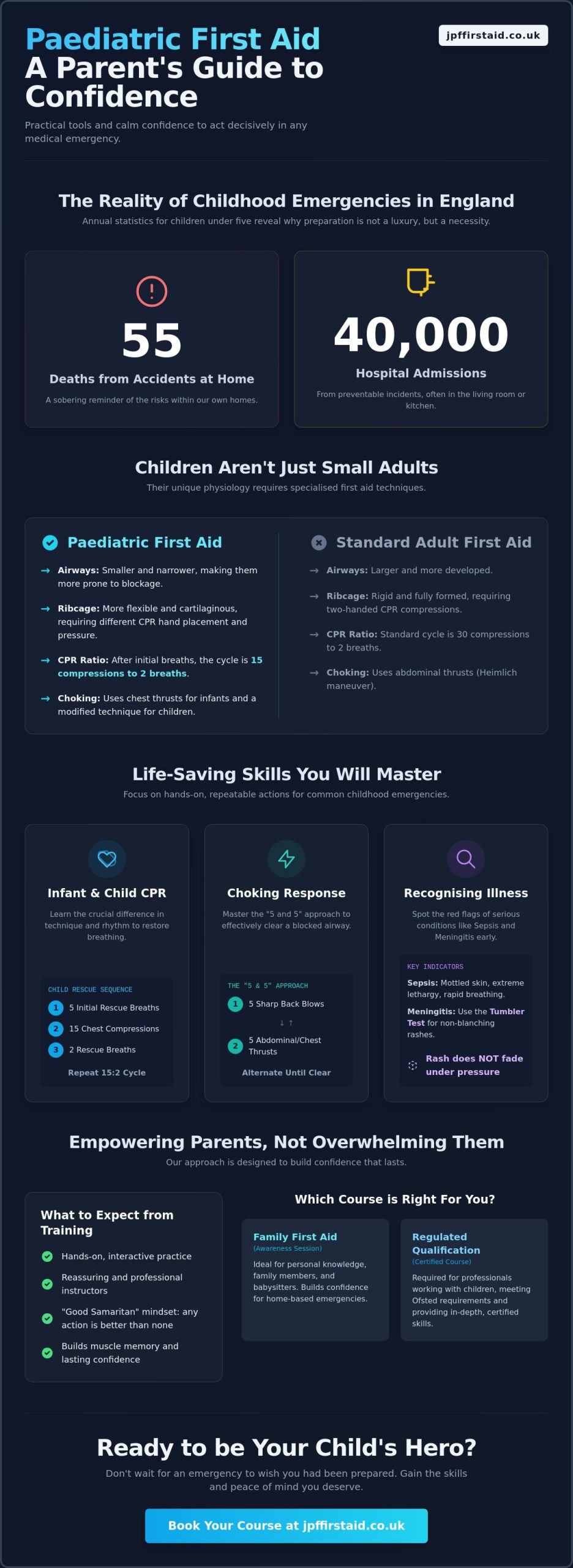
Did you know that every year in England, approximately 55 children under five die from accidents in the home, and another 40,000 are admitted to hospital? It is the silent worry that keeps every parent awake at night: the fear of “freezing” when your child needs you most. You have likely seen conflicting advice online and felt overwhelmed by clinical jargon that feels more like a medical textbook than a practical guide. Finding the right paediatric first aid course for parents shouldn’t feel like a chore or a source of extra stress.
We understand that you want to be the hero your child deserves, not a medical expert. You need hands-on skills that stick, delivered in a way that is actually engaging and fun. This guide promises to give you the practical tools and calm confidence to act decisively in any medical emergency. We will walk you through the essential life-saving techniques for 2026, the benefits of flexible blended learning, and how to secure a certificate that proves you are ready for anything.
Key Takeaways
- Understand why children require specialised first aid techniques due to their unique physiology, ensuring you apply the right methods in an emergency.
- Gain step-by-step mastery of infant and child CPR and choking protocols, replacing the fear of the unknown with practical, life-saving skills.
- Identify whether a “Family First Aid” awareness session or a regulated paediatric first aid course for parents is the right choice for your specific childcare needs.
- Learn how modern training focuses on interactive, hands-on practice to make the learning process engaging and fun rather than dry or clinical.
- Discover the simple steps to booking your local training and the importance of regular refreshers to keep your confidence and skills at their peak.
Why a Paediatric First Aid Course is Essential for Every Parent
Many people assume that first aid is a universal skill, but children aren’t just small adults. Their bodies work differently, which means the way we help them in a crisis must be different too. Paediatric first aid is a specialised branch of care designed specifically for infants, aged 0 to 1, and children, from age 1 up to puberty. Whether it’s a blocked airway or a sudden fall, the techniques you use need to be tailored to their developing physiology.
Children have smaller, narrower airways and more flexible ribcages, making them more susceptible to certain types of trauma. Because of these differences, following the protocols of Pediatric Basic Life Support (PBLS) is vital. A paediatric first aid course for parents teaches you these specific adjustments, such as using different hand positions for CPR or varying the force used for choking rescues. Understanding these nuances is often the difference between a panicked reaction and a life-saving intervention.
In the medical world, we often talk about the “Golden Hour,” but in a home emergency, you only have minutes. You are the first link in the chain of survival. By the time an ambulance arrives, your initial actions have already set the stage for your child’s recovery. This training isn’t about becoming a doctor; it’s about gaining the peace of mind that you can protect your family when it matters most.
The Reality of Childhood Emergencies in the UK
The statistics are a sobering reminder of why this training is a necessity rather than a luxury. In England, roughly 55 children under the age of five die each year due to accidents in the home. On top of that, 40,000 young children are admitted to hospital annually following preventable incidents. Since the majority of these accidents happen in the living room or kitchen, you are effectively the primary first responder. Being prepared means you can manage a situation safely before professional help takes over.
Building the Confidence to Act
The biggest barrier to helping a child is often the fear of making things worse. We hear it all the time: “What if I break a rib?” or “What if I forget the steps?” Our paediatric first aid course for parents is designed to dismantle that anxiety. We focus on a “Good Samaritan” mindset, where we show you that taking any positive action is almost always better than doing nothing at all. At JPF First Aid, our approach is reassuring and professional, ensuring you leave our sessions feeling empowered rather than overwhelmed. We swap clinical dread for a practical, “can-do” attitude that stays with you long after the course ends.
Key Skills Covered: What You Will Learn in a Parent-Focused Course
When you join a paediatric first aid course for parents, the goal isn’t to turn you into a paramedic. It’s to give you a clear, repeatable set of actions for the most common childhood emergencies. We strip away the complex medical jargon and focus on hands-on techniques that you can use the moment you get home. From managing a simple burn to responding to a life-threatening choking incident, the curriculum is designed to build your muscle memory and your confidence.
If you’d like to see how these skills fit into your wider home safety plan, you can explore our paediatric training options for a more personalised experience. We believe that practical, interactive learning is the only way to truly prepare for the unexpected.
Life-Saving Interventions: CPR and Choking
The most vital skill you will learn is how to help a child who has stopped breathing or is choking. According to Resuscitation Council UK guidelines, the specific rescue ratio for children involves 15 chest compressions for every 2 rescue breaths after an initial set of 5 breaths. This is a crucial distinction from adult CPR that we practice extensively during our sessions. For a choking child, we teach you the “5 and 5” approach: alternating between five sharp back blows and five abdominal thrusts (or chest thrusts for infants) to clear the airway. We use specialised manikins that mimic a child’s physiology, allowing you to feel the correct depth and pressure required for these life-saving moves.
Recognising Serious Illness: Sepsis and Meningitis
Not every emergency starts with an accident. Sometimes, the threat is a fast-moving illness. We teach you how to identify the “non-blanching” rash using the tumbler test, which is a key sign of meningitis. You will also learn to spot the red flags of sepsis, such as mottled skin or extreme lethargy. Knowing when to call 999 immediately versus when to contact 111 or your GP can save precious time. For more information on what you should keep at home to manage these situations, take a look at our guide on What Are the First Aid Essentials?.
Common Home Hazards: Poisoning and Febrile Convulsions
Household hazards often catch parents off guard. If your child swallows a cleaning product or a button battery, your first instinct might be to induce vomiting, but this can often cause more harm. We provide clear protocols for accidental ingestion and how to communicate effectively with emergency services. We also cover febrile convulsions, which affect about 1 in 20 children. These seizures are caused by a rapid spike in body temperature. While they are terrifying to watch, we’ll show you how to keep your child safe and manage their temperature until the seizure passes. This level of preparation aligns with the standards found in a Heartsaver Pediatric First Aid CPR AED course, ensuring you have professional-grade knowledge in a relaxed, parent-friendly setting.
Awareness vs. Regulated Qualifications: Which Course Do You Need?
Choosing the right paediatric first aid course for parents depends on one simple question: do you need a certificate for your job, or do you just want to protect your family? While the life-saving techniques remain the same, the depth of training and the formal recognition vary significantly between awareness sessions and regulated qualifications. Understanding these differences ensures you don’t spend more time or money than you actually need to.
The time commitment is often the deciding factor for busy households. A family-focused awareness session usually takes just 2 to 3 hours, making it easy to fit into a weekend or evening. In contrast, a regulated qualification requires 12 hours of training. This is typically delivered through a flexible “blended” model, consisting of 6 hours of online theory followed by 6 hours of practical, in-person practice. Both routes provide the same “can-do” confidence, but they serve very different purposes.
The Ofqual Regulated Route
If you are a childminder, nanny, or nursery worker, the law is very specific. The Early Years Foundation Stage (EYFS) framework mandates that at least one person with a full 12-hour paediatric first aid certificate must be on the premises at all times when children are present. This also applies to any off-site outings. Our Paediatric First Aid (Level 3) qualification is Ofqual regulated, meaning it is nationally recognised and meets all Ofsted requirements. These certificates are valid for three years, after which you will need to take a refresher course to maintain your professional compliance.
The Informal Awareness Route
For most parents, grandparents, and expectant couples, the informal awareness route is the ideal choice. These sessions are designed to be hassle-free and relaxed, stripping away the pressure of formal assessments. You still get to practice with the same professional-grade manikins and learn the identical life-saving protocols as the professionals, but without the need for a 12-hour commitment. It is the perfect way to gain the skills you need in a friendly, approachable atmosphere. Whether you are worried about weaning or want to be prepared for toddler mishaps, these sessions focus on the practical reality of parenting rather than workplace regulations.
- Family First Aid: Best for parents and carers who want peace of mind without an exam.
- Level 3 Paediatric First Aid: Essential for anyone working professionally with children under the EYFS framework.
- Blended Learning: A modern, convenient way to complete regulated training by splitting time between home study and the classroom.
Making First Aid ‘Engaging and Fun’: What to Expect
Many parents hesitate to book training because they expect a dry, clinical lecture filled with endless PowerPoint slides and medical jargon. We understand that your time is precious, and the last thing you want is to feel bored or overwhelmed. Our approach to a paediatric first aid course for parents is built on the belief that if you aren’t enjoying the session, you aren’t truly absorbing the life-saving information. We swap the stiff, classroom atmosphere for a relaxed and welcoming environment where the focus is on your success.
As your reliable expert mentors, we aim to make you feel completely at ease. We don’t just stand at the front of the room and talk at you. Instead, we facilitate a conversation. We share our deep knowledge with humility, focusing on the practical “how-to” rather than just the theory. This interactive style helps to alleviate the anxiety often associated with emergency response. You’ll find that our sessions are far from clinical; they are designed to be a “hassle-free” experience that builds your confidence through encouragement and clear, direct guidance.
Interactive Learning Techniques
We believe in learning by doing. Instead of reading from a textbook, we immerse you in real-world scenarios that reflect the actual challenges of parenting. You will spend a significant amount of time working with specialised manikins to build the muscle memory required for CPR and choking protocols. This physical practice is vital because it helps you bypass the natural “freeze” response that can happen during the panic of a real emergency. We also create plenty of space for “what if” discussions, encouraging you to ask the specific questions that keep you up at night. This ensures you leave with answers that apply directly to your home life.
Flexible Delivery: Coming to You
One of the biggest hurdles for busy parents is finding the time to travel to a training centre. That is why we offer a “coming to you” service that brings the training directly into your living room or a local community hall. This is an ideal solution for NCT groups, circles of friends, or extended families who want to learn together in a familiar space. Training in your own environment reduces the pressure of a formal qualification setting and allows you to relax and focus. To understand more about how this flexible approach fits into the modern training landscape, you can read our full guide on First Aid Courses in 2026.
Ready to gain life-saving skills in a way that actually sticks? Contact us to book a bespoke group session for your friends and family today.
How to Book and Maintain Your Life-Saving Skills
Booking your paediatric first aid course for parents is a straightforward process designed to fit into your busy life. You can choose to join one of our pre-scheduled sessions at a local venue or, as we discussed earlier, book a private group session where we come to you. Once you’ve decided on the format, the booking itself takes just a few minutes. We handle all the logistics and paperwork so you can focus entirely on the learning experience.
Preparing your home is the next logical step after completing your training. A “First Aid Ready” home means having a well-stocked kit in an accessible location and a list of emergency contacts clearly displayed. Your kit should include varied sizes of sterile dressings, hypoallergenic plasters, and a digital thermometer. Don’t forget to post the numbers for 999 and 111 on your fridge, along with your specific GP details and any relevant medical history for your children. This simple organisation ensures that even if you feel a brief moment of stress, the information you need is right there in front of you.
Finding the Right Training Partner
When selecting a provider, look for multi-award-winning experts who truly understand the unique needs of families. You want a trainer who doesn’t just follow a script but offers bespoke advice tailored to your specific concerns, such as managing severe allergies or childhood asthma. It’s about finding a mentor who makes you feel supported rather than tested. For those looking for local, high-quality sessions, our Paediatric First Aid Course Cannock provides the perfect balance of professional certification and practical, parent-focused skills.
Your Post-Course Action Plan
Your journey doesn’t end when the course finishes; it’s vital to refresh your skills annually and renew your formal certificate every three years to keep your life-saving knowledge sharp. We recommend keeping a physical first aid manual in your kit or a reliable emergency app on your phone for quick reference during those minor bumps and scrapes. These tools act as a helpful prompt for the skills you’ve already mastered. Taking this step is the best decision you can make for your family’s safety. Join a paediatric first aid course for parents today and transform from an anxious parent into a confident, capable responder.
Secure Your Peace of Mind Today
You now understand that children aren’t just small adults; they require a specialised approach when things go wrong. By choosing the right training, you’ve moved from worrying about “what if” to knowing exactly how to handle a crisis. We’ve explored how a paediatric first aid course for parents can bridge the gap between panic and professional action, whether you need a certificate for Ofsted or simply want to protect your own living room.
JPF First Aid is a multi-award-winning training provider dedicated to making life-saving skills accessible. Our expert-led, relaxed sessions focus on practical application rather than dry theory, ensuring you leave with genuine confidence. With Ofqual regulated qualifications available and the flexibility of on-site training, we make it easy to prioritise your family’s safety without the stress of a clinical environment.
Book Your Engaging and Fun Paediatric First Aid Course Today
You have the power to be the hero your child needs in an emergency. We’re ready to provide the expert-led guidance and “can-do” attitude to help you get there.
Frequently Asked Questions
Is a paediatric first aid course for parents different from a workplace one?
Yes, the main difference lies in the focus and the assessment process. While workplace courses follow strict Ofsted and EYFS requirements for professional certification, a paediatric first aid course for parents prioritises practical, home-based scenarios. You still learn the same life-saving techniques, but the atmosphere is more relaxed and there is no formal exam. This allows us to focus on the specific worries you have as a parent.
Can I bring my baby to the first aid class?
We usually welcome non-mobile babies to our private “at-home” sessions. Learning in your own environment makes it much easier to tend to your child while you gain new skills. For our public scheduled courses, it is best to check with us first. We want to ensure the venue is suitable and that you can focus fully on the hands-on practice without too many distractions.
How long does a parent first aid course typically last?
A standard awareness session for parents and carers typically lasts between 2 and 3 hours. We’ve designed this timeframe to cover the most critical skills, such as CPR and choking, without overwhelming you or taking up your entire day. It’s a “hassle-free” way to gain massive amounts of confidence in just one morning or afternoon. Professional qualification courses take longer to meet regulatory standards.
What happens if I forget what I’ve learned in an emergency?
This is a common worry, but our training is designed to build muscle memory that kicks in when you need it. We focus on simple, repeatable steps that stay with you even during a stressful moment. You’ll also leave with a helpful manual or access to resources. These tools act as a quick reference guide to refresh your memory whenever you feel your confidence start to dip.
Do I get a certificate after a parent first aid course?
You will receive a certificate of attendance to confirm you’ve completed your paediatric first aid course for parents. While this isn’t an Ofqual-regulated workplace qualification, it is a proud record of your commitment to your family’s safety. If you are a nanny or childminder who needs a formal Level 3 award for your job, we provide those regulated paths as well.
Is an online paediatric first aid course as good as an in-person one?
Online courses are great for learning theory, but they can’t replace the value of hands-on practice. Feeling the correct pressure for a chest compression on a manikin is a physical skill that requires in-person feedback. We believe the best way to learn is through a practical session where an expert can guide your technique. This ensures you have the physical confidence to act decisively.
What should be in a basic home first aid kit for children?
Your kit should include varied sizes of plasters, sterile dressings, a digital thermometer, and antiseptic wipes. It’s also vital to have saline solution for cleaning eyes or wounds and a pair of tweezers for splinters. We recommend keeping your kit in a specific, easy-to-reach spot. Make sure every adult in the house knows exactly where it is so no time is lost in an emergency.
Are there any specific courses for grandparents or babysitters?
Our Family First Aid and awareness sessions are ideal for grandparents, babysitters, and any other family members who help with childcare. These sessions are inclusive and easy to follow, ensuring everyone in your support network has the same life-saving knowledge. It gives you immense peace of mind to know that your child is in safe, capable hands even when you aren’t there.
Recent Comments