

What would you do if a child in your care started choking, or had a serious fall? For many parents and childcare professionals, the fear of freezing in a real emergency is all too real. And let’s be honest, the thought of enduring another dry, PowerPoint-heavy training day can feel just as daunting. But getting the right paediatric first aid training doesn’t have to be a chore you dread or a box-ticking exercise that leaves you feeling unprepared.
This comprehensive 2026 UK guide is designed to change that. We will walk you through everything you need to know to protect the children in your care with calm confidence. You’ll learn how to navigate the latest Ofsted and EYFS requirements with ease, finally understand the crucial differences between Level 3 and Emergency certificates, and discover how to find a practical, engaging course that gives you the skills you’ll actually remember. Get ready to feel genuinely capable and fully prepared.
Key Takeaways
- Understand the essential Ofsted and EYFS requirements for 2026 to ensure your school or nursery is fully compliant and safe.
- Master the crucial differences in CPR and choking procedures for infants and children, as treating them like ‘small adults’ can be ineffective.
- Compare blended and classroom learning to find the most efficient paediatric first aid training option that fits your team’s busy schedule.
- Build the confidence to act decisively in a real emergency, moving beyond theory with practical, hands-on skills you can trust.
Why Specialized Paediatric First Aid Training is Essential in 2026
When a child is in distress, every second counts. Paediatric first aid is not simply a scaled-down version of adult first aid; it is a specialized discipline focused on the unique needs of infants (from birth to 1 year) and children (from 1 year to puberty). The stakes are incredibly high, and having the confidence to act correctly can make all the difference. For nurseries and schools in Cannock, providing effective, rapid first aid is not just a legal requirement-it’s a fundamental part of your duty of care.
Statistics consistently show that prompt and appropriate first aid intervention significantly improves a child’s chances of a full recovery after an accident or medical emergency. Investing in professional paediatric first aid training equips your team with the practical skills and calm assurance needed to manage emergencies effectively, turning potential panic into purposeful action.
The Difference Between Adult and Paediatric Care
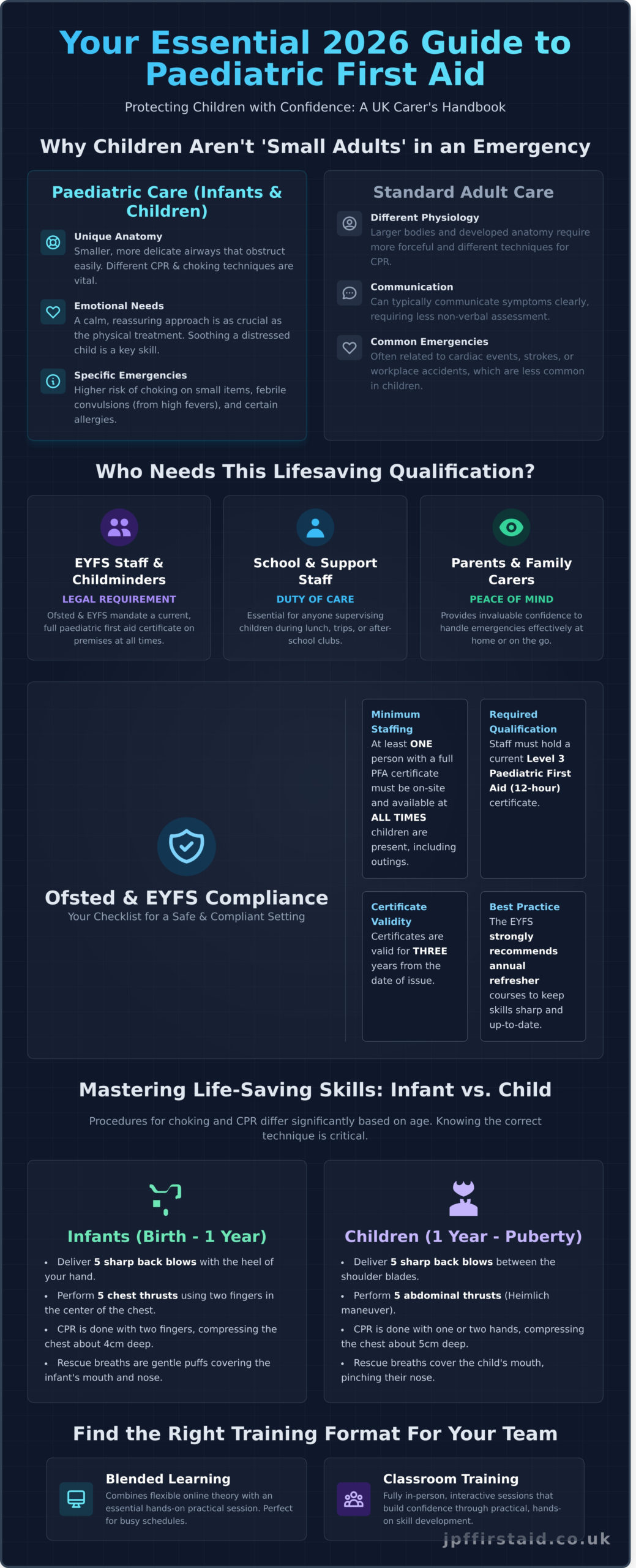
Treating a child as a ‘small adult’ in a medical emergency can be ineffective and even dangerous. Their bodies and emotional needs are fundamentally different, requiring a distinct approach. Key distinctions include:
- Anatomy and Physiology: Children have smaller, more delicate airways that can become obstructed easily. Their heart rates are faster, and the techniques for clearing an airway or performing CPR are distinct, forming the core of Pediatric Basic Life Support (PBLS).
- Emotional and Psychological Needs: A calm, reassuring approach is vital. Your ability to soothe a frightened or distressed child is just as important as the physical treatment you provide.
- Common Paediatric Emergencies: The risks are different. Children are more susceptible to specific issues like choking on small objects, high-temperature febrile convulsions, and certain allergic reactions.
Who Specifically Needs This Qualification?
While everyone can benefit from these life-saving skills, specific roles carry a professional or moral responsibility to be trained. This vital qualification is designed for:
- EYFS Staff and Ofsted-Registered Childminders: For you, this is a legal requirement. The Early Years Foundation Stage (EYFS) statutory framework mandates that at least one person with a current full paediatric first aid training certificate is on the premises and available at all times when children are present.
- Parents, Grandparents, and Carers: For family members, a non-regulated ‘Family First Aid’ course provides invaluable peace of mind and the confidence to handle emergencies at home.
- School Support Staff and Sports Coaches: Anyone supervising children during lunch, on school trips, or in after-school clubs plays a crucial role in maintaining a safe environment.
Navigating UK Regulations: Ofsted, EYFS, and Level 3 Requirements
Understanding your legal obligations is the first step towards creating a safe and compliant nursery environment. For childcare providers in Cannock and across the UK, Ofsted inspections are a reality, and first aid provision is a non-negotiable part of their assessment. The rules are set out within the Early Years Foundation Stage (EYFS) statutory framework, which acts as the definitive guide for your setting.
This framework clearly states that providers must have a deep understanding of the official UK regulations for paediatric first aid to ensure the safety of children in their care. Getting this right isn’t just about ticking a box; it’s about building genuine confidence to act effectively in an emergency. We make navigating these requirements straightforward and hassle-free.
EYFS Compliance for Nurseries and Pre-Schools
To meet Ofsted standards, your nursery or pre-school must have at least one staff member with a current, full Level 3 Paediatric First Aid certificate on-site and available at all times when children are present. This includes during trips and outings. For inspections, you must maintain clear records of all staff qualifications, including certificate expiry dates. While certificates are valid for three years, the EYFS strongly recommends annual refresher courses to keep life-saving skills sharp and up-to-date.
Choosing the Right Level for Your Role
Selecting the correct paediatric first aid training course is crucial for both compliance and competence. The right choice depends on your specific role and responsibilities within the early years setting.
- Level 3 Paediatric First Aid (12-hour): This is the comprehensive, two-day course that meets the full Ofsted and EYFS requirements. It is essential for childminders, nursery managers, and any staff member designated as a primary first aider.
- Emergency Paediatric First Aid (6-hour): A valuable one-day course suitable for support staff or newly qualified practitioners. While it provides essential skills, it does not meet the full EYFS requirement for the designated first aider on its own.
- Bespoke Family First Aid: This is our non-regulated option, perfect for parents, grandparents, and babysitters who want to learn vital skills for home safety without needing a formal qualification for work.
As qualification standards from bodies like Ofqual evolve, we ensure our training always reflects the latest best practices, giving you peace of mind that your team is fully prepared and compliant.
Blended Learning vs. Classroom Training: Which is Right for You?
When it comes to meeting your EYFS and Ofsted requirements, you have two excellent paths to achieving a fully regulated qualification. Both our Blended Learning and traditional 2-day classroom courses cover the complete 12-hour syllabus. The best choice for your Cannock nursery or school simply depends on your team’s schedule and learning preferences. Let’s break down the options to help you decide.
Our Blended Learning option splits the course into two manageable parts: 6 hours of engaging online theory, completed at your own pace, followed by a 6-hour practical session at your venue. This modern approach is ideal for minimising disruption in a busy setting.
The Benefits of Blended Learning
This flexible approach to paediatric first aid training is designed for the demands of commercial childcare. It significantly reduces staff downtime and scheduling headaches. Team members can complete the online modules from home, fitting crucial learning around their lives. Key advantages include:
- Maximum Flexibility: Staff learn the essential theory when it suits them best, without pressure.
- Reduced ‘Time Out’: Only one day of in-person training is needed, making it easier to manage staff ratios.
- Interactive Learning: Our engaging digital modules are designed to be more memorable and effective than traditional textbook study.
Why Traditional Classroom Training Still Wins
For many, nothing beats the focused, shared experience of a 2-day face-to-face course. This format allows your team to fully immerse themselves in the material without home-life distractions, fostering a strong sense of camaraderie and shared responsibility. The primary benefits are:
- Direct Expert Access: You can ask our lead trainer, John Fogarty, questions as they arise and benefit from group discussion.
- Real-Time Feedback: Get immediate, hands-on correction for crucial techniques like CPR, choking management, and bandaging.
- Powerful Team Building: Learning and practising life-saving skills together is an invaluable team-building experience that builds trust.
Ultimately, both training routes lead to the same vital qualification and the confidence to act decisively in an emergency. The critical element, as outlined in the official UK government guidance, is the practical, face-to-face assessment. Whether you choose the convenience of blended learning or the immersive classroom course, you can be confident that the hands-on skills are assessed thoroughly by an expert, ensuring your team is fully prepared and compliant.
Mastering Life-Saving Skills: From Choking to CPR
When an emergency happens, confident and decisive action can make all the difference. Our practical, hands-on paediatric first aid training is designed to build that confidence, turning theoretical knowledge into instinctive, life-saving skills. We focus on the core techniques you’ll need to manage the most critical situations calmly and effectively.
At the heart of any response is the Primary Survey, modified for little ones: DRABC (Danger, Response, Airway, Breathing, Circulation). You’ll learn how to assess a situation safely before acting. From there, we move into crucial hands-on practice, including infant and child CPR, using the correct 30 chest compressions to 2 rescue breaths ratio. We also cover the vital steps for managing a choking child, from effective back blows to abdominal thrusts, and how to recognise the signs of anaphylaxis and use an adrenaline auto-injector (like an EpiPen) without hesitation.
Handling Common Childhood Injuries
While nurseries are safe environments, bumps and tumbles happen. Knowing how to respond to common injuries is essential for any EYFS practitioner.
- Burns and Scalds: We teach the crucial ‘cool, call, cover’ method, including the updated 20-minute cooling rule, ensuring you provide the best immediate care.
- Head Injuries: You’ll learn to spot the difference between a simple bump and the more worrying signs of concussion or serious trauma that require urgent medical attention.
- Fractures and Dislocations: The priority is to prevent further harm. We show you how to support and immobilise an injury effectively until the paramedics arrive.
Medical Emergencies: Sepsis, Meningitis, and Asthma
Recognising the early signs of a sudden medical emergency is a key part of safeguarding children. Our training ensures you are prepared.
- Sepsis & Meningitis: Learn the critical early warning signs, including the ‘glass test’ for a non-blanching rash, and understand why acting fast is paramount.
- Asthma Attacks: We’ll guide you through the correct protocol for helping a child during an asthma attack, including how to assist with their inhaler and when you must call 999.
Mastering these skills is not just about ticking a box for Ofsted; it’s about creating a truly safe space for the children in your care. The expert guidance in our paediatric first aid training provides the assurance you need to act correctly when it matters most. Learn more about our on-site courses in Cannock today.
Why JPF First Aid is the Trusted Choice for Paediatric Training
Choosing the right training provider is a decision that directly impacts the safety of the children in your care. At JPF First Aid, we understand that responsibility. We believe effective paediatric first aid training is about more than just ticking boxes for compliance; it’s about building genuine confidence. Our ‘Reliable Expert Mentor’ approach means our trainers are not just presenters-they are experienced professionals dedicated to ensuring you leave feeling capable and prepared for a real emergency.
We make a simple promise: our courses are engaging and fun. You won’t find any boring, PowerPoint-led sessions here. Instead, we use practical, hands-on scenarios that make learning memorable. This active approach helps cement life-saving skills, ensuring you can recall them under pressure. When training is enjoyable, retention improves, and that’s what makes the difference in a critical moment.
Flexibility is at the heart of what we do. We can deliver training directly at your school or nursery in Cannock, minimising disruption to your schedule and allowing us to tailor scenarios to your specific environment. Alternatively, individuals or smaller groups can join one of our welcoming public courses held locally. Whichever you choose, you receive the same high-quality, supportive instruction. Your peace of mind is paramount, which is why all our qualifications are Ofqual regulated, guaranteeing they meet all EYFS statutory framework and Ofsted requirements.
Bespoke Group Training for Schools and Nurseries
Organising training for your whole team has never been easier. Our on-site group courses offer a simple, cost-effective solution for up to 12 delegates, designed specifically for the early years environment.
- Flat-rate pricing: A clear, predictable cost for your entire group with no hidden fees.
- Tailored to you: We adapt content to address risks unique to your setting, from the playground to the lunch hall.
- Hassle-free management: We handle the booking, delivery, and certification process, freeing up your valuable time.
Confidence-Based Learning Outcomes
A certificate is essential, but true confidence is what saves lives. Our training focuses on empowering your staff to move beyond theory and act decisively in a real-world situation. We build readiness, not just knowledge. All learners receive access to post-course support and resources, ensuring their skills remain sharp long after the training day is over. We are your partners in paediatric safety.
Ready to equip your team with the skills and confidence to protect the children in your care? Book your Paediatric First Aid course with JPF First Aid today.
Your Next Step: Become a Confident First Aider for Children
As we’ve covered in this 2026 guide, being prepared for a child’s medical emergency is about much more than just compliance. It’s about understanding UK regulations for your school or nursery, choosing the right training format, and mastering essential skills from CPR to choking response. Investing in professional paediatric first aid training provides the critical knowledge and confidence to act decisively when it matters most.
Choosing your training partner is a vital part of that investment. At JPF First Aid, our multi-award-winning team brings over 20 years of real-world experience to every session. We deliver Ofqual Regulated Qualifications in a way that is engaging, practical, and memorable, ensuring you leave not just with a certificate, but with the genuine confidence to handle an emergency calmly and effectively.
Don’t wait for a crisis to wish you were prepared. Secure your place on our next Paediatric First Aid course and take the definitive step towards safeguarding the children in your care. You have the power to be the person they can count on.
Frequently Asked Questions
Is the Paediatric First Aid course Ofsted approved?
Ofsted doesn’t directly approve specific training providers. Instead, they require that your qualification meets the standards of the Early Years Foundation Stage (EYFS) framework. Our Level 3 Paediatric First Aid course is a regulated qualification that fully meets these requirements, ensuring your Cannock nursery remains compliant. You can book with confidence, knowing our training gives you exactly what you need to satisfy an Ofsted inspection and keep children safe.
How long does a Paediatric First Aid certificate last?
Your Level 3 Paediatric First Aid certificate is valid for three years from the date you qualify. While the full qualification needs renewing every three years, the Health and Safety Executive (HSE) strongly recommends an annual refresher course. This shorter session helps keep your skills sharp and ensures your team remains confident in their ability to respond effectively in an emergency. We can help schedule these for your team to make it hassle-free.
Can I do my Paediatric First Aid training entirely online?
To meet EYFS and Ofsted requirements, you cannot complete your qualification entirely online. The framework mandates a practical, hands-on assessment of life-saving skills. We offer a blended learning option where you complete 6 hours of theory online, followed by a 6-hour practical session at your Cannock venue. This combines convenience with the essential hands-on training needed for full compliance and real-world confidence in your skills.
What is the difference between Emergency Paediatric and Level 3 PFA?
The main difference is the depth of training and its suitability for Ofsted compliance. The Level 3 Paediatric First Aid (PFA) is the comprehensive 12-hour course that fully meets EYFS requirements for nursery staff. The 6-hour Emergency Paediatric First Aid course is a great introduction for parents or those not needing to meet the full statutory framework. For your nursery to be compliant, you need staff qualified with the full 12-hour course.
Does this course cover both infants and older children?
Absolutely. Our comprehensive paediatric first aid training is designed to give you the skills to handle emergencies for all the children in your care. The course content and practical assessments cover life-saving techniques for both infants (under the age of one) and children (from one year up to the onset of puberty). This ensures your team is fully prepared and confident, no matter the age of the child who needs help.
How many first aiders does a nursery need to be compliant?
The EYFS framework states you must have at least one person with a current, full 12-hour Paediatric First Aid (PFA) certificate on the premises and available at all times children are present. This person must also accompany children on outings. Your own risk assessment will determine if more trained staff are needed to cover absences or different rooms, ensuring you always meet your legal duty of care and provide adequate cover.
What happens if I fail the practical assessment?
Our training environment is designed to be relaxed and supportive, so this rarely happens. Our expert trainers are there to build your confidence and help you succeed. If you struggle with a particular practical skill, your trainer will provide extra coaching and guidance on the day. We will give you every opportunity to practice and be reassessed, ensuring you leave the course feeling competent and ready to act in a real emergency.
Is the 12-hour course mandatory for all nannies?
While not legally mandatory for all nannies, completing the 12-hour Level 3 Paediatric First Aid course is a requirement for joining the Ofsted Voluntary Childcare Register (VCR). Many parents and agencies now insist on this registration as a mark of professionalism and safety. Holding this qualification demonstrates your commitment to the highest standards of care and gives parents who employ you complete peace of mind, making it a vital career investment.
Recent Comments