

A well-stocked first aid kit is essentially useless if your team is too intimidated to actually use it. You’ve likely noticed a certain tension or hesitation among your staff when potential hazards are discussed. This isn’t just general workplace stress; it’s a specific, underlying fear of being helpless during an emergency. To address this properly, you must begin with a comprehensive workplace first aid needs assessment checklist to identify the specific risks your team faces every day.
We believe that safety shouldn’t feel like a clinical burden or a series of scary “what-if” scenarios. By focusing on hands-on competence and psychological empowerment, you can replace that workplace anxiety with a calm, capable attitude. This guide will show you how to bridge the gap between basic compliance and a truly supportive safety culture. You’ll learn how to transform your environment into one where employees feel confident, looked after, and ready to act if the need arises.
Key Takeaways
- Distinguish between deadline-driven stress and the deep-seated fear of being unable to help during a medical emergency.
- Learn how the brain reacts during an accident and how structured training prevents the “Amygdala Hijack” from causing paralysis.
- Discover why a workplace first aid needs assessment checklist is the first step in replacing “what-if” anxiety with practical, team-led safety strategies.
- Transition from a passive safety culture to one of active confidence by prioritising interactive, hands-on training over simple tick-box compliance.
- Understand how specific qualifications, like Emergency First Aid at Work, serve as a psychological foundation for a calmer, more resilient workforce.
Understanding the Impact of Accident-Related Anxiety in the Workplace
Accident-related anxiety is a quiet but heavy weight in many UK workplaces. While most managers focus on deadline-driven stress, there’s a deeper worry that often goes unaddressed: the persistent fear of a serious injury or the terrifying thought of being helpless when a colleague is in pain. This isn’t the same as worrying about a performance review. It’s a visceral reaction to the environment. When your team feels unprepared, they don’t just work slower; they experience a mental paralysis that can be incredibly draining.
This paralysis is often linked to the bystander effect. In an emergency, people frequently freeze because they’re terrified of doing the wrong thing. Understanding What is First Aid? and its core principles is the first step toward breaking that cycle. When staff members don’t have the skills to help, they naturally withdraw. This anxiety carries a high price tag for your business, leading to reduced productivity and eventual burnout as employees spend more energy managing their fear than doing their jobs.
The Hidden Signs of Safety-Related Stress
You won’t always see safety anxiety on a spreadsheet. Instead, look for subtle shifts in behaviour. An employee might start avoiding specific pieces of equipment or show visible hesitation in high-risk zones like loading bays. Physically, this stress can manifest as tension headaches, fatigue, or a lack of focus. Safety hyper-vigilance, where a person is so worried about an accident that they become obsessively cautious, can actually lead to more accidents because their natural flow and concentration are broken. Identifying these patterns is a vital part of completing your workplace first aid needs assessment checklist properly.
How Perception of Risk Shapes Culture
There’s often a gap between the actual statistical risk of an accident and how your staff perceives it. A single incident from years ago can cast a long shadow over a team, making them feel unsafe even if you’ve updated every piece of kit in the building. Management must validate these fears rather than dismissing them. By using a workplace first aid needs assessment checklist to involve the team in the process, you’re telling them that their peace of mind is just as important as their physical safety. This collaborative approach turns a dry compliance task into a powerful tool for building trust and a resilient safety culture.
The Psychology of Emergency Response: Why We Fear the Unexpected
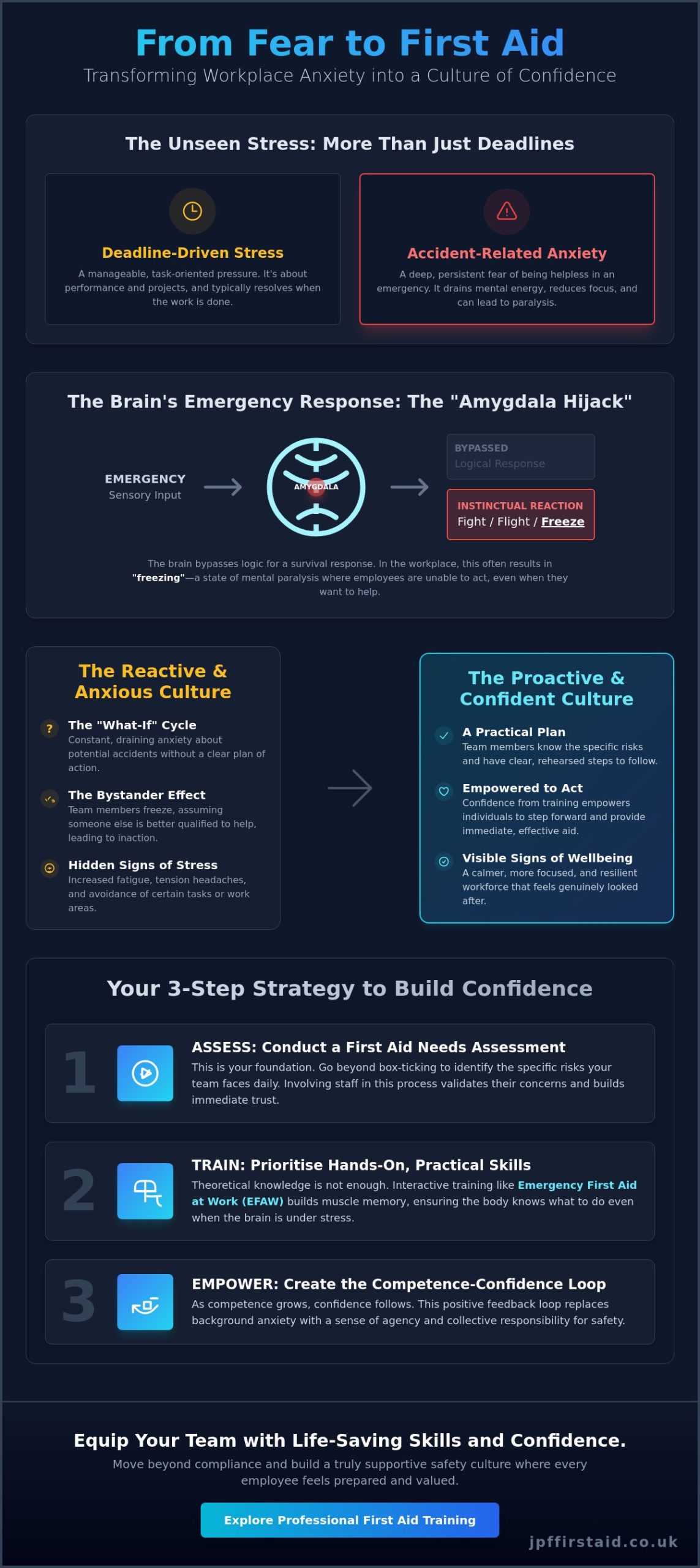
When an accident happens, the brain doesn’t reach for a safety manual. Instead, it often triggers what psychologists call the Amygdala Hijack. This is an immediate, involuntary survival response that bypasses the logical part of the brain in favour of a “fight, flight, or freeze” reaction. In many UK workplaces, this manifests as the “freeze” response. Employees find themselves unable to move or think clearly, not because they lack compassion, but because their brains are overwhelmed by a situation they don’t understand. It’s a distressing state that lingers long after the initial shock has passed.
This fear of the unknown is the primary driver of accident-related stress. If you haven’t identified specific risks through a workplace first aid needs assessment checklist, your team is effectively waiting for a crisis they aren’t prepared to handle. Training replaces this sense of helplessness with a powerful feeling of agency. It shifts the internal narrative from “I have no idea what to do” to “I have a plan and the skills to execute it.”
There is also immense psychological comfort found in mental health first aid. Knowing how to support a colleague’s emotional wellbeing during a panic attack or after a physical trauma reduces the secondary anxiety that often ripples through a team. It creates a comprehensive safety net that protects both the body and the mind, ensuring that the emotional aftermath of an incident doesn’t lead to long-term burnout.
The Competence-Confidence Loop
Confidence is rarely a personality trait; it’s a byproduct of demonstrated competence. When you learn a specific, practical skill, such as how to operate an AED or manage a choking incident, your background anxiety naturally begins to fade. You aren’t just memorising theory; you’re building muscle memory. This physical practice is vital because it ensures that even if the Amygdala Hijack kicks in, your body knows the motions. This loop of learning and doing is what transforms a worried bystander into a capable first aider. If you want to start building this resilience, our First Aid for Mental Health courses offer a brilliant foundation for supporting your team’s overall confidence.
Addressing the Fear of Legal Consequences
A common hurdle in UK workplaces is the myth that first aiders are legally liable for mistakes made during an emergency. Let’s be clear: there has never been a successful legal case in the UK against a bystander who provided first aid in good faith. Understanding the actual regulations and training to Ofqual-regulated standards removes the fear of “getting it wrong.” When you use a workplace first aid needs assessment checklist, you’re ensuring your staff are trained to the precise level required for your specific environment. This clarity is incredibly reassuring, as it replaces legal myths with professional certainty and the permission to act when it matters most.
Combatting the “What If” Cycle: Proactive Training vs. Reactive Stress
Reactive safety is a tiring cycle of worry. It involves waiting for the phone to ring with bad news and then scrambling to respond. Proactive safety is different; it’s about taking control before a crisis hits. When you use a workplace first aid needs assessment checklist, you move away from reactive stress and toward a culture of genuine preparedness. This proactive stance doesn’t just satisfy a legal requirement. It tells your team that you have thought ahead to protect their wellbeing.
A paper-based safety policy rarely soothes nerves during a real emergency. While documentation is necessary for compliance, it doesn’t provide the hands-on skills needed when a colleague is injured. This is where regular drills become essential. Much like a fire drill, first aid rehearsals keep anxiety levels low by making the correct response feel like second nature. You might worry that training takes too much time away from the daily grind. In reality, the time spent learning these skills is a small investment compared to the long-term impact of a poorly managed accident or the chronic stress of an unprepared workforce.
Moving Beyond Compliance to Empowerment
Meeting the bare legal minimum often leaves staff feeling vulnerable. There’s a massive psychological difference between knowing there’s a designated first aider somewhere in the building and being a person who knows how to help. When training is inclusive and offered to more than just the required few, collective anxiety drops. Everyone becomes part of the safety net. This fosters a much stronger sense of mutual support and confidence across the entire organisation.
Integrating Mental Health with Physical Safety
True safety is holistic. It covers both visible cuts and the invisible injuries that follow a traumatic event. A trauma-informed safety culture recognises that the aftershocks of an accident can last for weeks. By integrating mental health awareness into your physical safety plans, you help colleagues spot the signs of distress in each other. This approach ensures that your workplace first aid needs assessment checklist accounts for the full human experience, providing a environment where people feel truly looked after and emotionally secure.
Your Workplace First Aid Needs Assessment Checklist: 5 Practical Strategies
Safety isn’t just about ticking boxes; it’s about how your team feels while they work. A workplace first aid needs assessment checklist shouldn’t be a secret document kept in a manager’s drawer. It should be a living part of your office or warehouse culture. By involving your staff in the process, you turn a dry regulatory requirement into a powerful tool for building confidence. Here are five practical strategies to transform your workplace safety from a source of anxiety into a source of strength.
- Step 1: Conduct transparent risk assessments. Don’t just leave this to management. Involve the people who actually use the equipment or work in high-risk zones. They see the hazards that a desk-based assessment might miss, and their involvement makes the solutions feel relevant.
- Step 2: Prioritise hands-on training. Invest in high-quality first aid courses that offer plenty of practical, interactive sessions. Reading a manual isn’t enough; your team needs to feel the weight of a mannequin and the click of an AED to build real muscle memory.
- Step 3: Create a no-blame reporting culture. If staff are afraid of being punished for “near-misses,” they’ll hide potential hazards. Encourage open reporting so you can fix problems before they become accidents. This removes the fear of repercussions and focuses on collective learning.
- Step 4: Standardise and label your equipment. In a crisis, nobody should be hunting for a kit. Ensure all emergency supplies, including AEDs and specialised bleed kits, are in standardised locations with clear, high-visibility signage.
- Step 5: Implement regular “Safety Minutes.” Start team meetings with a sixty-second safety tip or a quick refresher on where the nearest first aid kit is located. These tiny segments keep knowledge fresh and ensure safety feels approachable rather than intimidating.
The Power of Visible Preparedness
There is immense psychological value in seeing well-stocked kits and clear signage every day. These visual cues of safety act as constant reassurance that the business cares about its people. When your staff know exactly who the designated first aiders are, and can see their photos or names on a noticeboard, it reduces that underlying background stress. It’s the difference between feeling like you’re on your own and knowing a capable safety net is always within reach. If you’re ready to empower your team with these essential skills, explore our professional first aid training options today.
Encaging Open Dialogue About Hazards
Facilitating regular safety huddles allows staff to voice their concerns without judgment. Managers should actively validate these fears. If a team member feels a specific task is dangerous, don’t dismiss it; work together to find a constructive solution. The most important part of this process is closing the feedback loop. When you show your team that their input led to a real change, like a new piece of equipment or a change in procedure, you build a foundation of trust that significantly lowers workplace anxiety.
Building a Culture of Confidence with Professional First Aid Training
At JPF First Aid, we don’t believe in simply ticking boxes to meet a legal requirement. Our goal is to build what we call “calm capability.” We want your team to leave our sessions feeling that they are in safe, expert hands, and more importantly, that they are now those expert hands themselves. By shifting the focus from dry theory to psychological empowerment, we help you transform an anxious workforce into a resilient community. This transition is essential for any business that wants to move beyond basic compliance and create a truly supportive safety culture.
The foundation of this confidence often starts with our emergency first aid at work qualification. It provides the essential skills needed to handle the most common workplace incidents with certainty. When you choose on-site group training, you’re also investing in team bonding. Learning these life-saving skills together creates a shared language of care and reassurance. It sends a clear message to every employee: your safety is our priority, and we’re giving you the tools to look after one another.
Why Interactive Learning Trumps Theory
Reading about a crisis isn’t the same as practicing for one. Hands-on practice is vital because it desensitises people to the initial shock of an emergency. If you’ve already applied a bandage or used a trainer AED in a relaxed, supportive environment, the real-world situation feels much less intimidating. We make our sessions enjoyable and interactive specifically to lower those mental barriers. This scenario-based learning ensures long-term retention, so the skills stay with your team long after the certificate is on the wall.
Tailoring Safety to Your Specific Workplace
Generic courses often fail to address the unique hazards of your specific environment. Whether you work in a high-risk warehouse or a busy retail space, your training should reflect your reality. When you use your workplace first aid needs assessment checklist to identify specific risks, we can tailor our approach to meet those exact needs. This bespoke focus is far more reassuring for staff than a one-size-fits-all lecture.
We also offer flexibility in how you learn. You can choose between traditional classroom sessions or blended learning, which combines online theory with shorter, practical in-person assessments. This ensures your safety training fits your operational schedule without compromising on quality. If you’re ready to replace workplace fear with professional preparedness, it’s time to take the next step. Book a consultation with JPF First Aid to empower your team today and build a safety culture that truly lasts.
Take the Next Step Toward a Fearless Workplace
Building a culture of confidence doesn’t happen by accident. It starts with acknowledging that safety anxiety is real and then taking practical steps to dismantle it. By using a workplace first aid needs assessment checklist, you’ve already begun the journey of identifying exactly what your team needs to feel secure. Remember that true empowerment comes from hands-on competence and the psychological certainty that you can handle the unexpected without freezing.
As a multi-award-winning training provider, we specialise in delivering Ofqual regulated qualifications that go beyond simple compliance. Our experienced trainers focus on psychological empowerment, ensuring that every learner leaves with a calm, capable attitude. We don’t just teach you how to follow a manual; we give you the confidence to act when it matters most. It’s time to move past the “what if” cycle and embrace a proactive safety culture that protects both your staff and your business.
Empower your workforce with expert first aid training from JPF First Aid. We’re here to help you turn safety from a source of stress into a foundation of strength. You’ve got this, and we’re ready to support you every step of the way.
Frequently Asked Questions
Can workplace anxiety about accidents lead to more injuries?
Yes, accident-related anxiety can paradoxically increase the risk of injury. When you are overly worried about hazards, your focus shifts from the task at hand to the potential danger. This leads to a state called safety hyper-vigilance. This mental distraction can cause you to hesitate or make mistakes with equipment you normally handle with ease, potentially creating the very accidents you fear.
How do I tell my boss I am anxious about safety without sounding like a complainer?
Frame the conversation around your desire to be more prepared and productive. Instead of just listing fears, suggest that the team reviews a workplace first aid needs assessment checklist together to identify areas for improvement. This positions you as a proactive team member who cares about the business’s resilience. It shows you are focused on solutions that benefit the entire workforce rather than just venting personal concerns.
Does first aid training actually reduce employee stress levels?
Hands-on training significantly reduces stress by replacing the fear of the unknown with practical, life-saving skills. When you know exactly how to use an AED or manage a severe bleed, the “what-if” scenarios that cause background anxiety lose their power. Competence builds confidence. This allows you to work with a much calmer and more focused mindset because you feel prepared for any situation.
What is the best way to support an employee who has witnessed a workplace accident?
Offer immediate emotional support and validate their feelings without any pressure to “get over it.” It’s vital to provide a safe space for them to talk and ensure they have access to professional resources if needed. Following up in the days after the event shows that their mental wellbeing is a genuine priority. This helps to prevent long-term trauma or burnout from taking root in the team.
Is it normal to feel frozen when thinking about a potential emergency?
Feeling frozen is a completely natural biological response known as the Amygdala Hijack. Your brain is essentially overwhelmed by a perceived threat and prioritises survival over logic. Professional training helps you move past this “freeze” state by building muscle memory. This allows your body to take over and act automatically, even when your mind feels momentarily stuck or panicked by the gravity of the situation.
How often should we run safety drills to keep anxiety low but stay alert?
Running small, focused drills every three to six months is usually the most effective balance for most UK businesses. Frequent refreshers keep skills sharp and make emergency responses feel like second nature without causing drill fatigue. These sessions should be interactive and supportive. This ensures that safety stays at the forefront of everyone’s mind in a positive, approachable way rather than a scary one.
What are the legal requirements for first aid in a low-risk office environment?
In the UK, even low-risk offices must have a suitably stocked first aid box and an appointed person to take charge of arrangements. You are legally required to provide employees with clear information about these provisions. Using a workplace first aid needs assessment checklist helps you determine if your specific office needs more than the bare minimum, such as a designated Level 3 first aider.
Can mental health first aid help with physical accident anxiety?
Mental health first aid is incredibly effective at addressing the emotional roots of accident-related fear. It gives you the tools to manage your own stress responses and support colleagues who may be struggling with the psychological aftershocks of a physical incident. This holistic approach ensures that your team feels protected both physically and emotionally, creating a much more resilient and confident safety culture.
Recent Comments