

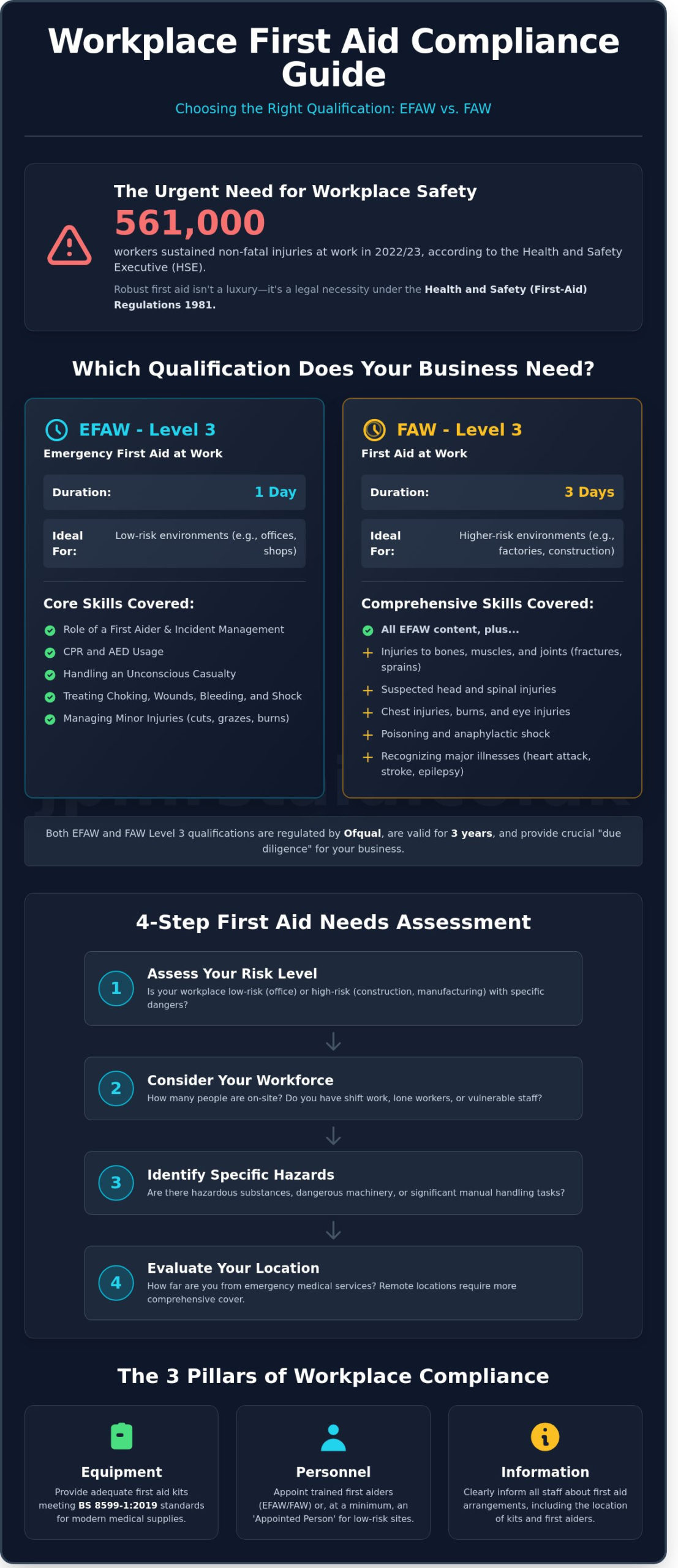
What if the biggest threat to your business isn’t a dip in sales, but an outdated certificate? According to the Health and Safety Executive (HSE) 2022/23 report, 561,000 workers sustained non-fatal injuries at work, making robust workplace first aid a legal necessity rather than a luxury. You likely already feel the weight of responsibility for your staff, yet the fear of heavy fines or failing a spot inspection is a constant source of stress.
It’s common to feel overwhelmed by the choice between EFAW and FAW qualifications, especially when you’re worried that the training will be a dry, boring experience your team will forget by Monday. This guide simplifies the process, helping you master your legal obligations while discovering training that’s genuinely engaging and practical. We’ll walk through exactly how to stay compliant, how to choose the right level of cover, and how to book hassle-free sessions that build real confidence in your team.
Key Takeaways
- Understand your legal duties under the Health and Safety (First-Aid) Regulations 1981 to ensure your business remains fully compliant and your staff are protected.
- Learn how to distinguish between EFAW and FAW qualifications to select the most appropriate and efficient training duration for your team’s specific needs.
- Discover a step-by-step method for conducting a workplace first aid needs assessment, helping you accurately calculate delegate numbers based on your unique site hazards.
- Find out how moving from dry theory to practical, engaging training builds the genuine hands-on confidence your staff need to act effectively in an emergency.
- Explore the benefits of bespoke on-site training across the West Midlands to minimise business disruption while securing cost-effective solutions for groups of up to 12 delegates.
What is Workplace First Aid and Why is it Legally Required?
Running a business in Birmingham means you’ve got plenty on your plate. From managing teams to hitting targets; it’s a busy environment. However, your most valuable asset is your people. Workplace first aid isn’t just a box-ticking exercise; it’s the immediate assistance you provide to an employee who is injured or falls ill while at work. To understand the basics, you might ask What is First Aid? at its core. In a professional setting, it’s about having the right tools and trained hands ready to act before professional medical help arrives. This immediate response can be the difference between a minor recovery and a life-changing incident.
Your duty as an employer is to ensure that an injured person receives immediate attention and that an ambulance is called in serious cases. You don’t need to be a doctor to save a life, but you do need a plan. This involves clear signposting so every staff member knows exactly where the kit is kept and who the designated first aider is. By creating a culture where safety is visible, you alleviate the anxiety that often surrounds medical emergencies.
The Health and Safety (First-Aid) Regulations 1981
The Health and Safety (First-Aid) Regulations 1981 set out exactly what you need to do. These rules apply to every single workplace in the UK, even if you’re self-employed or run a small office with only a few people. The law is built on three pillars: equipment, facilities, and personnel. You must provide adequate and appropriate equipment, a suitable space for treatment, and enough trained people to look after your team. Since 1981, these regulations have ensured that help is never more than a few moments away. If you ignore these duties, you’re not just risking a fine; you’re risking the safety of the people who keep your business running.
Key Components of Workplace Compliance
Staying compliant doesn’t have to be a headache. First, your kit should meet British Standards (BS 8599-1:2019) to ensure it contains modern medical supplies like sterile wipes, foil blankets, and nitrile gloves. Second, you need an ‘Appointed Person’ at the very least. In a low-risk office, this person looks after the kit and calls emergency services. In higher-risk settings, you’ll need fully qualified first aiders who have completed regulated qualifications. Finally, you must tell your staff where the help is. A simple poster or a mention in the induction pack works wonders. Clear communication ensures that when an accident happens, nobody wastes time wondering what to do next.
Getting this right protects your business from more than just physical injury. In 2022/23, the HSE reported that 561,000 workers sustained a non-fatal injury at work. Failing to provide adequate workplace first aid can lead to heavy fines or even prosecution. More importantly, it damages the trust your team has in you. When your staff know you’ve invested in their safety, it builds a foundation of confidence. This physical security is the essential first step toward supporting the wider mental health and well-being of your Birmingham workforce.
Choosing the Right Course: EFAW vs. FAW Qualifications
Deciding on the right level of training is a vital step in protecting your team and meeting your legal obligations. You need to ensure your workplace first aid provision matches the specific risks found in your Birmingham office or warehouse. The Health and Safety Executive (HSE) reported that 561,000 workers sustained a non-fatal injury at work in the 2022/23 period. This highlights why choosing between an Emergency First Aid at Work (EFAW) or a full First Aid at Work (FAW) course is more than just a box-ticking exercise. It’s about building a culture where people feel safe and supported.
Your insurance provider will often insist on certificates regulated by Ofqual to ensure the highest standards are met. These Level 3 qualifications provide a “due diligence” shortcut for business owners. You won’t have to spend hours proving the training provider’s competence because the national accreditation does that for you. It ensures your staff learn from a structured syllabus that meets strict quality benchmarks. Following Workplace First Aid Tips from industry experts can help you assess your specific site needs before you commit to a booking.
Emergency First Aid at Work (EFAW) – Level 3
The EFAW course is a one-day training commitment that fits perfectly into a busy Birmingham business schedule. It’s designed for environments where serious incidents are statistically unlikely, such as shops or small offices. You’ll gain the skills to handle life-threatening situations with a calm, practical approach. This course covers essential life-saving techniques including CPR, choking, wounds, and managing catastrophic bleeding. Emergency First Aid at Work is the recognised qualification for staff in low-risk UK workplaces such as small retail units or corporate offices. It provides the baseline of safety every modern employer needs to protect their staff.
First Aid at Work (FAW) – Level 3
If you manage a high-risk site like a manufacturing plant or a large construction team, the three-day FAW course is the standard you need for comprehensive workplace first aid. This training dives much deeper into medical emergencies than the one-day alternative. Learners tackle complex topics including heart attacks, strokes, spinal injuries, and poisoning. It builds a level of clinical confidence that shorter courses simply cannot match. To keep this Level 3 status, your staff must complete a two-day requalification course every 36 months. You can find bespoke training dates that work around your specific shift patterns to keep your team compliant without the stress.
Skills fade much faster than most people realise. Specific studies indicate that first aid knowledge and muscle memory start to decline just six months after a course ends. While your official certificate lasts for three years, the HSE strongly recommends an annual half-day refresher session. These short, engaging updates keep the “can-do” attitude fresh and ensure nobody panics when a real-world accident happens. It’s a small investment of time that pays off in lives saved and a more resilient, confident workforce. We make these sessions relaxed and practical, focusing on the techniques that matter most in your specific environment. Keeping an eye on your three-year expiry date is also vital for your internal health and safety audits, as an expired certificate can lead to insurance complications and legal risks.
How to Conduct a First Aid Needs Assessment
Providing workplace first aid isn’t just about ticking a box; it’s about creating a genuine safety net for your most valuable asset: your people. To get this right, you need to look beyond a basic headcount. Under the Health and Safety (First-Aid) Regulations 1981, the responsibility lies with you to ensure your provision is “adequate and appropriate.” This means your assessment must be bespoke to your Birmingham premises and the specific tasks your team performs every day.
Start by evaluating your specific hazards. A digital agency in the Custard Factory faces different risks than a metal fabrication plant in Tyseley. If your team works with chemicals, high-voltage electricity, or heavy machinery, your first aiders need to be prepared for more than just a minor cut. You should also consider the profile of your workforce. If 30% of your employees are over the age of 50, or if you have staff with known heart conditions or severe allergies, your training should reflect those specific needs. It’s about building confidence so your team knows exactly what to do when the pressure is on.
You must also account for the “what ifs” of daily business life. If your only first aider is on holiday, off sick, or attending a meeting in another city, your business is technically non-compliant. We recommend a 20% “cushion” in your trained staff numbers to cover for annual leave and unexpected absences. If you run multiple shifts, such as a 24-hour logistics hub near the M6, every single shift must have a designated person ready to act. You’re aiming for a seamless blanket of care that stays in place 24 hours a day, 7 days a week.
To calculate your exact requirements, follow this simple four-step process. First, identify your risk level based on your industry. Second, count your maximum number of staff on-site at any one time. Third, look at your accident history from the last 12 months to see if specific patterns emerge. Finally, consider your physical environment. If your office is split across four floors, you’ll likely need at least one trained person per floor to ensure help is never more than 60 seconds away.
Identifying Your Risk Category
Low-risk environments like offices or libraries generally require one person trained in Emergency First Aid at Work (EFAW) for every 50 employees. In high-risk sectors, this ratio tightens to one First Aider for every 25 people. If you have lone workers or staff who spend 80% of their time on the road, you must provide them with portable kits and the knowledge to manage emergencies until help arrives. This ensures your workplace first aid remains effective even outside the main office.
The Impact of Workplace Layout
Your physical location in Birmingham dictates your response time. If your business is spread across a large multi-site complex, a single kit in reception won’t suffice. You need equipment and trained staff within a quick walk of any potential incident. In shared buildings, you can often coordinate responsibilities with other tenants to save costs, provided you have a formal written agreement. Always check your proximity to the nearest A&E; if your site is remote, your staff may need more advanced skills to manage a casualty for longer.
What to Expect: Making First Aid Training Engaging and Fun
Most people associate health and safety courses with endless slide decks and lukewarm coffee. We don’t believe it has to be that way. JPF First Aid prioritises an atmosphere that feels more like a practical workshop than a stiff lecture. By removing the clinical stiffness often found in traditional classrooms, we help your team relax. This isn’t just about being friendly; it’s about effective learning. Research suggests that when learners feel at ease, they absorb information up to 40% more effectively than in high-stress or dull environments.
Our trainers move away from the role of a distant assessor to become a Reliable Expert Mentor. This means they’re there to guide, not to judge. We focus on the “why” behind every action, making the logic of workplace first aid easy to follow. We’ve found that 94% of our learners in a 2023 survey reported feeling significantly more prepared because the sessions were interactive rather than purely theoretical. We want your staff to leave feeling empowered, not exhausted by data.
The Practical Side of Training
We focus heavily on building muscle memory through physical practice. You won’t just hear about how to save a life; you’ll use high-spec manikins, bandages, and AED trainers until the movements feel like second nature. Scenario-based learning is the heartbeat of our sessions. We might stage a realistic medical emergency in your Birmingham warehouse or office to see how the team reacts. This “hands-on” approach ensures that if a real crisis happens, your staff won’t freeze. They’ll act because their hands already know the rhythm of the response. We measure our success by the level of confidence your team displays during these drills.
Alleviating Learner Anxiety
It’s common for employees to feel nervous about “getting it wrong” during a first aid course. We proactively create a safe space where there are no silly questions. Our sessions are designed to support different learning styles, whether someone is a visual learner who needs clear diagrams or a kinaesthetic learner who needs to handle the equipment. We’ve seen that removing the fear of failure leads to better performance during assessments. The JPF promise is simple: our training is professional, fully regulated, and follows the latest HSE 2024 guidelines, yet it remains approachable and never intimidating. We make sure every person in the room feels capable of stepping up when it matters most.
A relaxed environment doesn’t just make the day go faster; it saves lives. When the mood is light, people are more likely to participate, ask for clarification, and engage with the material. This leads to higher knowledge retention. In fact, a 2022 study showed that learners who participated in active, scenario-based training retained 75% of the information six months later, compared to just 5% for those who only listened to a lecture. We bring all the necessary equipment to your site, making the process hassle-free for you and familiar for your staff.
Bespoke Solutions: On-Site Training Across the West Midlands
Managing a business in Birmingham or the wider West Midlands involves juggling tight schedules and strict compliance. You shouldn’t have to choose between productivity and safety. Bringing training directly to your premises is the most efficient way to upskill your team while keeping your operations running smoothly. We come to you. This approach eliminates the logistical headache of coordinating travel for a dozen employees across the busy M6 or A38 corridors; it also ensures your staff learn in the environment where they actually work.
For organisations looking to train multiple staff members, bespoke group quotes offer the most cost-effective path forward. We provide flat-rate pricing for groups of up to 12 delegates, which often results in a 25% saving compared to sending individuals to external public courses. This transparent pricing model helps you manage your 2024/25 health and safety budget without hidden “per-head” surprises. You gain a dedicated instructor for the day who focuses entirely on your team’s specific needs and questions.
Flexibility is at the heart of our service. We recognise that every Birmingham firm has different operational pressures. To accommodate this, we offer three distinct delivery methods:
- Traditional Classroom: Fully face-to-face sessions delivered at your site for maximum hands-on interaction.
- Blended Learning: A modern 50/50 split where delegates complete theory modules online before a shorter, practical session in person.
- Distance Options: Theory-heavy components delivered via interactive digital platforms where appropriate.
Selecting a local provider for your workplace first aid requirements ensures you receive long-term support that national chains struggle to match. We aren’t just a voice on the end of a phone in a distant city. We understand the local landscape, from the industrial hubs of Wolverhampton to the corporate offices of Colmore Row. This local presence means we can offer quicker follow-up support and annual refreshers that keep your compliance up to date without the fuss.
The Convenience of On-Site Training
On-site training allows us to tailor the curriculum to your specific workplace hazards. If your Staffordshire manufacturing plant has high-risk machinery, we focus heavily on trauma and crush injuries. If you’re a Birmingham-based office, we might spend more time on cardiac arrest and stress-related emergencies. Organizing a session is straightforward; you provide a cleared room, and we bring all the manikins, bandages, and AED trainers. It is a “plug and play” solution for busy managers.
Why Trust JPF First Aid?
We are a multi-award-winning training provider with a reputation built on trust and reliability. When you book with us, you get direct access to John Fogarty, who brings over two decades of frontline safety expertise to every session. We don’t do dry, clinical lectures. Our sessions are designed to be engaging, practical, and, above all, fun. We turn the daunting task of emergency response into a boost of genuine confidence for your staff. You can book your on-site workplace first aid training today to ensure your business remains compliant and your people stay safe.
Secure Your Team’s Safety and Compliance Today
Ensuring your business meets its legal obligations doesn’t have to be a daunting task. By identifying whether your team requires the one-day EFAW or the comprehensive three-day FAW qualification, you’ve already taken the first step toward total compliance. Our Ofqual regulated training removes the guesswork from workplace first aid, providing you with a clear roadmap to safety that satisfies HSE requirements. We’ve supported hundreds of local employers with training that is both professional and approachable.
As a multi-award-winning provider, we specialise in making life-saving skills accessible. We bring our expertise directly to your premises across the West Midlands, offering bespoke on-site sessions for groups of up to 12 learners. This tailored approach means your staff learn in their own environment, building real-world confidence through practical, engaging exercises that are never dry or clinical. You get a hassle-free solution that fits your schedule while your team gains the skills to save lives.
Get a bespoke quote for your workplace first aid training
We’re looking forward to helping you build a safer, more confident team.
Frequently Asked Questions
Is workplace first aid a legal requirement for small businesses?
Yes, the Health and Safety (First-Aid) Regulations 1981 require every UK employer to provide adequate equipment and facilities. Even if you only employ one person, you must have a stocked first aid box and an appointed person to take charge. It’s about ensuring your team feels safe and valued while you stay compliant with the law. This creates a supportive culture where everyone knows they’re protected.
How many first aiders do I need for my workplace?
Your specific numbers depend on your risk assessment, but the HSE provides clear guidelines. In low-risk environments like offices, you should have one first aider for every 50 to 100 employees. If your Birmingham business is higher risk, such as a construction site, you’ll need one trained person for every 50 workers. We can help you calculate exactly how many staff need training to keep your site safe.
How long does a workplace first aid certificate last?
A standard certificate is valid for three years from the date of issue. While the certificate lasts 36 months, the HSE strongly recommends an annual refresher course to keep skills sharp. Research shows that practical skills and confidence levels begin to drop significantly just 6 months after training. Regular practice ensures your team is ready to act decisively during a real medical emergency.
What is the difference between EFAW and FAW?
EFAW stands for Emergency First Aid at Work, which is a one-day course designed for low-risk environments. FAW is the full First Aid at Work qualification, lasting three days and covering a much broader range of medical conditions and injuries. Choosing the right one depends on your specific workplace first aid risk assessment and the number of staff you employ. We make both courses engaging and practical for your team.
Can I do my workplace first aid training online?
You can’t become a fully qualified first aider through online-only courses because the HSE requires practical, face-to-face assessment. We offer blended learning options where you complete 1/3 of the theory online, followed by hands-on training at your premises. This approach is hassle-free and ensures you gain the physical skills needed to save a life. It’s the most flexible way to get your team certified without losing time.
What happens if I don’t have a trained first aider at work?
Failing to meet your legal obligations can lead to heavy fines and prosecution by the HSE. In the 2022/23 period, the HSE issued total fines of £46 million for various health and safety failures. Beyond the financial cost, lacking a trained responder puts your staff at risk and can damage your reputation as a responsible employer. Investing in training is a small price for total peace of mind.
Do I need to provide first aid for my customers or the public?
The 1981 Regulations only legally cover your employees, but the HSE strongly encourages you to include the public in your assessment. Most businesses include customers to protect against civil negligence claims and provide a better experience. Providing this extra layer of care shows your community that you’re a business that truly looks out for everyone. It’s a simple step that builds massive trust with your local Birmingham customers.
How often should I check my workplace first aid kit?
You should check your workplace first aid kit at least every 3 months to ensure everything is in date and fully stocked. Most sterile items have an expiry date of 3 to 5 years, so it’s vital to replace them before they expire. Keeping a simple log helps you stay organised and ensures you’re never caught short during an emergency. We can even provide a checklist to make this process quick and easy.
Recent Comments