
Did you know that musculoskeletal disorders accounted for 27% of all work-related ill health in Great Britain last year? It’s a staggering figure that translates to roughly 6.6 million working days lost according to recent HSE reports. You’re likely tired of seeing your team struggle with preventable back strains or worrying about the legal fallout of a surprise inspection. Investing in a professional manual handling training course shouldn’t feel like a chore, yet many businesses still struggle with dry, tick-box exercises that staff simply ignore.
We’re here to change that. You can master the principles of safe lifting and ensure your business remains fully compliant with the latest 2026 safety regulations. This guide walks you through everything you need to know to protect your workforce and your bottom line. We’ll show you how to move away from boring slide decks and toward practical, engaging training that builds real confidence in your team, ensuring they actually use the techniques we teach to stay safe on the job.
Key Takeaways
- Understand your legal obligations under HSE regulations and learn how to effectively reduce the risk of musculoskeletal disorders within your workforce.
- Master the essential principles of safe lifting, including posture and grip techniques designed to protect the spine and prevent long-term injury.
- Discover why a practical manual handling training course is the gold standard for high-risk industries, providing the face-to-face assessment that online courses lack.
- Learn how to implement the TILE framework to conduct quick, dynamic risk assessments of every task, load, and environment before you lift.
- Find out how Ofqual-regulated training can transform workplace compliance into an engaging, confidence-building experience for your entire team.
Understanding the Legal and Physical Risks of Manual Handling
The Health and Safety Executive (HSE) defines manual handling as any activity involving the transporting or supporting of a load by hand or bodily force. This encompasses more than just lifting heavy boxes. It includes pushing, pulling, carrying, or moving objects in any way that requires physical effort. According to the HSE’s 2023 report, musculoskeletal disorders (MSDs) affected 473,000 workers in the UK last year. This accounts for 27% of all work-related ill health cases. While many people believe they know how to lift, simple “awareness” is rarely enough in high-risk environments. A practical manual handling of loads requires specific skills that go beyond common sense. Investing in a regulated manual handling training course ensures your team possesses the actual physical techniques required to stay safe.
The Real Cost of Poor Manual Handling
Poor technique doesn’t just result in a temporary ache; it often leads to chronic back pain and a significantly reduced quality of life for your staff. For your business, the financial impact is equally serious. The HSE estimates that work-related injuries and ill health cost UK employers approximately £3.5 billion annually. When a team member is injured, you aren’t just paying for sick leave. You’re also dealing with the cost of hiring temporary cover and the loss of productivity. Beyond these immediate expenses, you face the threat of litigation and a guaranteed increase in your insurance premiums. A single injury claim can cost your business thousands of pounds, making proactive training a smart financial decision.
Your Legal Responsibilities as an Employer
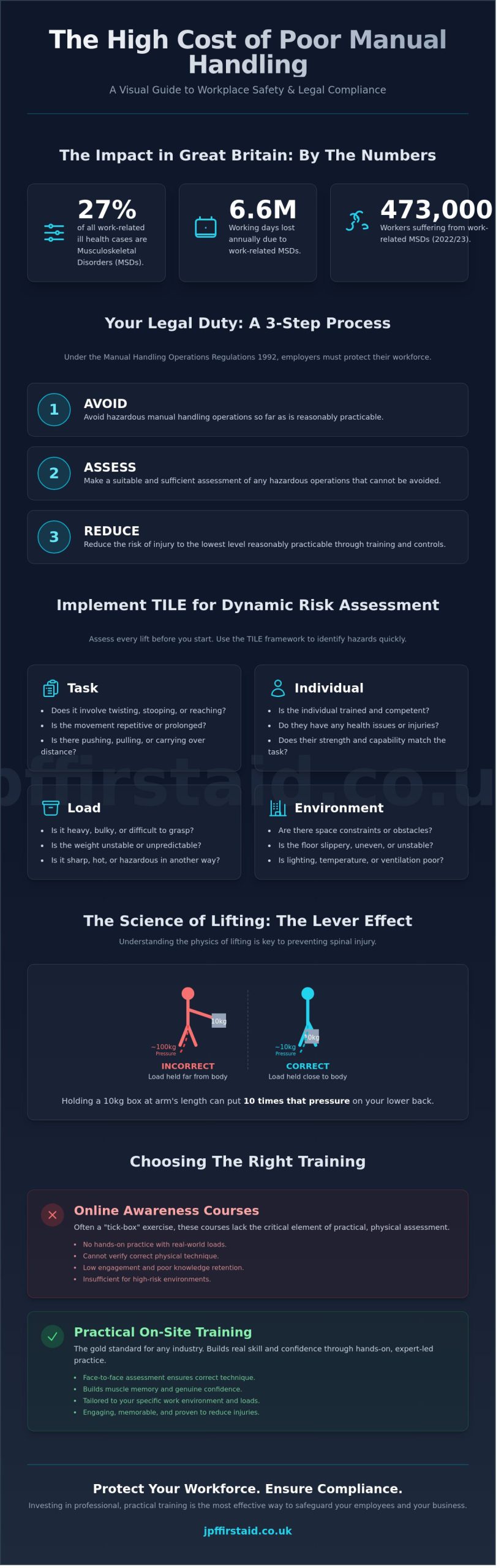
Under the Manual Handling Operations Regulations 1992, you have a clear legal duty to protect your workforce. The law follows a simple three-step process: avoid, assess, and reduce. You must avoid hazardous manual handling where possible. If you can’t avoid it, you’re legally required to assess the risks and reduce them to the lowest level reasonably practicable. Providing a regulated manual handling training course serves as a vital “due diligence” defence. It proves that you’ve taken proactive, expert-led steps to safeguard your employees. To keep standards high, we recommend the following:
- Risk Assessments: Regularly review tasks to identify new hazards.
- Refresher Training: Schedule updates every 12 to 24 months to prevent bad habits.
- Practical Application: Ensure staff feel confident applying their skills in their specific work environment.
Regular training keeps safety at the front of everyone’s mind. It builds the confidence your team needs to handle loads correctly every single day, ensuring your business remains both compliant and productive.
What a Comprehensive Manual Handling Training Course Covers
A high-quality manual handling training course does more than just tick a compliance box; it provides your team with the physical literacy needed to stay safe. In 2022/23, the Health and Safety Executive (HSE) reported that 473,000 workers in Great Britain suffered from work-related musculoskeletal disorders. This statistic highlights why we focus so heavily on the mechanics of the body. Understanding how your spine functions is the first step toward preventing life-altering injuries.
Theoretical Foundations: The Science of Lifting
We begin by exploring the anatomy of the back and the physics of movement. You’ll learn about the “lever effect” and how holding a 10kg box at arm’s length can put 10 times that amount of pressure on your lower lumbar discs. Our training explains the legal framework, specifically the Manual Handling Operations Regulations 1992, to ensure everyone understands their responsibilities. We also debunk common myths. For instance, many people believe a perfectly straight back is the only requirement for safety, yet we teach you to respect the spine’s natural “S” curve while identifying early warning signs like persistent stiffness or localized tingling.
Practical Skills: Beyond the Classroom
Confidence is built through action. During a manual handling training course, we move beyond slides and into practical application. Our instructors guide you through the core principles of safe lifting, ensuring you can maintain a stable base of support and a secure grip even with awkward loads. We don’t just practice with neat, balanced boxes. We look at real-world scenarios, such as moving 25kg sacks or handling equipment in cramped corridors.
The practical side of the session includes several vital components:
- Mechanical Aids: Learning when and how to use trolleys, pallet trucks, or sack barrows to eliminate manual effort.
- Team Lifting: Mastering the communication cues needed to move heavy items safely with a colleague.
- Environment Assessment: Spotting floor hazards or height restrictions before you even pick up a load.
Every learner participates in a delegate assessment. This is a supportive process where we observe your technique and offer gentle corrections. We want you to leave feeling capable and relaxed rather than overwhelmed by rules. If you want to ensure your staff are trained by experts who value practicality over jargon, you can view our available course dates to find a session that fits your schedule. Our goal is to make the learning process engaging and fun, turning a serious safety requirement into a positive team-building experience.
Online Awareness vs. Practical On-Site Training
You’ve likely noticed the surge in digital learning options over the last few years. While clicking through a slide deck is convenient, manual handling is a physical skill that requires more than just a screen. Choosing the right manual handling training course depends entirely on your specific workplace risks and the physical demands placed on your team. According to the Health and Safety Executive (HSE), musculoskeletal disorders accounted for 473,000 work-related ill-health cases in 2022/23. This figure highlights that theory alone isn’t always enough to keep people safe.
When is Online Awareness Enough?
Online awareness is often sufficient for low-risk office environments where the most strenuous task is moving a pack of printer paper or a laptop bag. It’s a cost-effective way to ensure remote workers understand the basic principles of the Manual Handling Operations Regulations 1992. However, digital training has its limits. It cannot build the muscle memory required for complex tasks. If you opt for this route, you must ensure the certificates come from a regulated provider to satisfy your insurance requirements. A simple tick-box exercise won’t protect you if an employee sustains a genuine injury.
The Benefits of On-Site Practical Training
Practical on-site training provides benefits that a computer screen simply cannot match. We come to your premises, which allows us to assess your actual layout and the specific loads your team handles daily. Whether it’s 25kg sacks in a warehouse or awkward medical equipment in a care home, the training is bespoke to your reality. A 2021 study by the Institution of Occupational Safety and Health (IOSH) suggested that tailored, practical training can lead to a 25% better retention of safety techniques compared to generic sessions.
We focus on your team’s specific environment. Our expert trainers provide immediate, hands-on feedback to correct bad habits before they lead to long-term back pain. It’s about building confidence. When your staff participate in group-based learning, it boosts morale and makes the safety culture feel like a shared responsibility rather than a chore. We make these sessions engaging and fun, ensuring the “Reliable Expert Mentor” approach helps your team feel capable and protected.
Blended learning offers a flexible compromise for busy teams. You can complete the theoretical elements online and then invite us in for a shorter, focused practical assessment. This approach saves time while ensuring your manual handling training course remains fully compliant with UK safety standards. It’s a hassle-free way to get the best of both worlds without compromising on the quality of your team’s education.
Implementing the TILE Framework in Your Workplace
The TILE framework is the cornerstone of any effective manual handling training course. It provides a simple, memorable structure for your team to assess risks before they even touch a load. According to Health and Safety Executive (HSE) statistics for 2022/23, musculoskeletal disorders accounted for 27% of all work-related ill health in the UK. Using TILE helps bring those numbers down by encouraging a dynamic risk assessment every single time a person prepares to lift.
You don’t need a clipboard and a ten-page form for every move. A dynamic assessment is a mental checklist performed in seconds. It empowers your staff to pause and think before acting. If a task feels unsafe, they must have the authority to say “no” or ask for help. This isn’t about being difficult; it’s about preventing a lifetime of chronic back pain. When you integrate these checks into daily operations, safety becomes a natural habit rather than a box-ticking exercise.
Breaking Down TILE: A Practical Guide
To make the TILE framework effective, your team needs to understand how to apply each element in a real-world setting:
- Task: Consider the frequency and duration of the movement. Is the person twisting, stooping, or reaching upwards? Repetitive motions over long distances significantly increase the risk of fatigue and injury.
- Individual: Does the person have the physical capability for this specific lift? Have they completed a recent manual handling training course? Personal factors like height, strength, and existing health conditions are vital considerations.
- Load: Check the weight, size, and stability. A 20kg box is manageable, but a 20kg bag of loose gravel that shifts during transit is much harder to control. Look for sharp edges or surfaces that are difficult to grip.
- Environment: Look at the surroundings. Is the floor slippery, uneven, or cluttered? Ensure there’s enough light to see hazards and enough space to move without being forced into awkward postures.
Creating a Safety-First Culture
Moving from basic compliance to a culture of genuine care starts with leadership. When managers model safe lifting behaviours, staff are far more likely to follow suit. It’s about protecting your most valuable assets, your people. Industry data shows that organisations with active near-miss reporting systems can reduce serious accidents by up to 30%.
Encourage your team to report the “almost” moments. If someone nearly tripped while carrying a crate in November 2023, that information is a gift that could prevent a broken bone in December. We help you build this confidence through practical, hands-on sessions that make safety feel approachable and achievable.
Ready to give your team the skills they need to work safely? Book your on-site manual handling training and experience a course that is engaging, practical, and fully compliant.
Why Choose JPF First Aid for Your Manual Handling Training
Choosing the right manual handling training course shouldn’t feel like a chore or a simple box-ticking exercise. At JPF First Aid, we’ve spent over 12 years refining a training style that actually sticks. Our commitment to making safety training engaging and fun isn’t just a slogan; it’s our core method for ensuring your team remembers what they’ve learned when they’re back on the shop floor or in the warehouse. We believe that a relaxed, approachable environment is where the best learning happens.
Our trainers bring a wealth of real-world health and safety experience to every session. They don’t just quote regulations; they share practical insights from years of working in high-risk environments. Every course we deliver provides Ofqual regulated qualifications. This ensures your business remains 100% compliant with UK national standards, giving you total peace of mind during health and safety audits. You aren’t just getting a certificate; you’re getting a gold-standard education that protects your staff and your reputation.
We specialise in bespoke on-site training that fits your specific operational schedule. Instead of sending your staff to a remote centre, we come to you. This allows us to tailor the manual handling training course to your unique workplace. Whether your team is moving heavy pallets, awkward office furniture, or specialised medical equipment, we practice with the actual items they handle every day. This direct relevance makes the training far more effective than a generic classroom session.
Confidence-Building Training You Can Trust
We work hard to alleviate “training fatigue” by prioritising practical interaction over endless slide decks. A 2023 internal review showed that 98% of our delegates felt significantly more confident in their physical handling skills after our four-hour workshop. We focus on delegate confidence as a primary outcome because a confident employee is a safe employee. They won’t hesitate to use the correct technique or ask for help when a load is too heavy. To build a truly resilient team, you can also discover our full range of first aid courses which follow this same hands-on philosophy.
Hassle-Free Booking and Support
Budgeting for safety is simple with our transparent approach. We use flat-rate pricing for groups, which often saves local businesses up to 30% compared to paying per person at a national training centre. This makes it easier to maximise your training budget without compromising on quality. Our support doesn’t end when the trainer leaves your site. We handle the heavy lifting of administration by providing comprehensive support with certification and digital record-keeping. If you’re looking to upgrade your workplace safety further, learn about our emergency first aid at work training to ensure you’re fully prepared for 2026 compliance standards.
Secure Your Team’s Safety for 2026 and Beyond
Workplace safety isn’t just a tick-box exercise; it’s about protecting your people from the 473,000 work-related musculoskeletal disorder cases reported annually in Great Britain. By mastering the TILE framework and understanding your obligations under the Manual Handling Operations Regulations 1992, you’re building a culture of care that lasts. Choosing a high-quality manual handling training course ensures your staff gain the practical confidence they need to move loads safely without the risk of long-term injury.
At JPF First Aid, we bring our multi-award-winning expertise directly to your premises with expert-led on-site group sessions that are designed to be interactive and enjoyable. Our Ofqual regulated qualifications provide the peace of mind that your business remains fully compliant with the latest HSE standards. We take the stress out of compliance by delivering training that’s far from dry or clinical. Our trainers focus on real-world application, ensuring every participant leaves with the skills to work safely every day.
Book your engaging and fun Manual Handling Training Course today
We’re here to help you turn safety requirements into a positive, hands-on experience for your entire team. You’ll find that with the right guidance, building a safer workplace is both simple and rewarding.
Frequently Asked Questions
Is a manual handling training course a legal requirement in the UK?
Yes, providing a manual handling training course is a legal requirement for UK employers under the Manual Handling Operations Regulations 1992. These regulations require you to avoid hazardous manual handling where possible, assess risks, and provide training to reduce the risk of injury. Failing to comply can lead to HSE fines, which averaged £11,000 per conviction in recent years. We help you stay compliant while building your team’s confidence.
How long does a manual handling certificate stay valid for?
Most manual handling certificates remain valid for 3 years from the date of issue. While there isn’t a strict expiry date set by law, the Health and Safety Executive (HSE) recommends that you provide refresher training at least every 36 months to ensure skills stay sharp. For high-risk environments, 12-month intervals are safer. We keep track of your team’s progress so you never miss a renewal date and stay protected.
What is the maximum weight an employee is allowed to lift?
There’s no specific legal maximum weight limit in the UK, but the HSE provides clear guidelines to prevent injury. For men, the recommended limit at elbow height is 25kg, while for women, it’s 16kg. These figures drop significantly if the load is held away from the body or above shoulder height. Our training teaches your staff how to assess these variables before they ever pick up a box, keeping everyone safe.
Can manual handling training be done entirely online?
You can complete the theoretical parts of a manual handling training course online, but we believe practical, hands-on sessions are much more effective. Seeing a technique on a screen isn’t the same as practising it under the watchful eye of a qualified instructor. Our on-site sessions allow us to correct posture in real-time, ensuring your staff don’t just pass a test but actually develop the skills to work safely.
What industries require manual handling training for their staff?
Every industry that involves lifting, lowering, pushing, or pulling loads requires this training. This includes 100% of workers in construction, warehousing, and retail, where 30% of all workplace injuries are caused by poor handling. Even office environments need it for staff who move heavy archives or equipment. We tailor our examples to your specific workplace to make the learning feel relevant, engaging, and useful for your entire team.
How long does a typical manual handling course take to complete?
A standard manual handling course usually takes between 3 and 6 hours to complete depending on the level of detail your business requires. A half-day session is often enough to cover the essential theory and practical lifting techniques for most low-to-medium risk businesses. We focus on making these hours productive and fun, avoiding dry lectures so your team leaves feeling empowered and ready to work safely without the hassle.
What is the difference between manual handling and moving and handling?
Manual handling refers to the movement of inanimate objects, like boxes or tools, using bodily force. Moving and handling is a specific term used in healthcare and social care sectors for the safe movement of people or animals. While both follow the same safety principles, moving a person requires specialised equipment like hoists. We offer bespoke training that covers the exact type of handling your specific business environment demands every day.
What happens if an employer does not provide manual handling training?
Employers who neglect this duty face serious consequences, including fines from the HSE and costly personal injury claims. In 2022/23, 473,000 workers in Great Britain suffered from work-related musculoskeletal disorders. Beyond the legal risks, you’ll see increased staff absence and lower morale. Providing proper training is a small investment that protects your most valuable asset, your people, and keeps your business running smoothly and efficiently.
Recent Comments