

A first aid certificate doesn’t save lives; a confident staff member does. You likely already know that keeping up with first aid training for schools uk feels like a moving target. Between balancing Ofsted’s Early Years Foundation Stage requirements and the HSE’s workplace standards, it’s easy to feel overwhelmed by the red tape. You want your team to be ready for anything, but finding the time in a packed 190 day school calendar is a constant struggle.
It’s natural to feel anxious about whether your staff could handle a real emergency or if your paperwork would pass a 2026 inspection. This guide will help you master the legal requirements and practical skills needed to create a safe, compliant culture where every teacher feels capable of acting when it matters most. We’ll break down the latest regulations, simplify the booking process, and show you how to turn mandatory training into an engaging, hassle-free experience for your entire team.
Key Takeaways
- Understand the latest 2026 legal standards and duty of care requirements to ensure your school remains fully compliant and safe.
- Discover how to select the right first aid training for schools uk, comparing emergency and full-length courses to find the perfect fit for your staff.
- Learn why integrating mental health first aid is now just as critical as physical response for supporting student wellbeing in today’s educational landscape.
- Explore the practical benefits of on-site versus blended learning models to find a training schedule that works seamlessly with your busy school calendar.
- Gain a clear, step-by-step roadmap to transition from basic preparedness to a high-confidence first aid culture led by expert mentors.
Navigating First Aid Requirements for UK Schools in 2026
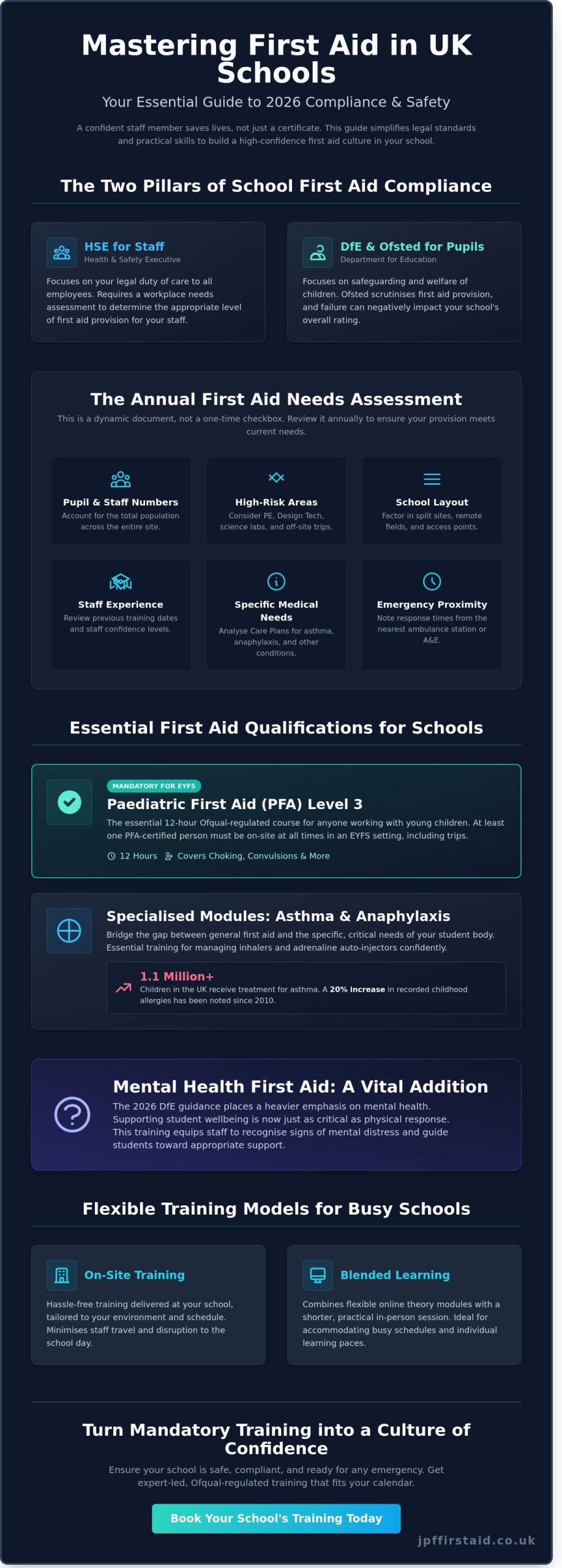
Ensuring your school meets the latest safety standards isn’t just about ticking boxes; it’s about protecting your entire community. In 2026, the legal framework for first aid training for schools uk remains anchored in the Health and Safety (First-Aid) Regulations 1981, but with refreshed Department for Education (DfE) statutory requirements that demand more from leadership teams. Your school holds a non-delegable duty of care. This means you’re legally and morally responsible for the well-being of both your employees and every pupil on your roll. The core principles of first aid focus on preserving life and preventing conditions from worsening, which is why a bespoke approach is vital. Every school site is unique, so a “one size fits all” policy won’t work for complex educational environments with varying risks.
You need to navigate two distinct sets of standards. The Health and Safety Executive (HSE) focuses on your staff as employees, while Ofsted and the DfE focus on the children. Balancing these can feel overwhelming, but it’s manageable with a clear plan. We focus on making this process hassle-free, providing you with the confidence that your compliance is watertight and your team is ready to act.
Statutory Guidance and Ofsted Compliance
The 2026 update to the “Essential Guidance for Schools and Colleges” places a heavier emphasis on mental health first aid alongside physical response. Ofsted inspectors now scrutinize your first aid provision as a core component of your safeguarding rating. If your school fails to demonstrate that enough staff are trained to handle emergencies, your overall effectiveness grade can be downgraded. For those managing nurseries or reception classes, the Early Years Foundation Stage (EYFS) statutory framework requires at least one person with a full 12-hour Paediatric First Aid (PFA) certificate to be on the premises at all times. This includes school trips and breakfast clubs.
The Role of the First Aid Needs Assessment
You shouldn’t guess how many first aiders you need. A thorough needs assessment looks at your specific risks, such as high-risk subjects like PE or Design Technology, and the 20% increase in recorded childhood allergies since 2010. You must account for your school’s physical layout, including split sites or remote playing fields where help might take longer to arrive. Consider these factors during your review:
- The total number of pupils and staff across the entire site.
- Specific medical conditions, including students with updated Care Plans for asthma or anaphylaxis.
- The experience levels of your current staff and their previous training dates.
- The proximity of your school to the nearest emergency department or ambulance station.
A “Needs Assessment” is a dynamic document that must be reviewed annually. This ensures your first aid training for schools uk stays relevant as your student population and staff numbers change each academic year. By staying proactive, you turn a legal obligation into a culture of care that parents and staff will truly value.
Essential First Aid Qualifications for Educational Settings
Choosing the right first aid training for schools uk involves more than a quick search; it requires aligning your staff’s skills with the specific age groups they look after. The official government guidance clarifies that schools must conduct a thorough risk assessment to determine their specific needs. We always recommend choosing Ofqual-regulated qualifications. Unlike non-accredited certificates, regulated courses ensure your school meets 2026 health and safety standards, giving you peace of mind that your training is legally robust and practically sound.
Beyond the basics, schools should consider specialised modules for asthma and anaphylaxis response. With approximately 1.1 million children in the UK currently receiving treatment for asthma, having staff who can confidently manage an inhaler or an adrenaline auto-injector is vital. These focused sessions bridge the gap between general first aid and the specific medical needs of your student body, ensuring no one is left vulnerable during a reaction.
Paediatric First Aid (Level 3) for Early Years
If you manage an Early Years Foundation Stage (EYFS) setting, this 12-hour course is mandatory. At least one person with a full Level 3 qualification must be on the premises at all times when children are present. This specialised paediatric first aid course covers critical scenarios like choking, febrile convulsions, and unresponsive infants. It’s designed to be hands-on and engaging, ensuring staff feel calm and capable when every second counts. We focus on building the confidence to act, rather than just memorising theory.
Emergency First Aid at Work (EFAW) for School Staff
While paediatric training focuses on children, you also have a duty to your adult workforce. The 6-hour EFAW course is the standard for general school staff, site managers, and administrators. It ensures emergency first aid at work compliance by teaching essential life-saving skills for adults. Your team will learn how to handle heavy bleeding, use an AED, and perform effective CPR. We make these sessions interactive and relaxed, stripping away the jargon to focus on practical skills that work in a busy school environment.
Student First Aid: Empowering the Next Generation
First aid isn’t just for the grown-ups. The FAA Level 2 Award in Student First Aid is a fantastic addition to the PSHE curriculum. Teaching pupils how to call 999 or help a friend who is hurt builds a supportive and proactive school culture. It transforms students from bystanders into confident helpers who understand the value of looking out for one another. If you’re looking to refresh your school’s safety plan, you can view our range of flexible training options to find the best fit for your pupils and staff alike.
Mental Health First Aid: A Vital Addition to School Safety
Physical injuries like scraped knees or broken bones are easy to see, but the invisible challenges are just as urgent. Mental health is now a primary focus of first aid training for schools uk because the data is hard to ignore. NHS England figures from 2023 show that 20.3% of children aged 8 to 16 years have a probable mental disorder. This means in an average classroom of 30, six students might be struggling with their mental wellbeing. A Mental Health First Aider acts as a vital bridge. They don’t diagnose or treat; instead, they provide immediate support and ensure the individual reaches the right professional care. By training your team, you break down the stigma that often prevents people from asking for help, creating a culture where it’s safe to speak up.
Supporting Staff Wellbeing and Stress Management
Teaching is a high-pressure profession. According to the 2023 Teacher Wellbeing Index, 78% of all education staff reported feeling stressed. Providing mental health first aid for staff is a practical way to combat burnout and keep your team healthy. We offer various levels of training, from half-day awareness sessions to comprehensive Level 3 qualifications. These courses empower colleagues to support one another through peer-to-peer check-ins, ensuring that stress doesn’t escalate into long-term absence. It’s about building a resilient workforce that feels valued and protected.
Recognising Mental Health Triggers in Pupils
Staff need the confidence to spot early warning signs before a crisis occurs. This might include sudden changes in attendance, social withdrawal, or uncharacteristic outbursts. Using the principles of Youth Mental Health First Aid, we teach your team how to initiate “the first conversation” safely. This framework focuses on active listening and non-judgmental support. It’s essential to remember that first aid has clear boundaries. Your role is to provide initial comfort and signpost to clinical experts, not to act as a counselor. This clarity ensures students get the right help while protecting the emotional capacity of your staff. Comprehensive first aid training for schools uk ensures your team is ready for both the visible and invisible emergencies that happen every day.
- Spotting signs: Identifying changes in appetite, sleep, or mood.
- Active listening: Giving full attention without offering immediate solutions.
- Signposting: Knowing exactly which professional services to contact.
- Self-care: Ensuring the first aider looks after their own wellbeing.
Planning Your Training: On-Site vs. Blended Learning
Organising first aid training for schools uk involves balancing strict HSE compliance with a busy academic calendar. Managing 50 or 60 staff members for a full day of training is a logistical puzzle. You have to consider cover costs, room availability, and the energy levels of your team. Choosing the right delivery model makes the difference between a simple box-ticking exercise and a session that truly empowers your staff. Group bookings are the most efficient path for educational settings. Booking a private session for 12 learners often reduces the cost per person by 30% compared to sending individuals to open public courses. It also ensures everyone receives the same consistent message tailored to your specific school site.
The Benefits of On-Site Group Training
Training in your own environment is a game-changer. When we practice drills in your sports hall or dining area, your team visualises real-world scenarios. They learn exactly where the nearest AED is kept and how to navigate your specific corridors during an emergency. This familiarity builds genuine confidence. These sessions naturally double as team-building events. Working together on practical life-saving skills fosters trust among departments that might rarely interact. Our trainers come to you, making the process completely hassle-free. You provide the space; we bring the expertise, mannequins, and training materials.
How Blended Learning Maximises Classroom Time
Blended learning is a modern solution for time-poor schools. It splits the qualification into two parts: independent online theory and a face-to-face practical assessment. For a standard 3-day First Aid at Work course, staff can complete the theoretical modules at their own pace before the practical day. This reduces the time they spend away from their pupils by 33% or more. It’s a flexible approach that respects the professional commitments of teachers and support staff. By the time they meet our instructors, they already have a solid foundation of knowledge. This allows us to focus entirely on hands-on skills and confidence-building exercises.
Choosing the right format ensures your school stays compliant without draining your budget or disrupting learning. We focus on making every session engaging, practical, and, most importantly, fun. You’ll leave feeling capable and ready to act. Our goal is to take the stress out of your health and safety requirements by providing a seamless, professional experience from start to finish.
Implementing an Effective First Aid Strategy in Your School
Moving your school from “unprepared” to “fully compliant” is a journey that starts with a structured audit. By January 2026, every educational setting should have a robust system that ensures life-saving skills are always current. It isn’t just about ticking boxes for Ofsted; it’s about creating a culture where staff feel empowered to act when it matters most. You need a strategy that balances the gravity of medical emergencies with a relaxed, confidence-building approach to learning.
Effective first aid training for schools uk works best when it’s treated as a continuous cycle rather than a one-off event. Start by identifying your “compliance gap” through a thorough risk assessment. Once you’ve booked your training, the focus shifts to maintaining that high standard through regular drills and meticulous record-keeping. This proactive stance ensures that when an accident happens, your team’s response is instinctive and calm.
Organising Your School First Aid Records
Keeping track of dozens of certificates can be a logistical headache. A simple, centralised spreadsheet is often the best tool for the job. You must record and report specific incidents under the Reporting of Injuries, Diseases and Dangerous Occurrences Regulations (RIDDOR) 2013 to remain legally compliant. Use this checklist to stay on top of your admin:
- Staff Matrix: List every staff member, their qualification type (e.g., Paediatric or Emergency First Aid at Work), and the exact expiry date.
- Automated Alerts: Set calendar reminders six months before any certificate expires to allow for hassle-free rebooking.
- Skills Drills: Schedule 15-minute “refresher” sessions every term. These keep skills sharp between formal three-year qualifications.
- Equipment Logs: Check first aid kits monthly to replace expired sterile wipes or bandages.
Choosing a Training Partner You Can Trust
The quality of your training depends entirely on the person standing at the front of the room. You should look for an award-winning provider that offers Ofqual-regulated qualifications and understands the unique pressures of a busy school environment. A great trainer acts as a mentor, not a lecturer. They should provide clear guidance on choosing the right first aid courses for your specific needs, whether you’re an Early Years setting or a large secondary school.
At JPF First Aid, we believe first aid training for schools uk should be engaging and fun. We bring the training to you, providing a practical, hands-on experience that builds genuine confidence. By choosing a partner who prioritises clarity and student success, you ensure your staff leave their session feeling ready to handle any situation with a calm, “can-do” attitude. This professional yet approachable style removes the anxiety from emergency response, making your school a safer place for everyone.
Empower Your Staff with Life-Saving Confidence
Ensuring your school is ready for 2026 involves more than just meeting basic DfE requirements. You’ve explored how vital it is to combine Ofqual regulated physical skills with essential mental health awareness to create a truly safe environment. Choosing the right first aid training for schools uk means finding a partner that understands the unique pressures of the classroom. We provide multi-award-winning instruction that replaces anxiety with a calm, can-do attitude. Our sessions are designed to be engaging and fun, ensuring every staff member builds the practical confidence they need to act when it matters most. It’s about providing total peace of mind through training that’s as enjoyable as it is professional.
Ready to secure your compliance and boost your team’s skills? You can book a bespoke first aid training session for your school today and let us handle the logistics with our hassle-free, on-site service. We’re excited to help you create a safer, more prepared educational setting for everyone. You’re in safe hands, and your students will be too.
Frequently Asked Questions
What are the legal first aid requirements for UK schools in 2026?
Schools must comply with the Health and Safety (First-Aid) Regulations 1981 and the Department for Education (DfE) statutory guidance updated for 2026. You’re legally required to provide adequate equipment, facilities, and personnel based on a written risk assessment. This assessment considers your specific school layout and the 1,000 or more pupils and staff on site. Our first aid training for schools uk ensures you meet these standards while building team confidence.
How many first aiders does a school legally need to have on-site?
There isn’t a single fixed number in the law, but the Health and Safety Executive (HSE) recommends one qualified first aider for every 50 people in higher-risk environments. For a school with 500 pupils, you should have at least 10 trained staff members available at all times. Your risk assessment must also account for staff absences and school trips to ensure you’re never left without a qualified lifesaver.
Is paediatric first aid mandatory for secondary schools and colleges?
Paediatric first aid is mandatory for staff working with children in the Early Years Foundation Stage (EYFS), but it isn’t a legal requirement for secondary schools. However, the 2026 DfE guidelines suggest it’s best practice if you have students with specific medical needs. Most secondary schools choose to train staff in Schools First Aid or First Aid at Work to cover both adults and older teenagers effectively.
Can school pupils be trained as first aiders under current regulations?
Yes, since the 2020 changes to the National Curriculum, all state-funded schools in England must teach basic first aid to pupils. Primary school children learn how to call 999 and deal with minor injuries, while secondary students learn life-saving skills like CPR and using a defibrillator. Teaching these skills builds incredible confidence in your students, turning them into capable lifesavers before they even leave the school gates.
How often should school first aid training be refreshed or renewed?
Your first aid certificates are valid for 3 years from the date of issue. To keep your skills sharp, the HSE recommends a 3 hour annual refresher course between these full renewals. This ensures your team doesn’t forget vital steps during the 36 month gap between qualifications. We make these sessions engaging and fun, so your staff actually look forward to keeping their life-saving knowledge up to date and compliant.
What is the difference between an “Appointed Person” and a “First Aider” in a school?
A First Aider is someone who has completed a regulated qualification like the 1 day EFAW or 3 day FAW course. An Appointed Person is someone chosen to take charge of first aid arrangements, such as calling emergency services or restocking the first aid kit. They aren’t required to provide medical treatment. For full first aid training for schools uk compliance, you’ll need qualified First Aiders on site during all school hours.
Does a school need a Mental Health First Aider by law?
There’s currently no legal requirement under the Health and Safety (First-Aid) Regulations 1981 to have a “Mental Health First Aider.” However, the DfE 2024 guidance encourages every school to have a designated Senior Mental Health Lead. This role helps manage the wellbeing of the 1 in 5 children who currently face mental health challenges. Adding this training creates a supportive environment that values the safety of both the mind and the body.
What equipment should be included in a standard school first aid kit?
Your school first aid kits should follow the British Standard BS 8599-1 for workplace containers. A standard medium kit includes 40 sterile plasters, 2 eye pads, 4 triangular bandages, and 6 medium wound dressings. You’ll also need 10 alcohol-free wipes and at least 1 resuscitation face shield for CPR. Keeping these kits stocked is a simple, hassle-free way to ensure you’re prepared for the hundreds of minor bumps that happen every term.
Recent Comments