

What if your next Ofsted inspection was derailed not by your teaching quality, but by a single oversight in your staff training records? With the Department for Education updating the statutory framework, staying on top of the eyfs first aid requirements 2026 is no longer just a “to-do” list item; it’s the foundation of your setting’s safety and legal standing. We know that managing a high-turnover team while trying to decipher the difference between Full and Emergency Paediatric First Aid (PFA) can feel overwhelming. You’re dedicated to providing the best care, and the last thing you need is the anxiety of a potential ratio error during a surprise visit.
We’re here to help you turn that compliance headache into a clear, manageable plan. This guide ensures your early years setting remains fully compliant with the latest 2026 updates, giving you the peace of mind that your team is prepared for any emergency. You’ll find a straightforward checklist for staff ratios, a clear breakdown of regulated course types, and a simple strategy to keep your training refreshers on track. Let’s make sure your setting isn’t just meeting the minimum standards, but is a place where every staff member feels confident and every child is in safe, expert hands.
Key Takeaways
- Understand how the updated statutory framework applies to your specific setting, ensuring you meet the mandatory eyfs first aid requirements 2026 without the guesswork.
- Clear up the confusion between Full PFA and Emergency PFA qualifications to ensure every member of your team holds the correct level of certification for their role.
- Master the “available at all times” rule to guarantee seamless cover during staff holidays, sickness, and off-site outings.
- Follow our practical roadmap to conduct a thorough risk assessment and calculate the essential “buffer” of first aiders needed for your nursery or school.
- Learn why choosing regulated, hands-on training builds the genuine life-saving confidence that a simple attendance certificate can never provide.
EYFS First Aid Requirements 2026: Understanding the Statutory Framework
The Department for Education (DfE) sets the health and safety benchmarks that every early years provider in England must follow. Whether you are a childminder, a school-based provider, or managing a large nursery, the eyfs first aid requirements 2026 apply to you with equal weight. These mandatory standards are designed to create a safe environment where children can thrive, ensuring that the adults responsible for them have the skills to act fast in an emergency. The Early Years Foundation Stage (EYFS) framework is not just a set of suggestions; it is a legal obligation that protects both the children and your professional reputation.
Staying compliant is about more than avoiding a difficult conversation with an inspector. If you fail to meet these requirements, the consequences are severe. During an Ofsted inspection, a lack of valid paediatric first aid certificates can result in an immediate “Inadequate” rating for safeguarding. In the event of a medical emergency, the lack of trained staff could lead to tragic outcomes and potential legal prosecution. We want to help you feel prepared and confident so that you can focus on providing the best possible care without the stress of compliance worries.
The 2026 Safeguarding and Welfare Amendments
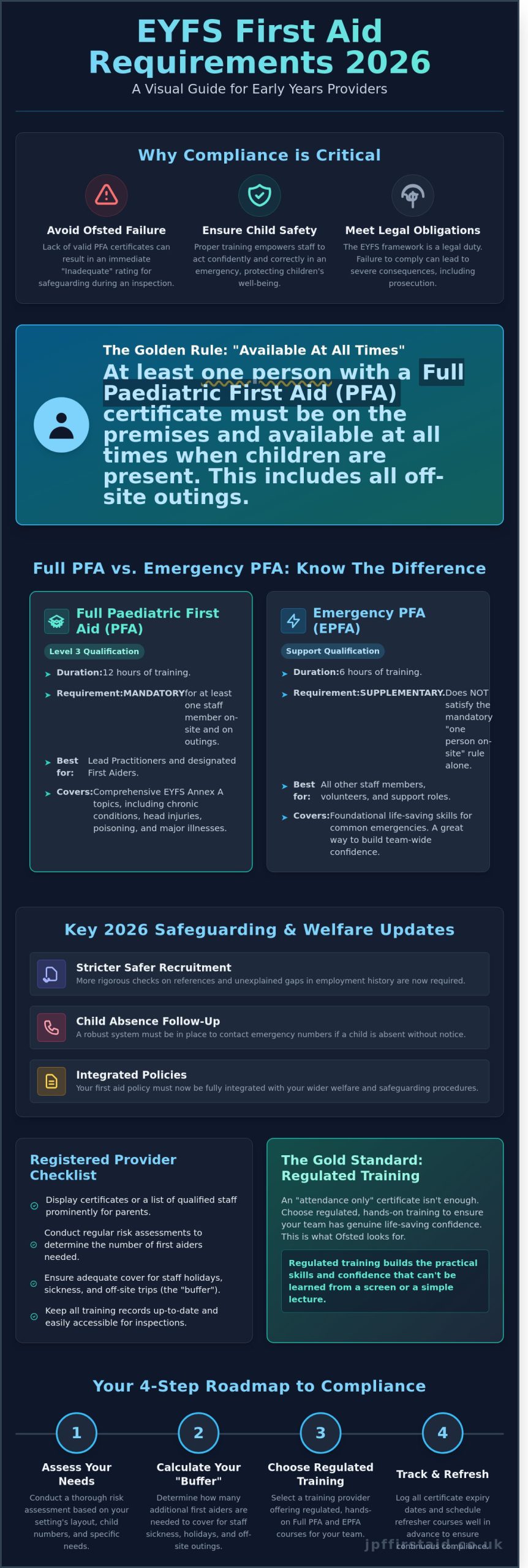
The 2026 framework incorporates vital updates that began rolling out in late 2025. You must now adhere to stricter “safer recruitment” protocols, which include more rigorous checks on references and employment gaps. There is also a heightened expectation for following up on child absences; you need a robust system to contact emergency numbers if a child fails to attend without notice. The safeguarding training criteria annex now requires you to integrate your first aid policy with your wider welfare procedures, ensuring your team is ready for any scenario, from a minor scrape to a major safeguarding concern.
Who is Responsible for Compliance?
The “Registered Provider” holds the legal duty to ensure all staff are suitably qualified and that the setting remains safe. It’s your responsibility to make sure that training is up to date and that certificates are easily accessible. Consider these practical steps to stay on the right side of the regulations:
- Displaying Certificates: You must display your paediatric first aid certificates clearly for parents to see, or provide a list of all qualified staff in a prominent place.
- Risk Assessments: You should conduct regular risk assessments to determine the total number of first aiders you need. This depends on your layout, the number of children, and the specific needs of those in your care.
- Staff Ratios: At least one person with a full paediatric first aid certificate must be on the premises and available at all times when children are present.
Full PFA vs Emergency PFA: Which Qualification Does Your Staff Need?
Understanding the distinction between the two types of paediatric training is vital for your nursery or school. The 12-hour Full Paediatric First Aid (PFA) is a Level 3 qualification that covers the exhaustive list of requirements found in Annex A of the EYFS statutory framework. This course delves into complex scenarios like chronic medical conditions, head injuries, and poisoning. To meet the eyfs first aid requirements 2026, you must ensure at least one person with a current Full PFA certificate is on the premises at all times when children are present. This rule also applies to all off-site outings.
The 6-hour Emergency Paediatric First Aid (EPFA) course serves a different purpose. It provides a solid foundation in life-saving skills for support staff or volunteers but it doesn’t satisfy the mandatory “one person on-site” requirement on its own. Most successful settings use a blend of both. They ensure all lead practitioners hold the 12-hour qualification while using the 6-hour course to upskill the rest of the team. This creates a robust safety net where everyone knows how to react in those first critical seconds.
Course Content and Ofqual Regulation
You should only ever invest in training that is Ofqual regulated. This is the only way to guarantee your certificates are legally valid during an Ofsted inspection. A regulated course ensures your staff are assessed on essential practical skills, including:
- Infant and child CPR techniques using specialized manikins
- Choking protocols for different age groups
- Managing unconscious casualties and the recovery position
- Using an Automated External Defibrillator (AED) on a child
We focus on making these practical sessions engaging and relaxed. When your team feels confident with the physical skills, the anxiety of emergency response fades away. This hands-on approach is a core part of meeting the eyfs first aid requirements 2026 with total peace of mind.
The Three-Year Renewal Cycle
Paediatric first aid certificates have a strict three-year lifespan. There is no grace period once the expiry date passes. If a staff member’s certificate expires on the 14th of the month, they are no longer counted towards your legal ratios on the 15th. This can cause immediate staffing crises if not managed correctly. We’ve seen that 85% of compliance issues in early years settings stem from simple administrative oversight regarding expiry dates.
Best practice involves booking refresher training at least 3 months before a certificate lapses. For larger organisations, maintaining a digital training matrix is the most reliable way to track these dates. If you’re looking to simplify your compliance, our on-site training solutions allow you to qualify your whole team at once, keeping your renewal dates synchronized and your setting safe.
Ratios, Outings, and the “Available at All Times” Rule
One of the most common mistakes we see is the “certificate in the drawer” trap. You might have a folder full of PFA certificates, but that doesn’t mean you’re compliant. The EYFS paediatric first aid requirements demand that a qualified person is physically present and available at all times. This isn’t just a suggestion; it’s a legal necessity that covers every minute of the day.
“Available at all times” means exactly that. If your only PFA holder is on a lunch break, off sick, or away on holiday, your setting isn’t meeting the required standards. You need to account for every scenario. If a child has an accident while your primary first aider is in the staff room, you’re at risk of a serious compliance breach. We recommend having enough trained staff to cover every room and every shift transition without gaps.
Managing First Aid During Staff Transitions
You must map out your PFA coverage from the second your doors open until the last child leaves. Early morning drop-offs and late afternoon collections are high-risk periods where staff numbers are often at their lowest. Relying on a single person creates a “single point of failure” that puts your business and the children at risk. If that one person is delayed in traffic, your setting cannot legally open. To maintain safety, ensure multiple staff members on every shift hold a valid certificate. Every single outing must be accompanied by at least one person who holds a full, valid PFA qualification.
Trainees and Students in the 2026 Framework
The 2026 amendments introduce stricter rules for how students and trainees count towards your staff ratios. Under these new guidelines, a student can only be counted in the staff-to-child ratios at one level below the qualification they’re studying for if they already hold a full PFA certificate. This is a significant shift designed to ensure that anyone counted as “qualified” in your ratios has the practical skills to act in an emergency.
This change prevents settings from relying on “unqualified” responders during busy periods or staff shortages. It ensures that the eyfs first aid requirements 2026 are met by people who have the confidence to step in when it matters. We’ve found that putting trainees through their PFA training early in their placement builds their confidence and makes them a much more reliable part of your team. It’s a practical way to boost your setting’s safety while supporting the next generation of early years professionals.
Organising Your 2026 First Aid Provision: A Step-by-Step Roadmap
Meeting the eyfs first aid requirements 2026 isn’t just about ticking a box; it’s about building a safety net that works when things go wrong. Start with a thorough risk assessment. You need to look at your specific layout, the age range of your children, and any specific medical needs like allergies or asthma. A setting with a large outdoor forest school area will have different needs than a small, single-room nursery.
Don’t just aim for the minimum. If the statutory framework says you need one person, train three. You have to account for staff sickness, annual leave, and lunch breaks. A “buffer” ensures you’re never caught short. In 2023, Ofsted reported cases where settings failed inspections because their only qualified first aider was away on an emergency. Having extra trained staff builds confidence across the whole team.
Choosing Between In-Person and Blended Learning
Ofsted accepts blended learning for the 12-hour Paediatric First Aid (PFA) qualification, provided the course includes at least six hours of face-to-face practical training. You cannot meet the eyfs first aid requirements 2026 with a 100% online course. These certificates won’t be accepted during an inspection. Booking on-site group training is often better for team morale. It allows your staff to practice together in the actual environment where they work, making the experience relaxed and practical.
Documenting and Reporting Accidents
You must keep a written record of all first aid treatment provided to children. Under the Statutory Framework, you are legally required to notify Ofsted of any serious accident, illness, or injury to a child within 14 days of the incident. Failing to do this is a direct breach of your registration. Ensure your records are GDPR compliant by keeping them in a secure, locked location or a password-protected digital system. They must be accessible to parents but kept private from others.
Clear communication builds trust with families. Share your first aid policy with parents during their initial tour and keep it updated in your handbook. Display your first aiders’ photos and their certificate expiry dates on a central noticeboard. This transparency shows families that their children are in safe, expert hands. It turns a legal requirement into a point of pride for your setting.
Why Regulated Training is the Gold Standard for Early Years
Choosing a first aid provider is more than a simple procurement task; it’s a safety decision that affects every child in your care. There’s a massive difference between an “attendance” certificate and a “regulated qualification”. An attendance certificate merely shows your staff were present in a room. A regulated qualification means every learner has successfully demonstrated their skills against strict national standards. This distinction is vital for meeting the eyfs first aid requirements 2026, as it provides an auditable trail of competence that satisfies both Ofsted and your insurance providers.
At JPF First Aid, we bridge the gap between legal compliance and life-saving confidence. We don’t believe in dry, clinical lectures that leave staff checking their watches. Instead, we focus on practical, hands-on training that people actually enjoy and, more importantly, remember. When your team feels comfortable and engaged during their session, they’re far more likely to retain the 12 hours of specialised knowledge required for a full paediatric qualification.
To prepare for the 2026 updates, you should audit your current staff training status immediately. Consider these steps:
- Check expiry dates: Ensure no certificates expire in the first quarter of 2026.
- Verify qualification levels: Confirm your team holds the Level 3 Award in Paediatric First Aid (RQF) rather than non-regulated certificates.
- Assess practical skills: Identify staff members who may need a “skills refresher” to boost their confidence before their formal renewal is due.
Building a Culture of Safety and Confidence
High-quality training moves your setting beyond tick-box compliance and into a state of genuine emergency preparedness. When staff know exactly what to do, their anxiety levels drop. This sense of empowerment is a significant factor in staff retention; a team that feels safe and supported is a team that stays. We also link our first aid training to your broader mental health and wellbeing strategy. Knowing how to handle a physical emergency reduces the secondary trauma often associated with workplace accidents, protecting your team’s mental health as much as the children’s physical safety.
Securing Your 2026 Training Dates
The demand for high-quality, regulated training will peak as the 2026 deadline approaches. Booking bespoke on-site training for your whole team is the most efficient way to ensure everyone is up to speed at the same time. This “hassle-free” approach allows us to tailor the scenarios to your specific nursery layout, whether you’re dealing with multi-storey buildings or large outdoor play areas. We provide clear, transparent quotes based on your specific headcount and location, ensuring you get the best value without any hidden costs.
Ensure your nursery is 2026 compliant with our regulated paediatric first aid courses. Don’t leave your compliance to chance; let us help you build a team of confident, capable life-savers.
Secure Your Setting’s Future Compliance
Navigating the updated eyfs first aid requirements 2026 doesn’t have to be a source of stress for your nursery or childminding business. Success lies in mastering the distinction between Full PFA and Emergency PFA while ensuring your team meets the statutory framework’s ratios both on-site and during outings. It’s about more than just ticking a regulatory box; it’s about fostering a culture of safety where every staff member feels prepared to act when it matters most.
At JPF First Aid, we take the hassle out of compliance. As a multi-award-winning training provider, we deliver Ofqual regulated qualifications that are designed to stick. We’ve helped thousands of learners move past clinical jargon to gain real-life skills through an experience that is far from dry. Our sessions are famously engaging and fun, ensuring your team leaves with the genuine confidence needed to protect the children in their care. We focus on practical success rather than just theory, acting as your reliable expert mentor every step of the way.
Don’t leave your 2026 roadmap to the last minute. Book your Ofsted-compliant Paediatric First Aid training today and enjoy the peace of mind that comes from working with a trusted partner. We’re ready to help you build a safer, more confident environment for your little ones.
Frequently Asked Questions
Does every staff member in a nursery need a paediatric first aid certificate?
Not every staff member is legally required to hold a certificate, but all staff who completed their Level 2 or Level 3 qualification after 30 June 2016 must have a PFA certificate within 3 months of starting work. Under the eyfs first aid requirements 2026, you’ll need at least one person with a full PFA certificate on the premises at all times when children are present. Most nurseries aim for 100% coverage to ensure they’re never caught short during staff absences.
Can I use an online-only paediatric first aid course for EYFS compliance?
No, you can’t use a 100% online course to meet EYFS requirements. The Department for Education mandates that PFA training must include a practical, face-to-face element where you demonstrate life-saving skills like CPR on a manikin. While “blended learning” is allowed, at least 6 hours of the 12-hour course must be delivered in person by a qualified trainer to ensure you have the confidence to act in a real emergency.
How many paediatric first aiders must be present in an early years setting?
You must have at least one person with a full 12-hour PFA certificate on the premises at all times when children are present. This legal minimum also applies to any outings or trips away from the main site. To remain compliant with the eyfs first aid requirements 2026, your risk assessment should determine if you need additional first aiders based on your layout, the number of children, or specific medical needs.
What is the difference between Emergency PFA and the full 12-hour PFA course?
The Emergency PFA (EPFA) is a 6-hour course covering urgent life-saving skills, whereas the full PFA is a 12-hour course covering a wider range of illnesses and injuries. Only the full 12-hour PFA certificate meets the mandatory requirement for newly qualified Level 2 and 3 staff. The EPFA is often used for additional staff members to boost safety levels without the time commitment of the full qualification.
How often must paediatric first aid training be renewed under 2026 rules?
You must renew your paediatric first aid certificate every 3 years to remain compliant. The Health and Safety Executive (HSE) also strongly recommends annual refresher sessions to keep your skills sharp. Since first aid protocols can change, attending a practical course every 36 months ensures you’re using the most current, evidence-based techniques to protect the children in your care.
Do childminders need to have a paediatric first aid certificate?
Yes, all registered childminders must hold a current, full 12-hour PFA certificate to operate. This rule is a core part of the EYFS framework and applies regardless of whether you work alone or with assistants. If you use an assistant, they must also hold a valid PFA certificate if they are ever left in sole charge of the children for any period of time.
What happens if our only paediatric first aider is off sick?
If you don’t have a PFA certificate holder on-site, you’re in breach of EYFS regulations and cannot legally care for children. You must have a robust contingency plan, such as having a second staff member trained or a local “on-call” first aider who can arrive immediately. Most settings train at least 2 or 3 staff members to avoid total closure during unexpected staff absences or 48-hour sickness bugs.
Are trainees and students allowed to be included in staff-to-child ratios?
Trainees and students can only be included in ratios if the provider is satisfied they are competent and responsible. Specifically, those aged 17 or over who are on long-term placements and studying for a relevant qualification can count towards ratios. However, they cannot be left alone with children and don’t count as the designated PFA lead required by the 2026 standards.
Recent Comments