

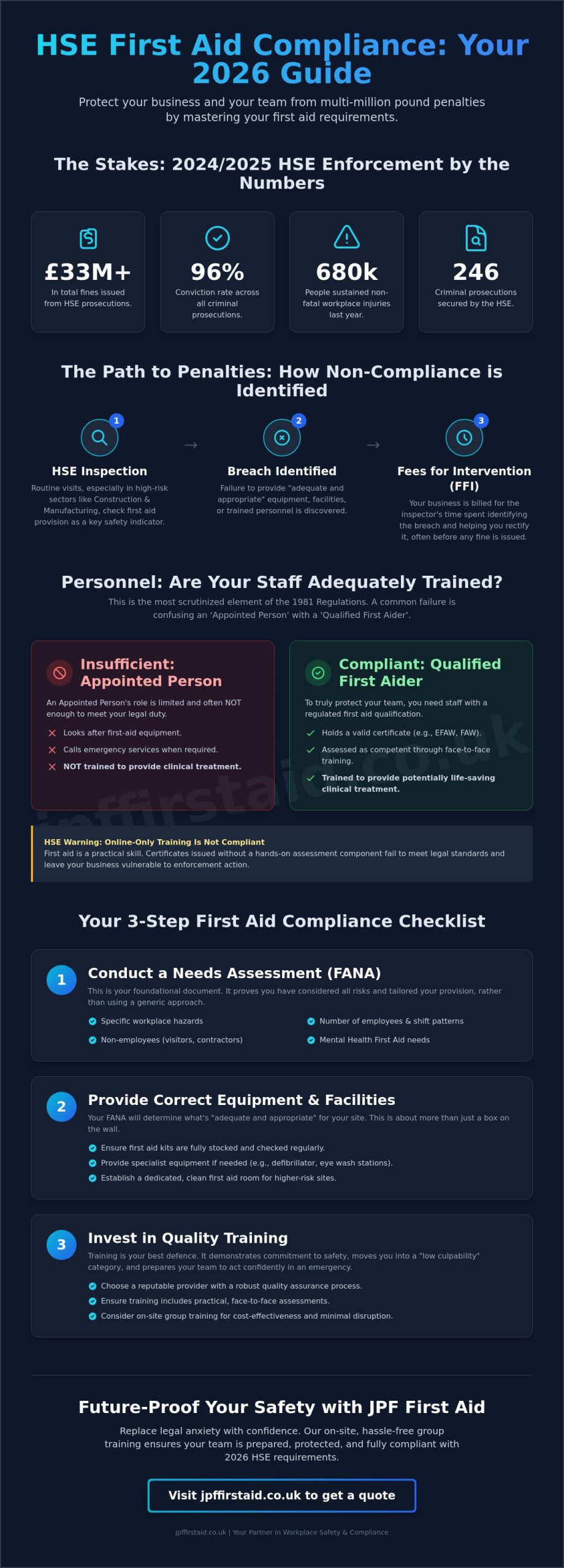
Did you know that the HSE secured a 96% conviction rate across 246 criminal prosecutions in 2024/2025, resulting in over £33 million in total penalties? For many business owners, the fear of hse fines for first aid non-compliance 2026 is a constant source of stress, especially when 680,000 people sustained workplace injuries last year. You want to keep your team safe, but the vague legal requirement for “adequate and appropriate” provision often feels like a moving target.
We understand that navigating health and safety laws can feel heavy, but we’re here to make the process hassle-free. This guide will show you exactly how to protect your business from multi-million pound penalties by mastering your first aid requirements. You’ll get a clear breakdown of the latest 2026 fine structures and a practical checklist to ensure your site is fully compliant. We’ll help you replace that legal anxiety with the confidence that your staff are prepared, protected, and in safe hands.
Key Takeaways
- Understand the “Fees for Intervention” (FFI) model and how the HSE identifies non-compliance during routine workplace inspections.
- Learn how to conduct a robust First Aid Needs Assessment (FANA) to ensure your equipment and facilities meet the 1981 legal standards.
- Discover why training is your best defence against hse fines for first aid non-compliance 2026 by moving your business into the “low culpability” category.
- Identify the correct staff-to-delegate ratios for Emergency First Aid at Work to keep your team safe and your business legally protected.
- Explore how on-site group training provides a cost-effective, hassle-free way to meet your regulatory requirements without disrupting your operations.
The 2026 HSE Enforcement Landscape: Why First Aid Compliance Matters
Understanding the current enforcement landscape is the first step toward peace of mind. Under the Health and Safety (First-Aid) Regulations 1981, non-compliance occurs when an employer fails to provide “adequate and appropriate” equipment, facilities, and personnel. This isn’t just a suggestion; it’s a legal duty derived from the Health and Safety at Work etc. Act 1974. If an inspector visits your site in 2026 and finds you’re falling short, they’ll likely trigger the Fees for Intervention (FFI) model. This means your business is billed for the inspector’s time spent identifying the breach and helping you rectify it, which can quickly escalate before a single fine is even issued.
The risk of hse fines for first aid non-compliance 2026 is higher than ever. With the HSE achieving a 96% conviction rate across 246 criminal prosecutions in 2024/2025, the odds are stacked against those who cut corners. Inspectors use “adequate and appropriate” as their primary benchmark, looking for a tailored approach rather than a generic, one-size-fits-all kit. They want to see that you’ve genuinely considered your specific hazards and prepared your team to handle them with confidence.
The Rising Cost of Workplace Negligence
Courts calculate fines by looking at your annual turnover, the level of harm risked, and your culpability. In the 2024/2025 period, total fines from HSE prosecutions exceeded £33 million, showing that the financial impact of safety failures is substantial. For 2026, there’s a clear shift toward harsher penalties for risks that were entirely foreseeable, such as an untrained staff member or an empty first aid box. Beyond the bank balance, the reputational damage and the emotional weight of a workplace fatality, which claimed 124 lives in 2024/2025, can be devastating for any local business.
HSE Focus Areas for 2026 Inspections
If you’re in construction, manufacturing, or education, you’re under increased scrutiny this year. Inspectors often start their routine visits by checking your first aid provision because it’s a reliable indicator of your overall safety culture. They’re looking for more than just a box on the wall; they want proof of personnel readiness. Genuine compliance is a balanced mix of high-quality equipment, regulated training qualifications, and up-to-date documentation. It’s about being ready for the 680,000 non-fatal injuries that occur annually, ensuring your team feels safe and supported every single day they come to work.
The Legal Framework: Health and Safety (First-Aid) Regulations 1981
The Health and Safety (First-Aid) Regulations 1981 remain the cornerstone of workplace safety, but their interpretation by inspectors has evolved. To remain compliant, you must provide “adequate and appropriate” equipment, facilities, and personnel. Equipment refers to well-stocked kits suited to your specific hazards, while facilities might include a dedicated first aid room for higher-risk sites. However, the most scrutinized element is your personnel. Many employers confuse “appointed persons” with “qualified first aiders.” An appointed person’s role is limited to looking after equipment and calling emergency services; they aren’t trained to provide clinical treatment. To truly protect your team, you’ll likely need staff who have completed an Emergency First Aid at Work course or a full Level 3 qualification.
Don’t be tempted by the convenience of “online-only” training. The HSE is very clear that first aid is a practical skill that requires face-to-face assessment. Certificates issued without a hands-on component often fail to meet legal standards, leaving you vulnerable to HSE enforcement action. In 2026, inspectors are increasingly checking that training was delivered by a reputable provider with a robust quality assurance process in place. Failing to prove this personnel readiness is a fast track to hse fines for first aid non-compliance 2026.
The Duty of Care to Employees and Non-Employees
Your legal responsibility doesn’t end with your payroll. You owe a duty of care to everyone on your premises, including contractors, delivery drivers, and visitors. A First Aid Needs Assessment (FANA) is your best tool for documenting how you’ve considered these groups. If you haven’t reviewed your FANA recently, you might be missing the 2026 emphasis on mental health. Integrating first aid for mental health into your provision is no longer an optional extra; it’s a vital part of a modern, holistic safety strategy that shows you value your team’s total wellbeing.
Regulated vs. Non-Regulated Qualifications
Not all certificates carry the same weight in a courtroom. Ofqual-regulated qualifications provide a built-in “due diligence” shield for employers because the training provider has already been vetted for quality. If you choose an unaccredited provider, the burden of proof is on you to show the training was sufficient. This is a high bar to clear during an investigation. When choosing a partner, look for these three markers:
- Regulated Status: Do they offer Level 3 awards from a recognized awarding body?
- Practical Focus: Is the training hands-on with a “can-do” approach?
- Expertise: Are the trainers qualified professionals with real-world experience?
Taking the time to verify these details ensures your compliance is rock-solid. If you need help identifying your specific requirements, we can provide bespoke training solutions tailored to your industry.
Calculating the Cost of Non-Compliance: Fines vs. Training
Investing in a Level 3 First Aid at Work course is a minor expense when you look at the alternative. In 2026, the courts follow strict sentencing guidelines where fines are directly linked to your annual turnover. For a large company, a serious breach can lead to penalties in the millions. Even for smaller businesses, the minimum fine levels often start at £20,000 for a single failure. When you weigh the modest cost of a three day training session against the risk of hse fines for first aid non-compliance 2026, the financial logic is undeniable. Training isn’t just a safety measure; it’s a savvy business decision that protects your bottom line.
The HSE categorises your business based on “culpability” during an investigation. If you’ve ignored the Health and Safety (First-Aid) Regulations 1981, you’ll be placed in the “high culpability” bracket. This leads to much harsher sentencing. However, having a team of staff with regulated qualifications moves you into the “low culpability” category. It proves you’ve taken every reasonable step to ensure safety. Beyond the fine, you must also consider the impact of a “Notice of Improvement.” This legal order can force you to halt operations or change your workflows until you prove your first aid provision is adequate, leading to costly downtime that many businesses can’t afford.
Case Study: When First Aid Provision Fails
Imagine a medium sized warehouse that decides to delay its training schedule to save on immediate costs. An employee suffers a severe allergic reaction, but because no one on shift holds a current first aid certificate, the response is panicked. The delay in providing basic life support leads to a much worse medical outcome. A £500 investment in a training day would have ensured a calm, effective response. Instead, the HSE investigation results in a £50,000 fine. The court’s 2026 sentencing guidelines don’t just look at the injury; they punish the “foreseeable risk” of having no trained responders on site.
The Insurance Implications of HSE Fines
Many business owners mistakenly believe their liability insurance will pick up the tab for legal penalties. It won’t. Most policies specifically exclude HSE fines and the associated Fees for Intervention. If you’re hit with an enforcement notice, your insurance premiums will likely skyrocket, as you’re now viewed as a high risk client. You also face the risk of “vicarious liability,” where you’re held responsible for the lack of action taken by your staff during an emergency. Compliance is the only true “insurance” for a director’s personal liability, ensuring you stay on the right side of the law and keep your business running smoothly.
The 2026 First Aid Audit: Avoiding the HSE Spotlight
Proactive auditing is your best defence against unexpected inspections. By conducting a regular internal review, you can effectively eliminate the risk of hse fines for first aid non-compliance 2026. The HSE issued over 4,400 enforcement notices in the 2024/2025 period; many of these were preventable through simple, structured checks. Your audit should begin with a fresh First Aid Needs Assessment (FANA). This isn’t a one-time document. It’s a living record that must reflect your current staff numbers, office layouts, and specific workplace hazards. If you’ve introduced new machinery or changed your floor plan since your last review, your FANA is likely out of date.
Once your assessment is current, you must review your personnel ratios. A common pitfall is having enough certificates on paper but not enough people on the shop floor during holidays or night shifts. You need to ensure that emergency first aid at work delegates are distributed across all working hours. Next, audit your physical supplies. Check every kit against the BS 8599-1 standard and look for expired sterile items. Finally, verify the validity of every staff certificate. Don’t wait for an expiry date to pass; schedule refreshers at least three months in advance to maintain seamless coverage. If you’re unsure where to start, you can book professional first aid training with us to ensure your team is fully compliant.
Determining Your Risk Category
Your environment dictates your legal requirements. Low-risk settings, like a standard retail shop, typically require one first aider for every 100 employees. However, high-risk sectors like construction or manufacturing require one for every 50. You must also account for lone workers or staff members who travel frequently. If your team works in shifts, you need a qualified person on every rotation. A simple way to stay safe is to aim for a 10% buffer in your trained staff numbers to cover unexpected absences or sickness.
Documentation and Record Keeping
Inspectors love paperwork because it tells the story of your safety culture. You must maintain a compliant Accident Book (BI 510) and ensure every incident is logged correctly. In 2026, digital training records are highly recommended as they provide an instant, searchable trail of your compliance efforts. Missing or poorly maintained paperwork is often the easiest way for an inspector to justify a fine. Keeping your records organised shows that you take your “can-do” attitude toward safety seriously, making any HSE visit a much more relaxed experience.
Future-Proofing Safety with JPF First Aid
Protecting your business shouldn’t be a source of constant stress. At JPF First Aid, we provide a hassle-free route to total compliance, ensuring you stay well clear of the legal spotlight. We’ve seen how the threat of hse fines for first aid non-compliance 2026 weighs on directors and managers. Our goal is to take that weight off your shoulders by acting as your reliable expert mentor. We specialise in on-site group training, which means we bring the classroom to your doorstep. This approach isn’t just convenient; it’s highly cost-efficient. You save on travel expenses and staff downtime while ensuring your team learns in the exact environment where they’ll actually need to use their skills.
We only deliver regulated qualifications. These courses act as your ultimate legal shield during an inspection. When an HSE officer asks for proof of competence, an Ofqual regulated certificate provides immediate, undeniable evidence of due diligence. It shows you’ve chosen a provider that meets the highest national standards for quality assurance. By choosing this path, you’re effectively insulating your business from the most severe hse fines for first aid non-compliance 2026. You get more than just a piece of paper; you get the peace of mind that your compliance is rock-solid.
Bespoke Training for National Compliance
We don’t believe in “one-size-fits-all” solutions because every workplace has its own unique set of risks. A high-risk manufacturing plant needs a different focus than a quiet corporate office. We tailor our courses to your specific hazards, making the training relevant, practical, and immediately useful. To keep your operations running smoothly, we also offer blended learning options. This allows your team to complete the theory portions online at their own pace before joining us for the essential hands-on practical assessment. If you’re unsure about your current status, you can book a compliance review with us to identify any gaps before an inspector does.
Why Confidence Trumps Certification
Our training is designed to be engaging and fun. We know that first aid can feel intimidating, so we use a relaxed, practical approach to build real-world skills. A certificate on a wall is useless if your staff are too anxious to step forward in a crisis. We focus on building a “can-do” attitude so that when an emergency happens, your team acts with speed and precision. This confidence is the primary outcome we promise. It ensures your staff are prepared to save lives, not just pass a test. Ready to secure your workplace and protect your team? Contact JPF First Aid for a bespoke workplace training quote today and let us help you lead with confidence.
Secure Your Business and Empower Your Team
Protecting your business from hse fines for first aid non-compliance 2026 doesn’t have to be a daunting task. By moving beyond basic kit maintenance and focusing on personnel readiness, you create a safer environment for everyone. A robust First Aid Needs Assessment is your first line of defence, while choosing regulated qualifications ensures your compliance stands up to the toughest scrutiny. These steps transform health and safety from a legal burden into a proactive shield for your workforce.
We’re here to help you turn these requirements into a positive part of your company culture. As a multi-award-winning training provider, JPF First Aid delivers expert-led sessions that are designed to be engaging and fun. We focus on building the practical skills and confidence your staff need to act decisively in an emergency. Don’t leave your safety record to chance or wait for an inspection to find a gap in your provision.
Secure your workplace compliance with JPF First Aid training and join the many businesses that trust us to keep their teams safe. You’re in safe, expert hands, and we’re ready to help you lead with a calm, capable, and compliant approach.
Frequently Asked Questions
What is the maximum HSE fine for first aid non-compliance in 2026?
The maximum fine for health and safety breaches can reach £10 million for large organisations with a turnover exceeding £50 million. Courts determine the final penalty based on your level of culpability and the seriousness of the harm risked. In the 2024/2025 period, the HSE secured over £33 million in total fines, proving they’re committed to holding businesses of all sizes accountable for safety failures.
How many first aiders do I need for a workplace of 50 people?
For a low-risk environment like an office or shop, you need at least one person with an Emergency First Aid at Work qualification. If your workplace is high-risk, such as a construction site or factory, the requirement is one qualified first aider for every 50 employees. You must also account for shift patterns and annual leave to ensure you’re never left without adequate cover during working hours.
Does the HSE recognise online-only first aid certificates?
No, the HSE doesn’t recognise first aid certificates earned through online-only training without a practical, face-to-face assessment. First aid is a hands-on skill that requires a qualified instructor to verify your technique and build your confidence. To avoid hse fines for first aid non-compliance 2026, you should always choose a regulated qualification that includes a physical classroom component and practical testing.
What happens if an employee is injured and I don’t have a first aider on site?
If an injury occurs and you lack a qualified responder, you’ll likely face a Fees for Intervention (FFI) charge and a formal investigation. The HSE issued over 4,400 enforcement notices in 2024/2025, many of which followed incidents where provision was found to be inadequate. This negligence can lead to criminal prosecution, significant financial penalties, and a total loss of your business’s reputational trust.
How often should first aid kits be checked for compliance?
You should check your first aid kits at least once a month to ensure all items are present and sterile. Many items, like dressings and eye wash, have expiry dates and aren’t compliant with BS 8599-1 standards once those dates pass. Keeping a simple monthly log of these checks shows an inspector that you’re proactive about your safety culture and helps prevent accidental hse fines for first aid non-compliance 2026.
Are mental health first aiders a legal requirement in 2026?
While not yet a standalone statutory requirement like physical first aid, the 2026 HSE guidance places a heavy emphasis on including mental health in your needs assessment. Failing to address the mental wellbeing of your staff can be viewed as a failure in your general duty of care. Many proactive businesses now include Level 2 or Level 3 Mental Health First Aid training to meet these modern safety expectations.
Can a director be held personally liable for first aid failures?
Yes, directors and senior managers can be personally prosecuted for health and safety breaches if the failure is linked to their neglect. This can result in unlimited personal fines and, in the most serious cases, a prison sentence. Taking a “can-do” approach to your first aid provision is the best way to protect your team while also safeguarding your personal career and reputation.
What should be included in a 2026 HSE-compliant first aid kit?
A compliant kit must meet the BS 8599-1 standard and include basic items like sterile plasters, bandages, safety pins, and nitrile gloves. For 2026, the HSE also looks favourably on high-risk sites that supplement their kits with catastrophic bleed equipment, such as tourniquets and haemostatic dressings. Your kit should always be tailored to the specific hazards you’ve identified in your latest First Aid Needs Assessment.
Recent Comments