

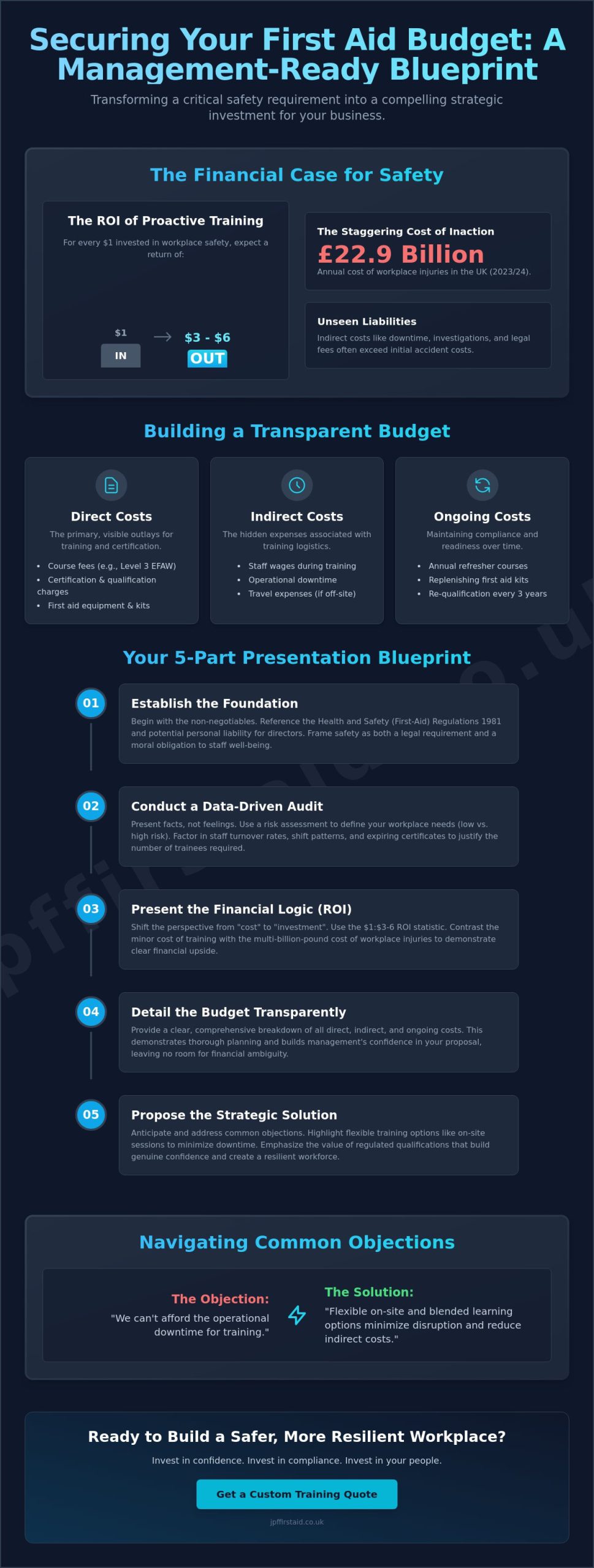
Did you know that for every $1 your company invests in workplace safety, you can expect a return of between $3 and $6? This return isn’t just a guess; it comes from reduced insurance premiums, fewer injuries, and lower legal liabilities. When you’re presenting a first aid training budget to management, it’s easy to feel like you’re just asking for another “tick-box” expense. You likely feel the pressure of quantifying the cost of non-compliance, especially when regulations like OSHA 29 CFR 1910.151 require trained responders to be just minutes away from an incident.
We understand that translating life-saving skills into financial data can feel like a daunting task. You want your team to be safe, but you need the board to see the value in a comprehensive training programme. This guide will help you build a professional, evidence-based proposal that secures the approval you need. We’ll walk you through a clear structure that justifies every penny of your spend, giving you the confidence to turn a dry financial request into a compelling case for a safer, more resilient workplace.
Key Takeaways
- Learn how to categorise your workplace risk levels to ensure your training spend is targeted, compliant, and cost-effective.
- Discover the hidden financial impact of workplace injuries on insurance premiums and how proactive training helps mitigate these long-term costs.
- Use our structured 5-part blueprint for presenting a first aid training budget to management to turn a simple cost request into a strategic business proposal.
- Overcome common objections regarding operational downtime by introducing flexible blended learning and the convenience of on-site training sessions.
- Understand why choosing regulated qualifications that focus on building learner confidence creates a more resilient and prepared workforce.
Understanding the Foundations of a Workplace First Aid Budget
A first aid budget is far more than a simple line item for course fees. Think of it as a strategic insurance policy for your company’s most valuable asset: your people. When you are presenting a first aid training budget to management, you need to show that you’ve considered the full scope of the business impact, not just the cost of a single certificate. A well-constructed budget covers the training itself, the equipment required to save a life, and the time allocated for your staff to remain competent and confident.
Choosing a proactive approach is always more cost-effective than reactive emergency spending. Consider the data from 2024, where private industry employers reported 2.5 million nonfatal workplace injuries. The indirect costs of these incidents, such as production downtime and administrative investigations, often dwarf the initial price of a training course. By investing in a comprehensive programme now, you’re preventing the financial shock of future accidents. This shift in mindset moves your proposal from “spending money” to “protecting profit.”
The bedrock of your budget is the Health and Safety (First-Aid) Regulations 1981. These UK regulations require every employer to provide adequate and appropriate equipment, facilities, and personnel to ensure their employees receive immediate attention if they are injured or taken ill at work. Understanding the basics of first aid is the starting point, but your budget must reflect the specific needs of your unique environment to move from basic compliance to a true safety culture.
The Legal Necessity vs. Moral Obligation
Compliance isn’t just about avoiding fines. Under current health and safety legislation, directors can face personal liability for safety failings. Meeting the minimum HSE requirements is the baseline, but a robust budget addresses the moral obligation to keep staff safe. When employees see that you’ve invested in their well-being, morale and retention rates naturally climb. A workplace that feels safe is a workplace where people want to stay.
Budget Components You Must Include
To ensure your proposal is airtight, you must account for both visible and hidden costs. Management will appreciate a transparent breakdown that includes:
- Direct Costs: These are your primary outlays, such as course fees for an Emergency First Aid At Work (Level 3) qualification and the subsequent certification charges.
- Indirect Costs: You must factor in staff downtime and any travel expenses if the training isn’t conducted on-site. We always recommend on-site training to keep these costs as low as possible.
- Ongoing Costs: Budget for annual refresher sessions and the regular replenishment of first aid kits to meet current standards.
By mapping out these elements clearly, you demonstrate a high level of competence and preparation. It shows management that you aren’t just looking for a quick fix, but are building a sustainable, trustworthy safety framework for the entire team.
Auditing Your Requirements: Gathering the Data
Before you step into a boardroom, you need cold, hard facts. Management values precision, and presenting a first aid training budget to management requires a thorough audit of your current workplace landscape. Start by conducting a risk assessment to determine your environment’s specific hazards. A quiet office has vastly different needs than a manufacturing plant. While low-risk environments primarily deal with minor injuries, high-risk sites must prepare for more severe trauma. This distinction is the first step in justifying your spend.
You also need to look at your human data. Check your existing certificates and note when they expire. If you have five first aiders but three certificates lapse next month, your budget needs to reflect that immediate need. Don’t forget staff turnover. If your business has a 15% annual turnover rate, you should train 15% more staff than the legal minimum to maintain a buffer. This prevents a compliance gap if a key first aider leaves. Considering the annual cost of workplace injuries reached £22.9 billion in 2023/24, having a trained team is a small price to pay for such high-stakes risk management.
Calculating Your First Aider Ratios
Finding your “magic number” isn’t guesswork. Use the Health and Safety Executive (HSE) guidelines as your compass. You must account for shift patterns, annual leave, and sickness to ensure someone is always available. For a low-risk office with more than 50 employees, you should have at least one first aider for every 100 people employed. This ratio ensures that even when people are away, your site remains safe and compliant.
Choosing the Right Qualifications
Not every role requires the same level of training. You might choose an Emergency First Aid at Work course for your office marshals, while your floor managers might benefit from the full three-day First Aid at Work (Level 3) qualification. If you work in a nursery, Paediatric First Aid is a legal must. To reduce budget friction, consider blended learning. This allows staff to complete theory online at their own pace, significantly reducing the time they spend away from their desks. It’s a “can-do” solution that keeps the office running while ensuring everyone stays safe. If you’re unsure which level fits your team best, you can always browse our bespoke training options to find the right match.
Proving ROI: The Financial Logic of Workplace Safety
When you’re presenting a first aid training budget to management, you must shift the conversation from what the training costs to what it saves. Most senior leaders view health and safety as a “compliance cost”, a necessary but annoying drain on resources. Your job is to reframe it as a “risk cost” mitigation strategy. For every £1 invested in workplace safety, research shows companies can expect a return of between £3 and £6. This isn’t just a theoretical number; it’s a practical reflection of reduced insurance premiums, lower legal liabilities, and significantly fewer workplace injuries.
A trained workforce directly reduces “Lost Time Injuries” (LTI). When a team member knows exactly how to respond to a minor incident, they can often prevent it from escalating into a long-term absence. This keeps your production lines moving and your desks occupied. Beyond the balance sheet, there’s the “Value on Investment” (VOI). This includes the intangible but vital benefits like brand reputation and employee trust. Staff who feel protected are more engaged, and a company known for its safety culture attracts better talent in a competitive market.
Insurance providers often look favourably on businesses that can demonstrate a robust, documented training programme. By proving your team is prepared, you’re in a much stronger position to negotiate lower premiums or reduced “excess” payments. It’s about showing the board that you aren’t just ticking a box; you’re actively protecting the company’s financial health and its most expensive asset, its people.
The Cost of Non-Compliance
The financial sting of doing nothing is severe. The HSE doesn’t just issue warnings; they issue heavy fines for inadequate first aid provision. Beyond government penalties, civil claims and legal fees from a single major incident can easily exceed the cost of a three-year training budget for your entire staff. It’s far better to invest in a “can-do” safety culture now than to face the devastating financial and emotional fallout of a preventable tragedy later. In this context, the training budget isn’t an expense; it’s a bargain.
Efficiency Through Group Training
You can make your budget stretch further by choosing smart delivery methods. Booking on-site group sessions offers a significant price-per-head advantage compared to sending individuals to external centres one by one. It also eliminates the hidden costs of travel and external subsistence. By choosing bespoke training bundles, you reduce administrative overhead and ensure the content is tailored to your specific workplace hazards. We come to you, which means your team stays in their familiar environment, and downtime is kept to an absolute minimum. It’s a logical, efficient way to build a team that’s both compliant and confident.
Structuring Your Proposal: A 5-Part Presentation Blueprint
Having the data is one thing; presenting it in a way that wins approval is another. When presenting a first aid training budget to management, your document should follow a logical, professional flow that addresses their primary concerns: risk, cost, and operational impact. Start with an Executive Summary that leads with a “safety-first” mission statement. This frames the request as a commitment to employee welfare and business continuity rather than just a financial withdrawal. It sets a positive, proactive tone for the rest of the meeting.
Next, move into a Gap Analysis. Use the findings from your requirements audit to show exactly where the current provision falls short. If your first aider ratios don’t account for shift patterns or if certifications are set to expire, highlight these as immediate risks. Follow this with a Financial Breakdown. We recommend presenting two paths: the “Compliance Option,” which meets the bare legal minimum, and the “Gold Standard,” which includes comprehensive training and annual refreshers. This gives management a choice while making the benefits of the more robust plan obvious.
Your Implementation Plan is where you alleviate anxiety about downtime. Detail a clear timeline for the training and explain how on-site sessions or blended learning will keep the business running smoothly. Finally, end with a clear Call to Action. Don’t leave the room without a defined next step, whether that is a final sign-off or a date for a follow-up review. If you need precise figures to finalise your plan, you can request a tailored quote from us today.
Visualising the Data
Senior leaders often prefer to digest information through clear visuals. Use simple bar charts to show certificate expiry timelines; this creates a visual “deadline” for the budget. A “Cost of Inaction” slide is also powerful, contrasting the small price of a training programme with the potential thousands lost in HSE fines or civil claims. When discussing the numbers, presenting a single, flat-rate group fee for an on-site course often feels more palatable to finance departments than a long list of individual delegate costs that can fluctuate.
Aligning with Corporate Goals
Your proposal will be much more persuasive if it aligns with existing company objectives. Link your first aid plan to ESG (Environmental, Social, and Governance) targets to show you’re thinking about the company’s broader impact. A comprehensive safety strategy also supports Mental Health First Aid and other wellbeing initiatives, which are proven to boost recruitment and retention. By positioning safety as a competitive advantage, you show that presenting a first aid training budget to management is really about investing in the company’s future growth.
Navigating Objections and Finalising Your Training Partner
Even the most logical proposals can face a final hurdle. When presenting a first aid training budget to management, you must be ready to navigate common objections with a calm, can-do attitude. If the board suggests there is “no budget” this quarter, reframe the conversation immediately. First aid isn’t a luxury or an optional extra; it’s a mandatory compliance spend. Remind them that certifications for First Aid and CPR are typically valid for two years, and allowing them to lapse puts the company at significant legal risk. Failing to meet HSE standards is a gamble that could cost the business far more in fines than the price of a Level 3 qualification.
The “no time” objection is another frequent barrier. You can solve this friction by introducing blended learning. This modern approach allows your team to complete the theoretical portion of their course online at their own pace. This is followed by a shorter, focused in-person skills session, which can reduce operational downtime by as much as 50%. It shows management that you’re a helpful partner who respects the company’s productivity while refusing to compromise on safety. By making the process hassle-free, you remove the administrative anxiety that often blocks approval.
The final part of your strategy is ensuring the training actually sticks. Don’t settle for a generic training mill where staff simply watch a slideshow. You need a provider that makes the experience engaging and fun. High levels of engagement lead to better knowledge retention, which means your staff will have the genuine confidence to act in a real emergency. If they don’t remember the skills, the budget has been wasted. Quality training is an investment in a resilient workforce, not just a certificate on a wall.
Due Diligence: Choosing a Regulated Provider
Management needs peace of mind that the training they’re paying for meets the highest standards. Always look for Ofqual regulated qualifications, as these are the gold standard for workplace compliance. It’s also vital to work with an expert mentor who understands your specific industry needs rather than a one-size-fits-all service. Before you sign off, check for “all-in” pricing. You don’t want any hidden certification fees or travel costs appearing later and upsetting the finance department.
Finalising the Deal
To close your presentation, focus on how easy you’ve made the next steps. Highlight a “hassle-free” booking process that saves HR time and keeps the project on track. You should request a bespoke quote for workplace training bundles that covers everything from Emergency First Aid At Work to Mental Health support. End your meeting with a clear “Ready to Book” slide that outlines the timeline you’ve already established. When you show that you have a qualified, flexible partner ready to come to your site, the decision becomes an easy “yes” for any leadership team.
Securing Approval and Building a Safer Workplace
You now have the tools to transform a standard health and safety request into a strategic business case. By using the data-driven ROI figures we’ve discussed and following the 5-part presentation blueprint, you can show leadership that safety is a smart investment rather than a burden. Presenting a first aid training budget to management is your opportunity to lead with competence and demonstrate a genuine commitment to your team’s wellbeing.
We’re here to help you make that case even stronger. As a multi-award-winning training provider, JPF First Aid offers Ofqual regulated qualifications that give management total peace of mind. Our hassle-free on-site delivery nationwide ensures your training is practical, engaging, and fits perfectly around your operational schedule. We focus on building the confidence of your staff so they’re ready to act when it matters most.
Get a bespoke group training quote for your management proposal and take the final step toward a fully compliant workplace. You’ve gathered the evidence and structured your plan. Now, go into that meeting with the confidence that you’re protecting your company’s most valuable asset and its future success.
Frequently Asked Questions
How do I calculate the cost of first aid training per employee?
You calculate the per-head cost by dividing the total group booking fee by the number of staff attending. Choosing an on-site group session for up to 12 people is usually more cost-effective than booking individual places at an external centre. Don’t forget to factor in indirect costs like staff downtime, which you can significantly reduce by using blended learning options.
Is workplace first aid training a legal requirement for small businesses?
Yes, the Health and Safety (First-Aid) Regulations 1981 apply to every workplace, regardless of its size. Even a small office must have at least one “appointed person” to manage first aid arrangements and equipment. This legal baseline is a vital fact to use when presenting a first aid training budget to management, as it establishes compliance as a non-negotiable business requirement.
Can I save money by doing first aid training online?
Online-only courses are often cheaper, but they rarely meet the HSE requirements for workplace first aider certification. A better way to save is through blended learning. This method allows staff to complete theory online and then attend a shorter in-person practical session. It reduces the time employees spend away from their desks, which lowers the hidden costs of training without risking your compliance status.
What happens if we don’t have enough first aiders and an accident occurs?
Your business could face severe fines and potential prosecution from the HSE for failing to provide adequate safety measures. In 2023/24, the HSE issued millions in penalties for safety failings. Beyond the legal costs, you also risk expensive civil claims and lasting damage to your company’s reputation. Having a proactive budget ensures you maintain the correct ratios and avoid these devastating financial consequences.
How often should I include first aid refreshers in my annual budget?
You should budget for annual refresher training to keep your team’s skills sharp and their confidence high. While full certificates like First Aid At Work (Level 3) are valid for three years, the HSE strongly recommends a 3-hour update every year. Including these in your annual cycle prevents “knowledge fade” and ensures your responders are always ready to act in a real emergency.
What is the average cost of a 3-day First Aid at Work course in the UK?
Industry benchmarks from 2024 suggest that individual places on a 3-day course typically range from £250 to £350. However, these costs vary based on your location and the provider you choose. Booking a group session at your own premises is often the most efficient route. It provides a fixed price and eliminates the travel and subsistence expenses associated with external training centres.
Can I claim back the cost of first aid training as a business expense?
Yes, first aid training is a legitimate, tax-deductible business expense in the UK. Because it’s a statutory requirement for health and safety, you can usually offset the costs of courses and equipment against your Corporation Tax. Highlighting this tax efficiency when presenting a first aid training budget to management shows that the net cost to the business is actually lower than the initial quote.
Should I include Mental Health First Aid in my general safety budget?
Yes, including Mental Health First Aid in your budget shows a modern, holistic approach to employee safety. Psychological wellbeing is now recognised as being just as important as physical health in the workplace. Integrating this training into your proposal helps align your safety plan with corporate ESG goals. It also supports a more resilient workforce, which can improve overall productivity and staff retention rates.
Recent Comments