

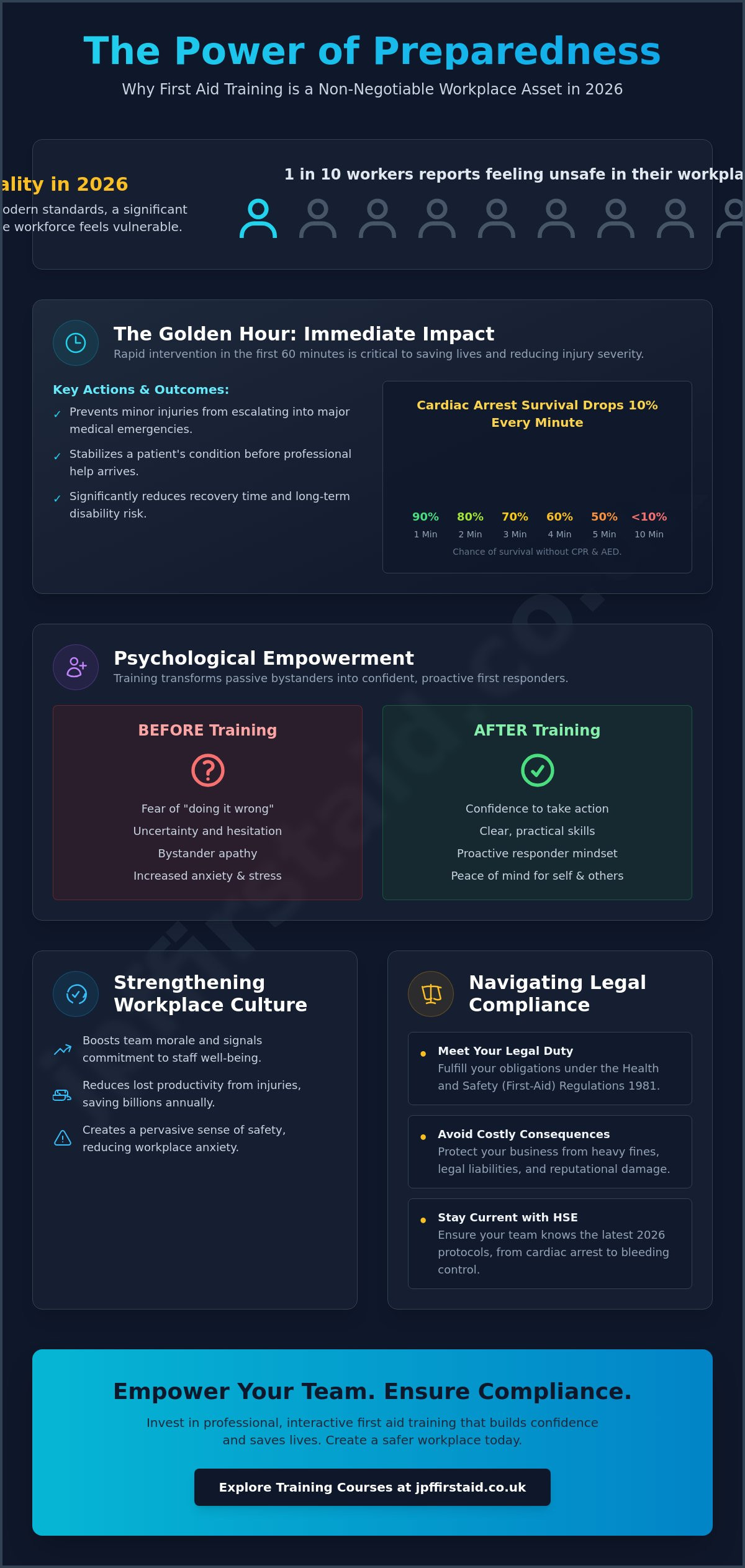
Did you know that in 2026, one in ten workers still reports feeling unsafe at their workplace? While many businesses view safety courses as a simple regulatory requirement, the real benefits of first aid training for employees go far beyond just checking a box. You likely understand the weight of responsibility that comes with managing a team; it’s natural to worry about how your staff would react during a genuine medical emergency. Many leaders fear that training will feel dry or clinical, leaving employees more anxious about making a mistake than ready to help.
We believe that learning to save a life should be an empowering and interactive experience, not a source of stress. This article shows you how professional training transforms your workplace safety by replacing fear with practical confidence. You’ll discover how to foster a culture of care that makes your team feel valued while ensuring you stay in full compliance with the latest HSE regulations. We’ll walk through the most critical 2026 updates, from new cardiac arrest models to advanced bleeding control, so you can lead your team with total peace of mind.
Key Takeaways
- Learn how rapid intervention during the “Golden Hour” prevents minor incidents from escalating into life-threatening medical emergencies.
- Discover how the benefits of first aid training for employees include transforming passive bystanders into confident, proactive responders who aren’t afraid to act.
- See how investing in interactive safety sessions boosts team morale and signals a genuine commitment to your staff’s well-being.
- Understand your legal obligations under the Health and Safety (First-Aid) Regulations 1981 to avoid costly fines and liabilities.
- Explore flexible training options like blended learning and on-site sessions that fit your specific workplace needs and schedule.
The Immediate Impact: Saving Lives and Reducing Recovery Times
In emergency medicine, the first sixty minutes after a traumatic injury or medical event are known as the “Golden Hour.” This isn’t just a clinical term; it’s the critical window where prompt intervention can mean the difference between a full recovery and a tragic outcome. When your staff understands these foundational first aid principles, they stop being bystanders and start being life-savers. One of the primary benefits of first aid training for employees is the ability to act effectively within these critical minutes before professional help arrives.
Immediate action prevents minor injuries from escalating. A simple cut that isn’t cleaned or dressed properly can lead to sepsis, while a faint that isn’t managed can result in a serious head injury from a fall. Trained employees recognize early warning signs and know how to stabilize a colleague, preventing a manageable situation from spiraling into a major medical crisis. In 2026, with updated protocols such as the “5-and-5” approach for choking victims, having someone on-site who knows the current standards is invaluable for workplace safety.
The role of CPR and AEDs cannot be overstated. Survival rates for cardiac arrest drop by approximately 10% for every minute that passes without defibrillation. By training your team to use an Automated External Defibrillator (AED) and perform high-quality chest compressions, you’re giving a colleague a genuine fighting chance. Correct initial handling of trauma, such as applying pressure to a severe bleed or stabilizing a limb, also significantly reduces the risk of long-term disability and permanent physical damage.
The Role of the First Responder in the Workplace
Your employees aren’t expected to be doctors. Instead, they serve as a vital bridge between the incident and professional paramedics. This role requires clear communication and a calm attitude. When a trained responder gives a concise handover to the ambulance crew, it speeds up the entire medical intervention process. This is why our Basic Life Support Training focuses on keeping a cool head under pressure. It’s about knowing exactly what to say and do when every second counts.
Minimising the Severity of Common Workplace Injuries
Most incidents aren’t life-threatening, but they still impact your business and your people. Slips, trips, and minor burns happen in every environment, from offices to warehouses. Proper wound management reduces the risk of infection and long-term scarring. There’s a clear economic benefit here too. Employees who receive immediate, correct care often recover faster and return to work sooner. With workplace injuries costing billions in lost productivity annually, the proactive care provided by your team is a smart investment in both human health and business continuity.
Beyond the Bandage: Psychological Empowerment and Confidence
You’ve likely felt that split-second freeze when something unexpected happens. That hesitation isn’t a lack of care; it’s a lack of certainty. One of the most significant benefits of first aid training for employees is the profound psychological shift from “bystander apathy” to a proactive responder mindset. Instead of looking around for someone else to take charge, a trained individual feels the internal permission to step forward. This empowerment transforms your staff from passive observers into confident leaders who can manage a crisis with a calm, capable attitude.
Structured training is the most effective way to remove the paralyzing fear of “doing the wrong thing.” We focus on practical, hands-on experience because we know that theory alone doesn’t settle the nerves. When you’ve practiced a skill until it feels like second nature, the anxiety of making a mistake disappears. You’re no longer guessing; you’re following a clear, logical path that we’ve mapped out together. This confidence doesn’t just stay at the office either. These skills are entirely transferable, giving your team the peace of mind that they can protect their families and neighbors at home too.
Reducing Workplace Anxiety and Stress
A prepared workforce is fundamentally a more secure workforce. When your team knows that help is always nearby, the baseline of daily stress begins to drop. It’s about more than just responding to an accident; it’s about the psychological comfort of working in an environment where safety is a lived value. This sense of security fosters a more relaxed atmosphere, allowing people to focus on their roles without the underlying worry of “what if.” High safety awareness naturally leads to lower overall anxiety, making the workplace a more positive space for everyone.
The Value of Mental Health Awareness
In 2026, we recognize that safety isn’t just about physical wounds. Modern workplace resilience requires a holistic approach that includes spotting early signs of burnout, anxiety, or emotional distress. While OSHA first aid requirements provide a solid framework for physical readiness, integrating mental health support completes the picture. By training your staff to recognize when a colleague is struggling, you create a culture where people feel seen and supported before a crisis occurs.
Mental health first aid creates a “safety net” for the modern office by ensuring no one has to struggle with psychological distress in isolation. This training perfectly complements physical first aid, ensuring your team is ready for any challenge, whether it’s a visible injury or an internal struggle. If you want to start building this culture of care, our Mental Health First Aid courses offer the perfect starting point for your team.
Strengthening Workplace Culture: Morale, Teamwork, and Loyalty
When you invest in your team, they notice. It isn’t just about the certificate on the wall; it’s about the message you send every time you schedule a session. One of the most overlooked benefits of first aid training for employees is how it bridges the gap between management and staff. By prioritizing health and safety, you signal that your team’s well-being is a core value rather than a secondary concern. This investment builds a foundation of loyalty that is hard to replicate through traditional corporate perks.
In a 2026 survey, 18% of workers stated they have never had a safety drill. Breaking this cycle of neglect by implementing a first aid program immediately sets you apart as an employer of choice. Employees who feel safe and valued are more engaged, more productive, and less likely to look for opportunities elsewhere. This proactive approach to safety transforms the workplace from a simple job site into a community where people feel protected.
Building Trust Through Shared Responsibility
Training together creates a shared language of safety that persists long after the session ends. When colleagues practice life-saving techniques on one another, they develop a unique “buddy system” mentality. This shared responsibility improves internal communication and builds deep trust between departments that might not otherwise interact. Our First Aid Courses are designed to be interactive and genuinely enjoyable. We believe that bonding over a practical skill is far more effective than any trust fall exercise. It’s a chance for your team to relax, learn together, and see each other as capable allies.
Enhancing Corporate Social Responsibility (CSR)
The impact of your training investment doesn’t stop at the front door. Trained employees carry these skills into their homes and neighborhoods, creating a ripple effect of safety. This benefits the wider community and gives your company a significant reputational boost. Going above and beyond minimum safety standards shows that your business is a responsible local partner. In 2026, clients and potential hires look for companies that demonstrate a genuine culture of care. By empowering your staff to save lives anywhere they go, you’re contributing to a safer society while strengthening your own brand identity.
Navigating Legal Compliance and Risk Management
Compliance isn’t just about avoiding trouble; it’s about building a robust safety framework for your people. One of the core benefits of first aid training for employees is the peace of mind that comes from knowing you’ve met your legal obligations. Under the Health and Safety (First-Aid) Regulations 1981, UK employers must provide adequate equipment, facilities, and personnel to ensure their staff receive immediate attention if they’re injured or taken ill at work. It’s a standard that protects both the worker and the business owner from unnecessary risk.
Failing to meet these standards carries heavy financial risks. Non-compliance can lead to substantial fines from the Health and Safety Executive (HSE) and leaves your business vulnerable to personal injury lawsuits. Beyond legal fees, workplace injuries are incredibly expensive. In 2021, the total cost of work injuries reached $167.0 billion globally, which includes medical expenses and significant productivity losses. Investing in professional training reduces the frequency of these incidents and often leads to more favorable insurance terms by demonstrating active, documented risk management.
Understanding HSE Requirements in 2026
You don’t need to guess your requirements. A workplace first aid risk assessment will clarify your needs based on your industry, staff numbers, and specific site hazards. You’ll need to decide between having a “First Aider,” who holds a full qualification, or an “Appointed Person.” An Appointed Person typically takes charge of first aid arrangements but doesn’t necessarily provide medical treatment. For low-risk environments with fewer than 25 people, one Appointed Person might be enough. However, as your team grows or hazards increase, the ratio of trained first aiders must rise to maintain safety levels and full compliance.
Protecting the Business from Liability
Documented training serves as your primary defense during health and safety audits. It’s tangible proof of “due diligence,” showing that you’ve taken every reasonable step to protect your workforce. We often find that staff worry about the legal side of helping during a crisis. It’s helpful to reassure them that the UK legal context, including principles like the Social Action, Responsibility and Heroism Act, generally supports those acting in good faith. When your team is trained to recognized standards, they’re much less likely to make a mistake that could lead to liability issues.
Staying on top of these requirements doesn’t have to be a complex process. Our Emergency First Aid at Work course provides everything you need to keep your business compliant and your people safe. If you’re unsure about your specific needs, we can help you navigate the process with a calm, expert approach that focuses on practical solutions for your workplace.
Choosing the Right Path: How to Implement Effective Training
Implementing a new safety program doesn’t have to feel like a logistical hurdle. Choosing the right delivery method is just as important as the training content itself. On-site group training is often the most cost-effective choice for businesses. It allows us to come directly to your workplace, using your actual environment to make the scenarios feel real and relevant. If your team has a tight schedule, the blended learning model is an excellent alternative. It lets your staff complete the theory portion remotely before joining us for hands-on practical assessments.
When you consider the long-term benefits of first aid training for employees, the ease of implementation plays a major role in your success. Always look for Ofqual-regulated courses to ensure your certificates are valid and meet the high standards required for workplace compliance. These regulated qualifications provide the necessary authority and trust that your team is in safe, expert hands.
Tailoring Training to Your Industry
Every industry faces unique challenges. A school or nursery environment requires specific skills found in our Emergency Paediatric First Aid or Paediatric First Aid (Level 3) courses. High-risk environments like construction or manufacturing are better suited for the comprehensive First Aid At Work (Level 3) qualification. For standard office settings, Emergency First Aid At Work (Level 3) is usually the ideal fit. We offer workplace training bundles to ensure you have complete coverage, often combining physical first aid with a Manual Handling Qualification Course or Fire Safety training for a total safety solution. Managers should look for trainers who offer flexibility in scheduling to minimize disruption to the working day.
The JPF Difference: Enjoyable, Life-Saving Skills
We pride ourselves on being more than just a service provider; we’re your expert mentors. Our sessions are interactive and relaxed because we know people learn best when they’re comfortable and engaged. We’ve moved away from the dry, clinical style of traditional courses to focus on real-world application and practical success. Our primary goal is the psychological empowerment of your staff. We want every learner to leave our session feeling capable, calm, and ready to help in an emergency. If you’re ready to build a safer, more confident team, book your on-site group training with JPF First Aid today and experience the difference that expert, personable instruction makes.
Transform Your Workplace Safety Today
Creating a safer environment starts with a simple decision to empower your team. We’ve explored how the benefits of first aid training for employees extend far beyond basic compliance; it builds a culture where people feel valued, confident, and ready to act. By moving away from dry, clinical sessions and embracing interactive learning, you replace workplace anxiety with a proactive responder mindset. Your staff doesn’t just gain a certificate; they gain the life-saving skills needed to protect their colleagues and the wider community.
As a multi-award-winning training provider, we’re here to guide you through every step of the process. Our lead mentor, John Fogarty, brings years of expertise to every session, ensuring your team receives Ofqual regulated qualifications in a relaxed and supportive atmosphere. We offer flexible on-site delivery nationwide, making it easier than ever to bring high-quality training directly to your door.
Empower your team with multi-award-winning first aid training, Enquire about our group rates today. Taking this step ensures your business remains compliant while fostering a genuine sense of security and care among your staff.
Frequently Asked Questions
Is first aid training a legal requirement for all UK employees?
Yes, the Health and Safety (First-Aid) Regulations 1981 require all UK employers to provide adequate first aid equipment, facilities, and personnel. While not every individual staff member needs a certificate, your business must have enough trained first aiders or an “appointed person” to ensure help is always available. This ensures that if anyone is injured or taken ill at work, they receive immediate attention from a capable colleague.
How long does a workplace first aid certificate remain valid?
Most workplace first aid qualifications, including our Level 3 awards, remain valid for three years from the date of issue. The HSE strongly recommends that first aiders attend an annual refresher session to keep their skills sharp and their confidence high. Once your certificate expires, you’ll need to complete a re-qualification course to maintain your status as a recognized first aider for your team.
Can first aid training be conducted online or must it be in person?
Practical first aid training requires an in-person assessment to meet workplace compliance standards. You can’t learn life-saving physical techniques like CPR, AED usage, or wound dressing through a screen alone. However, we offer a “Blended Learning” model where you complete the theory portion remotely before joining us for hands-on practice. This gives you the flexibility of remote study with the essential confidence of in-person expert guidance.
What is the difference between Emergency First Aid at Work and First Aid at Work?
Emergency First Aid at Work is a one-day course designed for lower-risk environments, covering essential life-saving skills. The full First Aid at Work qualification is a more comprehensive three-day course that covers a wider range of medical conditions and injuries. When considering the benefits of first aid training for employees, the three-day course provides a much deeper level of knowledge for handling complex emergencies in higher-risk workplaces.
How many first aiders does my business legally need?
The number of first aiders you need depends on your specific risk assessment, your industry, and your total headcount. For a low-risk office with fewer than 25 people, you might only need one “appointed person.” For larger teams or high-risk sites, the HSE generally suggests at least one trained first aider for every 50 employees. We can help you look at your specific hazards to ensure you have the right level of cover.
Does first aid training include mental health support for employees?
Standard physical first aid courses don’t typically cover mental health, but specialized training is becoming a vital part of modern workplace safety. One of the most significant benefits of first aid training for employees in 2026 is the ability to support psychological well-being. Our dedicated Mental Health First Aid courses teach your team to recognize signs of burnout or emotional distress, creating a holistic safety net for everyone in the office.
What should be included in a standard workplace first aid kit?
Your kit should follow the current ANSI/ISEA Z308.1-2021 standard, which specifies contents for Class A and Class B kits. Essential items include sterile plasters, bandages, eye pads, and disposable gloves. In 2026, many businesses are also adding trauma supplies like tourniquets for advanced bleeding control. It’s important to check your kit regularly to ensure items are in date and that you have the specific supplies your risk assessment requires.
Are employees legally protected if they perform first aid at work?
Employees who act in good faith during an emergency are generally protected under UK law, including the Social Action, Responsibility and Heroism Act. As long as your staff members use the techniques they learned during their professional training, the risk of legal trouble is incredibly low. This legal framework is designed to reassure responders that they can step forward and help a colleague without the fear of facing personal liability.
Recent Comments