

Did you know that 80% of UK businesses that fail to recover within a month of a serious fire end up closing their doors forever? It’s a sobering thought that highlights why fire safety is about so much more than just ticking a box for a regulator. We understand that keeping up with the fire safety training requirements for small business uk can feel like a daunting task. Between the fear of unlimited fines and the confusion over who actually needs to be a Fire Marshal, it’s easy to feel overwhelmed by the weight of responsibility.
You’re not alone in feeling this anxiety. We believe that compliance shouldn’t be a legal burden that keeps you up at night. Instead, it’s a framework for psychological empowerment. When your team knows exactly what to do in a crisis, that fear transforms into genuine capability. This guide provides a clear roadmap to meeting your legal obligations under the latest 2026 standards. We’ll break down the specific training roles you need, clarify the difference between basic awareness and specialist duties, and help you protect both your people and your livelihood with total confidence.
Key Takeaways
- Master the core legal obligations of the Regulatory Reform (Fire Safety) Order 2005 to ensure your business stays protected and compliant.
- Navigate the mandatory five-step fire risk assessment process to identify hazards and protect your team before booking any training.
- Identify the exact fire safety training requirements for small business uk, helping you distinguish between basic staff induction and the vital role of a designated Fire Marshal.
- Learn how to conduct effective annual fire drills that transform theoretical knowledge into life-saving practical skills for your entire workforce.
- Understand why choosing an Ofqual regulated Fire Safety Qualification Course provides the documented evidence of competence that fire inspectors look for.
Understanding Fire Safety Legislation for UK Small Businesses
The foundation of all fire safety in England and Wales is the Regulatory Reform (Fire Safety) Order 2005. It’s a piece of legislation that replaced over 70 different sets of rules, streamlining the History of UK Fire Safety Legislation into one clear, manageable framework. For you as a business owner, this means the law is no longer about just following a checklist provided by the fire brigade. Instead, it places the duty on you to actively manage your own risks. This includes meeting specific fire safety training requirements for small business uk, ensuring every member of your team knows how to stay safe. Fire safety law applies to almost all non-domestic premises. Whether you run a high-street shop, a small office, or a local cafe, these regulations are there to protect your staff and your customers.
The Role of the Responsible Person
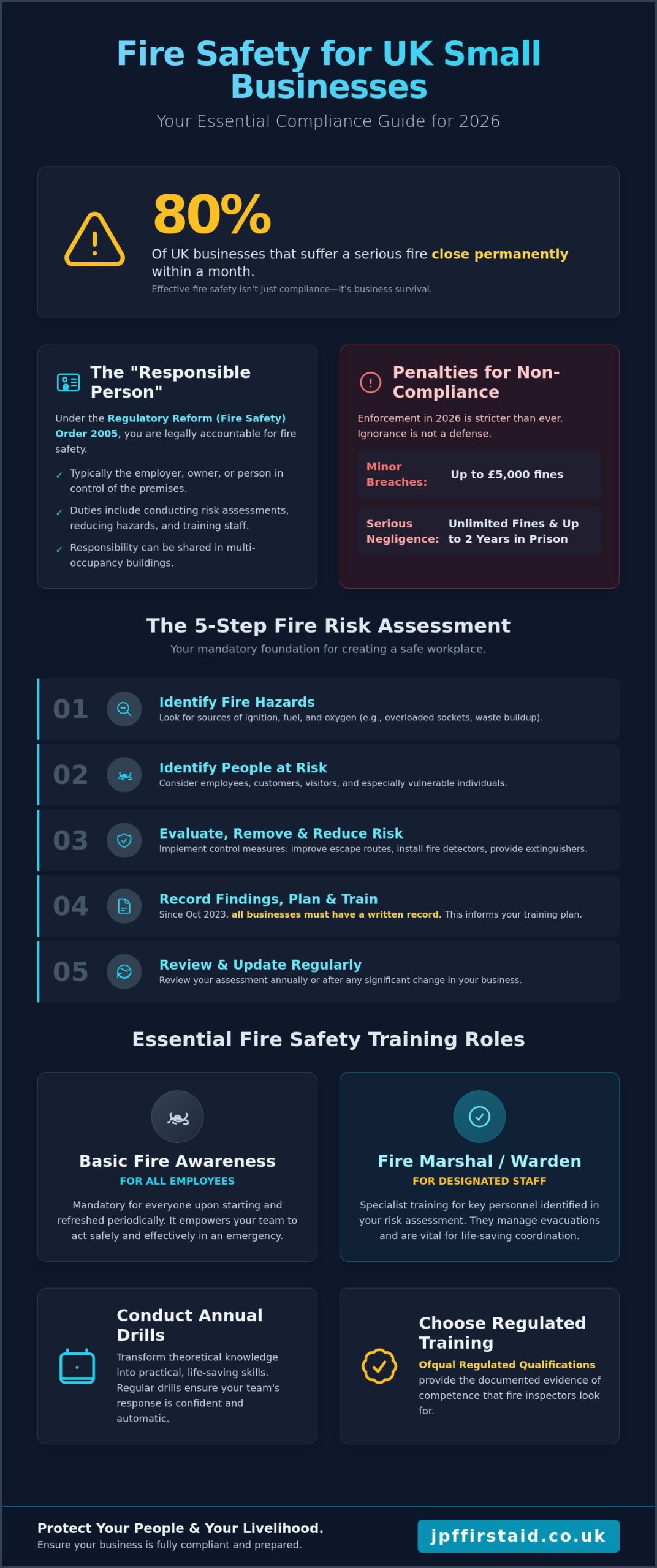
The law identifies a “Responsible Person” who is legally accountable for fire safety. The Responsible Person is the individual legally accountable for fire safety within your business premises. In most small businesses, this is the employer, the owner, or the person in control of the building. Your core duties involve conducting a thorough risk assessment, reducing fire hazards where possible, and providing clear instruction to your staff. If you operate from a shared office or a business hub, this responsibility is often shared with the building owner or other tenants. It’s a collaborative effort to ensure everyone gets out safely if an alarm sounds. You don’t have to do this alone, but you do have to ensure the work gets done.
Penalties for Non-Compliance in 2026
Staying compliant isn’t just about safety; it’s about protecting your business from severe financial and legal consequences. In 2026, enforcement is stricter than ever. Minor breaches can lead to fines of up to £5,000. However, serious negligence can result in unlimited fines or even custodial sentences of up to two years. For example, in February 2026, an office block owner was fined £48,000 for failing to meet their legal duties. While these numbers sound intimidating, don’t let them cause undue anxiety. Meeting your fire safety training requirements for small business uk is a straightforward, methodical process. When you approach it step by step, compliance becomes a natural and reassuring part of your business rhythm.
The law requires you to provide “adequate” fire safety training to all employees. This training must be provided when they first start their job and should be repeated periodically to keep skills fresh. The goal is simple: everyone in your building should feel capable and confident enough to act effectively in an emergency. By focusing on competence rather than just a “tick-box” exercise, you create a culture of safety that protects your team and your livelihood.
The Fire Risk Assessment: Your Compliance Foundation
Before you book a single seat in a classroom, you need a clear picture of what you’re actually protecting. Think of the fire risk assessment as your strategic roadmap. It doesn’t just satisfy the law; it tells you exactly what your specific fire safety training requirements for small business uk actually are. Without this foundation, you might end up over-training for risks you don’t have or, worse, missing a critical danger unique to your premises. Starting with an assessment ensures your training budget is spent where it matters most.
Following the official government guidance on fire safety, the assessment follows a logical five-step path. You must identify fire hazards, identify people at risk, evaluate and reduce those risks, record your findings, and review the document regularly. While older rules once only required written records for teams of five or more, current regulations since October 2023 mean every business must now document their assessment in writing regardless of size. This document is your best friend during a Fire and Rescue Service inspection. Most importantly, the findings dictate how many staff members should attend fire marshal training to ensure a safe evacuation can be managed at all times.
Identifying Hazards and People at Risk
Every workplace has its own unique set of dangers. In a typical small business, hazards often include overloaded electrical sockets, poorly stored waste, or heating equipment. Statistics show that over 50% of non-domestic fires are caused by faulty appliances; so your assessment should look closely at your PAT testing schedule. You also need to consider who is in the building. This isn’t just about your healthy, full-time staff. You must account for lone workers, visitors who don’t know the layout, and individuals with disabilities who might need extra help. The specific hazards you find will directly influence your training needs; for example, a workshop with flammable materials requires much more intensive staff instruction than a small retail shop.
Reviewing and Updating Your Assessment
Regular reviews are essential because a business is never static. We recommend a full review of your assessment at least once a year, but certain triggers should prompt an immediate update. If you hire new staff, change your office layout, or experience a “near-miss” incident, your assessment needs to reflect those changes. A “living” document provides the best legal protection and ensures your safety measures remain effective. It also helps you spot issues like fire door failures, which affect an estimated 70% of doors during their first inspection. Keeping your records digital and accessible makes this process much smoother for everyone involved. If you find your assessment highlights a need for fresh skills, our Fire Safety Qualification Course can help bridge that gap with practical, expert-led sessions.
Determining Your Fire Safety Training Requirements
Once you’ve used the 5-step fire safety risk assessment checklist to identify your specific risks, you can begin to tailor your training plan. It’s a common misconception that one short video for the whole team is enough. In reality, the fire safety training requirements for small business uk demand a tiered approach. You need to ensure that every person on-site has a foundational understanding, while designated individuals take on more advanced responsibilities. The complexity of your building also plays a huge role; a multi-story warehouse requires a much more robust evacuation strategy than a single-room studio. We believe that training should feel like an investment in your people’s confidence, not just a chore to be completed.
Basic Fire Awareness for All Staff
Every employee, whether they’re full-time, part-time, or a temporary contractor, needs basic fire awareness training. This shouldn’t be a “one and done” event. You’re legally required to provide this instruction during their induction and refresh it periodically to keep the information fresh. At a minimum, every team member must know what the fire alarm sounds like, where the nearest exit routes are, and the location of the assembly point. We also recommend teaching staff about “good housekeeping.” Preventing a fire is always better than reacting to one. This means keeping fire doors clear, managing waste properly, and reporting faulty electrical equipment immediately. While we touch on fire extinguishers, the primary goal for most staff is a safe and swift evacuation. They need to know when it’s safe to use a tool and when it’s time to simply get out.
Appointing and Training Fire Marshals
While everyone needs awareness, your Fire Marshals are your “boots on the ground” during an emergency. Their role is more involved than just walking to the car park. They’re responsible for sweeping the building to ensure no one is left behind, checking that fire doors have closed correctly, and acting as the main point of contact for the Fire and Rescue Service. The number of marshals you need depends on your risk level and staff numbers. For a low-risk small office, two might suffice to cover holidays and sickness. Meeting the fire safety training requirements for small business uk means going beyond the basics for these key staff members. We find that a formal Fire Safety Qualification Course provides these individuals with the authority and psychological empowerment they need to lead in a crisis. Often, these safety roles overlap; a Fire Marshal who also holds an emergency first aid at work certificate becomes a truly versatile pillar of your workplace safety strategy.
Implementing Fire Safety Measures and Practical Drills
Think of your fire drill as the practical exam for your entire safety programme. You can have the most detailed risk assessment in the world, but it only matters if your team can execute the plan when the alarm sounds. Meeting the fire safety training requirements for small business uk involves testing your evacuation procedures at least once every twelve months. This annual drill isn’t just a legal hurdle. It’s a vital opportunity to build muscle memory and ensure that a calm, capable attitude prevails over panic during a real emergency.
A robust safety culture also relies on the reliability of your hardware. You must establish a regular schedule for testing fire detection systems and emergency lighting. For instance, the updated BS 5839-1:2026 standard provides clear guidance on maintaining alarm systems in non-domestic premises. We often recommend a ‘blended learning’ approach for small teams. This allows your staff to gain theoretical fire safety knowledge through flexible sessions before applying those skills during your scheduled practical drills. This combination ensures that the ‘why’ and the ‘how’ of fire safety are equally understood.
How to Run an Effective Fire Drill
Running a drill shouldn’t feel like a disruption; it should feel like a professional exercise in empowerment. Follow these four steps to get the most value from your session:
- Step 1: Brief your Fire Marshals on the specific objectives of the drill, such as testing a new exit route or assembly procedure.
- Step 2: Trigger the alarm and carefully monitor the evacuation time and the behaviour of your staff.
- Step 3: Conduct a debrief immediately afterward to identify any bottlenecks, blocked exits, or areas of confusion.
- Step 4: Document the results, including the evacuation time and any corrective actions, in your fire safety logbook.
Equipment Maintenance and Staff Familiarity
Your fire extinguishers are only useful if your team feels confident using them. Staff should be able to distinguish between water, foam, and CO2 extinguishers at a glance, knowing which is safe for electrical fires and which is for general waste. Beyond the annual service by a professional, your team should perform daily and weekly checks. This includes ensuring all exits are clear, fire doors are kept closed, and all safety signage remains visible. Equipment is only effective if staff are trained to use it. When your team understands the tools at their disposal, they feel safer and more capable. If you want to ensure your team is fully prepared for any workplace emergency, consider booking a Fire Safety Qualification Course to provide them with hands-on, expert instruction.
Choosing the Right Fire Safety Training Partner
Selecting a training provider is the final piece of your compliance puzzle. You want more than just a certificate; you want a team that feels capable and ready to act if the worst happens. When you look at the fire safety training requirements for small business uk, it’s clear that the quality of instruction matters just as much as the content itself. Choosing an award-winning provider that offers both fire safety and first aid courses brings a holistic view of workplace safety to your business. We believe that training shouldn’t be a dry, clinical experience. Instead, an interactive and relaxed atmosphere helps information stick, turning what could be an intimidating subject into a confidence-building session for your whole team.
Ofqual regulated qualifications are the gold standard for UK compliance. These certifications provide independent proof that your staff have met a rigorous national standard. For a small business, bundling your training can be a highly cost-efficient move. Combining your Fire Safety Qualification Course with First Aid or Manual Handling training reduces the time your staff spend away from their roles while ensuring all your legal bases are covered in one go. It’s a logical, streamlined approach that respects both your time and your budget.
The Value of Professional Certification
A recognised certificate provides immense peace of mind for both you and your employees. It’s tangible proof that you’ve met your legal duties as a Responsible Person. Professionally led training is also the best way to reduce the “bystander effect” during a real emergency. When people have practiced their roles under expert guidance, they don’t wait for someone else to take charge; they step up because they know exactly what to do. Additionally, many insurance providers look favourably on businesses that can demonstrate high-quality, regulated training. Showing that your team is competent can sometimes even have a positive impact on your business insurance premiums.
Why JPF First Aid for Your Small Business?
We pride ourselves on being more than just a service provider. We act as a reliable expert mentor for your business. Our approach is professional and reassuring, designed to alleviate the anxiety often associated with emergency response. We understand that every workplace is different, so we tailor our sessions to your specific environment and risks. To make things as easy as possible for you, we offer flexible, mobile delivery. We can come directly to your premises, meaning your team learns in the very environment they are protecting. This hands-on, local approach ensures that the training is relevant, practical, and immediately useful.
Protect your business and empower your team-book your fire safety training with JPF First Aid today.
Secure Your Business Future with Confident Fire Safety
Meeting the fire safety training requirements for small business uk doesn’t have to be a source of stress. By starting with a robust risk assessment and implementing a tiered training approach, you transform legal obligations into a culture of genuine safety. Your team will move from being anxious about emergencies to feeling truly capable and empowered to act. We’re here to help you navigate these 2026 standards with ease and professionalism. You’ve worked hard to build your livelihood; protecting it should feel like a natural, positive extension of your business success rather than a clinical chore.
As a multi-award-winning training provider, JPF First Aid offers bespoke on-site training for groups of up to 12. Our expert-led sessions focus on building real-world confidence through interactive, practical learning that stays with your staff long after the session ends. Book your Ofqual regulated fire safety training and secure your compliance today. You’re in safe, expert hands, and we look forward to helping your team gain the essential skills they need to stay protected every day.
Frequently Asked Questions
How many fire marshals do I need for a small business in the UK?
You generally need at least two fire marshals to ensure you have adequate coverage during holidays, sickness, or off-site meetings. The exact number depends on your specific risk level and building layout. A low-risk office might only need one marshal per 50 staff, but high-risk environments like workshops require more frequent coverage. Your fire risk assessment is the best tool to determine the precise number for your premises.
Is fire safety training a legal requirement for all employees?
Yes, providing fire safety training to every employee is a mandatory legal requirement under the Regulatory Reform (Fire Safety) Order 2005. This instruction must occur during their initial induction and should be repeated whenever new risks are introduced to the workplace. It ensures that every team member, regardless of their role, knows how to evacuate safely and act with confidence during an emergency.
How often should staff fire safety training be refreshed?
You should refresh your staff training at least once a year to maintain a high level of safety awareness. While the law states that training must be repeated “periodically,” an annual schedule is the industry standard for meeting fire safety training requirements for small business uk. Regular refreshers prevent vital knowledge from fading and ensure your team stays prepared for any changes in your safety procedures.
Can I do my own fire risk assessment for a small business?
You can carry out your own fire risk assessment if you are a “competent person” with enough knowledge to identify hazards and evaluate risks accurately. The government provides templates to help small business owners with simple premises. However, if your building is complex or you manage high-risk materials, hiring a professional ensures your document is “suitable and sufficient” to meet strict legal standards.
What is the difference between a fire warden and a fire marshal?
There is no legal difference between these two titles in the UK; the terms fire warden and fire marshal are almost always used interchangeably. Some organisations choose to use “wardens” for daily fire prevention tasks and “marshals” for evacuation duties. The most important factor isn’t the title you choose, but ensuring that their specific responsibilities are clearly defined and documented in your safety policy.
Do I need to provide fire extinguisher training to everyone?
You don’t need to provide practical extinguisher training to every employee, but everyone must know where the equipment is kept and what the different types are for. Only staff members who are expected to use extinguishers as part of your emergency plan require formal, hands-on instruction. For the majority of your team, the primary focus of their training should be a safe and swift evacuation.
What happens if I don’t have a fire risk assessment?
Failing to maintain a written fire risk assessment can result in unlimited fines or even a prison sentence of up to two years for serious negligence. Beyond these legal penalties, your business insurance could be invalidated if a fire occurs. Since October 2023, all businesses must have a written record of their assessment, regardless of their size or the number of people they employ.
Does fire safety training need to be accredited or regulated?
While the law doesn’t strictly name a specific accreditation, choosing Ofqual regulated courses is the most reliable way to meet the fire safety training requirements for small business uk. Regulated qualifications provide fire inspectors with clear, independent evidence that your staff have reached a national standard of competence. This level of certification offers the highest degree of protection for your business and the best quality of learning for your team.
Recent Comments