

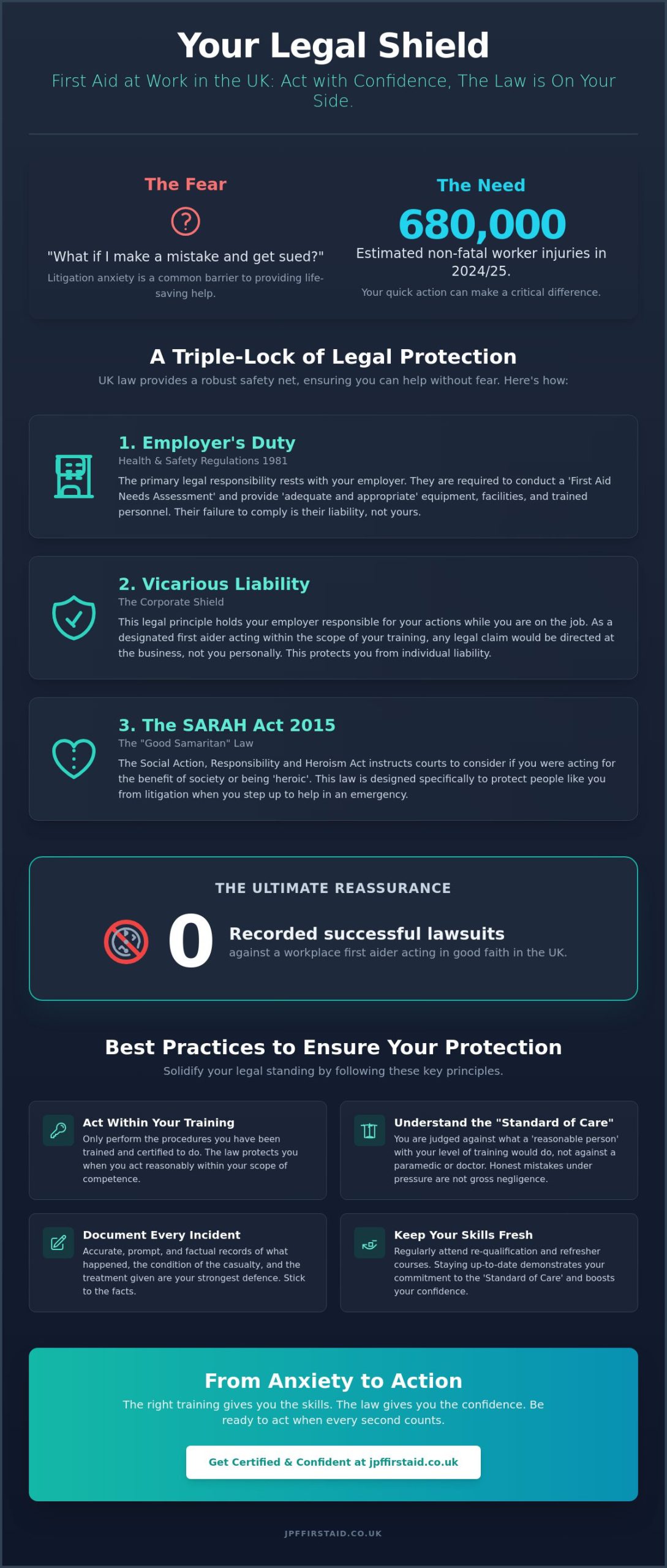
What if your hesitation to help a colleague in a medical emergency isn’t due to a lack of skill, but a fear of the courtroom? With an estimated 680,000 workers sustaining non-fatal injuries in 2024/25 alone, the need for quick action is real, yet many people still freeze because they worry about litigation. It’s completely natural to feel anxious about making a situation worse or wondering where the line between your responsibility and your employer’s liability actually sits. You want to help, but you don’t want to risk your career or your future in the process.
You deserve to feel safe while you’re keeping others safe. This guide clarifies the legal protection for first aiders at work, explaining how the SARAH Act 2015 and the principle of vicarious liability provide a robust safety net for those acting in good faith. We’ll explore why being sued for providing first aid in the UK is extremely rare and how the right training empowers you to act without legal fear. We will break down the essential frameworks that protect you, giving you a clear understanding of your rights and the confidence to step forward when it matters most.
Key Takeaways
- Understand the employer’s legal duty under the Health and Safety (First-Aid) Regulations 1981 to provide adequate equipment and trained personnel.
- Learn how the principle of vicarious liability provides legal protection for first aiders at work, ensuring you aren’t held personally responsible for acting in good faith.
- Discover how the SARAH Act 2015 protects those who act heroically, making it extremely rare for a first aider to face legal action in the UK.
- Master the documentation habits and re-qualification schedules that keep your skills sharp and your legal defense solid.
- Gain the psychological empowerment you need to move past anxiety and act decisively when every second counts.
The Statutory Framework: Health and Safety (First-Aid) Regulations 1981
The Health and Safety (First-Aid) Regulations 1981 serve as the foundation for all workplace safety in the UK. This legislation doesn’t just exist to create paperwork. It’s there to ensure that every employee has access to immediate help if they’re injured or fall ill. For you, this framework provides the essential context for legal protection for first aiders at work. It places the primary responsibility on the employer to provide ‘adequate and appropriate’ equipment, facilities, and personnel.
You might wonder what ‘adequate’ means. It varies by industry. A high-risk manufacturing plant requires more intensive provision than a small office. The law expects employers to be practical. They must ensure that a casualty receives immediate attention and that an ambulance is called if needed. This system creates a clear chain of responsibility where you are a vital link, but not the person carrying the entire legal weight of the organization.
There’s also a key difference between an ‘appointed person’ and a qualified first aider. An appointed person takes charge of first aid arrangements, such as looking after the first aid box and calling emergency services. They aren’t required to have formal first aid training. A qualified first aider has undergone specific training to provide hands-on care. Understanding which role you hold helps clarify your boundaries and provides peace of mind while you work.
Employer Legal Duties and First Aid Needs Assessments
Employers determine the level of cover required by conducting a first aid needs assessment. This document looks at your workplace’s specific risks, the number of staff, and the layout of the building. It’s a legal necessity that ensures the right resources are in place. If an employer fails to meet these standards, that non-compliance is their burden. It doesn’t automatically shift liability to you as an individual. Your legal protection for first aiders at work is built on the fact that you’re acting within a system your employer is responsible for maintaining.
The Role of the Health and Safety Executive (HSE)
The HSE acts as the national regulator for workplace health and safety. They focus on enforcing standards and investigating serious incidents. While they look for ‘persistent poor compliance’ from businesses, they aren’t in the business of penalising individuals who try to help. In fact, the UK legal climate is designed to support you. The Social Action, Responsibility and Heroism Act 2015 specifically instructs courts to consider whether a person was acting for the benefit of society or being ‘heroic’ during an emergency. The HSE views your efforts to provide care as a positive contribution to workplace safety, not a legal trap.
Personal Liability: Am I Protected if I Make a Mistake?
The single biggest barrier to people stepping forward in an emergency is the fear of being sued. It’s a persistent myth that clouds the reality of workplace safety. In truth, there are no recorded cases in the UK of a first aider being successfully sued for providing assistance in good faith. This fact alone should offer immense reassurance. The legal system is designed to support life-savers, not penalize them for trying their best in a crisis. This reality forms the backbone of legal protection for first aiders at work.
Understanding Vicarious Liability in the Workplace
Vicarious liability is a legal principle that should give every workplace responder peace of mind. It means that, in most cases, your employer is legally responsible for your actions while you are at work. If you’re a designated first aider and you act within the scope of your role, any legal claim would be directed at the business rather than you personally. This protection applies as long as you’re acting in the course of your employment. By staying within the boundaries of your first aid training, you ensure this protective shield remains firmly in place.
Negligence and the Duty of Care
Once you step forward to help, you have a ‘Duty of Care’ to the casualty. However, the law doesn’t expect you to be a surgeon or a paramedic. You’re judged against the ‘Standard of Care’ of a reasonable person with your specific level of training. An honest mistake made under pressure is very different from ‘gross negligence,’ which involves a reckless disregard for someone’s safety. The courts recognize that emergencies are high-stress environments. They look for whether you followed your protocols and acted reasonably, which is why maintaining your knowledge is a key part of your legal protection for first aiders at work.
The legal landscape was further strengthened by the Social Action, Responsibility and Heroism Act 2015. This legislation requires courts to consider whether a person was acting for the benefit of society or demonstrating a responsible approach when a claim arises. You can read the full text of the SARAH Act 2015 to see how the law explicitly protects those who intervene to help others. This focus on heroic action makes it incredibly difficult for a negligence claim against a first aider to succeed.
Understanding these rules allows you to focus on the person in need rather than the paperwork. When you know you’re protected, you can act with the speed and decisiveness that saves lives. If you feel your confidence needs a boost, consider how a fresh approach to first aid training can help you feel truly ready for any situation.
The Good Samaritan Principle and the SARAH Act 2015
While the UK doesn’t have a single ‘Good Samaritan Law’ in the way some other countries do, our legal system is deeply rooted in the ethos of helping others. This spirit of community support is backed by common law and specific legislation designed to ensure you don’t face unfair consequences for trying to save a life. This cultural and legal foundation is a core part of the legal protection for first aiders at work. It ensures that if you act in good faith, the law is on your side.
The courts are explicitly instructed to support individuals who step up during a crisis. Judges aren’t looking for reasons to penalize you. Instead, they look at the context of your actions. Were you trying to help? Were you acting in the heat of the moment to prevent a tragedy? By prioritizing the intent of the responder, the UK legal system creates an environment where people can feel safe providing life-saving care without the constant shadow of litigation.
How the SARAH Act 2015 Protects You
The Social Action, Responsibility and Heroism (SARAH) Act 2015 was a landmark piece of legislation. It requires courts to consider three specific factors if a claim of negligence is ever brought against a first aider. First, they must look at whether the person was acting for the benefit of society. Second, they check if the person demonstrated a generally responsible approach. Finally, they consider if the person was acting heroically by intervening in an emergency. This act provides the ‘teeth’ for legal protection for first aiders at work, making it clear that heroism is a valid legal defense.
Consent and the Unconscious Casualty
A common worry is whether you have permission to touch someone, especially if they can’t speak for themselves. In life-threatening situations where a casualty is unconscious or unresponsive, the law applies the concept of ‘Implied Consent.’ This means you can legally perform CPR or use an AED because it’s assumed a reasonable person would want life-saving help. If a casualty is conscious, you should always ask for permission first. If they refuse, you must respect that ‘Informed Consent,’ but you can still stay with them and call for professional help. These rules exist alongside the Health and Safety (First-Aid) Regulations 1981 to ensure that every action you take is both ethically sound and legally protected.
Best Practices to Ensure Continuous Legal Protection
Legal protection isn’t just a shield that sits in a cupboard alongside your first aid kit. It’s a proactive status you maintain through your daily professional habits. While the law is designed to support you, your strongest defense is always a clear record of your competence. By following a few simple best practices, you ensure that the legal protection for first aiders at work remains robust and unquestionable if an incident ever reaches a courtroom.
Think of your actions during an emergency as one half of your role; the other half is proving that those actions met the expected standard. This involves staying within your ‘Scope of Practice.’ If your certificate covers Level 3 First Aid at Work, you should never attempt advanced medical procedures that fall outside that training. Staying in your lane isn’t just about safety; it’s a legal requirement that keeps you under the umbrella of your employer’s liability insurance.
Effective Record Keeping and Accident Reporting
A well-written first aid report is your best friend in a legal dispute. It serves as a contemporaneous record of exactly what happened, providing a level of detail that memory alone cannot match months or years later. When you’re writing your report, stick strictly to the facts. Describe what you saw, what the casualty told you, and exactly what treatment you provided. Avoid offering medical diagnoses or personal opinions. For example, write “the casualty reported a sharp pain in their left wrist” rather than “the casualty has a broken wrist.”
You should also be aware of the Reporting of Injuries, Diseases and Dangerous Occurrences Regulations (RIDDOR). While the employer usually handles these filings, your detailed notes provide the evidence they need to comply. With 40.1 million working days lost due to work-related ill health and injury in 2024/25, the accuracy of these records is vital for workplace safety trends and your own legal security.
Keeping Your Skills and Certification Current
Your legal protection for first aiders at work is directly tied to the validity of your training. The ‘Standard of Care’ you’re expected to provide is based on the most recent, evidence-based protocols. If your certificate expires, your legal standing becomes vulnerable because you’re no longer recognized as a ‘qualified’ person under the 1981 Regulations. The HSE strongly recommends annual skills refreshers to prevent ‘skill fade,’ which is the natural decline in life-saving knowledge over time.
Choosing an Ofqual-regulated training provider ensures that your qualification meets a high national standard. This regulation provides an extra layer of reassurance for both you and your employer, as it proves the training was rigorous and officially recognized. Maintaining your certification isn’t just a box-ticking exercise; it’s the foundation of your confidence. If you’re approaching your expiry date, it’s time to book your First Aid At Work Re-qualification to keep your skills and your legal defenses sharp.
Building Confident First Aiders with JPF First Aid
JPF First Aid believes that the best way to ensure your safety is through empowerment. We don’t just teach you how to bandage a wound; we give you the mental tools to step forward when others hesitate. Our multi-award-winning training is Ofqual-regulated, meaning you’re getting the highest standard of instruction available in the UK. This professional foundation is the first step in establishing your legal protection for first aiders at work, as it proves you’ve been trained by experts who value precision and compliance.
Our approach is far from dry or clinical. We understand that emergency response can be intimidating, so we create a welcoming, relaxed atmosphere where you can ask questions and practice without pressure. We bring this expertise directly to your doorstep with our flexible mobile delivery, ensuring your team learns in the environment where they’ll actually be working. This tailored service makes the transition from learning to doing feel seamless and natural.
Practical Training for Real-World Scenarios
Theory only gets you so far. To be effective, you need muscle memory. Our sessions focus on hands-on practice that builds your response speed and ensures you know exactly what to do when every second counts. During these interactive sessions, our trainers spend time addressing your specific legal fears. We break down the complexities of the law into manageable, clear concepts, so you leave the room feeling legally secure and personally capable. We want you to focus on the person in need, not the potential for a lawsuit.
Learning in an encouraging environment helps you absorb information more effectively. We replace anxiety with a calm, capable attitude. By the time you finish your course, the concept of legal protection for first aiders at work isn’t just a theory; it’s a lived reality that gives you the confidence to save lives. You’ll walk away knowing that you have the skills, the legal backing, and the mindset to make a difference.
Support Beyond the Classroom
Our commitment to your safety doesn’t end when the training session closes. We act as a reliable expert mentor for your entire organization. Whether you need help conducting a first aid needs assessment or want to ensure your workplace meets the latest national safety standards, we’re here to partner with you. We help you navigate the logistical and regulatory requirements with ease, making compliance feel like a natural part of your business culture rather than a burden.
Empowering your staff with life-saving skills is one of the most significant investments you can make in your community. If you’re ready to build a team that is both technically skilled and psychologically prepared, we can help. Book a workplace first aid course with JPF First Aid today and take the first step toward a safer, more confident workplace.
Step Forward with Certainty and Skill
Navigating an emergency is challenging enough without the added burden of legal worry. You now have a clear view of the frameworks that keep you safe, from the specific instructions given to courts by the SARAH Act 2015 to the employer’s responsibility under vicarious liability. These laws exist so you can focus on what truly matters: providing immediate, life-saving care. When you combine this legal protection for first aiders at work with regular skills refreshers and diligent record-keeping, you create a professional environment where safety and support go hand in hand.
Ready to turn this knowledge into action? JPF First Aid is a multi-award-winning training provider that specializes in building capable, fearless responders. Through our Ofqual regulated qualifications and the guidance of experienced, reassuring expert trainers, we help you master the techniques and the mindset needed for real-world success. Our sessions are designed to be interactive and engaging, ensuring you leave with both a certificate and true peace of mind. Empower your team with accredited first aid training today and gain the skills to protect your colleagues with absolute confidence.
Frequently Asked Questions
Can a first aider be sued for negligence in the UK?
While anyone can technically be sued, there are no recorded cases of a first aider being successfully sued in the UK for providing assistance in good faith. The legal system is heavily weighted in your favor to encourage bystanders to help. Provided you act within the scope of your training and don’t demonstrate gross negligence, the legal protection for first aiders at work remains extremely strong and reliable.
What is the SARAH Act 2015 and how does it protect me?
The Social Action, Responsibility and Heroism (SARAH) Act 2015 is a law that instructs judges to look at the context of your actions. If someone claims negligence, the court must consider if you were acting for the benefit of society or being heroic in an emergency. This legislation was specifically designed to prevent a compensation culture from stopping people like you from saving lives in a crisis.
Am I covered by my employer’s insurance if I provide first aid?
Yes, you are typically covered by your employer’s liability insurance under the principle of vicarious liability. As long as you are performing your duties as a designated first aider within the scope of your training, the employer is legally responsible for your actions. This means any legal claims would be directed at the business rather than your personal assets, providing you with a significant safety net.
Do I have a legal obligation to help someone if I am not at work?
In the UK, you generally don’t have a legal obligation to provide first aid if you are off-duty or not in a workplace role. There is no general duty to rescue in common law for ordinary citizens. However, once you choose to step in and start providing care, you then owe a duty of care to the casualty to act reasonably and not make the situation worse through recklessness.
What happens if I break a rib while performing CPR?
Breaking a rib is a recognized and common complication of performing high-quality chest compressions during CPR. If you are acting in good faith to save a life, you won’t be held liable for such injuries. The courts prioritize the attempt to save a life over physical damage that occurs as a result of standard, approved resuscitation techniques taught in regulated courses.
Can I be held liable if I use an AED (defibrillator) incorrectly?
Modern Automated External Defibrillators (AEDs) are designed to be used by anyone and will only deliver a shock if the heart rhythm requires it. Because these devices provide clear voice prompts and are highly automated, it’s very difficult to use them incorrectly in a way that causes harm. If you follow the instructions and act in good faith, you are well-protected by the law.
Is it legal to provide first aid if my certificate has expired?
While it isn’t illegal to help, providing first aid with an expired certificate means you are no longer a qualified first aider under HSE standards. This can compromise the legal protection for first aiders at work because your employer may no longer be compliant with their needs assessment. It’s always best to keep your certification current to ensure you are following the most recent, legally defensible medical protocols.
What should I do if a casualty refuses first aid treatment?
If a conscious adult refuses treatment, you must respect their decision as they have the right to informed consent. You shouldn’t force help upon them, as this could lead to a claim of battery. Instead, stay nearby, call the emergency services, and monitor their condition. If they eventually lose consciousness, you can then step in under the principle of implied consent to provide life-saving care.
Recent Comments